$44.95
For Research Use Purposes Only
TB-500 peptide is a synthetic peptide commonly used in laboratory research related to cellular migration, tissue repair mechanisms, and actin regulation pathways. Derived from a naturally occurring peptide known as Thymosin Beta-4, TB-500 research peptide represents the active region of this larger protein and has become widely studied in cellular biology and regenerative peptide research.
Within laboratory environments, TB-500 peptide research frequently focuses on molecular pathways involved in cell migration, tissue regeneration signaling, and cytoskeletal regulation. Because of these properties, TB-500 regenerative peptide research has expanded across multiple scientific fields including molecular biology, cellular physiology, and regenerative biology.
The TB-500 peptide structure consists of a short chain of amino acids derived from the active region of Thymosin Beta-4 peptide TB-500, allowing researchers to study specific signaling interactions within experimental models. Scientists studying TB-500 actin binding peptide mechanisms frequently investigate how this peptide interacts with actin proteins, which play a major role in cell structure and movement.
Celonyx Labs supplies TB-500 research peptide as a high-purity lyophilized peptide designed strictly for laboratory research applications. Each batch is synthesized and tested under controlled conditions to ensure reliable peptide materials for scientists conducting TB-500 peptide research.
TB-500 peptide is a synthetic peptide fragment based on the naturally occurring protein Thymosin Beta-4. In laboratory research, Thymosin Beta-4 peptide TB-500 represents the biologically active portion responsible for many of the signaling properties studied in experimental models.
Researchers studying TB-500 research peptide often examine its interaction with actin proteins, which are essential components of the cellular cytoskeleton. Because actin regulates cell structure and movement, TB-500 actin binding peptide research focuses on how this peptide may influence cellular migration processes.
The study of TB-500 cell migration peptide activity has contributed to broader scientific interest in peptides that regulate cellular repair signaling pathways. Within experimental models, scientists exploring TB-500 tissue repair peptide research analyze how peptide signaling influences cellular communication networks involved in tissue maintenance.
The discovery and isolation of Thymosin Beta-4 peptide TB-500 have made it an important subject in modern peptide research. Today, laboratories studying TB-500 peptide research investigate its role in cytoskeletal regulation, cell signaling pathways, and regenerative biology.
Understanding the TB-500 peptide structure is essential for researchers studying cytoskeletal signaling pathways.
TB-500 research peptide consists of a short sequence derived from the active region of Thymosin Beta-4, a naturally occurring protein found in many types of cells. The peptide functions as an actin binding peptide, meaning it interacts with actin proteins that control cell structure and movement.
Because actin plays a fundamental role in cellular architecture, TB-500 actin binding peptide research has become an important area of molecular biology.
Researchers studying TB-500 peptide structure often analyze:
• Peptide folding properties
• Actin interaction mechanisms
• Cellular signaling pathways
• Molecular stability in experimental conditions
These investigations help scientists better understand how TB-500 laboratory peptide interacts with cellular structural proteins and signaling pathways.
One of the primary focuses of TB-500 peptide research involves cell migration, a biological process in which cells move in response to chemical or structural signals.
Scientists studying TB-500 cell migration peptide mechanisms investigate how peptide signaling molecules interact with pathways that regulate cellular movement. These pathways play an important role in tissue maintenance, cellular communication, and biological repair mechanisms.
In laboratory models, TB-500 regenerative peptide research often examines how peptides influence cytoskeletal dynamics and cell mobility. Because actin proteins are central to cell movement, the interaction between TB-500 actin binding peptide and actin structures is a key research focus.
Understanding how peptides regulate cellular migration helps scientists gain insights into broader biological processes such as tissue regeneration and cellular repair.
Another major research area involving TB-500 peptide is tissue repair signaling.
Researchers studying TB-500 tissue repair peptide research examine how peptide signals influence cellular pathways related to tissue integrity and repair mechanisms.
Within laboratory experiments, TB-500 regenerative peptide research often focuses on how peptides interact with molecular signals that regulate cellular communication during tissue maintenance processes.
Scientists investigating TB-500 peptide research frequently analyze peptide-mediated pathways that influence cellular stress responses and regenerative signaling networks.
Because these pathways are complex and interconnected, TB-500 research peptide serves as a useful research tool for studying molecular mechanisms related to tissue biology.
The cytoskeleton is a structural network within cells that maintains cellular shape and enables movement. Actin proteins are one of the most important components of this system.
Researchers studying TB-500 actin binding peptide interactions frequently explore how peptides regulate cytoskeletal structure and actin polymerization.
Within laboratory models, TB-500 peptide research often examines how peptides influence cytoskeletal signaling pathways that control cell migration and structural organization.
Scientists working with TB-500 laboratory peptide frequently investigate its influence on actin dynamics and cellular structural regulation.
These studies contribute to a deeper understanding of peptide signaling mechanisms within cellular architecture.
Because of its unique biochemical properties, TB-500 research peptide is commonly used in several scientific research areas.
Researchers studying TB-500 cell migration peptide pathways investigate how peptides influence cellular movement and cytoskeletal dynamics.
Within TB-500 tissue repair peptide research, scientists analyze molecular signaling pathways involved in tissue maintenance and cellular repair mechanisms.
Laboratories studying TB-500 actin binding peptide interactions often investigate how peptides regulate cytoskeletal protein networks.
Scientists studying TB-500 peptide research frequently explore peptide signaling pathways and cellular communication mechanisms.
These research applications make TB-500 laboratory peptide an important tool for scientists studying cellular biology.
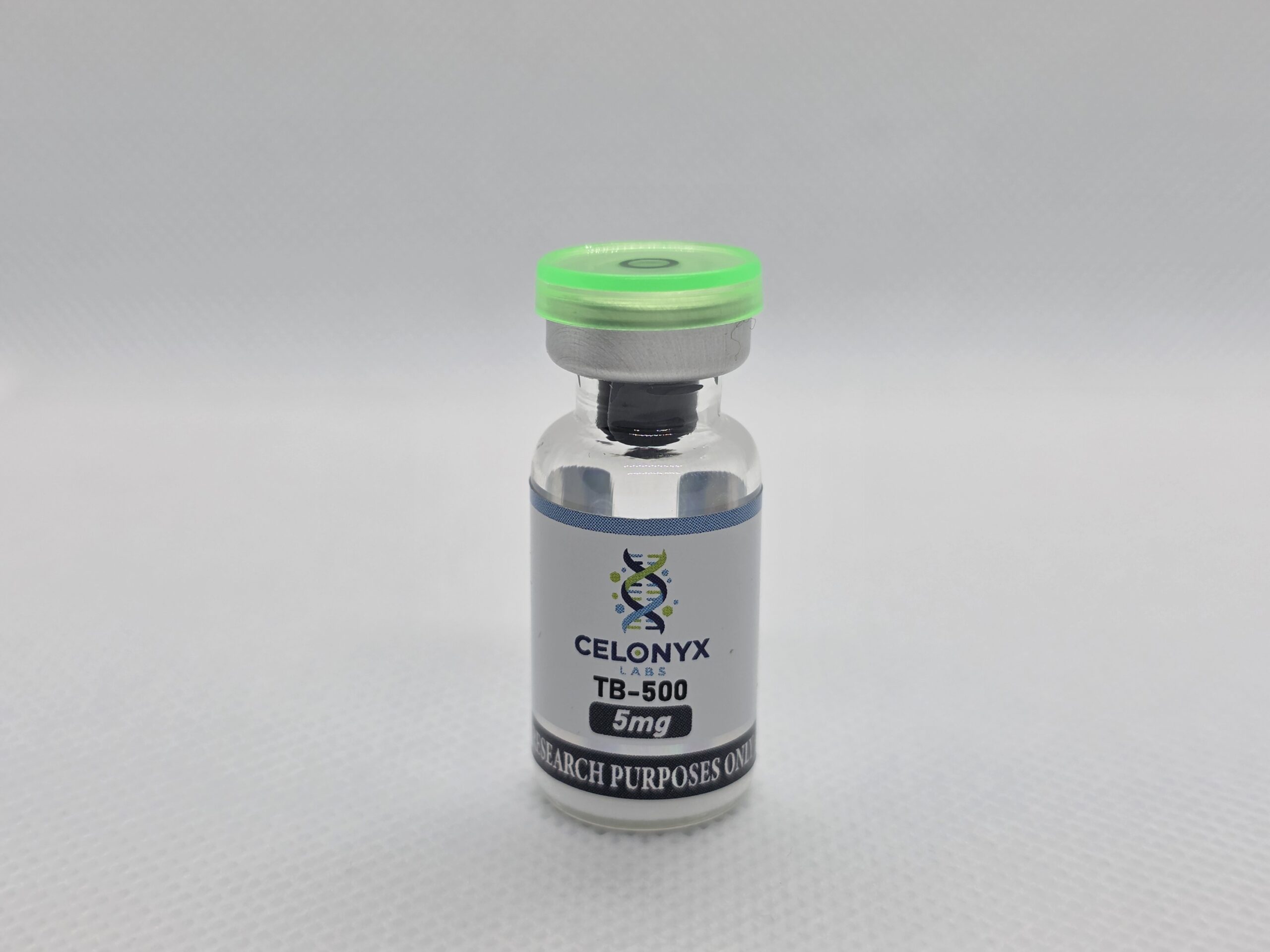
Product Name: TB-500 Research Peptide
Quantity: 5mg Lyophilized Peptide
Purity: ≥98% (HPLC verified)
Appearance: White lyophilized powder
Peptide Type: Thymosin Beta-4 active region fragment
Storage: Store at −20°C for long-term stability
Reconstitution: For laboratory research use only
Celonyx Labs provides TB-500 peptide manufactured using controlled synthesis methods to ensure high purity and batch consistency for scientific research.
Celonyx Labs maintains strict quality standards for all TB-500 research peptide products.
Each batch undergoes multiple verification procedures including:
• High-performance liquid chromatography (HPLC)
• Mass spectrometry analysis
• Purity and identity verification
These testing procedures ensure that TB-500 laboratory peptide supplied by Celonyx Labs meets high research standards.
Scientists conducting TB-500 peptide research, TB-500 regenerative peptide research, and TB-500 actin binding peptide studies require reliable peptide materials for reproducible results.
Celonyx Labs is committed to supporting laboratory research by providing consistent peptide reagents for scientific investigation.
TB-500 peptide sold by Celonyx Labs is intended strictly for laboratory research purposes only.
This TB-500 research peptide is not intended for human consumption, medical use, veterinary use, or therapeutic applications.
Products are supplied only to qualified researchers and laboratory professionals conducting scientific studies.
By purchasing TB-500 peptide, the customer acknowledges that the product will be used exclusively for research and laboratory experimentation.
Celonyx Labs products are not pharmaceuticals, dietary supplements, or food products.
All peptides are labeled “For Research Use Only.”
Celonyx Labs provides high-purity research peptides designed for scientific investigation.
Researchers choose Celonyx Labs because we offer:
• High purity TB-500 research peptide
• Verified analytical testing
• Reliable peptide manufacturing standards
• Secure packaging and storage stability
• Consistent peptide supply for laboratory protocols
Our goal is to support researchers studying TB-500 peptide research, cytoskeletal signaling, and regenerative peptide research.
By maintaining strict quality standards, Celonyx Labs helps advance scientific understanding in peptide biology and cellular research.