

Celonyx Labs vs Honest Peptide: 2026 Verdict
Celonyx Labs vs Honest Peptide in 2026: compare purity evidence, batch documentation, pricing checks, and
You've selected a peptide for a time-sensitive experiment, secured internal approval, and reached checkout. Then a no refund return policy appears. The immediate questions are practical: Can the lab send the order back if the study changes? What happens if the vial arrives damaged? Does “no refund” mean the supplier has no responsibility after payment?
For research buyers, those questions matter because peptide orders are often lot-specific, condition-sensitive, and tied to a defined protocol. A strict policy can control reverse-logistics costs and reduce disputes, but it shouldn't erase remedies for an incorrect, defective, damaged, or misdescribed product. The safest approach is to treat the policy as a procurement control that must be read before approval, not as checkout language to skim after the purchase decision.
A university lab may order a peptide for a particular assay, only to discover that the principal investigator has changed the protocol. A biotech team may find that its internal purchase order names the wrong sequence. A CRO may receive the correct product but no longer need it because a client has paused the study. Those are different situations, yet buyers often group them together as “returns.”
That shortcut creates avoidable confusion. A change-of-mind request usually concerns a buyer's decision after an accurate order was accepted. A product or fulfillment problem concerns what the supplier delivered, how it arrived, or whether it matches the order and supporting documentation. A no refund rule typically targets the first category, while the second may require a separate review.
The commercial reason for strict policies is understandable. Online order returns are commonly reported at about 19.3% of sales in 2025, and broader U.S. retail returns reached roughly $849.9 billion, or 15.8% of total retail sales, that year, according to ecommerce return statistics for 2026. Those figures explain why high-volume sellers try to limit reverse logistics, fraud exposure, and margin loss. Research materials add another layer because opened or mishandled packaging may make it difficult to verify the condition of the returned item.
For a lab, the answer isn't to reject every supplier with a no refund return policy. The better question is whether the policy is clear, operationally workable, and compatible with applicable consumer protections. The sections below translate the language into order scenarios, identify the boundary between preference and remedy, and provide a procurement file checklist that can support approval and exception handling.
Practical rule: Treat the return policy like a storage requirement or a lot specification. Review it before ordering, record the version you reviewed, and make sure the purchasing file preserves the evidence needed if something goes wrong.
A no refund return policy generally means the seller won't accept a return or issue a refund merely because the buyer changed their mind. The buyer may have ordered the wrong quantity, selected the wrong sequence, lost project funding, or decided that the material is no longer needed. If the supplier shipped exactly what was ordered and the product meets the stated requirements, the policy may exclude that voluntary return.
A useful analogy is a reagent prepared and allocated for a specific laboratory request. Once the supplier has processed the order, that material may be removed from general inventory, assigned to a lot, packed under defined conditions, and shipped with documentation. Returning it because the project changed is not the same as reporting that the supplier sent the wrong reagent.
Start by separating the policy into three questions:
A strict policy is more useful when it explains these boundaries rather than stating only “all sales are final.” For research buyers, the relevant quality record may include the product name, sequence or identifier, lot number, certificate of analysis, and the condition of the package at delivery. Celonyx Labs presents research-peptide quality attributes including 99% purity and independent third-party testing in its published business information. Those assurances don't turn every preference return into a refund claim, but they give the buyer specific records to compare against the delivered order.
The policy should also be read alongside the seller's terms, shipping rules, and warranty language. Buyers who need a broader legal overview can review these return policy warranty details for context on how return terms and warranties may interact.
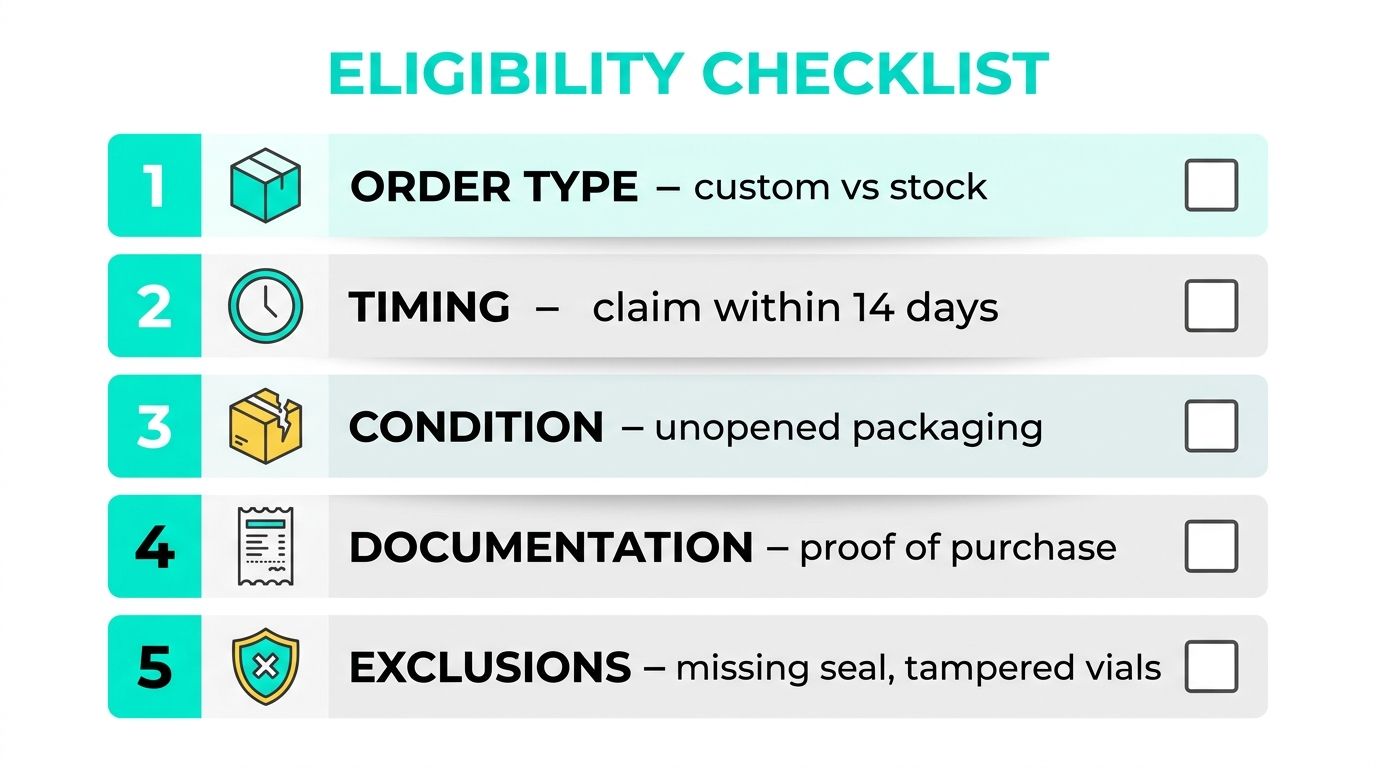
The key point is narrow but important: “No refund” usually describes the seller's voluntary return policy. It doesn't automatically decide every claim involving product identity, condition, delivery, or legal rights.
A defensible policy needs more than a refusal. It must tell the buyer what the rule covers, when it starts, and what evidence changes the analysis. Return-policy guidance emphasizes defining the return window, product condition, refund options, and fees because ambiguity creates disputes and can complicate chargeback responses. The most important wording often concerns the trigger date.
A policy may refer to the date of purchase, shipment, delivery, or receipt. Those dates aren't interchangeable. A buyer can't reasonably document a transit-damage claim in the same way if the policy starts before the package arrives, particularly where carrier delays or delivery problems are involved.
A procurement reviewer should locate the exact answer to these questions:
The buyer should also check whether the published policy is consistent across the product page, checkout, terms, refund page, and shipping page. A purchasing office shouldn't have to reconcile contradictory versions after a dispute begins. Celonyx Labs' shipping policy is one example of a separate operational document that should be reviewed with the return terms, because delivery timing and transit events can affect the evidence available for a claim.
A phrase such as “returns aren't accepted for laboratory products” may address change-of-mind returns, but it leaves a buyer asking what happens when a supplier ships the wrong sequence or a vial arrives visibly compromised. Stronger wording identifies exclusions and exceptions separately. It also explains whether opened packaging, missing seals, or tampered vials affect eligibility.
Read the trigger sentence first. If you can't tell whether the clock starts at purchase, shipment, or delivery, ask the supplier to clarify before the purchase order is released.
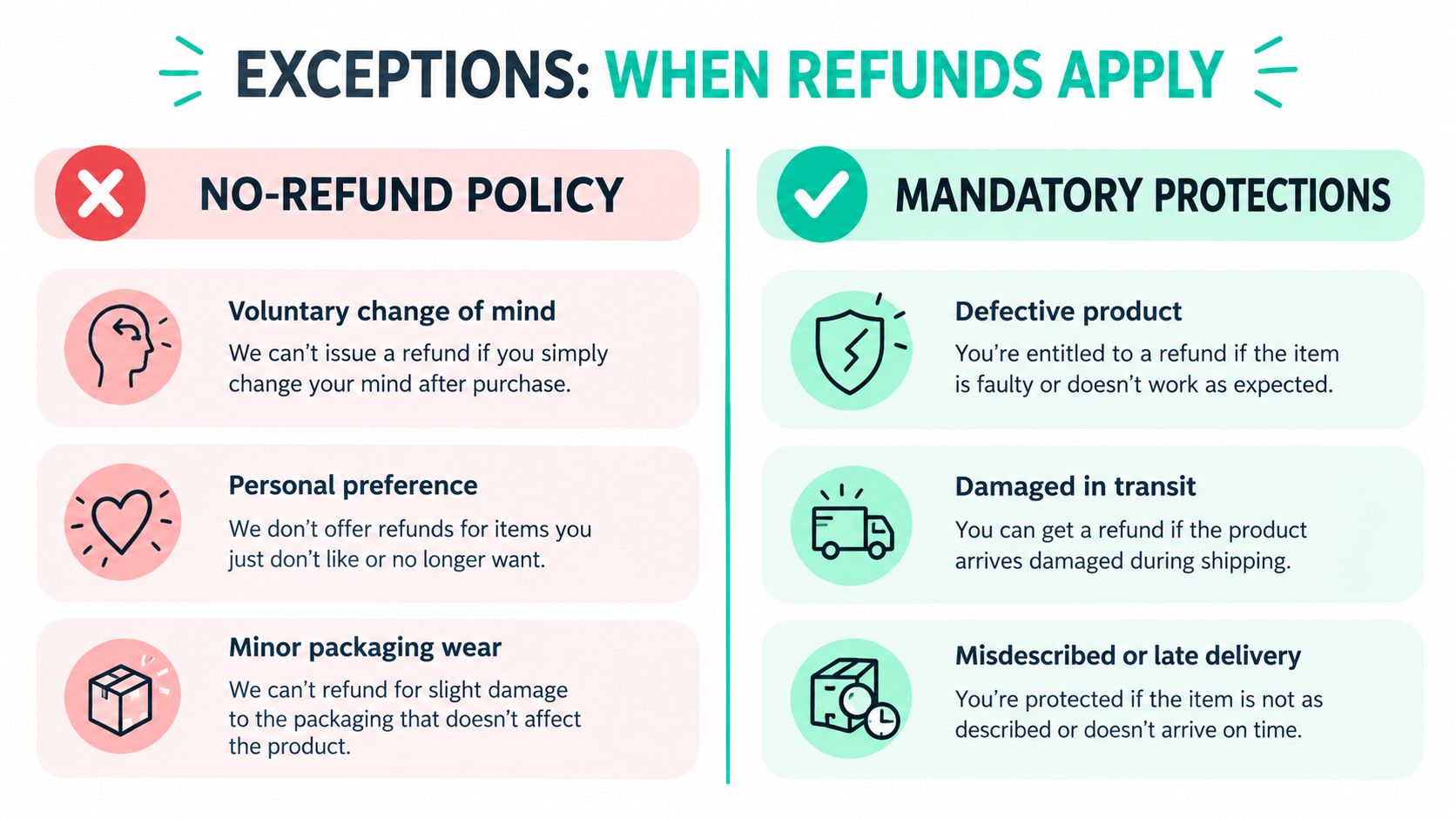
The policy should distinguish commercial preference from product nonconformity. A buyer who ordered the wrong item may have no return route. A buyer who received an item that doesn't match the order may have an exception route, subject to the supplier's investigation and applicable law.
The most consequential misunderstanding is treating “no refunds” as permission to deny every remedy. Merchant guidance warns that mandatory protections may still apply to defective, damaged, misdescribed, or late-delivered goods in some jurisdictions. A lab should therefore run two tracks: one for voluntary returns and another for possible nonconformity.
Consider four order scenarios:
The legal sensitivity is visible in major consumer frameworks. In the United Kingdom, distance-sale customers generally have 14 days after receiving an item to cancel, another 14 days to send it back, and the seller must refund within 14 days of receiving the return, as described by the UK government's guidance on accepting returns and giving refunds. Australia's regulator warns businesses not to claim that no refunds are permitted under any circumstances, especially for faulty goods, as reflected in the ACCC warning about online shopping return policies.
These examples don't provide a universal rule for every research purchase. They demonstrate the boundary a policy must respect: a seller can restrict voluntary returns, but a posted term may not override statutory rights that apply to the transaction.
| Situation | Typically covered by no refund | Potential exception path |
|---|---|---|
| The lab no longer needs the correctly ordered peptide | Change-of-mind request | Ask whether a discretionary credit is available, but don't assume one exists |
| The buyer selected the wrong sequence at checkout | Customer ordering error | Review the policy and contact support before shipment or processing |
| The vial arrives damaged in transit | Not a preference issue | Preserve packaging, photograph the damage, and submit a shipping-damage claim |
| The delivered sequence differs from the purchase order | Incorrect product | Provide the order record, label, packing slip, and photographs |
| The lot number doesn't match the COA | Documentation or identity discrepancy | Request supplier investigation and hold the material pending clarification |
A documented exception workflow protects both parties. It gives the buyer a defined way to raise a legitimate issue and gives the supplier a consistent method for deciding whether the evidence supports replacement, credit, refund, or another remedy.
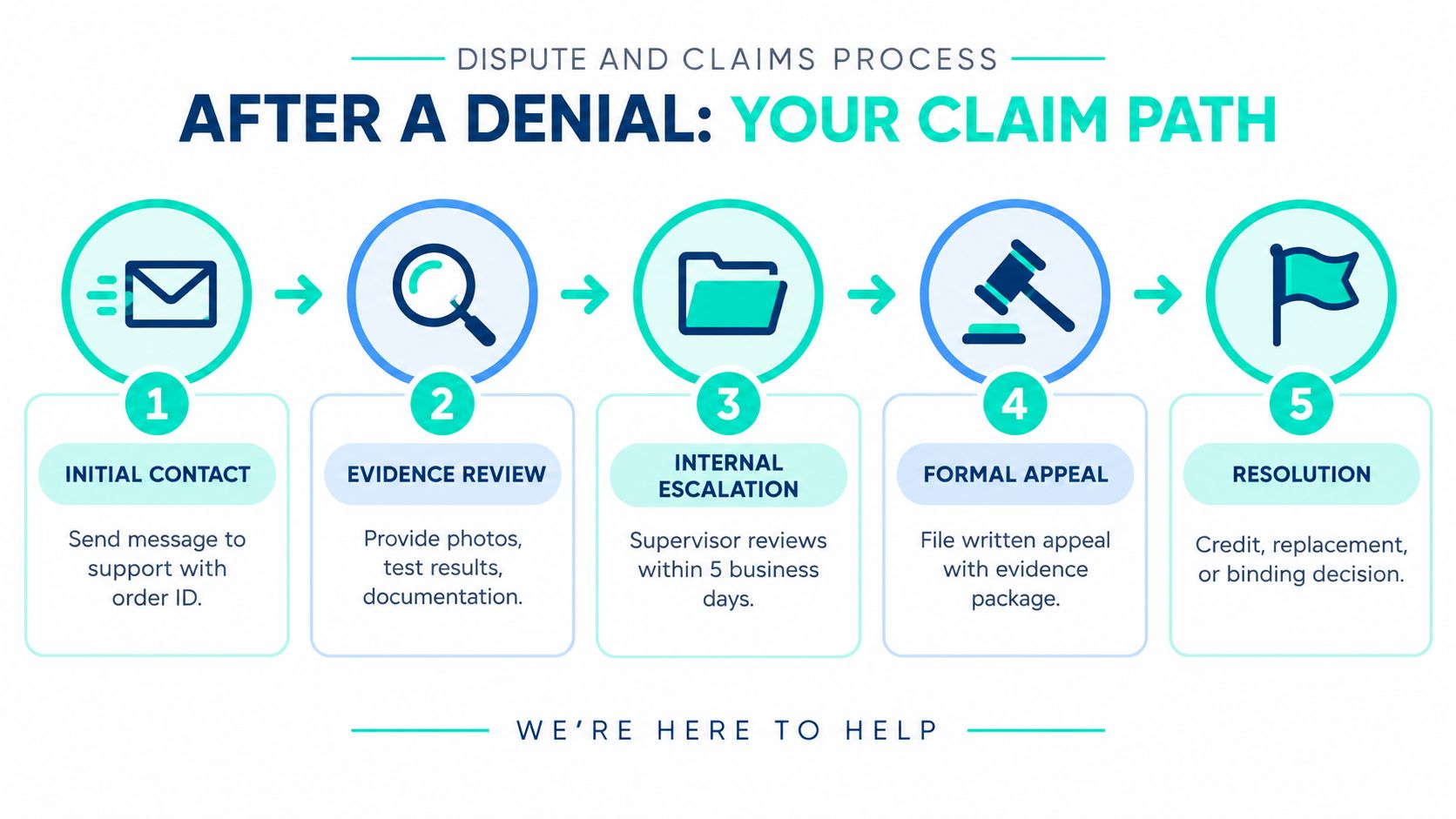
The following video provides another visual explanation of the claims path and the importance of separating a preference return from a product problem.
A rejection shouldn't end the conversation if the buyer believes the supplier sent an incorrect, damaged, or defective product. The buyer's next task is to turn a general complaint into a traceable claim with a clear theory and evidence. “We can't use this order” is different from “the vial label identifies sequence A, while our purchase order specifies sequence B.”
Contact the supplier through the channel identified in the policy. Include the order ID, purchase date, delivery date, product identifier, lot number, and a short description of the issue. If the claim concerns damage, photograph the outer packaging before discarding it. If it concerns identity or documentation, attach the relevant order, label, packing slip, and COA.
Avoid language that blends separate issues. State whether the request concerns buyer preference, shipping damage, incorrect fulfillment, or a suspected quality discrepancy. That classification helps customer support route the matter to the right reviewer and prevents a legitimate exception from appearing to be an ordinary return request.
If support denies the request, ask for the specific policy provision and rejection reason. A useful escalation asks what evidence was missing, whether the claim was reviewed against the order record, and which person or team can conduct a secondary review. Keep the exchange in writing where possible, even if the initial contact occurs by phone.
Consumer research indicates that 36% of surveyed consumers had a return rejected in the past year, while 66% were reluctant to buy under tighter return policies, according to the 2025 Global Consumer Returns Survey infographic. The practical lesson for procurement teams is clear: a policy should explain not only the rule, but also the rejection criteria, appeal route, and documentation requirements.
A research office handling repeated supplier problems may also benefit from a structured guide to handling supplier conflicts, particularly when a claim affects a purchase order, project schedule, or vendor relationship.
Create one folder containing the order confirmation, approved purchase order, policy snapshot, tracking record, delivery proof, photographs, correspondence, and test or inspection notes. Record dates for every contact and avoid altering or discarding the product or packaging before the supplier responds, unless laboratory safety procedures require otherwise.
The objective isn't to escalate every disagreement. It's to make the facts easy to verify. A clear record gives the supplier a fair opportunity to correct an error and gives the lab a defensible file if the matter proceeds to a formal complaint, payment dispute, or internal vendor review.
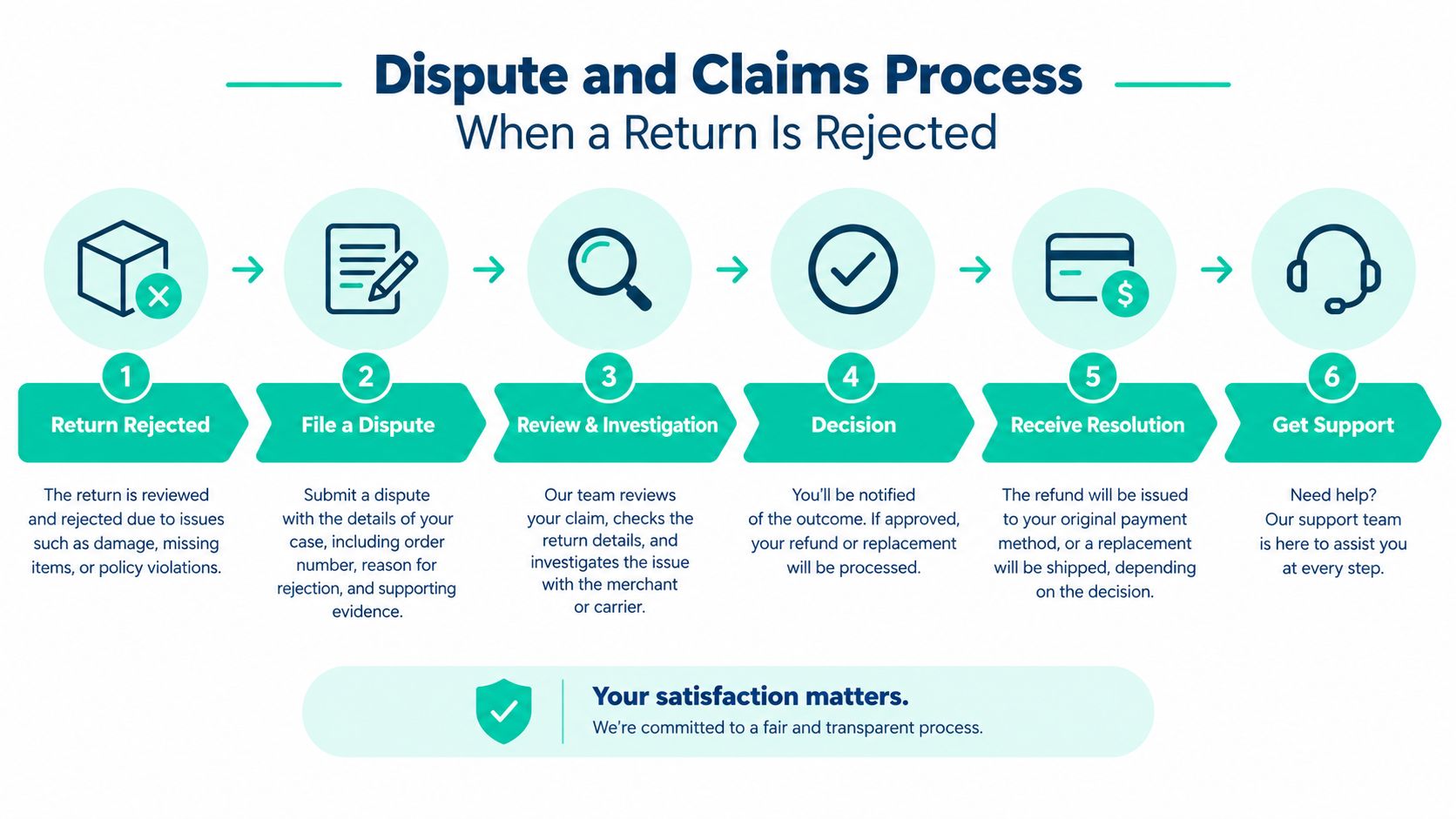
A no refund return policy becomes manageable when the purchasing file answers three questions: what did we order, what did the supplier promise, and what did we receive? Institutional buyers should assemble that record before payment or shipment, not after a dispute starts.
Start with the commercial documents. Save the product page, quotation, purchase order, order confirmation, invoice, and the exact refund and return policy in effect at approval. If the supplier's terms can change online, a dated PDF or internal record of the reviewed language helps establish what the buyer understood when the order was authorized.
A practical file should contain:
This checklist supports more than a possible return. It helps a purchasing officer justify the expenditure, allows a receiving team to verify the delivery, and gives a principal investigator a clear record of what entered the laboratory's inventory.
A supplier review should document business identity, contact routes, published policies, quality statements, and the organization's process for handling discrepancies. Teams can use Celonyx Labs' vendor qualification process as one reference point when designing an internal review workflow, while applying their own institutional requirements.
On receipt, the lab should quarantine any questionable item according to its own safety and quality procedures. Don't place a vial into active experimental use until the order identity, package condition, lot number, and accompanying documentation have been reconciled.
The strongest protection is a short pre-order decision, not a complicated dispute after delivery. Confirm that the sequence, quantity, formulation, lot expectations, delivery destination, and project timing match the approved purchase request. If any item is uncertain, pause the order and ask the supplier in writing.
Use this three-part decision framework:
A few habits make the policy predictable:
The guide to buying peptides can help buyers organize the ordering questions they should resolve before checkout. Celonyx Labs is one supplier option that publishes research-peptide products, quality information, shipping details, and customer-support routes for laboratory purchasers.
A no refund return policy doesn't have to block responsible research purchasing. It becomes a manageable risk-control measure when the lab knows which decisions are final, which problems may qualify for review, and which records establish what happened.
Celonyx Labs offers research peptides through an online catalog with stated 99% purity, independent third-party testing, published shipping and return information, and customer support for order questions. Visit Celonyx Labs to review the available products and policy details before submitting your next laboratory purchase request.
Celonyx Labs vs Honest Peptide in 2026: compare purity evidence, batch documentation, pricing checks, and

Celonyx Labs vs Sigma-Aldrich: compare peptide focus, reference standards, documentation, ordering, and vendor fit to

Celonyx Labs vs Peptides.org compared for 2026: purity documentation, GLP-1 specialization, and catalog breadth —
FOR RESEARCH USE ONLY. Products sold by Celonyx Labs are intended exclusively for laboratory and scientific research. They are not intended for human or veterinary use, consumption, diagnosis, treatment, cure, or prevention of any disease. By purchasing from this site, you acknowledge that you understand the intended research purpose of these materials and agree to comply with all applicable laws and regulations.