

Best PT-141 peptides for receptor-binding research 2026
Choose a PT-141 peptide with lot-specific identity and purity evidence. Compare research material profiles, content
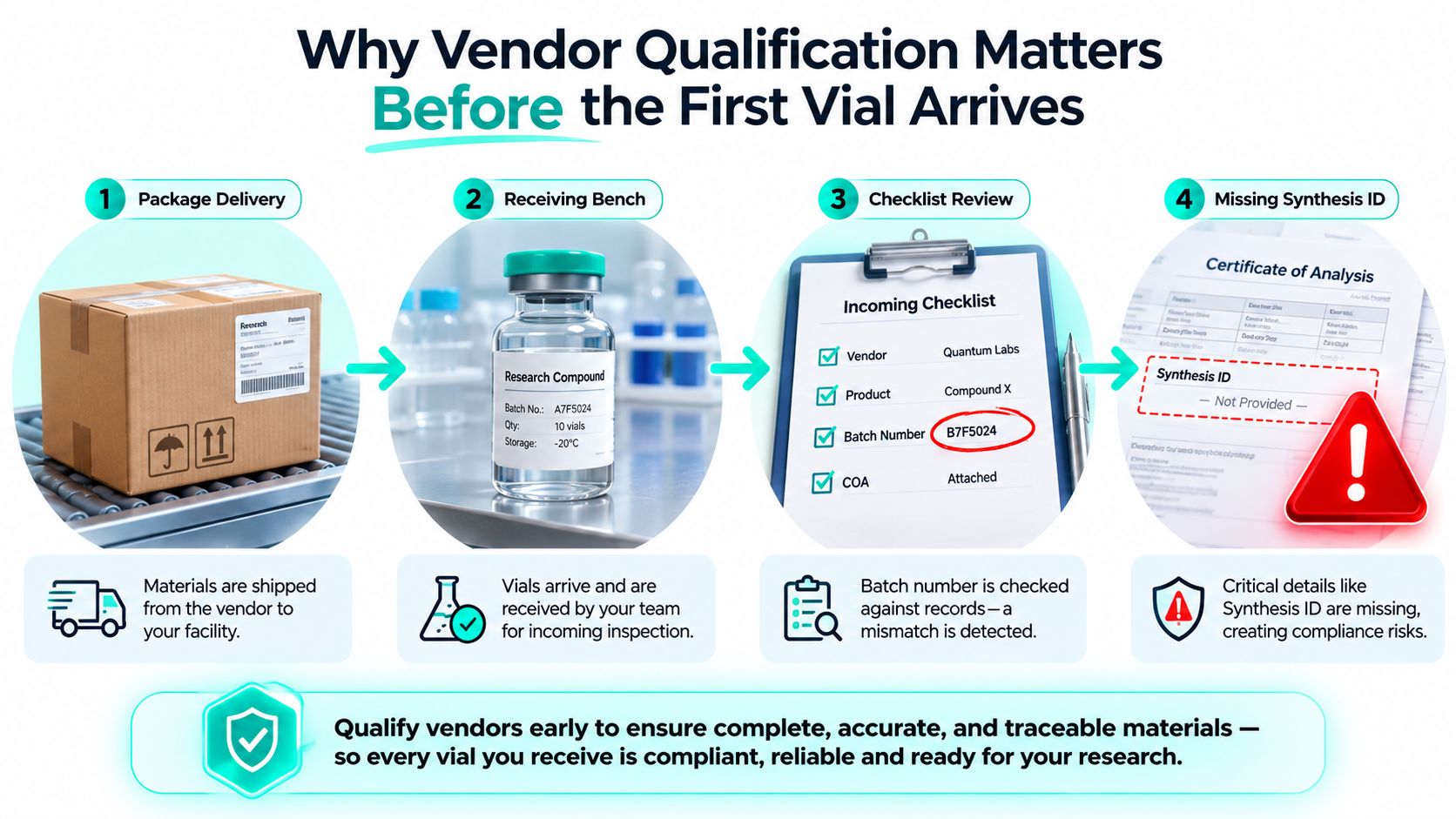
A peptide shipment can look perfectly acceptable until it reaches the receiving bench. The vial says 98% purity, but the Certificate of Analysis names a different batch. The synthesis lot ID is missing, the chromatogram isn't attached, and nobody can explain whether the material was repurified after the reported test.
That isn't a minor paperwork defect. It leaves the lab unable to establish that the vial in hand is the material described in the purchasing record. A structured vendor qualification process catches that mismatch before the supplier becomes embedded in protocols, freezer inventory, and experimental schedules.
The qualification gate is usually the least expensive point at which to challenge a supplier. A benchmark study of vendor qualification found that completing a qualification took almost 5 months for single-service providers and nearly 7 months for multi-service providers, while global drug developers spent about $375 million in 2018 on roughly 25,000 new qualifications and requalifications, an average of about $15,000 per event (CASRAI vendor qualification process benchmark). Those figures describe the burden of doing the work properly, but they also show why sending a purchase order before defining the evidence creates avoidable cost.
Qualification isn't procurement administration. A signed supplier form proves that a commercial relationship exists. Qualification documents why the vendor is fit for the intended use, how the lab will verify incoming material, and what happens when quality or supply conditions change.
At the receiving bench, the first question isn't whether a supplier has an attractive catalog. It's whether the package, vial, label, and supporting records describe the same material. A mismatch between the batch number on the label and the batch number on the COA should stop receiving until the supplier resolves it.
That single check can prevent a chain of downstream problems. The lab may otherwise release the vial, cite it in a protocol, discover an unexpected result later, and then spend time separating an experimental failure from a material failure. If the synthesis lot ID is absent, the supplier can't easily connect the vial to the crude peptide, purification record, lyophilization run, or final release test.
A useful qualification gate answers four practical questions:
ISO 9001:2015 clause 8.4.1 ties external-provider control to criteria for evaluation, selection, performance monitoring, and re-evaluation based on the provider's ability to meet requirements (supplier qualification guidance aligned with ISO 9001:2015). That makes qualification a recurring quality control, not a one-time purchasing hurdle.
The practical sequence is straightforward. Review the document packet, define quality criteria, escalate the right suppliers to an audit and sample evaluation, then verify shipping and contractual controls. A vendor that passes only because reviewers accepted a polished PDF hasn't been qualified. The test is whether the evidence survives comparison with the vial at the bench.
A document packet should let a scientist reconstruct what happened to a specific lot without relying on a supplier's verbal reassurance. Start with the Certificate of Analysis, but don't treat a reported purity number as analytical evidence. For a research peptide, the COA should identify the method, instrument, column, gradient, acceptance criteria, test date, lot number, and analyst or laboratory responsible for the result.
A chromatogram matters because it shows the separation behind the reported result. The report should make clear whether the result came from HPLC, what was integrated, and which peaks were counted as impurities. A vendor's in-house QC summary can be useful, but it shouldn't be confused with independent confirmation. Where the risk warrants it, request a separate report from an ISO 17025-accredited laboratory.
The lot number should reconcile across the order, vial label, COA, mass spectrometry report, third-party report, shipping record, and any certificate of origin. For a synthesized peptide, request traceability through the relevant stages, including crude material, purification, lyophilization, and vialing. The exact depth depends on the supplier's role and the material's risk, but unexplained gaps weaken the qualification decision.
A safety data sheet should identify the substance and relevant handling information rather than functioning as a generic template. A certificate of origin should identify the manufacturing source and origin details that institutional procurement requires. If the supplier provides a stability statement, ask what data support the stated storage condition and retest date, and whether the date is based on real-time data, an internal policy, or a justified testing schedule.
| Document | Must Contain | Red Flag |
|---|---|---|
| Certificate of Analysis | Exact lot, test methods, instruments, acceptance criteria, results, and analyst or laboratory identification | A purity number without a chromatogram or method |
| Independent analytical report | Supplier lot, sample identification, test date, laboratory identity, method, and results | A vendor QC summary presented as third-party testing |
| Mass spectrometry report | Expected identity, observed m/z, instrument or method details, and lot reference | Identity stated without observed data |
| Certificate of Origin | Manufacturing source, origin information, product identity, and lot linkage | Generic wording that can't be tied to the shipment |
| Safety data sheet | Material identity, hazards, handling, storage, and supplier details | A generic SDS with no product or supplier traceability |
| Stability or retest statement | Storage conditions, retest basis, date logic, and applicable lot or product scope | An unexplained retest date |
| Quality or certification records | Certificate number, issuing body, scope, site, and validity | An ISO certificate with no scope statement |
Receiving rule: Any document the supplier can't explain clearly on a call is a document that hasn't earned qualification status.
Generic ISO certificates, marketing specification sheets substituted for COAs, and analytical reports without chromatograms may look formal while adding little control. For buyers comparing catalog options, the research peptide ordering resource should be only the starting point. The qualification decision still rests on lot-specific, auditable evidence.
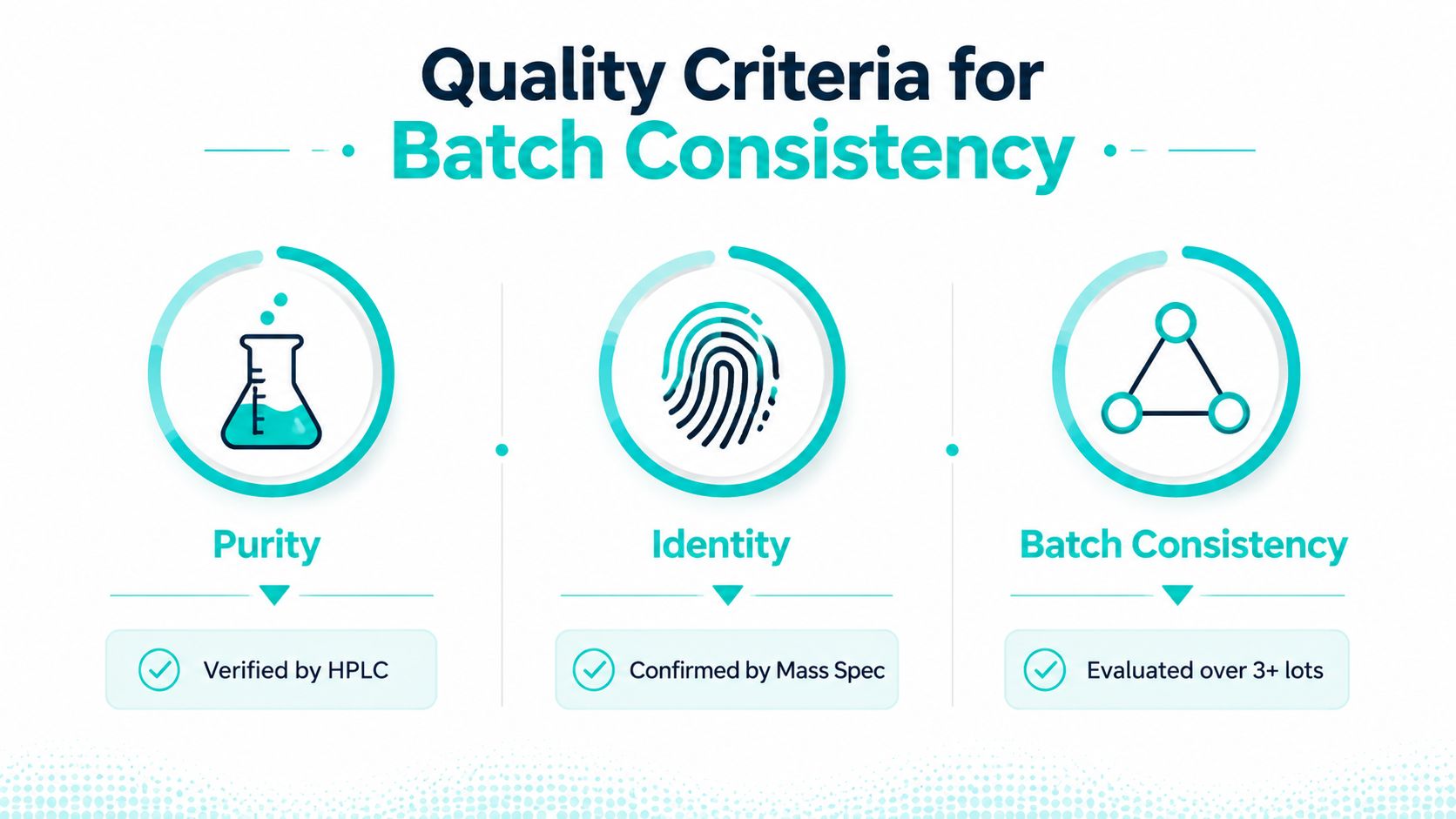
A supplier's stated purity is only one part of the material profile. For research peptides, the useful quality question is whether the next vial has the expected purity, identity, and batch consistency, and whether the lab can verify each attribute with appropriate evidence.
Purity should be supported by HPLC data with the chromatogram attached. The report should show the analytical method and acceptance criteria, not print a result in a prominent font. Counterions, residual solvents, water content, and other associated components can affect the effective concentration or handling behavior even when the headline purity appears strong.
Mass spectrometry provides an identity check that HPLC alone can't replace. Ask for the expected mass and the observed m/z, with the lot number connected to the report. A clean chromatographic profile doesn't prove that the principal peak has the intended sequence.
Batch consistency requires comparison across production history rather than confidence in one attractive COA. Review purity, impurity profiles, appearance, and relevant release results across three or more consecutive lots, as specified in the practical qualification criteria for peptide suppliers. The purpose isn't to demand identical traces. It's to identify unexplained drift, recurring secondary peaks, or a supplier whose best lot doesn't represent normal output.
For research peptides, a documented specification may use at least 95% purity, provided the lab has defined that requirement for its intended application. The specification should also address individual impurity limits and acceptable lot-to-lot variation. Those thresholds must be agreed before testing, otherwise reviewers can unconsciously move the goalposts after seeing a borderline result.
An external analytical check is particularly useful when the supplier's own data are sparse or difficult to interpret. A lab evaluating options can review the stated approach to third-party tested peptides while still requesting the underlying report for the exact lot under consideration.
The strongest practical signal is the supplier's response to a request for trend data. A vendor that can provide coherent lot comparisons, explain variation, and distinguish specification limits from typical process performance is showing process awareness. A vendor that refuses to share any meaningful history leaves the lab unable to judge whether a single compliant lot predicts reliable future supply.
A good audit workflow escalates effort according to evidence and risk. It doesn't send every supplier directly to an expensive site audit, and it doesn't approve a high-impact source because a questionnaire was completed neatly.
Send a structured questionnaire that covers manufacturing or sourcing responsibility, quality-system ownership, analytical capability, subcontractors, storage, shipping, deviations, complaints, change control, and data integrity. Then compare the answers with the documents. Contradictions matter more than presentation quality.
Return the packet before sample shipment if the supplier can't identify the manufacturing site, won't provide lot-specific analytical records, supplies conflicting product identities, or refuses to explain subcontracted testing. A missing document can sometimes be corrected. An unwillingness to establish traceability is a more serious qualification concern.
For a higher-risk source, review:
An on-site or virtual facility audit should follow a process map rather than a generic tour. Trace a representative lot from incoming raw materials through production, testing, release, packaging, storage, and shipment. Ask operators to show the record they use, not the SOP selected for the presentation.
An audit should examine material handling, change control, deviation and OOS management, and data integrity controls. If the supplier can't demonstrate how an issue moves from detection to investigation and corrective action, the audit should produce a documented gap, not a polite verbal observation.
Select a lot that reflects normal production, not a specially prepared demonstration sample. Define the acceptance criteria before testing, then use an independent laboratory where the risk or institutional policy warrants it. Useful tests can include HPLC purity, mass spectrometry identity, residual solvents, and endotoxin, where relevant to the intended research use.
A pilot lot passes when the documented results meet the preapproved specification and the records reconcile. A borderline result shouldn't create an approval loophole. Place the lot on hold, investigate method suitability and sample handling, request the supplier's response, and decide whether to reject, repeat under controlled justification, or approve with a time-bound corrective action.
Testing laboratories can help separate a supplier's release claim from independently generated evidence. A lab comparing providers may review available peptide testing laboratory services as part of its sample-evaluation plan, but it should retain ownership of the final acceptance decision.
A peptide can meet its analytical specification and still arrive unusable if packaging, temperature control, or delivery records fail. Logistics deserves a separate review because receiving staff need to know what evidence accompanies the vial and what action to take when the shipment doesn't match the agreed conditions.
Specify packaging configuration, storage conditions, permitted excursions, carrier responsibilities, and required delivery records. Depending on material sensitivity, the shipment may require temperature monitoring, protective packaging, desiccation, or controlled handling. The receiving procedure should state who checks the package, who reviews the temperature record, and who can release or quarantine the material.
A late or warm shipment shouldn't disappear into an email thread. Photograph the package, retain the temperature record, record the condition on arrival, quarantine the material when required by the specification, and open a vendor incident. The supplier scorecard should capture response quality as well as the final disposition. A vendor that replaces a shipment quickly but can't investigate the transport failure hasn't closed the quality loop.
Quality agreements and purchase terms should reinforce the same controls used during qualification. Include lot-specific COA obligations, authenticity and record-retention expectations, recall and replacement responsibilities, audit rights, indemnification language, and a clear route for reporting changes before implementation.
Change notification is especially important. The agreement should identify what counts as a material change, who receives notice, how much review time the lab needs, and whether the lab can suspend purchasing while the impact is assessed. Without those terms, the supplier can alter a site, process, raw material, or subcontractor while the approved-vendor record remains unchanged.
| Category | Required Checks | Common Gaps |
|---|---|---|
| Packaging | Container integrity, labeling, seals, storage protection, and excursion instructions | Packaging described generally, with no acceptance criteria |
| Temperature control | Monitoring method, shipment record, excursion limits, and review owner | No temperature evidence or unclear responsibility |
| Delivery | Agreed lead-time expectations, carrier controls, and incident escalation | Late deliveries logged informally |
| Shipment records | Chain of custody, COA, SDS, lot identity, and applicable handling records | Documents arrive separately or reference different lots |
| Quality agreement | Testing duties, audit rights, change notification, recall, replacement, and escalation | Commercial terms exist without quality responsibilities |
| Compliance records | Traceable approvals, corrections, communications, and audit trail | Decisions made by email with no controlled record |
A flawless batch with no contractual recourse isn't fully qualified for institutional research. The lab needs both material evidence and a defensible response when the supplier fails to deliver it.
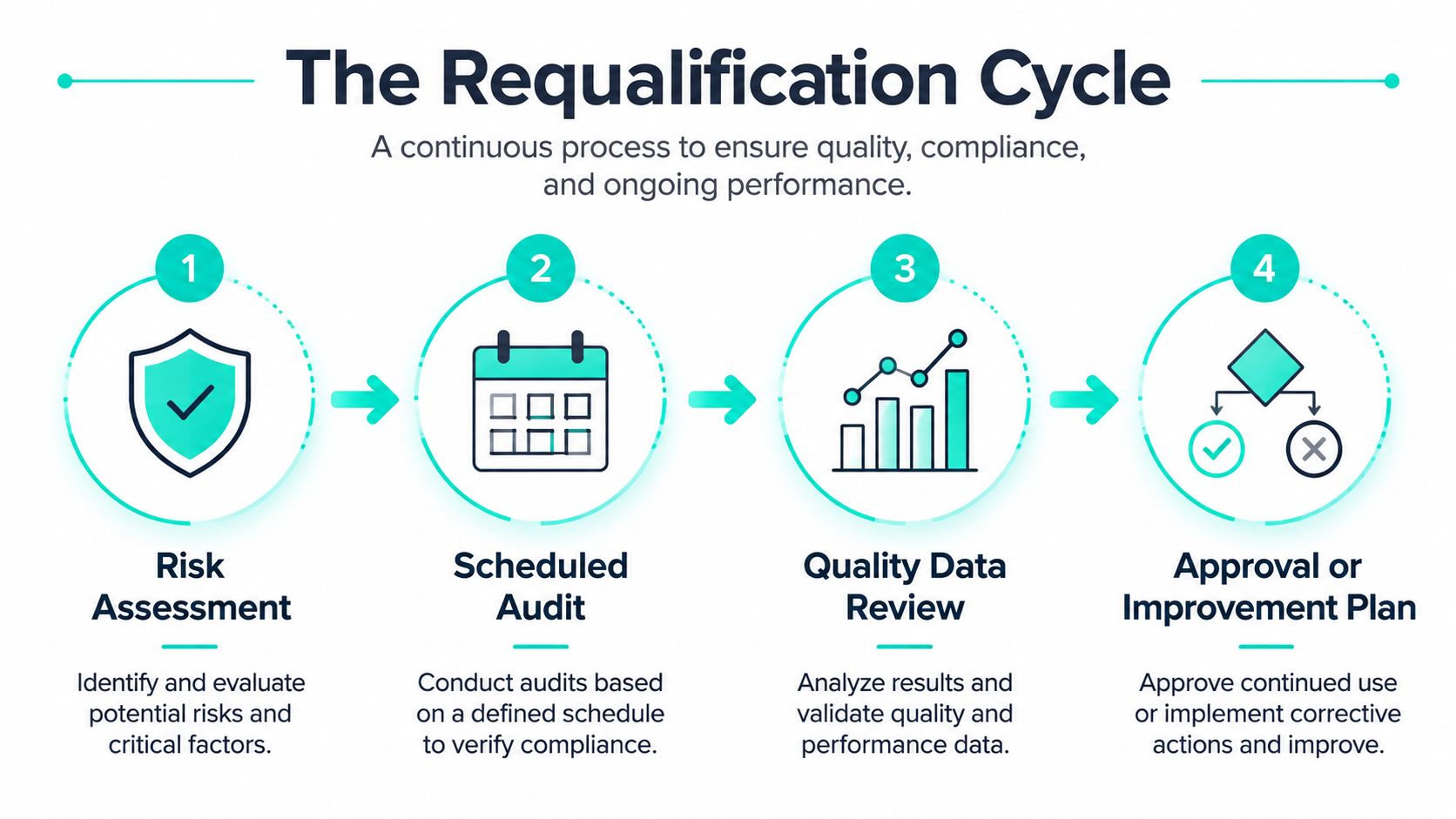
Approval expires in practice long before it expires in a database. A supplier may change its site, synthesis route, raw materials, equipment, subcontractors, or key personnel while the original qualification packet remains untouched. Ongoing monitoring therefore belongs inside qualification, not in a separate quality project.
ISO 9001:2015 clause 8.4.1 connects external-provider controls with monitoring and re-evaluation. A supplier lifecycle commonly moves through assessment, evaluation, approval, surveillance, and requalification, as described in ISO-aligned supplier qualification lifecycle guidance. A three-year period may serve as a planning point for review or re-audit, but risk, performance, and change history should set the timing.
Classify each research peptide supplier by material criticality, experimental impact, purchasing volume, performance history, and the availability of an alternative source. A peptide used in a sensitive assay warrants more scrutiny than a low-impact material that can be replaced easily.
High-risk suppliers may need a full GMP audit, sampling, material testing, and COA verification every 2 years, or after a major change. Low-risk vendors may rely more on questionnaires and performance tracking every 4 to 5 years, according to vendor qualification benchmarking and risk-frequency guidance. These are planning benchmarks, not permission to overlook a serious incident.
Change-control rule: A new manufacturing site, synthesis route, raw-material source, key quality-system change, or regulatory-status change should trigger an impact assessment before the supplier continues under the old approval scope.
Receiving staff should not complete a regulatory dossier for every delivery. Give them a short controlled record covering label and COA reconciliation, package condition, storage evidence, visible defects, and deviations from the purchase specification. Those checks are often the first indication that a supplier's documentation does not match the material at the bench.
Quality and procurement can trend complaints, rejected or quarantined lots, COA discrepancies, shipment excursions, response time, corrective actions, and unexplained analytical variation. Require prompt change notification and keep supplier master data current, including the legal entity and manufacturing site.
An IQVIA report identifies a gap between written procedures and execution: over 90% of organizations have SOPs for vendor qualification, fewer than 60% qualify at least 75% of vendors before work starts, and in slightly more than half of organizations CQA is informed only after the fact (IQVIA supplier quality management report). The practical lesson is clear. A short monitoring routine that reaches QA before material use has more value than an elaborate SOP that receiving staff bypass.
A repeatable workflow should be usable by a new lab member without relying on institutional memory:
How long does initial qualification take? It can take months in regulated procurement. A benchmark found nearly 5 months for single-service providers and nearly 7 months for multi-service providers, with substantial variation between companies (CASRAI qualification timeline benchmark). Plan the work before a project depends on the material.
What happens after a synthesis-route change? Put purchasing on hold if the change could affect identity, impurities, residual solvents, yield, or consistency. Request the revised process description, impact assessment, new analytical evidence, and a fresh sample or pilot lot before extending the old approval.
What if a COA meets specification but shows unfamiliar impurities? Don't waive the concern because the headline result passes. Ask the supplier to identify the peaks, assess toxicological or experimental relevance where applicable, compare the profile with prior lots, and document a controlled disposition.
Is ISO 9001 certification alone enough to skip an audit? No. Clause 8.4.1 addresses control of external providers, but a certificate doesn't prove that a specific peptide lot has the required identity, purity, traceability, or transport history. Scope, site, product fit, performance, and risk still determine the audit decision.
Keep a printed receiving checklist beside the bench: match the label to every record, verify the analytical evidence, inspect packaging and storage conditions, quarantine discrepancies, document incidents, and notify QA before use. The strongest vendor qualification process is the one that remains usable when the shipment arrives late on a busy experimental day.
Celonyx Labs supplies research peptides with stated purity information, independent third-party testing references, shipping support, and published purchasing policies for laboratory buyers. Visit Celonyx Labs to review the catalog and contact the team about documentation and ordering requirements for your lab.
Choose a PT-141 peptide with lot-specific identity and purity evidence. Compare research material profiles, content

Choose a hexarelin peptide by lot-specific evidence, not purity alone. Compare research material, reference standards,

Choose the best semax peptide format for laboratory research. Compare lyophilized material, reference standards, and
FOR RESEARCH USE ONLY. Products sold by Celonyx Labs are intended exclusively for laboratory and scientific research. They are not intended for human or veterinary use, consumption, diagnosis, treatment, cure, or prevention of any disease. By purchasing from this site, you acknowledge that you understand the intended research purpose of these materials and agree to comply with all applicable laws and regulations.