

What Does Third Party Tested Mean for Research Peptides
The most popular advice about peptide purchasing is also the least useful: “Look for a
You've probably had this happen. A protocol is ready, the PI wants the run scheduled, and the peptide you need either wasn't available last week or is buried somewhere in a large catalog. At that point, “browse the site” isn't useful advice. You need a faster way to answer three practical questions: what's new, what's available now, and what's worth checking before you place the order.
That's where a New Arrivals Target mindset helps. Instead of treating a new-arrivals page like a storefront banner, treat it like a live procurement board. It can tell you which materials have recently entered the catalog, which ones deserve a documentation check, and which items may affect your ordering schedule for upcoming experiments.
The peptide category is large enough that this matters. One market report values the global peptide synthesis market at about USD 1.9 billion in 2026 and projects USD 2.59 billion by 2031, with North America accounting for roughly 40% of global revenue according to the cited report at BioLongevity Labs. Broader peptide therapeutics estimates are larger still, with one 2026 report placing the market at USD 49.68 billion in 2026 and projecting USD 70.20 billion by 2031 at a 7.16% CAGR, while another estimates USD 56.06 billion in 2026 and USD 87.21 billion by 2035 according to Market Research Future's peptide therapeutics market report. In plain terms, there's a lot of product movement, a lot of demand, and plenty of room for confusion if your lab doesn't use catalog views strategically.
A new researcher often shops like a retail customer. They type a peptide name into search, click the first result that looks right, and hope the rest will sort itself out. Procurement people learn a different habit. They look for recently added inventory, because new listings can affect timing, substitutions, and experiment planning.
Say your team is preparing an in vitro assay for next week. The sequence you want wasn't in the catalog during your last review, but a newly synthesized lot is now available. If you only revisit old bookmarks or rely on broad category browsing, you can miss that update and lose a day or two chasing alternatives.
A dedicated New Arrivals area solves that basic workflow problem. It shortens the distance between “we may need this soon” and “this is now orderable.” For busy labs, that isn't a cosmetic feature. It's an inventory-awareness tool.
Practical rule: Check new arrivals before you build your final purchase list, not after.
New products also create a second benefit. They tell you where the catalog is changing. That matters if your lab is comparing vendors, tracking availability patterns, or planning a batch of related studies over several weeks.
In ecommerce more broadly, merchants watch what's newly listed because fresh inventory often signals what buyers will notice next. If you want a simple outside-the-lab explanation of that pattern, SelfServe's piece on high-demand products for Shopify stores is a useful comparison. The same logic applies in a research catalog, except the goal isn't impulse buying. The goal is spotting relevant stock changes early enough to make better procurement decisions.
For newer buyers, I usually suggest a simple rhythm:
That habit makes the New Arrivals Target page less about novelty and more about control.
Think of a new-arrivals section the way a well-run supply room works. The front shelf doesn't replace the full inventory system. It surfaces what was added recently so people don't have to open every cabinet.
A catalog-wide search is like walking into the stockroom with a clipboard and checking every bin. Sometimes that's necessary. Most of the time, it's inefficient.
A New Arrivals Target view works like the front shelf in a supply area:
That structure is helpful because researchers don't all arrive with the same question. One person wants to see what's newly available in a peptide category. Another wants to know whether a just-added item matches a purity threshold or belongs to a specific use case.
Here's the basic logic visually:
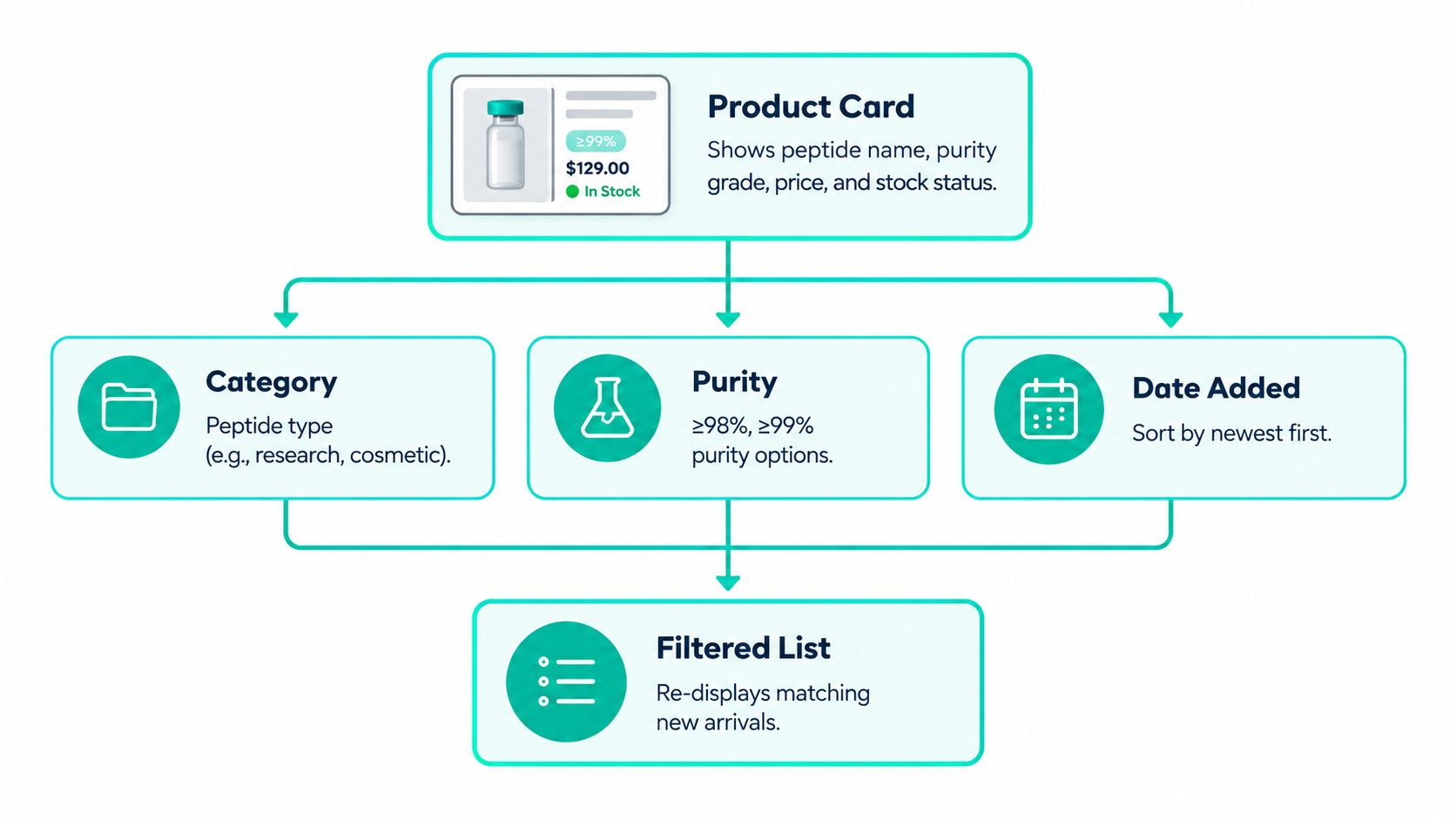
A functional new-arrivals page usually shows a compact product card. That card should help you answer, within seconds, whether the item deserves a closer look.
Look for cues like these:
The value isn't that the page is smaller than the full catalog. The value is that it narrows your attention to recently changed inventory. For procurement, that's often the most important slice of the catalog because it's where timing questions, substitution options, and documentation reviews begin.
New arrivals should help you decide where to investigate, not persuade you to stop investigating.
That distinction matters. A good buyer uses the page as a triage tool. The page highlights candidates. The product record and supporting documents carry the decision.
Once you open a new-arrivals page, the layout starts doing procurement work for you. Good structure reduces wrong clicks. Better still, it reduces wrong assumptions.
A product card is a summary label. You're not trying to learn everything from it. You're trying to decide whether it warrants review.
On most peptide listings, I tell new buyers to scan in this order:
That order keeps you from making the classic beginner mistake of selecting by convenience before confirming fitness for use.
The process below is a simple way to move through the catalog:
Filters aren't just navigation tools. They help you reduce noise. In procurement terms, every irrelevant listing you remove is one less chance to confuse your order.
Useful filter logic usually includes:
If you've ever managed a large ecommerce catalog, you'll recognize the same discipline in search architecture. For a broader technical explanation of why structured filtering matters, Keyword Kick's technical SEO advice is useful reading. The article focuses on faceted navigation from a site-structure angle, but the buyer-facing lesson is simple: good filters make discovery cleaner.
A well-organized catalog also gives you supporting navigation nearby. Quick links to products, contact pages, about information, and blog content don't just help browsing. They tell you whether the seller has built a usable procurement environment.
Here's the practical test I use:
| Catalog signal | What it tells a buyer |
|---|---|
| Clear product cards | The seller expects comparison shopping |
| Filter and sort tools | The catalog is meant to be used systematically |
| Contact access | Availability questions can be resolved quickly |
| Policy links | Institutional review and purchasing become easier |
If the page is visually tidy but hides the details that matter, treat it as incomplete until the product page and support team fill the gaps.
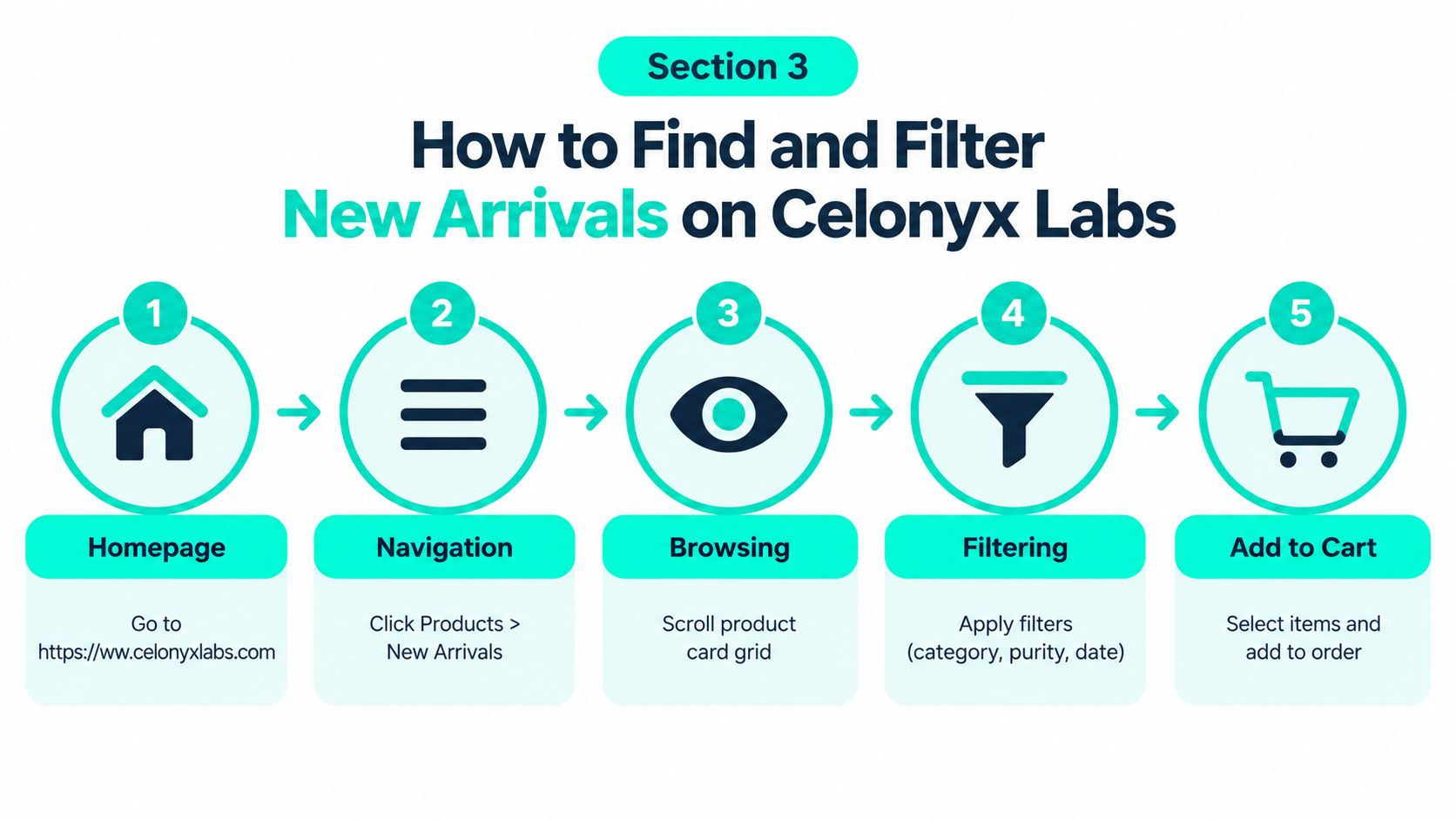
When you're ready to place an order, use a repeatable path. Don't wander. The goal is to move from discovery to verification with as few judgment errors as possible.
Go to the site homepage and open products, then open the new-arrivals collection. Starting this way is better than relying on an old bookmarked product page because you'll see what has changed recently across the catalog.
Once you're in the new-arrivals view, scan the grid before applying filters. That quick visual pass helps you notice whether the newest listings cluster around one category or whether the page includes several different product types.
After the quick scan, apply filters in a deliberate order:
That sequence prevents a common mistake. If you sort first and filter later, you can lose track of whether the remaining results still represent the newest relevant listings.
This checklist view captures the workflow well:
Once a listing looks relevant, click through and review the item as if you were checking a shipment label against a purchase order.
Focus on these questions:
Many newer researchers stop too early. They see a product page, a purity statement, and an add-to-cart button, then assume the review is complete. It isn't. The product page should lead you toward lot-level confirmation if your workflow requires it.
If your experiment is sensitive to batch variation, treat “available to order” and “ready for use” as two different checkpoints.
Add items to cart only after you've decided which records pass your initial screen. If availability is unclear or your lab needs documentation before approval, contact support first rather than placing a speculative order.
This is the one place where it's useful to mention Celonyx Labs directly. The site functions as an ecommerce catalog for research peptides, with ordering, support access, and dedicated sections for new arrivals and bestsellers. For a first-time buyer, that means you can move from listing review to cart and then pause for support questions if needed, instead of restarting the process elsewhere.
A good routine is to keep a simple order note with the peptide name, the date you checked the listing, and whether you still need the batch documents. That turns a one-off search into a process your whole lab can repeat.
People often treat these views as interchangeable. They're not. Each one answers a different procurement question.
New Arrivals is for change detection. It answers, “What's been added recently that might affect my upcoming order?”
Bestsellers is for demand awareness. It answers, “What are buyers returning to often enough that I should at least be aware of it?” If you want to inspect that view directly, the Celonyx Labs bestsellers collection is the relevant catalog section.
Full Catalog is for complete coverage. It answers, “What are all my options, including items that aren't newly listed or especially prominent?”
Use the table below when a colleague says, “Can you check whether they carry it?” That question is too broad unless you know what you're trying to accomplish.
| Catalog View | Primary Purpose | Best When You Need |
|---|---|---|
| New Arrivals | Spot recent additions | To catch newly listed peptides before finalizing an order |
| Bestsellers | See recurring buyer interest | A quick signal of commonly selected items |
| Full Catalog | Review total availability | Exhaustive browsing, substitutions, or broad comparison |
I usually tell junior buyers to work in this order when the request is open-ended:
That sequence keeps the search efficient without making you dependent on a single view.
The best starting page depends on the question, not on what looks most convenient.
A new-arrivals page becomes much more useful when you connect it to quality review. That's where many labs gain discipline. They stop asking only, “Is this item new?” and start asking, “Can this lot support the work we're planning?”
A broad purity claim can help you decide whether to open a listing, but it shouldn't be the end of your review. Recent coverage has pushed buyers toward batch-level transparency, with emphasis on reviewing the exact lot's Certificate of Analysis, HPLC chromatogram, and mass spectrometry result rather than trusting a generic product page, as described in Business Insider coverage of batch-level transparency in research peptides.
That shift is healthy for procurement. It moves the conversation from marketing language to documentation.
For peptide verification, the strongest basic pairing is reversed-phase HPLC for purity and mass spectrometry for identity, because HPLC shows the target peptide as a main peak relative to impurities while MS confirms the measured mass matches the expected sequence. That two-method approach is described clearly in Amino Core Research's article on third-party testing for research peptides.
For some workflows, purity and identity still won't be enough. More rigorous validation can also include endotoxin, heavy metal, sterility, and residual-solvent screening, with acceptance needs varying by use case, as discussed in coverage of broader contaminant panels and random-lot testing.
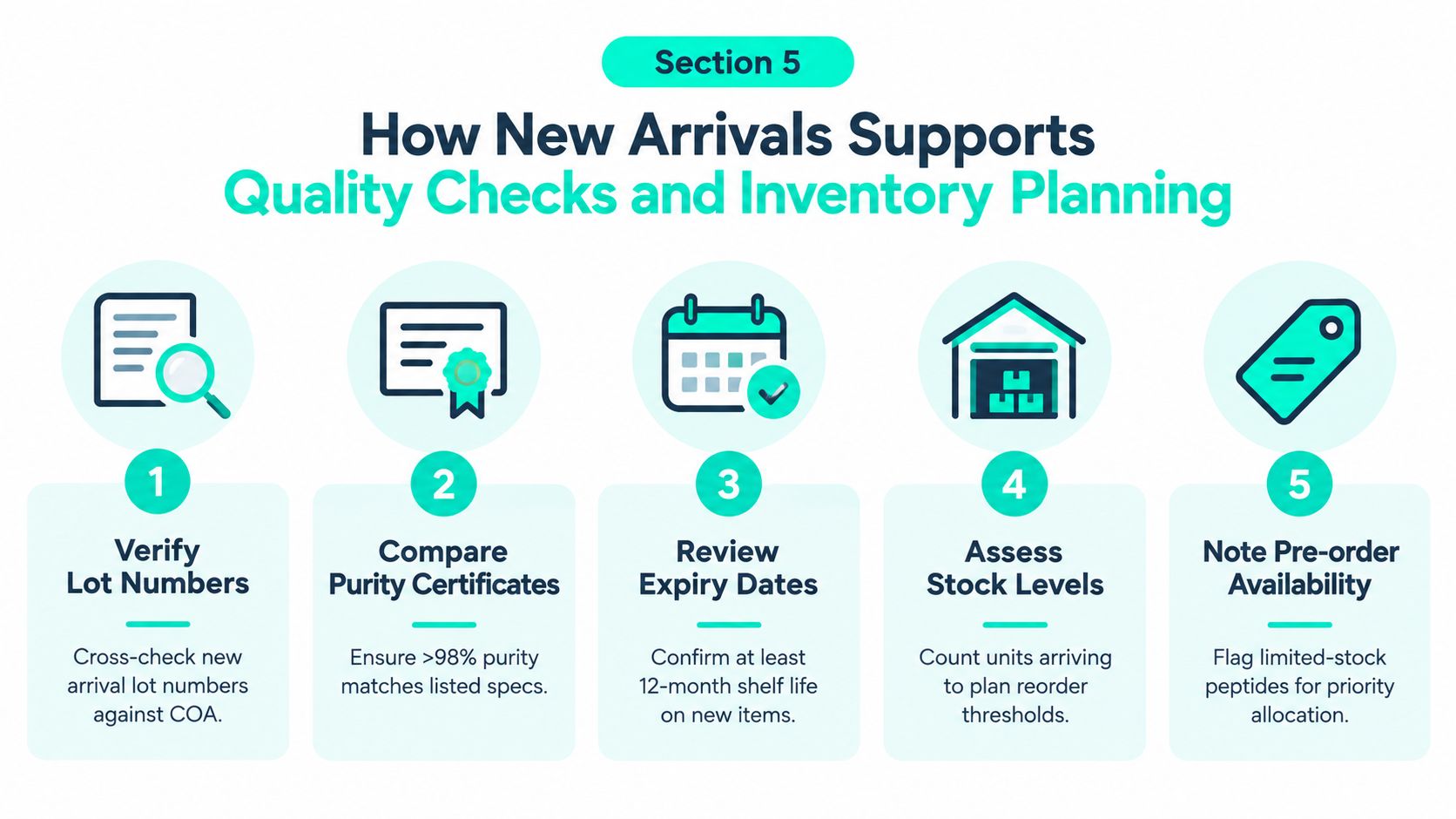
Use the page below as a simple planning reminder:
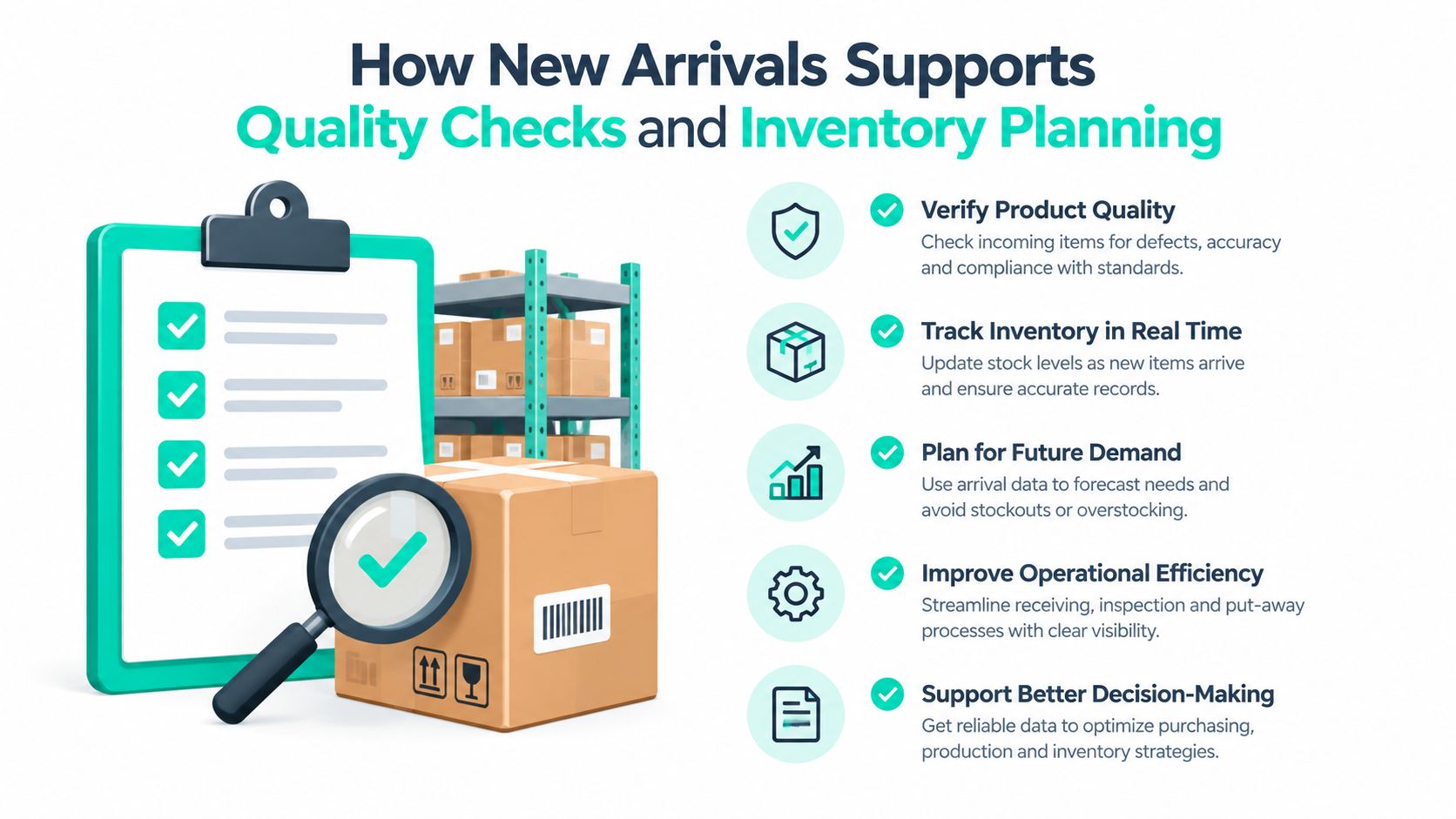
Labs also tend to overreact to shipping assumptions. For lyophilized research peptides, standard domestic shipping often doesn't require active cold-chain control because the dry, sealed form is relatively stable for days to weeks at ambient temperature, and brief transit exposure around 30–40°C often doesn't produce measurable purity loss for most sequences, according to Nexara Labs' discussion of cold-chain and shipping for lyophilized peptides.
That doesn't mean shipping speed is irrelevant. It means the value of fast fulfillment is often about scheduling and workflow continuity rather than strict preservation for many products.
A practical procurement checklist looks like this:
The smartest way to use a New Arrivals Target page is to stop thinking of it as a highlight reel. It's better used as a first-pass procurement screen. You check it to see what's changed, identify which listings might matter, and decide where deeper review is required.
That habit saves time because you aren't re-reading the entire catalog every time your lab needs something. It also reduces avoidable mistakes. New buyers often confuse “found the item” with “cleared the item.” The page helps with the first step. Your documentation workflow handles the second.
If you want a repeatable process, keep it short:
Experienced procurement staff don't browse passively. They maintain a small decision trail. They note what appeared, what was reviewed, and what still needs confirmation.
That's what turns a catalog feature into a lab operation. Once you adopt that approach, the New Arrivals Target page stops being a place you glance at and becomes a place you use intentionally.
Celonyx Labs offers an online catalog of research peptides, including dedicated New Arrivals and Bestsellers sections, along with ordering support, published policies, and contact access for labs that need a clearer purchasing workflow. If you want to turn new-arrivals browsing into a more disciplined documentation and inventory routine, visit Celonyx Labs and review the catalog with that procurement lens.
The most popular advice about peptide purchasing is also the least useful: “Look for a

Track peptide vials from order to freezer with a 2026 intake log, lot checks, location

Build a spreadsheet workflow that logs peptide reconstitution calculations automatically in 2026 — auto-calculate concentration,
FOR RESEARCH USE ONLY. Products sold by Celonyx Labs are intended exclusively for laboratory and scientific research. They are not intended for human or veterinary use, consumption, diagnosis, treatment, cure, or prevention of any disease. By purchasing from this site, you acknowledge that you understand the intended research purpose of these materials and agree to comply with all applicable laws and regulations.