
Purity Ingredients Explained: How to Read a Peptide COA
The advice you'll see most often about peptide quality is to buy 99% purity and
The advice you'll hear most often about buying BPC-157 for the bench is short: demand a certificate of analysis and make sure the material is third-party tested. Follow it exactly and you're still exposed. A certificate answers one narrow question, whether the powder in that vial is the peptide the label names, at the purity the vendor states, by the method the lab used. It tells you nothing about whether the compound does anything in a living system, and nothing at all about whether the paper you're trying to replicate was worth publishing.
That confusion runs through most buyer-side discussion of this peptide. Vendor pages sell purity as though it were a clinical result. Reviewers accept a generic PDF as proof of a specific vial. Fitness content converts a rodent outcome into a protocol. Untangling those claims, and checking each one against evidence that can support it, is what integrity research on BPC-157 looks like in practice. Not a purity number, but a chain that runs from lot to document to study to conclusion, with a clear note at each link about what it does not cover.
One rule governs everything downstream. Vendor paperwork counts only when it is tied to the lot printed on the vial. A certificate that names a product, or a catalog page with a specification, describes a category of goods. It does not describe the powder in front of you, and it cannot support a single measurement you generate with it.
So the first document to request is a batch-specific certificate of analysis carrying three things that must agree: the lot number that also appears on the vial label, the date the tests were run, and the method used for each test. Ask for it before you order rather than after. A supplier who can't produce lot-level data on request rarely produces it on complaint.
Identity records come next. An identity confirmation report should show the measured mass against the expected mass for the sequence in that lot, with the sequence printed in full. For this peptide that is Gly-Glu-Pro-Pro-Pro-Gly-Lys-Pro-Ala-Asp-Asp-Ala-Gly-Leu-Val, a chain of 15 amino acids. If the sequence differs between two documents from the same supplier, stop and ask which one describes your material before you open the vial.
Ask for the independent report itself, not a badge: the lab's name, the test date, and the lot it tested. A vial labeled third-party tested is making a claim until that report is in your hands. Add a storage statement (our BPC-157 research peptide is stored at −20°C for long-term stability as lyophilized powder), Research Use Only labeling on both the vial and the documents, and a supplier record tracing the vial back to a production batch. Every batch of our BPC-157 research peptide undergoes analytical verification by HPLC, mass spectrometry and batch consistency testing, and that statement only becomes useful to you when it arrives as lot-level data rather than a sentence on a product page.
Put four questions in writing before you pay: which lot was tested, which method was used, who ran it, and where the raw report can be read. Add a fifth if the purity figure on the product page differs from the one on the certificate, and ask the supplier to explain the gap. The answers tell you more about the vendor than any testimonial.
| Document | What It Should Show | Red Flag |
|---|---|---|
| Batch-specific certificate of analysis | Lot number matching the vial label, plus test date and method | Generic COA with no lot number or date |
| Identity confirmation report | Measured mass matching the expected mass for the 15-residue sequence in that lot | No identity test, or a mass that does not match |
| Sequence record | Gly-Glu-Pro-Pro-Pro-Gly-Lys-Pro-Ala-Asp-Asp-Ala-Gly-Leu-Val, 15 amino acids | Sequence missing, or different between documents |
| Third-party test report | Independent lab name, test date and the lot tested | Third-party claim on the label with no report available |
| Storage statement | Lyophilized powder storage conditions stated for long-term stability | No storage guidance on the label or documents |
| Research-use labeling | For Research Use Only on the vial and the documents | Any wording that suggests human, medical or therapeutic use |
| Lot traceability | Supplier record linking the vial to its production batch | Lot number cannot be traced beyond the label |
Practical rule: a missing row is a question for the supplier, not a detail to work around. A vendor who can't answer the four questions in writing has told you what the rest of the relationship will look like.
A certificate is only as useful as the lines you can verify, so read it in order and stop at the first failure rather than skimming to the purity figure at the bottom.
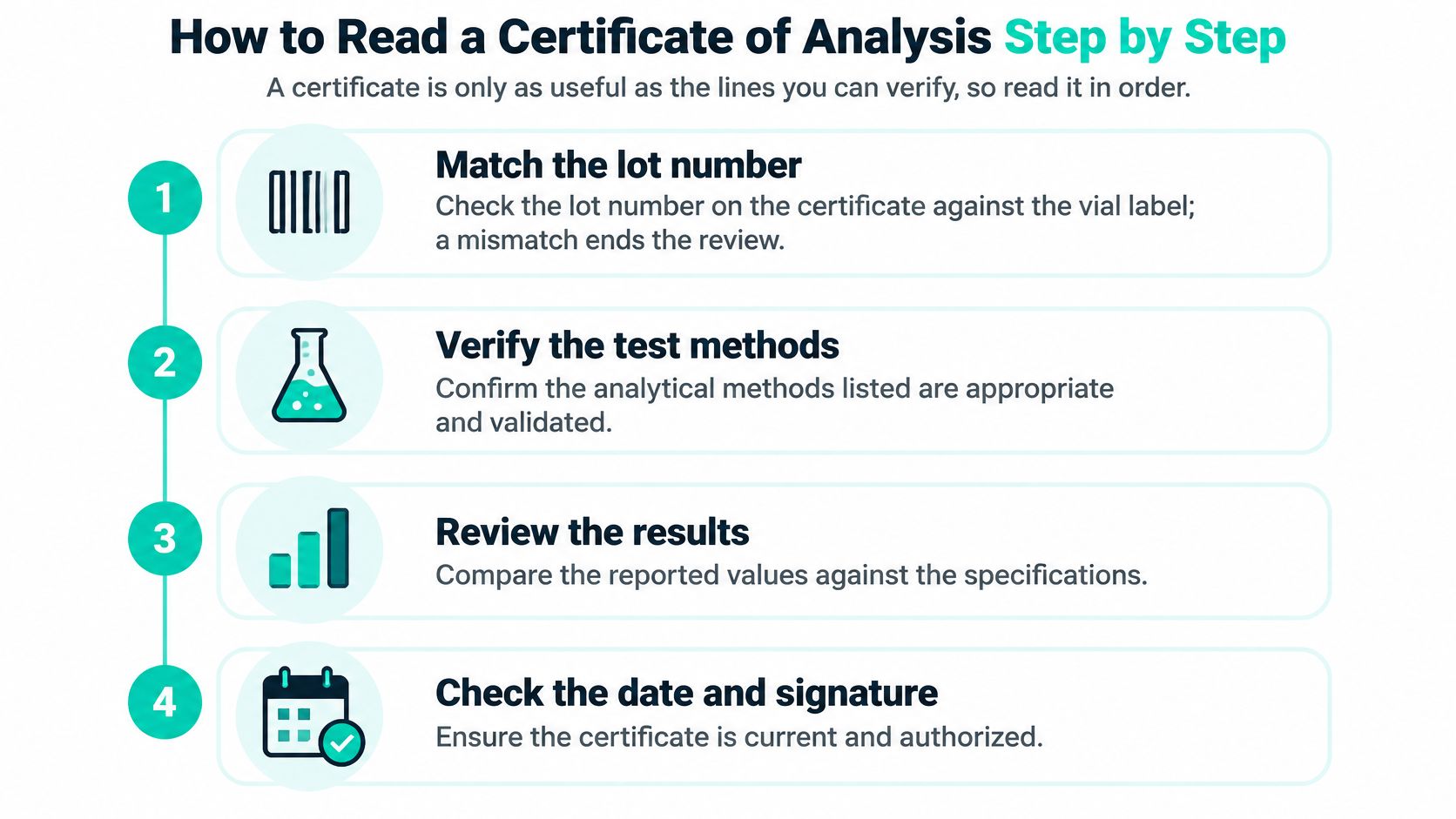
Those eight checks turn a PDF into a document you can defend in a lab meeting. If you want to see how the fields should be laid out before you request one, the peptide certificate of analysis guide walks through the structure line by line.
A useful certificate is specific, traceable to a lot, and explicit about methods and limits. A weak one is a logo, a percentage, and a signature with no printed name.
The BPC-157 research peptide listing states a purity of at least 98%, verified by HPLC, while the homepage lists 99% purity as a headline feature of the catalog. Those figures don't contradict each other, since a 99% measurement satisfies a 98% specification, but a buyer comparing them learns nothing about the vial in the cart. Neither number means anything until you know which lot it describes and what was measured.
HPLC purity is an area percentage. It reports the share of the UV signal at the detector that came from the main peak, which is not the same thing as the mass fraction of peptide in the vial. A sample can read 99% by area and still contain water, salts or residual solvent that pull the actual peptide content well below that. Mass spectrometry settles a different question entirely. It compares observed molecular mass with the mass expected from the sequence, so it confirms identity and says nothing about quantity.
| Measurement | What It Measures | What It Cannot Show |
|---|---|---|
| HPLC purity (area percent) | Share of the UV signal from the main peak | Water, salt or residual solvent mass, or the absolute amount of peptide |
| Mass spectrometry identity | Observed molecular mass compared with expected sequence mass | How much material is in the vial, or its purity |
| Peptide content (net) | Peptide mass as a share of total powder weight | Sequence identity or impurity profile |
| Water content | Moisture in the lyophilized powder | Purity or identity of the peptide |
| Counterion or salt form | Whether acetate or TFA salt is present and in what amount | Biological activity or study outcome |
Two researchers can weigh the same nominal dose from two vials with identical purity figures and deliver different amounts of peptide, because content and salt form differ. That's the failure mode the purity number hides.
When two figures disagree across pages or documents, don't average them. Request the method, the lot, the raw chromatogram or report, and a written explanation of why the numbers differ.
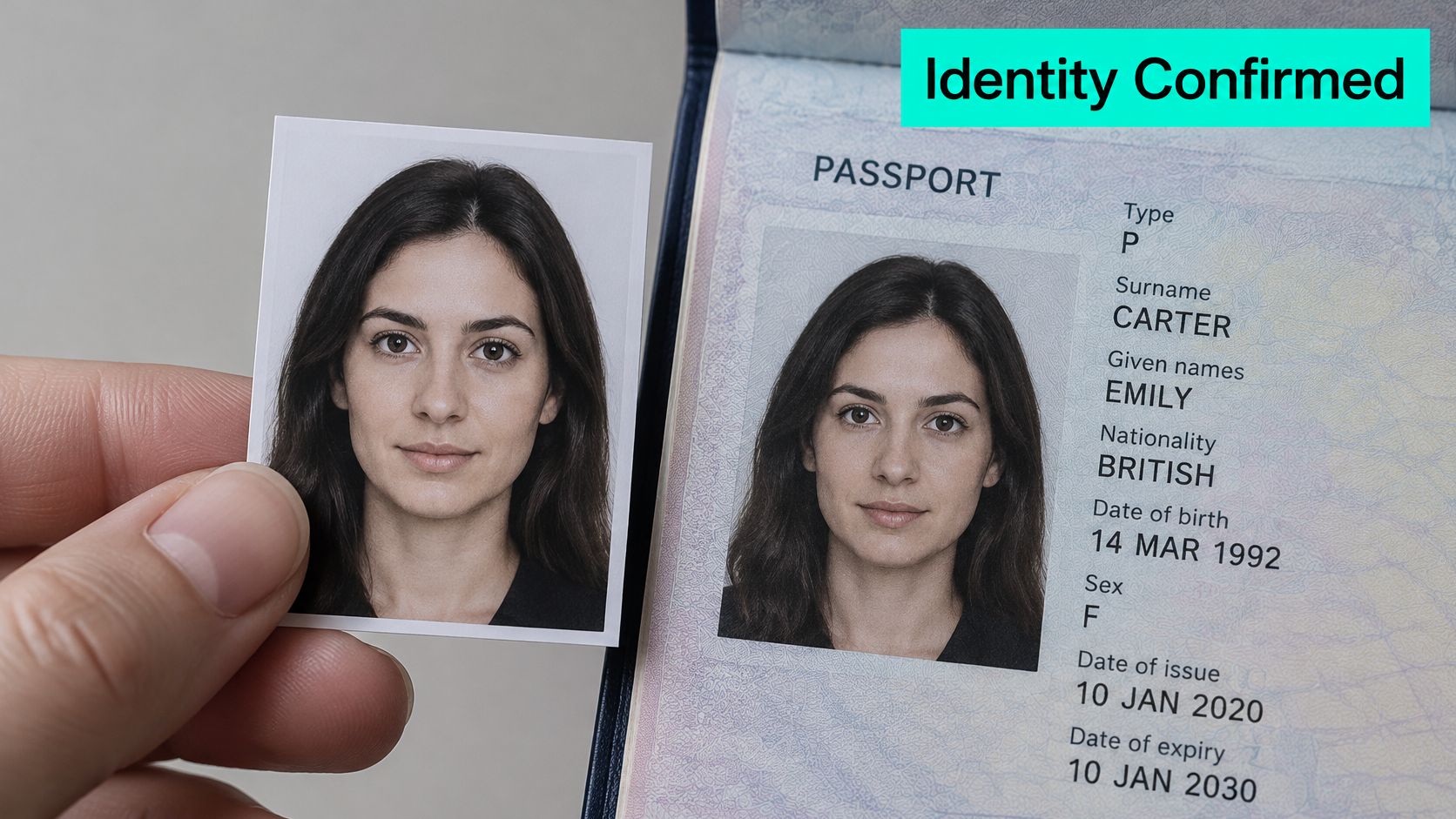
A certificate of analysis works like a passport photo. It confirms that the item in hand matches the record, and it says nothing about how the trip will go. The photograph is still useful. It just isn't a character reference, a visa, or a guarantee at the border.
What vendor testing establishes is chemical identity and batch composition: this lot contains this sequence, at this measured mass, with this profile by this method. That is a real and necessary achievement. It is also where the paperwork stops.
The evidence base for what the compound does sits far behind the paperwork. A 2025 systematic review of human evidence in orthopaedic and regenerative medicine identified 36 eligible studies, of which 35 were preclinical and only 1 involved humans. The review rated those studies poor in methodological quality and the overall certainty of evidence very low, citing serious risks of bias, indirectness and imprecision, and its authors concluded that BPC-157 should not be used clinically outside ethically approved, regulated, high-quality clinical trials.
That gap should shape how you write conclusions. Two sentences, same experiment, very different claims:
"This lot matched its identity and purity data and produced the reported response in the rat model at the stated dose."
"BPC-157 is effective."
The first is a claim your documents can support. The second is a claim no certificate in existence can support, and no study in that review supports either. Keep conclusions tied to the tested preparation, the model, the dose, the route and the study conditions, and the record stays defensible when someone asks a year later.
For the testing side of that chain, the walkthrough below follows a sample from receipt through to the report.
One distinction is worth printing on the wall: the certificate proves your material was what you thought it was. It does not prove the experiment will work. Reading the third-party testing labs breakdown helps you separate what an external lab verifies from what you still owe the study design. A clean certificate is a necessary condition for a reliable experiment. It is never a sufficient one.
A positive result can come from a well-built study or a lucky one, and the purity of the material fixes neither problem. At this point, most vendor-adjacent commentary changes the subject without saying so, presenting a mechanism diagram or an animal outcome as if analytical quality transferred into evidence of effect.
The 2019 rat spinal-cord-injury study summarized in the FDA briefing materials on BPC-157 makes a clean worked example. All rats receiving the compound showed consistent clinical improvement, and by day 15 the reported outcomes included increasingly better tail motor function, no autotomy and resolved spasticity. That is a specific, reportable finding in one species and one injury model. It does not transfer to another species, another route, another dose, or a human.
Mechanism work has the same boundary. Proposed repair pathways include activation of VEGFR2 and Akt/eNOS nitric oxide signaling, stimulation of fibroblast activity and angiogenesis, and engagement of ERK1/2, as set out in the review of the compound's mechanistic literature. Those findings belong in a notebook as hypothesis-generating endpoints, tested with vehicle controls, blinded outcome assessment, dose-response curves and orthogonal readouts such as histology, collagen organization, vascular markers and inflammatory cytokines.
| Criterion | Strong Sign | Weak Sign |
|---|---|---|
| Species and model | Named species with a validated injury or disease model | Single unnamed or unvalidated model |
| Sample size | Stated n per group with a power rationale | n not reported |
| Controls | Vehicle and positive controls included | No vehicle control |
| Randomization and blinding | Randomized allocation and blinded outcome scoring | Not stated |
| Route and dose | Route and dose justified and reported | Dose or route missing |
| Preregistration | Protocol registered before dosing | No registration |
| Publication status | Peer-reviewed, with negative results reported | Conference abstract or selective reporting |
| Independent replication | Replicated by a separate lab | Single lab only |
Run the 2019 rat study against those rows and the score is thinner than the headline. Species and model are named, and outcomes are reported by day and by measure, which are strong signs on two rows. Sample size, randomization and blinding are not stated in what's reported, so they score as not reported rather than as present. Independent replication is a separate question the summary doesn't answer.
That's not a reason to dismiss the study. It's a reason to describe it accurately, which is the whole point of an evidence audit that covers species, model, sample size, controls, randomization, blinding, route, dose, preregistration, publication status and independent replication. A review of the BPC-157 evidence base makes the contrarian case directly: human clinical safety data were unavailable, and a highly pure, independently tested material reduces one source of experimental noise without correcting weaknesses in study design, selective reporting, publication bias or poor external validity.
Negative results and missing controls matter as much as positive ones. A lab that records vehicle controls, lot numbers and chain of custody can later judge whether its own result was reproducible or was a one-off it failed to notice. For teams setting up a first protocol, the BPC-157 peptide reference page carries the material specifications you'll need to write into the methods section.
"No adverse events observed" is the sentence doing the most work in public-facing content about this compound, and it deserves the most scrutiny. The question isn't whether a study recorded an adverse event. It's what size of study, over what duration, could have detected one.
The available human evidence is small enough to count on your fingers. A systematic review indexed on PubMed found only three human studies totaling 30 participants: retrospective series involving 16 knee-pain patients and 12 interstitial-cystitis patients, plus a prospective intravenous pilot. All three were judged methodologically poor, with very low certainty because of bias, indirectness and imprecision. The same source notes that clinical studies were small, exploratory and short, with no study lasting longer than two weeks in the FDA-reviewed evidence summarized.
The third study is the one most often quoted. A 2025 review indexed by the U.S. National Library of Medicine reports a pilot in which two healthy adults received intravenous infusions of up to 20 mg, with no adverse events and no clinically meaningful changes in measured vital signs, electrocardiograms or laboratory biomarkers. That's a useful early signal about short-term tolerability at that dose by that route. It's not a safety profile.
Risk excluded is a conclusion you can reach only when a study was large enough and long enough to have found the harm if it existed. Thirty participants across three uncontrolled studies cannot reach it, whatever the results say.
The variables that can change risk are the ones these studies don't isolate: route, formulation, dose, impurity profile, co-administered substances, disease state, immune status and duration of exposure. Identity and purity testing says nothing about toxicology, pharmacokinetics, sterility, endotoxin control or long-term surveillance, and each of those is a separate body of work nobody has done here.
For laboratory planning, the practical consequence is simple. Treat every safety claim from public content as unverified and keep it out of your protocol rationale. The material is sold for research: our BPC-157 research peptide is not intended for human consumption, medical use, veterinary use, or any therapeutic application. That labeling is the accurate description of the evidence, not a legal formality.
Celonyx Labs supplies BPC-157 as a lyophilized powder for laboratory research only, with every batch verified by HPLC, mass spectrometry and batch consistency testing so the documentation you receive can be matched to the lot in your hand. If your work needs material you can trace from the vial label to the analytical report to the notebook page, Celonyx Labs publishes the quality and policy information to support that chain. Request the lot report before you order, and read it against the eight checks above before the first vial is opened.
The advice you'll see most often about peptide quality is to buy 99% purity and

Can LL-37 be combined with antimicrobial peptides? Yes, for controlled laboratory research. Learn how to

Can GHK-Cu be combined with BPC-157? Learn how to frame a controlled laboratory study, verify
FOR RESEARCH USE ONLY. Products sold by Celonyx Labs are intended exclusively for laboratory and scientific research. They are not intended for human or veterinary use, consumption, diagnosis, treatment, cure, or prevention of any disease. By purchasing from this site, you acknowledge that you understand the intended research purpose of these materials and agree to comply with all applicable laws and regulations.