
BPC 157 TB 500 GHK Cu Research Guide 2026
The popular advice to treat BPC-157, TB-500, and GHK-Cu as a ready-made regenerative stack skips
The popular advice to treat BPC-157, TB-500, and GHK-Cu as a ready-made regenerative stack skips the most important question: what evidence belongs to each material? Putting their names together doesn't establish a shared mechanism, a validated combination, or a human treatment protocol.
For a laboratory, the useful starting point isn't a blend ratio. It's a clear separation between molecular identity, route of exposure, and evidence class. A cell-migration result, a symptom report, and a controlled trial of a related molecule answer different questions.
BPC-157, TB-500, and GHK-Cu aren't one research intervention with one evidence base. They're more like tools sharing a toolbox: their placement together doesn't mean they perform the same job.
BPC-157, TB-500, and GHK-Cu research identities
| Compound | Molecular identity | Research context | Human-evidence snapshot |
|---|---|---|---|
| BPC-157 | Synthetic peptide | Predominantly preclinical tendon, ligament, muscle, bone, vascular, and gut models | Broad animal literature; human studies few, small, and very low certainty |
| TB-500 | Fragment associated with thymosin beta-4, not the full parent peptide | Fragment-related migration research must remain distinct from parent-molecule actin research | No indexed human trial, systematic review, or meta-analysis reported specifically for the fragment |
| GHK-Cu | Copper-binding tripeptide | Skin, wound, and remodeling research, with topical and injectable routes kept separate | The cited human wound and post-procedure studies didn't establish an objective advantage |
The central problem isn't that researchers need more publications. It's that consumer-facing explanations often combine laboratory observations, animal injury models, and human treatment claims under the same regenerative label. The orthopaedic evidence review in the American Journal of Sports Medicine emphasizes the predominantly preclinical BPC-157 literature and the absence of peer-reviewed human musculoskeletal-healing evidence for TB-500.
A shared nickname does not create shared evidence.
Our BPC-157 sequence is Gly-Glu-Pro-Pro-Pro-Gly-Lys-Pro-Ala-Asp-Asp-Ala-Gly-Leu-Val, a chain of 15 amino acids. Writing that identity into a protocol is more informative than labeling the material a repair peptide. The latter describes an intended research theme, not a demonstrated outcome.
For TB-500, the critical label is fragment. A paper about full-length thymosin beta-4 doesn't become fragment evidence because a supplier uses the names interchangeably. Investigators need the actual construct, not just a familiar catalog term.
GHK-Cu introduces a different distinction. A copper-complexed peptide applied in a topical formulation isn't the same experimental exposure as material introduced by injection. The carrier, tissue barrier, local exposure, and endpoint all belong in the interpretation.
Say a project team collects a tendon-cell paper, a parent-molecule eye trial, and a topical wound study. Those papers might help the team formulate separate hypotheses. They don't establish that combining the materials will improve tendon healing in people.
The practical annotation beside every claim should therefore contain:
That small habit prevents a plausible biological story from becoming an unsupported clinical conclusion.
A human study belongs in an evidence ledger as a specific observation, not as a general endorsement. Pain improvement, bladder symptoms, tolerability, and tissue healing aren't interchangeable endpoints.
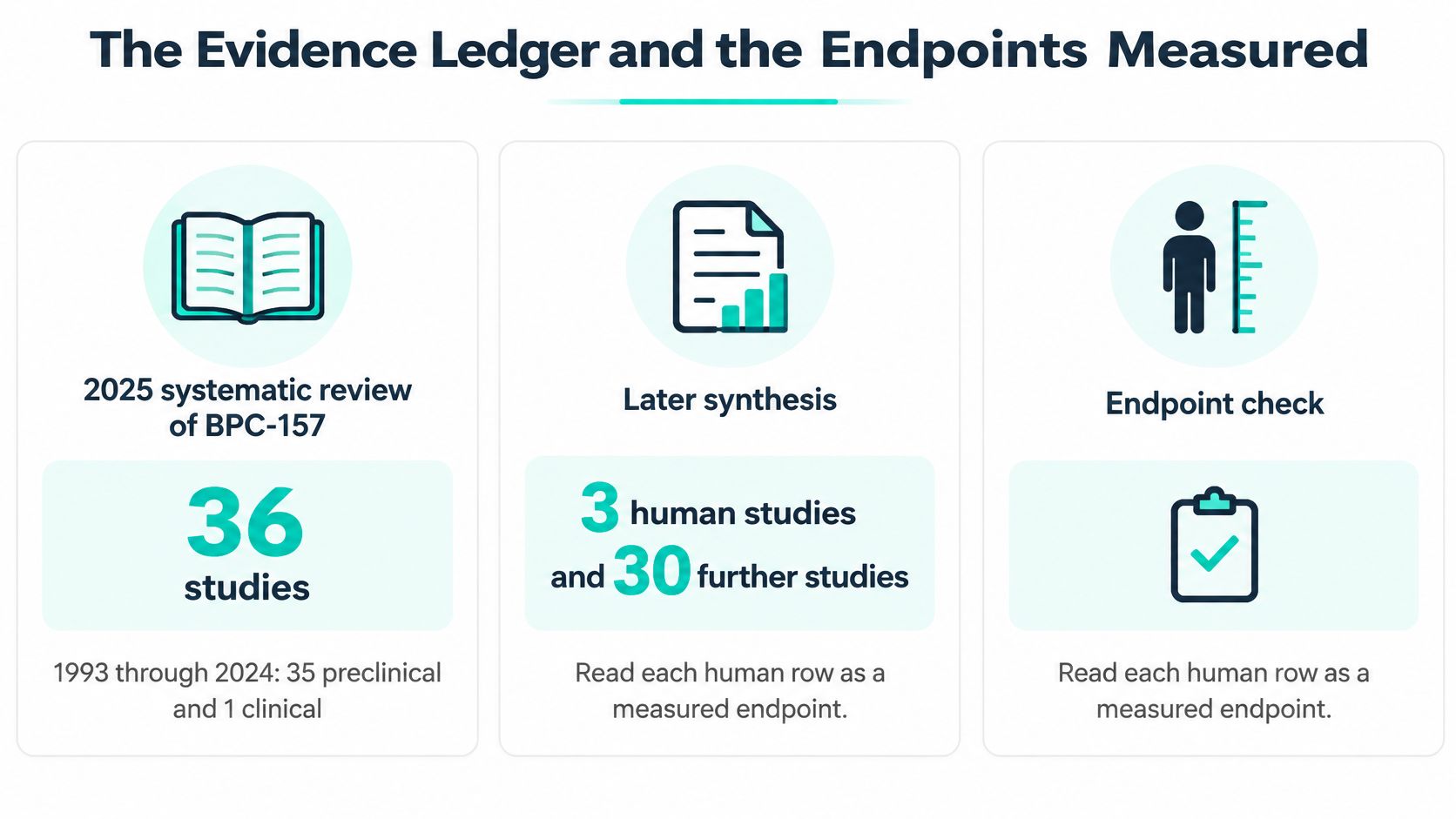
The BPC-157 evidence synthesis describes a 2025 systematic review of 36 studies published from 1993 through 2024, including 35 preclinical investigations and 1 clinical study. It also describes a later human evidence synthesis comprising 3 studies and 30 participants, with poor methodological quality and very low certainty.
Evidence counts by molecule
| Molecule or construct | What was counted | Number | How to read it |
|---|---|---|---|
| BPC-157 | Studies in the systematic review described above | 36 total; 35 preclinical and 1 clinical | Broad preclinical literature, not a mature clinical program |
| BPC-157 | Human studies in the later synthesis | 3 studies; 30 participants | Symptom reports exist, but certainty was very low |
| BPC-157 | Interstitial-cystitis pilot described below | 12 patients; single 10 mg intravesical procedure | 10 reported complete resolution and 2 approximately 80% improvement; uncontrolled |
| TB-500 fragment | Indexed human trials, systematic reviews, or meta-analyses | None reported | Missing fragment evidence cannot be supplied by parent-molecule trials |
| Thymosin beta-4 | Controlled dry-eye research | Parent-molecule participants only | Enrollment in a parent trial isn't enrollment in a TB-500 trial |
| GHK-Cu | Venous-leg-ulcer cream trial | Human topical study | No advantage over placebo reported |
| GHK-Cu | Post-laser-resurfacing study | Small human study | No objective difference reported |
The BPC-157 guide describing the 2024 interstitial-cystitis pilot in Alternative Therapies in Health and Medicine reports 12 patients receiving a single 10 mg intravesical procedure, after which 10 reported complete symptom resolution and 2 reported approximately 80% improvement. Those are reported bladder-symptom outcomes following administration into the bladder, not evidence for an injury-repair injection protocol.
An uncontrolled symptom series can't isolate treatment effects. Symptoms may change over time, participants may receive other care, and retrospective reporting can introduce selection and recall bias. Without a suitable comparison group, an investigator can't reliably assign the change to the peptide.
Route is part of the finding. An intravesical observation doesn't establish oral absorption or the consequences of subcutaneous or intramuscular exposure. Moving a result between routes requires supporting pharmacokinetic and clinical evidence, not a conversion calculation.
A safety pilot isn't an efficacy trial. A small prospective exposure study may help identify immediate observations under its particular conditions. It can't establish a broadly usable dose, rule out uncommon harms, or demonstrate long-term safety.
The human synthesis reported no treatment-related adverse events in the available studies. That finding needs the same methodological caution as the reported improvements: limited observation doesn't establish the absence of risk.
For each paper, extract endpoint, formulation, follow-up, and control status before writing a summary. If follow-up isn't clearly reported in the record you're reviewing, mark it as unresolved rather than assuming that improvement persisted.
Our BPC-157 peptide explainer can support terminology checks, but a compound overview shouldn't replace the underlying methods when designing a study.
Interpretation rule: Report what participants experienced under the studied conditions. Don't turn that observation into a general claim that the compound heals tissue.
An evidence ledger should make gaps visible. Leaving a field unresolved is more useful than filling it with findings from another route, another indication, or another molecule.
A TB-500 vial shouldn't inherit the clinical history of thymosin beta-4. The technical issue is construct equivalence: whether the tested material is the material named in the claim.
The Peptide Library research-tracking record reports no indexed human trial, systematic review, or meta-analysis specifically for the TB-500 fragment, while describing a 2015 Phase 2 thymosin beta-4 dry-eye trial involving 72 participants over 28 days. It also lists later parent-molecule ocular trials and earlier wound studies, none of which validates a commercial fragment product.
The same record describes a 1992 GHK-Cu venous-leg-ulcer trial involving 86 patients and 0.4% cream, with no advantage over placebo, and a 2006 post-laser-resurfacing study involving 13 patients, with no objective difference. These findings belong to their particular formulations and indications, not to every product carrying the molecular name.
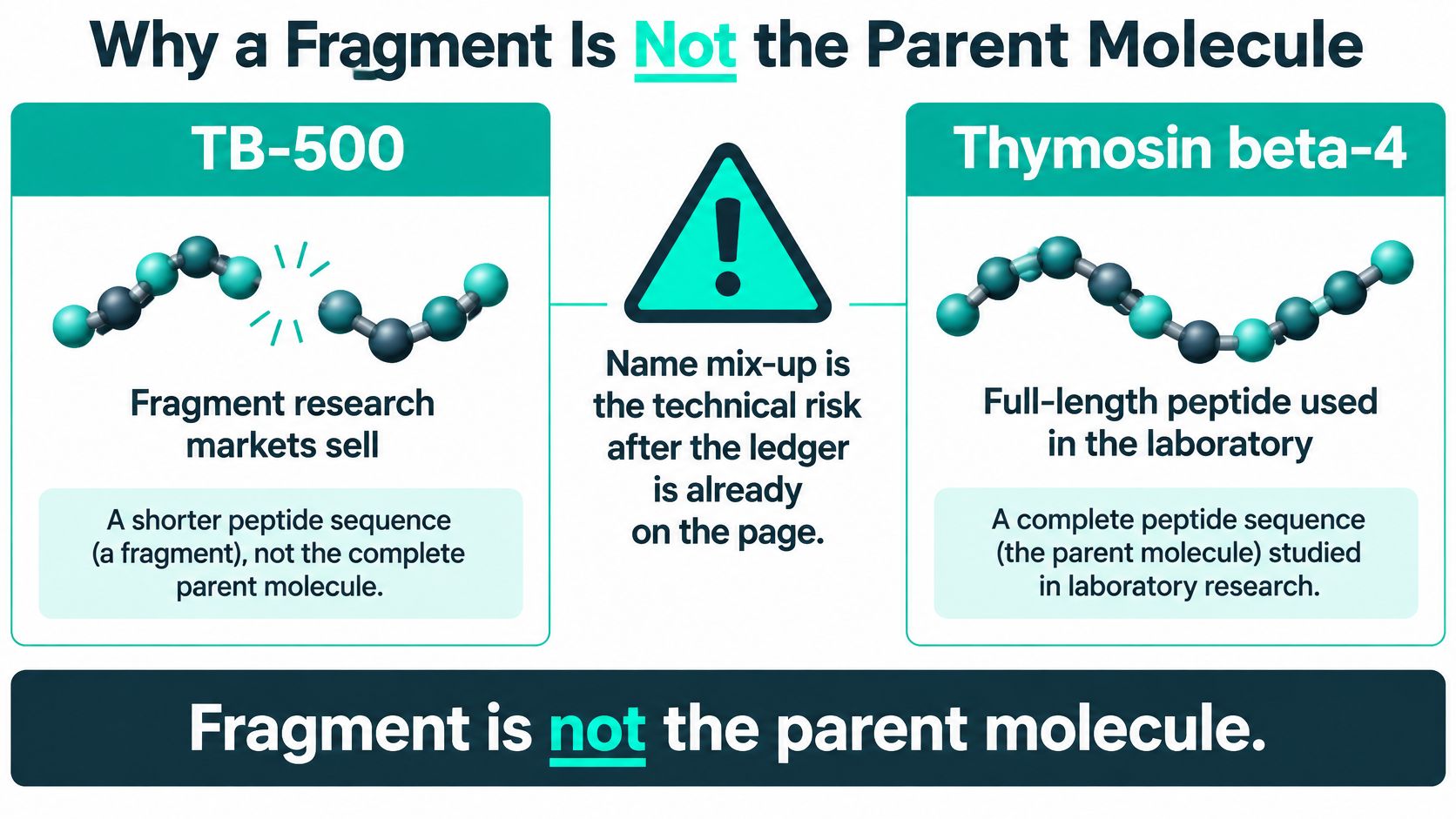
A lock-and-key analogy helps explain the problem. Sharing part of a key's shape doesn't guarantee that a shorter key will interact with the same lock in the same way.
For peptides, investigators must account for the complete sequence, stability, exposure, and possible interactions with binding partners. Even when constructs share a biologically interesting region, those differences can change the experimental result.
Our comparison of TB-4 and TB-500 provides a terminology reference. In a methods section, however, the exact construct should replace shorthand whenever ambiguity could affect interpretation.
Use this order when documenting fragment material:
A vascular or migration signal may support a repair-model hypothesis or complicate a disease-model interpretation. The relevant control condition therefore belongs beside the result, not in a distant disclaimer.
A defensible conclusion is narrow: this result belongs to this construct, not to every product with a similar name.
Consider a laboratory planning a migration experiment. Before selecting a material, the investigator should define what movement will be measured, which cells will be used, and how movement will be distinguished from changes in cell number or viability.
That approach starts with an observable question. It doesn't start with a promise of regeneration.
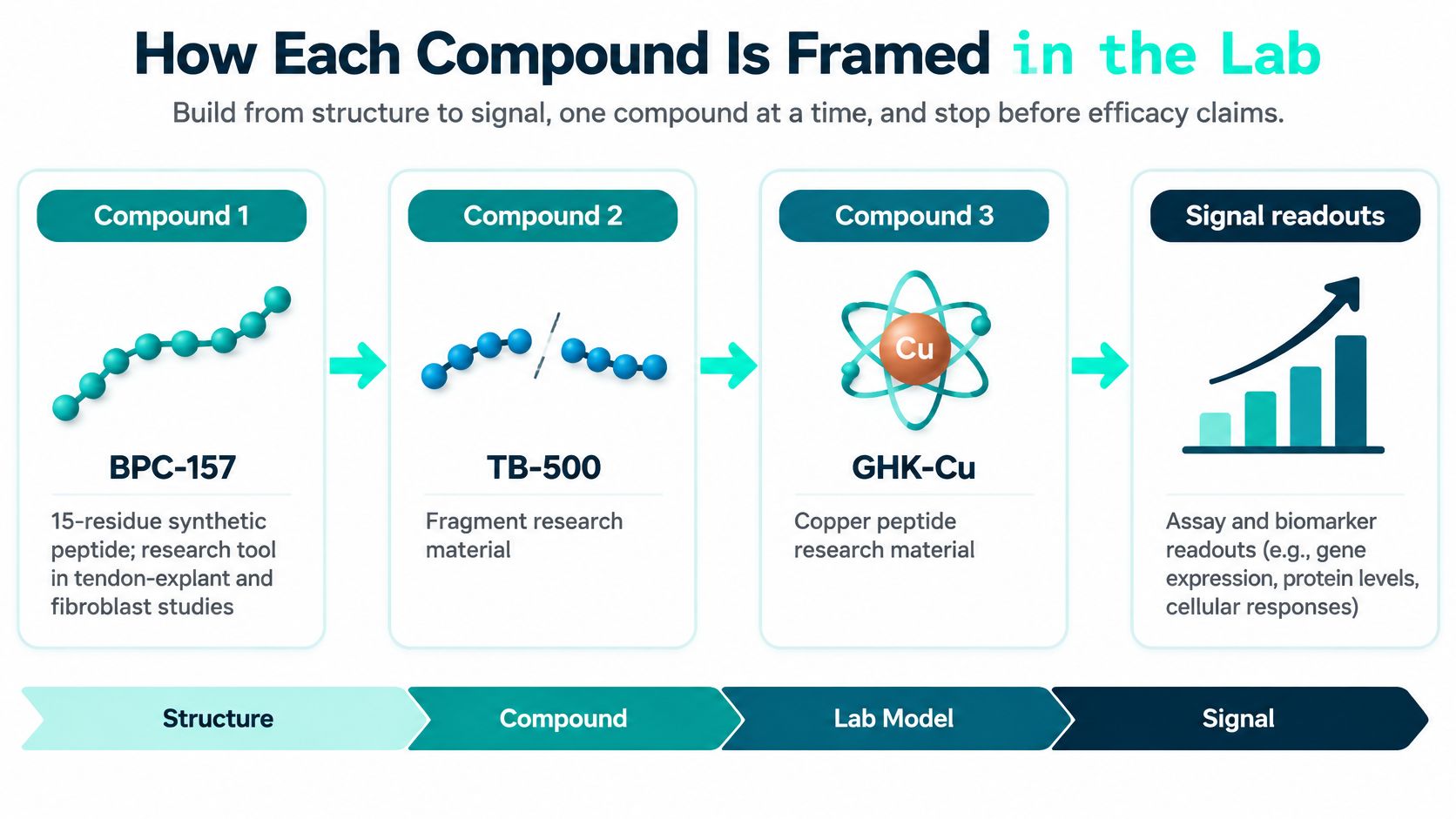
The Cell and Tissue Research review of BPC-157 describes tendon-explant and fibroblast findings involving dose-dependent migration and spreading, plausibly associated with focal-adhesion kinase, or FAK, and paxillin signaling. The review also discusses animal-model pathways involving VEGF/VEGFR2, nitric oxide, Akt-eNOS, ERK1/2, angiogenesis, and inflammatory signaling.
These are hypothesis-generating observations. Think of them as road signs along experimental routes in cells and animals, not a completed map to human healing.
A migration assay can help test a pathway question. It can't, by itself, establish mechanical tendon recovery, clinical pain relief, or an acceptable human safety profile.
The Noho Labs TB-500 guide describes thymosin beta-4 binding globular actin and identifies the LKKTETQ region with that interaction, alongside preclinical links to cytoskeletal remodeling, endothelial activity, migration, and wound-repair processes.
That parent-molecule biology supplies context for a question, not an automatic answer about a fragment. Sequence, stability, impurities, binding interactions, and exposure may differ, so fragment experiments need their own analytical and biological controls.
For example, increased movement in a cell assay should be interpreted alongside viability and proliferation measurements. Otherwise, the investigator may describe a change in cell abundance as a change in migration.
GHK-Cu belongs in a skin and matrix-remodeling research frame, but the experimental material still needs a precise description. A cream on a wound and lyophilized material in a vial aren't equivalent test articles.
Our GHK-Cu skin and wound-healing research guide provides context for organizing those questions. A study should define its formulation and readout rather than treating skin research as a universal indication.
Across the compounds, keep these variables visible:
A plausible mechanism is a reason to design a controlled experiment. It isn't a reason to assume translation.
Combining investigational materials makes attribution harder. If a readout changes, investigators need a way to distinguish an ingredient effect from an interaction, a formulation effect, or a material-quality problem.
The classification should therefore happen ingredient by ingredient, before anyone describes the combination as additive or synergistic.
How to classify each ingredient in a combined protocol
| Ingredient | Status to record | Sport-rule note | Documentation that must stay separate |
|---|---|---|---|
| BPC-157 | Investigational research compound, not an approved therapy | Prohibited at all times under the cited WADA list | Sequence, route, and the statement that human efficacy isn't established |
| TB-500 | Fragment product, not validated by thymosin beta-4 trials | Prohibited-list concern; no peer-reviewed human musculoskeletal-healing evidence | Exact construct, purity, and exclusion of borrowed parent-molecule validation |
| GHK-Cu | Injectable form not FDA-approved; topical forms handled separately | Don't infer clearance from its different evidence profile | Route, formulation, and strength |
| Combined materials | Separate experimental variables within a protocol | Consequences must be assessed by ingredient | Controls and an adverse-event attribution plan |
Under the 2025 World Anti-Doping Code prohibited list, BPC-157 is a non-approved substance prohibited at all times, and TB-500 is also prohibited. A laboratory-use label isn't an exemption from athlete eligibility rules.
These aren't interchangeable permissions. A procurement decision doesn't establish clinical authorization, and approval of a research protocol doesn't settle an athlete's eligibility obligations.
GHK-Cu also requires route-specific regulatory review. Injectable use shouldn't be justified by the existence of topical products, and a description of compounding status as under review shouldn't be treated as authorization.
Our BPC-157 research peptide is not intended for human consumption, medical use, veterinary use, or therapeutic applications. That boundary should remain explicit in procurement and laboratory records.
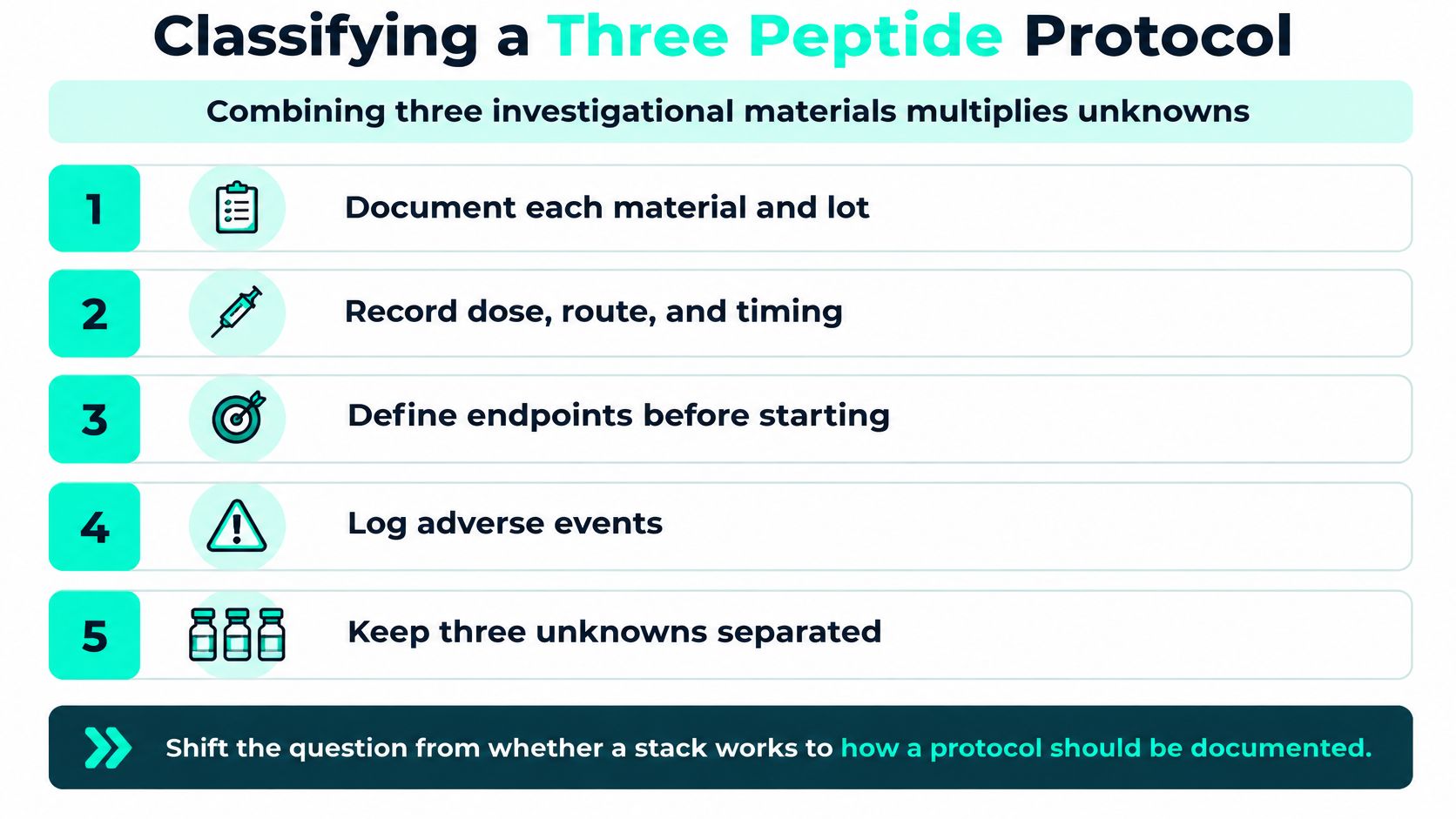
A combination study needs suitable component and vehicle comparisons if investigators intend to distinguish combination effects. The endpoint should be defined before the experiment begins, including what would count as an uninterpretable or unacceptable result.
Record each material and lot separately, even when the experimental design combines them. Keep exposure timing, formulation changes, deviations, and adverse observations connected to those records.
Protocol boundary: Combining materials doesn't combine their permissions, establish their safety, or prove that their effects add together.
Athletes, human-study participants, and laboratory purchasing teams can face different consequences. Check the currently applicable sport rules, ethics requirements, and import or procurement restrictions rather than treating a historical list or supplier description as complete clearance.
The defensible decision is to document identity, exposure, controls, and attribution at ingredient level. Without that work, a blend creates uncertainty rather than evidence of additive benefit.
Material acceptance is a scientific decision, not just an inventory task. The vial, analytical paperwork, and protocol must describe the same test article before the laboratory releases it for use.
For BPC-157, that means the specified synthetic peptide. For TB-500, it means the stated fragment rather than an assumed full-length parent; for GHK-Cu, it means the specified copper-peptide material with the intended experimental route recorded.
At Celonyx Labs, every BPC-157 batch undergoes HPLC analysis, mass spectrometry verification, and batch consistency testing. Each GHK-Cu batch also undergoes HPLC, mass spectrometry identity confirmation, purity verification, and batch consistency testing.
Those processes support material characterization. They don't supply missing human efficacy evidence or turn analytical acceptance into clinical approval.
Suppose a combination produces an unexpected readout, but the records don't identify the component lots or preserve suitable comparisons. Investigators can't confidently assign that result to a sequence, an impurity, or an interaction.
A documented acceptance decision should identify who reviewed the material, what was reviewed, and whether unresolved issues prevent release. Keep discrepancies visible rather than replacing them with a general statement that the material passed quality control.
Choose the single construct your design can interpret unless a combination is necessary to answer a defined question. Complete the lot-and-identity check, then file the acceptance record before the material enters the study.
Celonyx Labs offers BPC-157, TB-500, and GHK-Cu research peptides for laboratories and investigators. Visit Celonyx Labs to review the catalog and research-use information, then match your selected material and lot documentation to the construct in your protocol before ordering.
The popular advice to treat BPC-157, TB-500, and GHK-Cu as a ready-made regenerative stack skips

How much does a vial of MOTS-C cost? Check the current listing, then compare peptide

Can PEG-MGF be combined with muscle-repair peptides? Study combinations only in controlled research; learn controls,
FOR RESEARCH USE ONLY. Products sold by Celonyx Labs are intended exclusively for laboratory and scientific research. They are not intended for human or veterinary use, consumption, diagnosis, treatment, cure, or prevention of any disease. By purchasing from this site, you acknowledge that you understand the intended research purpose of these materials and agree to comply with all applicable laws and regulations.