

Is bacteriostatic water the same as sterile water? No 2026
Is bacteriostatic water the same as sterile water? No. Compare preservatives, vial handling and peptide
BPC-157 peptide sits in an unusual category. It has attracted outsized attention despite a striking lack of published human evidence. The current literature points to an evidence gap, not a mature clinical record. A registered Phase II study has been listed on the Chinese Clinical Trial Registry, but publicly available human results remain sparse, and clinical efficacy in people is still unproven.
That gap matters because the preclinical story is much more active than the human one. In animal and cell-based models, researchers have reported findings related to tissue repair, vascular signaling, and recovery after injury. Those signals are scientifically interesting, but they do not establish clinical benefit in humans. A rodent result is better understood as a hypothesis generator than as a treatment claim.
This creates the central paradox around BPC-157. The compound is widely discussed as if the translational step has already happened. It has not.
A careful reader has to hold two ideas at once. First, BPC-157 appears biologically active in preclinical systems and deserves serious examination. Second, the human evidence base is still too thin to support confident claims about efficacy, dosing, or longer-term safety. That second point is often treated as a footnote when it should be near the center of the discussion.
Safety is where caution becomes more than a formality. Any compound linked, even indirectly, to angiogenic or pro-migratory signaling raises a question that responsible investigators cannot ignore. Could the same pathways that appear helpful in healing models also support unwanted cell survival, vascularization, or tumor-related processes in the wrong context? That concern is still unresolved, not proven, but unresolved is enough to justify restraint.
The useful approach is disciplined uncertainty. For researchers, BPC-157 is best treated as a promising but unvalidated experimental peptide whose preclinical literature is far ahead of its human record.
BPC-157 has become a classic example of how modern research culture can get ahead of clinical evidence. The molecule is presented in many places as if its value for healing were already settled. It isn't. The paradox is that the compound looks unusually promising in preclinical systems while remaining almost untested in humans.
That distinction matters more than most discussions admit. A rodent tendon model can suggest a biologic effect. It can't establish that the same compound will improve recovery, function, or safety in people. The gap isn't a minor technicality. It's the difference between a lead worth studying and a treatment worth using.
Several features make BPC-157 easy to overstate. It's small, stable, and tied to pathways that make intuitive sense for repair biology. If a compound appears to support blood vessel formation, fibroblast behavior, and tissue organization in animals, it's not hard to see why people extrapolate.
But extrapolation is where many claims fail. The available human record remains strikingly limited, and that limitation should dominate any serious conversation about the molecule.
Practical rule: Treat BPC-157 as a research hypothesis with interesting animal support, not as a clinically validated recovery agent.
For a fellow investigator, the useful questions are narrower and more rigorous than the ones driving online enthusiasm:
BPC-157 is worth discussing because it's scientifically interesting. It's worth discussing cautiously because the evidence hierarchy is still heavily weighted toward preclinical work.
At the molecular level, BPC-157 is not a vague "healing factor." It's a specific synthetic peptide with a defined structure. According to a molecular profile of the compound, it is a synthetic pentadecapeptide with the amino acid sequence Gly-Glu-Pro-Pro-Pro-Gly-Lys-Pro-Ala-Asp-Asp-Ala-Gly-Leu-Val, a molecular mass of 1419.55 Daltons, and exceptional stability, including a melting point over 232°C.

The "157" label often makes the compound sound more mysterious than it is. In practice, what matters most to a lab is that this is a short peptide sequence with known composition and measurable physicochemical behavior. That gives researchers a concrete starting point for identity testing, formulation work, and study design.
You can think of it as a specialized biological repair signal candidate, not as a finished therapy. That's a better mental model. A peptide like this may influence repair-related pathways, but its usefulness depends on context, dose, route, timing, and species.
Its reported stability is one reason BPC-157 draws sustained laboratory interest. A peptide that remains physicochemically stable is easier to handle in experimental workflows than one that rapidly degrades under ordinary conditions. Stability doesn't prove efficacy, but it does affect feasibility.
For researchers, three molecular facts matter most:
A defined molecule can still be a poorly defined therapy. Structural clarity doesn't substitute for clinical evidence.
BPC-157 is often described as a partial sequence related to a gastric body protection compound found in human gastric juice. That origin story is useful background, but it's easy to overread it. "Derived from" or "originally isolated from" doesn't mean "naturally safe when synthesized and administered by multiple routes."
That's where scientific discipline matters. Once a molecule is synthesized, purified, stored, reconstituted, and used in a model system, each of those steps can influence what investigators observe. The peptide's identity is clear. Its clinical role isn't.
BPC-157 attracts attention because preclinical papers describe a peptide that seems to touch several core repair programs at once: blood vessel formation, nitric oxide signaling, fibroblast behavior, and cell migration. That pattern is scientifically interesting and also the reason caution is warranted. A molecule that appears to support wound repair in animals may also influence pathways that matter in tumor biology.
One useful way to frame the mechanism question is this: investigators are not looking at a single on-off switch. They are looking at a control panel with several knobs that may be turned at the same time. In rodent and cell-based research, BPC-157 has been reported to interact with angiogenic signaling, including VEGFR2-related responses and downstream Akt and eNOS activity, while also affecting adhesion and motility pathways discussed in reviews of the experimental literature such as this preclinical pharmacology overview from Frontiers in Pharmacology.
The most frequently discussed mechanism is angiogenesis, the formation of new blood vessels. In injured tissue, new vessels can improve oxygen delivery, nutrient supply, and movement of repair cells into the damaged area. In that narrow preclinical sense, an angiogenic signal can look attractive.
The biology is less simple than the marketing version. Angiogenesis is context dependent. A pathway that helps close a tendon defect in a rat does not automatically predict a useful or safe effect in a human subject with a very different injury, immune environment, and treatment history.
A practical summary looks like this:
| Pathway or process | Reported preclinical implication |
|---|---|
| VEGFR2 signaling | Associated with angiogenic responses in experimental models |
| Akt-eNOS axis | Linked to nitric oxide-related vascular signaling |
| Fibroblast activity | May support matrix production and repair-site organization |
| FAK-paxillin signaling | Deserves scrutiny because adhesion and migration pathways can also matter in cancer biology |
Fibroblasts are the construction crew of repair tissue. They deposit extracellular matrix, remodel damaged areas, and help determine whether healing tissue becomes organized or chaotic. In animal models, BPC-157 is often discussed as a compound that may improve the local conditions in which these cells migrate and function.
That idea helps explain the interest in tendon, ligament, and wound studies. If a peptide shifts cell migration, vascular support, and matrix organization in the same direction, histology can look better and injured tissue can appear more orderly. Those are meaningful observations inside a preclinical experiment.
They are still surrogate observations.
A cleaner tendon section under the microscope is not the same endpoint as reduced pain, restored function, or durable recovery in a human trial. That evidence gap matters because mechanism-driven enthusiasm often grows faster than translation.
This video gives a broader overview of the compound's proposed biology and why it remains controversial.
The pathway that deserves the most careful reading is FAK-paxillin signaling. In normal repair biology, adhesion and migration are expected. Cells need to attach, move, and reorganize tissue. In oncology, some of those same behaviors become concerning because malignant cells also use adhesion and motility programs to invade surrounding tissue.
The concern here should be stated precisely. No human clinical dataset shows that BPC-157 promotes tumors. No responsible reader should overstate that risk as an established outcome. But the absence of human evidence cuts both ways. It means there is no human proof of benefit, and there is also no human safety record strong enough to dismiss a mechanistic tumor-promotion concern.
For researchers, that is the central paradox. The same signaling profile that makes BPC-157 look promising in animal repair models is the profile that justifies a more skeptical safety lens. Until controlled human studies address both efficacy and longer-term risk, mechanism claims should be treated as hypotheses generated from preclinical systems, not as evidence of clinical usefulness.
The strongest claim the current literature can support is narrow. BPC-157 appears biologically active in multiple animal injury models. That is a reason to study it carefully, not a reason to treat it as a validated human therapy.
This distinction matters because preclinical enthusiasm can create a false sense of certainty. A compound may look consistent in rodents and still fail in people for reasons that only become visible in controlled human trials. With BPC-157, that gap is the story.
Across published animal work, the recurring signals cluster around connective tissue repair, soft tissue healing, and gastrointestinal injury models. Investigators have described faster tendon healing, improved closure of skin and muscle wounds, and benefit in rodent ulcer models. Those findings are interesting, but they remain observations from preclinical systems. As noted earlier, there is still no confirmed human replication for these effects. A separate orthopedic review makes the clinical problem plain. There is no credible high-quality clinical evidence supporting efficacy for orthopedic use in humans because well-controlled trials have not established benefit.
A careful reading of the preclinical record supports a modest conclusion. BPC-157 belongs on the list of compounds that may justify controlled laboratory investigation.
That conclusion is narrower than many promotional summaries suggest.
If the question is limited to animal and in vitro research, several themes appear repeatedly:
Those patterns justify better study design, replication, and clearer reporting. They do not establish clinical usefulness.
A stack of animal papers is not the same thing as human evidence. The easiest way to frame the issue is to separate signal detection from translation. Preclinical studies ask whether a biological effect might exist under controlled model conditions. Human trials ask whether that effect is real, clinically meaningful, and acceptably safe in people.
BPC-157 has not crossed that second threshold.
That is why the evidence gap should be treated as more than a missing checkbox. It affects both efficacy claims and safety claims. A reader cannot reasonably say the compound works in humans, and a reader also cannot reasonably dismiss unresolved risks, including the concern raised earlier that repair-associated signaling could, in some settings, overlap with pathways relevant to tumor behavior. Animal promise without human follow-up leaves both sides of the question open.
| Research Area | Preclinical Evidence (Animal/In-Vitro) | Clinical Evidence (Human Trials) |
|---|---|---|
| Tendon and ligament repair | Reported regenerative effects in animal models | No credible high-quality clinical evidence |
| Muscle and skin wound repair | Reported healing signals in preclinical models | No established human efficacy |
| Gastric and ulcer healing | Reported benefit in rodent models | No confirmed human replication |
| Orthopedic indications overall | Widespread preclinical interest | No large, well-controlled completed human trials |
Preclinical results narrow the hypothesis. They do not answer the clinical question.
The balanced view is less dramatic and more useful. BPC-157 may prove to be a productive research compound. At present, the published record supports interest, not confidence.
For research applications, the largest avoidable error isn't usually conceptual. It's material quality. If peptide identity, purity, or batch consistency are weak, any mechanistic conclusion becomes unstable. You can misread contamination, degradation, or lot variation as biology.
That matters especially for BPC-157, where investigators are often trying to measure subtle changes in repair signaling, migration behavior, or histologic outcomes. If the starting material is inconsistent, the study may still produce a result. It just won't be a trustworthy one.
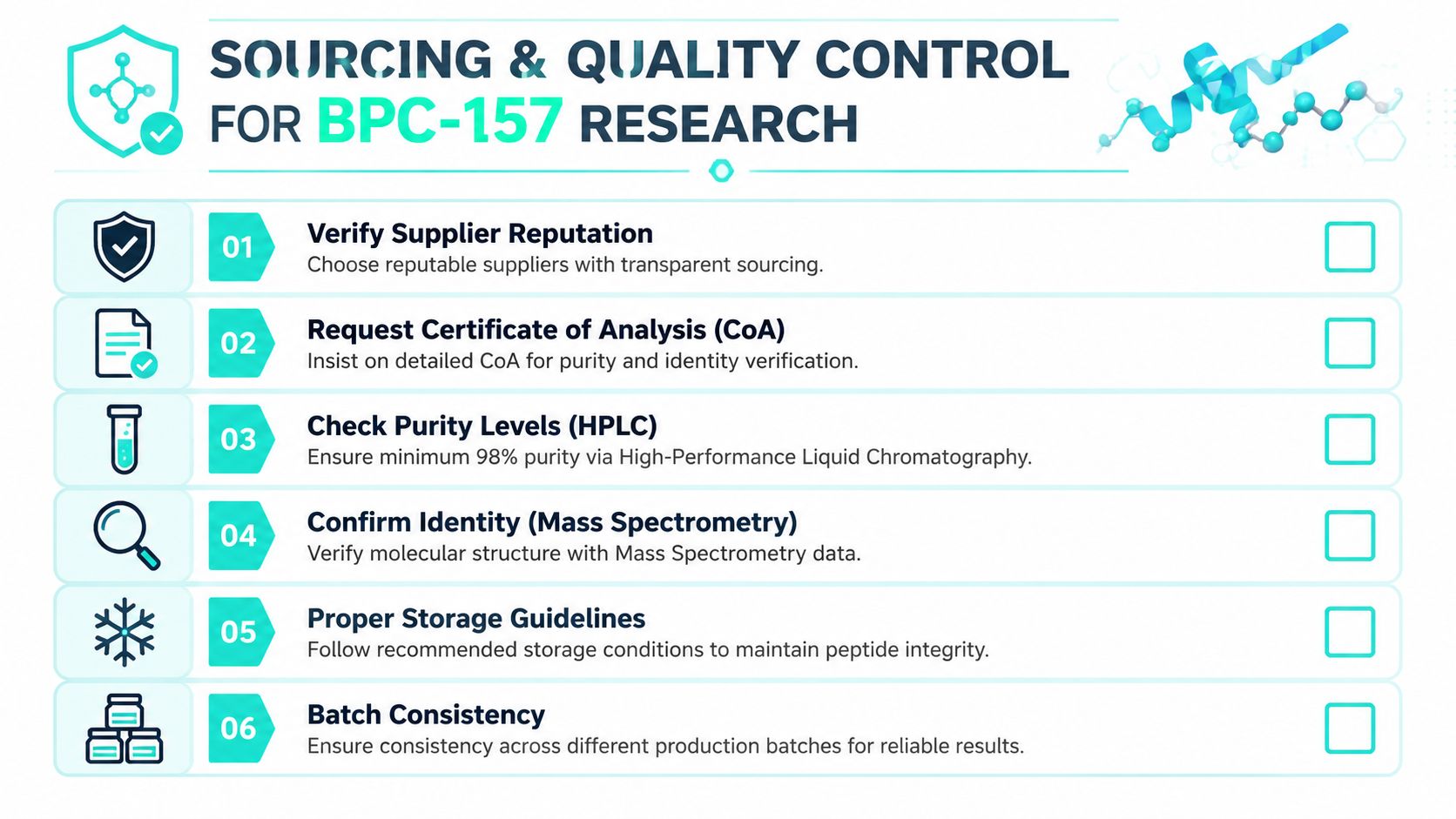
For a lab, procurement standards should be explicit rather than informal. The minimum goal is to verify that the vial contains the correct peptide in a reproducible state.
Use a screening checklist like this:
A Certificate of Analysis is useful, but it isn't self-validating. Researchers should read it critically.
Look for alignment between the product name, lot number, assay date, and analytical outputs. If HPLC and mass spectrometry are listed, confirm the paperwork is specific enough to link those results to the material you received. If a vendor supplies only a summary statement without underlying analytical context, that should lower confidence.
A good internal review process often includes:
Lab note: The more uncertain the biology, the less tolerance you should have for uncertain materials.
Poor sourcing doesn't just create procurement risk. It changes scientific meaning. If one batch contains degradants or unexpected byproducts, a migration assay or wound model can produce a false mechanistic story. Investigators may think they're learning about BPC-157 when they're observing a formulation artifact.
That is why quality control belongs inside experimental design, not in an administrative appendix.
Once the peptide reaches the lab, handling errors can undermine otherwise careful work. BPC-157 may be described as stable, but that doesn't eliminate the need for disciplined storage, solvent choice, and aliquoting practices. Stability helps. It doesn't rescue poor technique.
Most labs treat lyophilized peptide as a material that should be protected from avoidable stress. In practical terms, that means storing it cold, shielding it from unnecessary light exposure, and minimizing repeated temperature shifts. If multiple experiments are planned, it usually makes sense to organize use around small working quantities rather than repeated opening of the same container.
When receiving a new batch, record:
That basic chain of handling can save a project when unexpected variability appears later.
Reconstitution should be standardized within the lab and documented in the protocol. The important thing is consistency. Use the same solvent strategy across comparable experiments, mix gently rather than aggressively, and note the final concentration clearly in both notebook and vial labeling.
Common preventable mistakes include:
A peptide study often fails at the bench before it fails in analysis.
Once in solution, labs generally become more conservative. Aliquoting helps reduce repeated handling. Short-term and longer-term storage plans should be predetermined instead of improvised each time someone needs material. If your team is comparing assays across days or weeks, consistency in post-reconstitution handling is just as important as assay execution.
Keep the protocol boring. Boring handling produces interpretable data.
For BPC-157 research, the best storage protocol is the one your group can apply identically every time. Reproducibility starts long before the first animal, plate, or imaging session.
BPC-157 sits in an awkward category that often gets blurred online. It is discussed like a recovery tool, but from a regulatory standpoint it remains an unapproved investigational peptide. That distinction matters because the central problem is not paperwork. The central problem is that human evidence is still too thin to establish efficacy, define dose-dependent risk, or rule out serious long-term harms.
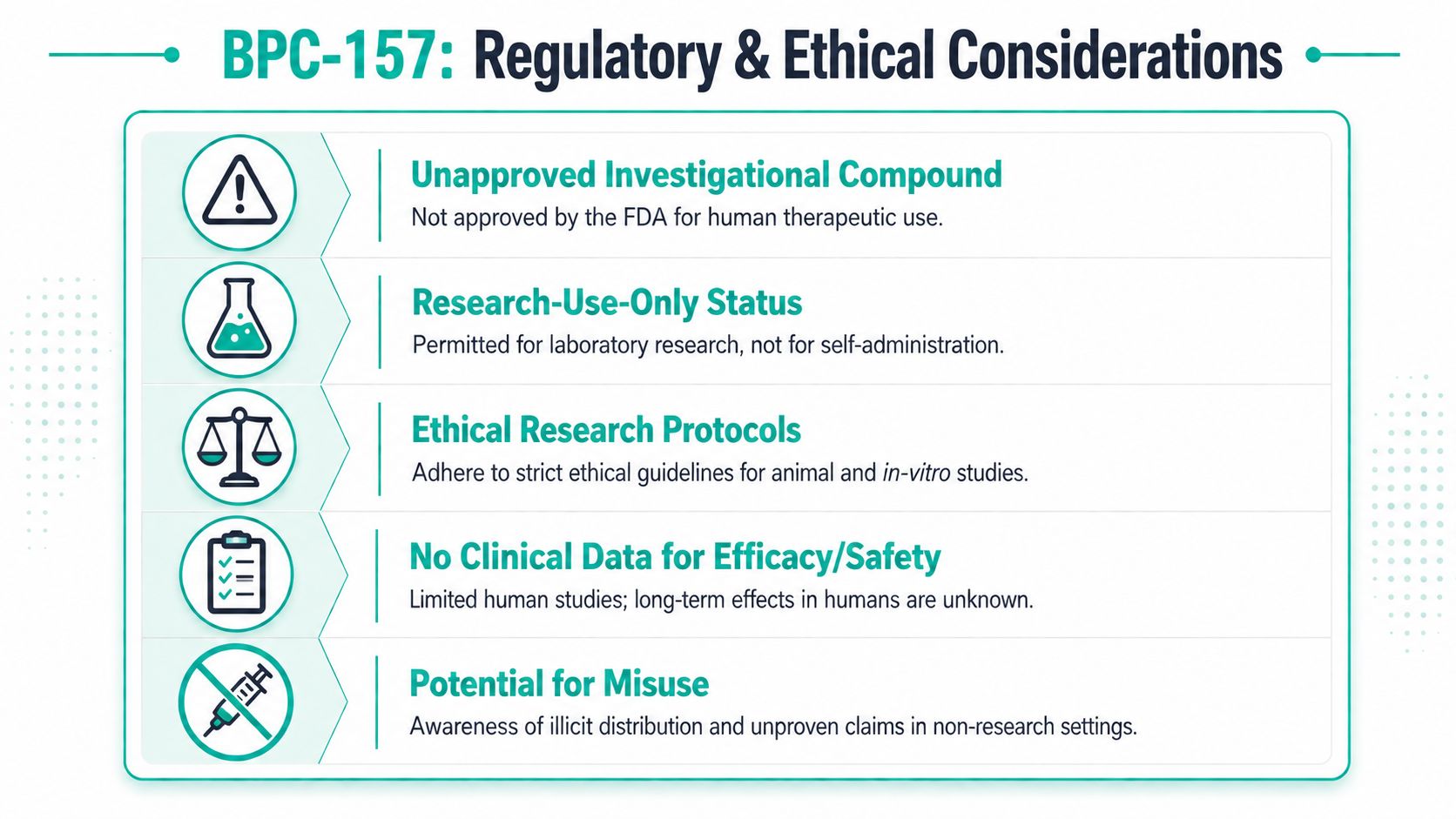
For researchers, the key paradox is simple. Animal studies can make a compound look promising in tissue repair while leaving the highest-stakes human safety questions unanswered. BPC-157 fits that pattern. Preclinical findings have generated interest, but interest is not validation, and a sparse human record cannot carry the weight of broad safety claims.
The tumor question deserves careful treatment because repair signaling and cancer biology often use overlapping machinery. In plain terms, the same biological programs that help injured tissue close a gap can also help abnormal cells survive, migrate, or establish new blood supply under the wrong conditions. That does not prove BPC-157 promotes cancer in humans. It does explain why the issue cannot be waved away as speculation.
Some preclinical discussion around BPC-157 has focused on pathways involved in adhesion, migration, and angiogenic signaling, including FAK-related signaling. That is a mechanistic caution flag, not a clinical verdict. The evidence gap is the primary problem. There are no adequate human trials designed to determine whether those signals remain irrelevant, context-dependent, or potentially harmful in people with occult malignancy, prior cancer, or high-risk biology.
That uncertainty should change how investigators frame the compound. A reasonable scientific posture is not “safe until proven dangerous.” It is “insufficiently characterized for human risk.”
Regulatory agencies and oversight bodies have treated BPC-157 cautiously. In the United States, it is not an approved drug, and it should not be presented as if it occupies the same category as a marketed therapeutic. In sport, anti-doping authorities have also restricted it. Those restrictions do not prove effectiveness, but they do show that institutions responsible for health policy and competitive integrity do not view it as an ordinary benign supplement.
The same logic applies in defense and occupational settings. If a compound may alter recovery, adaptation, or injury response, oversight bodies tend to act before the science is settled, not after.
Ethics here is less abstract than it sounds. It starts with accurate description. If the evidence comes from rodent, cell, or other preclinical systems, say so directly. If human data are absent or minimal, say that too. A peptide can be scientifically interesting and still be inappropriate for casual use, informal recommendation, or self-experimentation by lab personnel.
Practical guardrails help:
Hype causes the most damage. It compresses three separate questions into one. Does the compound do something in preclinical models? Might that effect translate to humans? Is that translation acceptably safe? For BPC-157, the first question has partial support. The second remains unresolved. The third is still inadequately studied.
A careful lab can work with uncertainty. It cannot pretend the uncertainty is gone.
BPC-157 sits in a narrow category. Researchers may encounter it through laboratory supply channels, but that should not be confused with approved medical availability. In the United States, it is not an FDA-approved drug product, and that distinction matters. A vial sold for research is not the same thing as a therapy cleared for clinical use, just as a reference standard in an analytical lab is not automatically a medicine for patients.
For investigators, the practical question is chain of custody. Procurement, labeling, intended use, and documentation should all stay clearly on the research side.
No published clinical record establishes proven orthopedic benefit in humans.
That is the central paradox around BPC-157. The compound has generated wide interest because animal studies report signals in tendon, muscle, gut, nerve, and vascular injury models. But a signal in preclinical work is an early clue, not a clinical answer. Until controlled human trials are completed and independently assessed, claims of orthopedic efficacy remain ahead of the evidence.
There appear to be limited human observations, but not enough to support broad safety conclusions.
That gap is larger than many summaries imply. Small, uncontrolled, or clinic-linked reports cannot answer the questions that matter most in translational work: dose range, route-specific risk, duration effects, interactions, and whether uncommon adverse events emerge only after wider exposure. A compound can look quiet in a small sample and still present problems once use expands. That is one reason researchers should separate "little evidence of harm" from "evidence of safety."
The unresolved cancer-related question also belongs here. If a peptide is being discussed for effects on angiogenesis, tissue repair, or cell signaling, investigators should at least ask whether the same biology could, in some settings, support unwanted growth. That concern is not proof of tumor promotion. It is an open safety question that has not been settled in humans.
A small pilot report is often cited because it is one of the few human examples in circulation. It described symptom improvement after intravesical administration and did not report short-term adverse effects in that limited setting.
The problem is interpretability. An unblinded pilot from a clinic-associated setting can generate a hypothesis, but it cannot establish efficacy or general safety. Without randomization, masking, independent replication, and longer follow-up, the result should be treated as preliminary human observation, not confirmation.
The useful comparison is methodological, not promotional.
Both compounds are often grouped under a broad "recovery" or "regenerative" label, but that shortcut hides important differences in sequence, proposed targets, and the quality of supporting evidence. For a serious lab, the better comparison asks three questions: Is the material well characterized, are the preclinical findings reproducible, and do credible human trials exist? With BPC-157, the human trial gap remains the limiting factor.
Preclinical papers and research discussions mention several routes, including local and systemic exposure models. That variety may sound informative, but it also complicates interpretation. Route changes can alter absorption, concentration at target tissue, metabolic handling, and off-target exposure.
A simple analogy helps. Changing administration route is less like switching containers and more like changing the entire delivery system. The same compound can behave very differently depending on how it enters the body. Without sufficient human safety data across routes, route selection remains a scientific variable with ethical implications, not just a technical detail.
If your lab is evaluating BPC-157 for preclinical work, material quality and documentation matter as much as biological curiosity. Celonyx Labs supplies research peptides for laboratory investigators and highlights batch quality attributes such as stated purity and independent third-party testing, along with ordering support for research procurement workflows.
Is bacteriostatic water the same as sterile water? No. Compare preservatives, vial handling and peptide

How do you know if a peptide vial has gone bad? Quarantine changes, check storage

Can too much bacteriostatic water ruin a peptide vial? Yes, if it overfills the vial
FOR RESEARCH USE ONLY. Products sold by Celonyx Labs are intended exclusively for laboratory and scientific research. They are not intended for human or veterinary use, consumption, diagnosis, treatment, cure, or prevention of any disease. By purchasing from this site, you acknowledge that you understand the intended research purpose of these materials and agree to comply with all applicable laws and regulations.