
What Is KPV Peptide? Structure and Research Guide 2026
If KPV is one of the smallest peptide sequences ever reported to inhibit inflammation, why
If KPV is one of the smallest peptide sequences ever reported to inhibit inflammation, why can no one tell you what dose to use? Both statements are true at the same time, and that's the tension worth understanding before you read another product page. The molecule is tiny, well defined, and interesting to inflammation researchers. The human data is absent.
Most coverage picks one side. It either sells the tripeptide as a near-future anti-inflammatory or dismisses it as unproven hype. Neither helps a lab manager planning an experiment, a clinician fielding a patient question, or a curious reader trying to work out what has been measured.
Here's the gap in conventional thinking: KPV's small size is usually presented as proof of convenience, when it's really a statement about mechanism and a warning about translation. A three-amino-acid chain is easy to synthesise and easy to characterise. It is also small enough that its behaviour depends heavily on transporters, formulation and cell type, which is exactly why lab results have not carried over into people.
This guide builds the picture from the ground up. You'll get the structure, the proposed cellular mechanism, the specific studies that exist, and the human evidence that doesn't. By the end you'll be able to read a KPV claim and place it on the right rung of the evidence ladder.
So what is KPV peptide, precisely? It's a chain of three amino acids, and the name is the recipe. K is lysine, P is proline, V is valine. Nothing hides behind a proprietary sequence or a brand name. If you can read a one-letter amino acid code, you already know the entire molecule.
That three-letter chain is the tail of something larger. Alpha-melanocyte-stimulating hormone (alpha-MSH) is a 13-amino-acid melanocortin peptide processed from a precursor protein called proopiomelanocortin. KPV is its final three residues, which is why the scientific designation reads alpha-MSH(11-13).
Think of alpha-MSH as a long sentence and KPV as its last three words. Researchers found that a surprising share of the sentence's anti-inflammatory meaning sits in that ending. Reviews report that KPV can retain anti-inflammatory activity similar to or stronger than the full hormone while lacking the parent peptide's pigmentation-related activity.
What it isn't matters just as much. KPV is not an approved drug. It isn't a vitamin, and it isn't a supplement with an established dose. In research settings it's a laboratory reagent studied in inflammation models, supplied as a lyophilised powder and handled like any other peptide standard. If you want the wider context of how these materials are classified and handled, our overview of what research peptides are covers the category rules.
Four questions organise everything that follows. What is it made of? How is it thought to act inside a cell? What has research tested? And what has never been shown in people? Answer those in order and the confident online claims start to sort themselves out.
Before any mechanism discussion, here's the profile sheet. These are the values a reader typically wants to confirm, and each one changes how you'd plan an experiment or judge a claim.
| Attribute | Value | Why it matters |
|---|---|---|
| Full name | Lysine-proline-valine tripeptide (KPV) | The name is the sequence, so there's no hidden proprietary structure |
| Amino acid sequence | Lys-Pro-Val | Only 3 residues, so synthesis and characterisation are relatively simple |
| Scientific designation | alpha-MSH(11-13) | Identifies it as the tail fragment of a known hormone |
| Parent hormone | alpha-MSH, a 13-residue melanocortin from proopiomelanocortin | Explains where the anti-inflammatory interest originated |
| Length compared with parent | 3 residues versus 13 | Described in the literature as one of the smallest sequences reported to inhibit inflammatory responses |
| Receptor relationship | Activity reported with and without MC1R involvement | Suggests effects that are not purely receptor-driven |
| Uptake route | Human peptide transporter PepT1 in intestinal epithelial and immune cells | Uptake can be transporter-dependent, which changes how experiments are designed |
| Experimental concentrations | Nanomolar in intestinal cell work; 50 micrograms per millilitre in a 2025 keratinocyte and 3D skin study | Shows how widely test conditions vary between studies |
| Human clinical evidence | None identified by FDA briefing material for free base or acetate | No established dose, route, pharmacokinetics or safety profile |
| Formulation forms discussed | Free base and acetate | Purity and identity tests do not answer stability, sterility or endotoxin questions |
The 2003 comparison published in the Journal of Pharmacology and Experimental Therapeutics is the structural anchor here. It set KPV against other alpha-MSH segments in a crystal-induced peritonitis model and concluded that the tripeptide produced an anti-inflammatory effect distinct from the hormone's central receptor-binding region. In plain terms, the interesting chemistry lives at the end of the chain, not in the middle.
Signalling peptides are usually longer. Three residues is short enough that the molecule has almost no folded structure of its own, so it can't present a complex binding surface the way a larger peptide does. That's precisely what makes it a useful probe: if a three-amino-acid fragment reproduces part of a 13-residue hormone's behaviour, the active information is concentrated in a very small stretch of sequence.
Picture the parent hormone as a string of 13 beads. The C-terminus is the end that carries a free carboxyl group. KPV is the last three beads at that end. Everything upstream is gone, including the region that binds melanocortin receptors centrally and the region tied to pigmentation effects.
The two forms differ in the salt, not in the peptide sequence. Free base is the uncharged molecule; the acetate salt carries acetic acid counterions. That distinction affects solubility, stability and handling, and regulators treat them as separate substances. It does not change what the amino acid chain is.
For lab planning, the rows that matter are sequence, uptake route, concentration and form. For judging a claim, the rows that matter are the last two: what human evidence exists, and which form anyone is even talking about.
The mechanism story has three links, and each one has a limit attached.
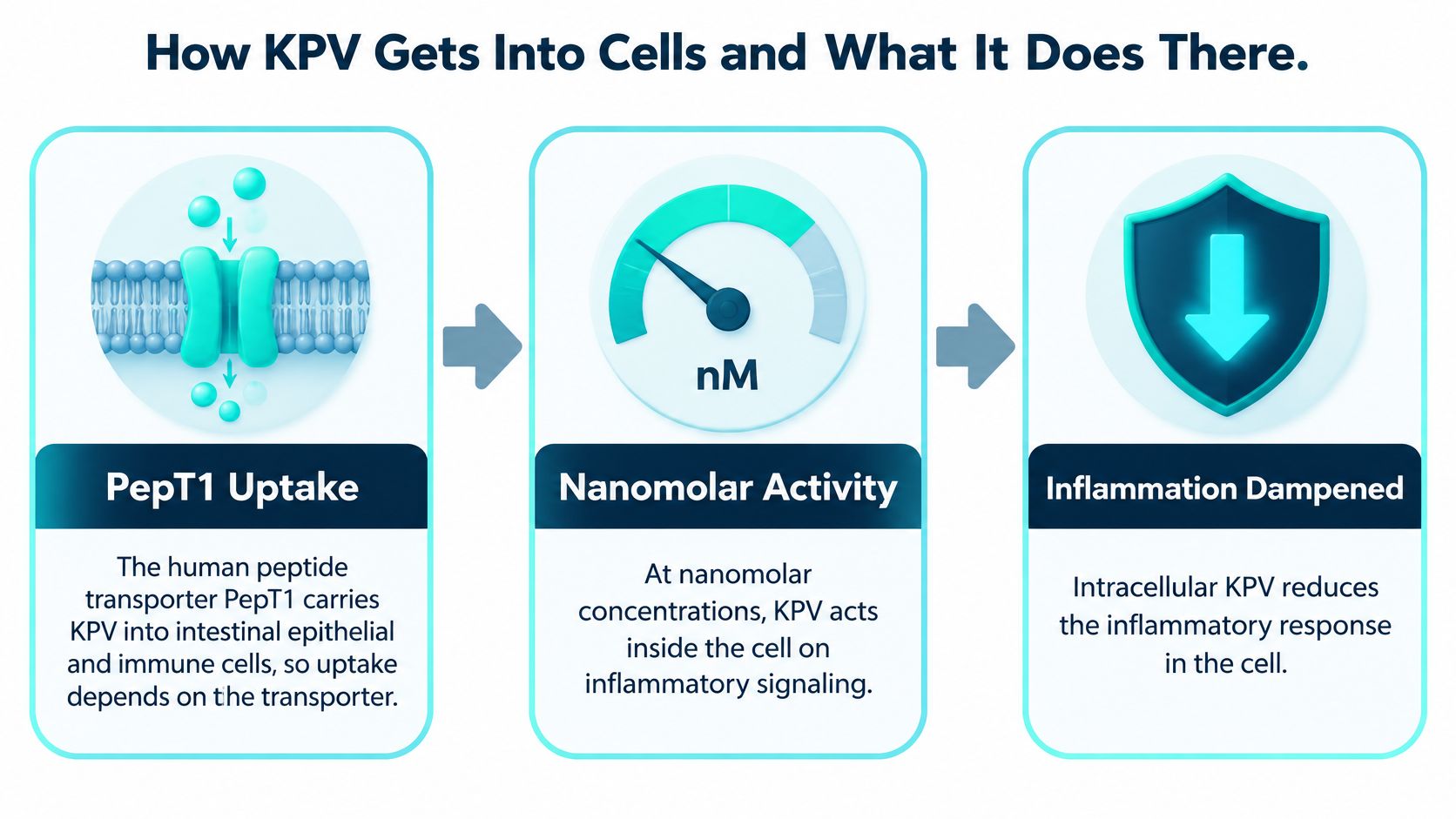
In intestinal epithelial and immune cells, KPV is transported through the human peptide transporter PepT1. That's not a passive leak through the membrane. It's a carrier-mediated step, which means uptake depends on how much PepT1 the cells express, and PepT1 expression varies by cell type and culture conditions. A 2008 study in the PMC archive lays out this transport route and its consequences for experimental design.
At nanomolar concentrations, that transporter-mediated uptake was associated with reduced activation of NF-kB and mitogen-activated protein kinase pathways, and with lower secretion of pro-inflammatory cytokines. Some of these effects appear to occur independently of the melanocortin-1 receptor (MC1R).
That last point trips people up. A receptor-independent effect means KPV isn't a weak MC1R agonist. The analogy that fits is a key that partly works by changing the shape of the lock rather than turning it. The signal is interrupted somewhere downstream, not blocked at the receptor's front door.
What this does not establish: a cell-level signalling result is not a clinical pathway. Nothing in this chain of events defines a human dose, a route of administration, or a pharmacokinetic profile.
Because uptake runs through a transporter, a credible experiment has to separate direct peptide effects from transport artefacts. In practice that means PepT1-expression controls, pathway-specific inhibitors, vehicle controls and a full concentration-response curve. Skip those and you can't tell whether you measured KPV or measured the transporter's capacity.
The same logic applies to comparative work in this field. Labs studying other melanocortin-adjacent or immunomodulatory peptides, such as MT-2 peptide, run into the same design question: is the observed effect a property of the molecule or of the cells you chose?
Three lines of work carry most of the KPV literature. Each one is worth reading as a case with a model, a concentration and an endpoint, followed by the sentence that says what it can't prove.
The 2003 peritonitis work compared KPV against other alpha-MSH segments in a crystal-induced inflammation model. The endpoint was the inflammatory response in that model. The finding was that KPV's anti-inflammatory effect was distinct from the hormone's central receptor-binding region. What it can't prove: that the same effect occurs in a human peritoneum, or at any particular dose.
The intestinal epithelial and immune cell studies established PepT1-dependent uptake and reduced NF-kB and MAPK signalling at nanomolar concentrations, with lower pro-inflammatory cytokine secretion. The endpoint was signalling activity and cytokine output in cultured cells. What it can't prove: that oral delivery reaches the same cells in a living body at a concentration that matters.
A 2025 study by Sung and colleagues tested KPV in human HaCaT keratinocytes and a three-dimensional skin model exposed to PM10, at a reported experimental concentration of 50 micrograms per millilitre. A summary of the KPV anti-inflammatory research describes that work. The endpoint was the response of skin cells and reconstructed tissue to particulate exposure. What it can't prove: that topical or systemic use in a person produces the same tissue response, or that 50 micrograms per millilitre corresponds to anything achievable in skin.
Small in-vitro and animal-model studies, mostly inflammation endpoints, with the skin-model work the most recent addition. Notice how far apart the test conditions sit: nanomolar in one system, tens of micrograms per millilitre in another. Those aren't interchangeable, and neither maps onto a human dose.
These are hypothesis-generating and mechanism-probing experiments. They're the right kind of work for early-stage biology, and they're the wrong kind of evidence for a dose, a route or a safety claim. If you've read how Thymosin Alpha 1 is characterised in preclinical literature, the pattern will feel familiar: solid mechanistic groundwork, thin human follow-through.
Here's the finding that should reset every conversation about KPV. FDA briefing material states that it identified no human clinical studies or human exposure data for KPV free base or KPV acetate by any route, and no adequate pharmacokinetic, toxicokinetic or clinical effectiveness evidence for proposed inflammatory or wound-healing uses. The same assessment concludes that potential human safety risks remain unknown (FDA briefing document).
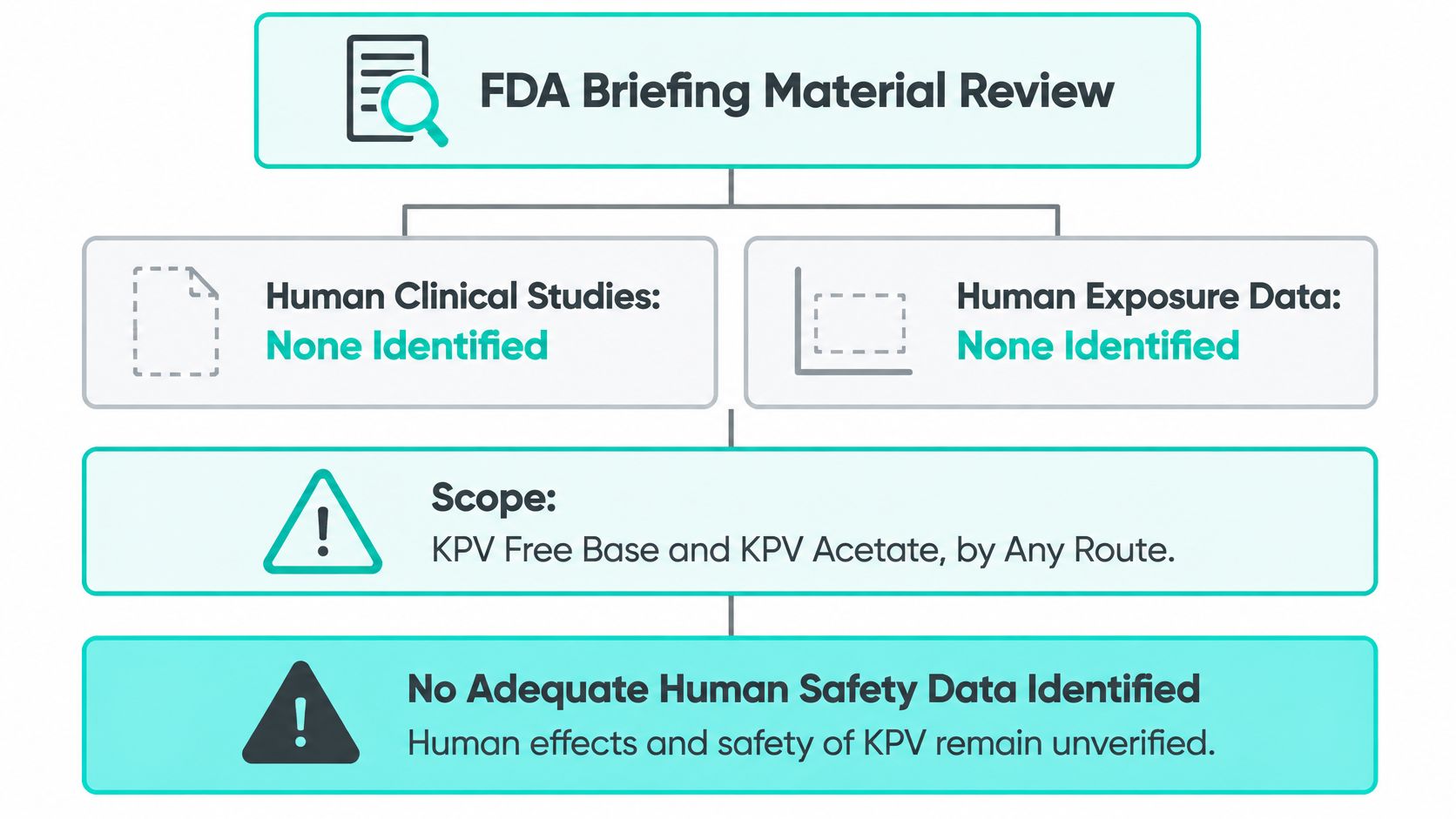
Read that carefully. It isn't a statement that KPV is dangerous. It's a statement that nobody has generated the data required to say either way, across every route, for both forms.
Place any KPV claim on this ladder and its position becomes obvious:
A certificate of analysis sits firmly on the bottom rung. It says nothing about toxicology, sterility, endotoxin load, or how a given route of exposure behaves in a body.
The uncertainty isn't only about the peptide. Free base and acetate are treated as separate substances, and each brings its own questions about stability, sterility, endotoxin control and route-dependent exposure. A purity figure doesn't answer any of them.
Does the claim cite a human study, or does it cite a purity report and call it safety? That single test filters most of what you'll read online.
Confident claims persist because the preclinical signal is real and the regulatory language is dry. A reader skimming a summary sees "anti-inflammatory" and stops before the sentence about missing human data. The gap isn't hidden. It's just less quotable than the promise.
Six claims come up repeatedly. Each has a specific correction you can reuse.
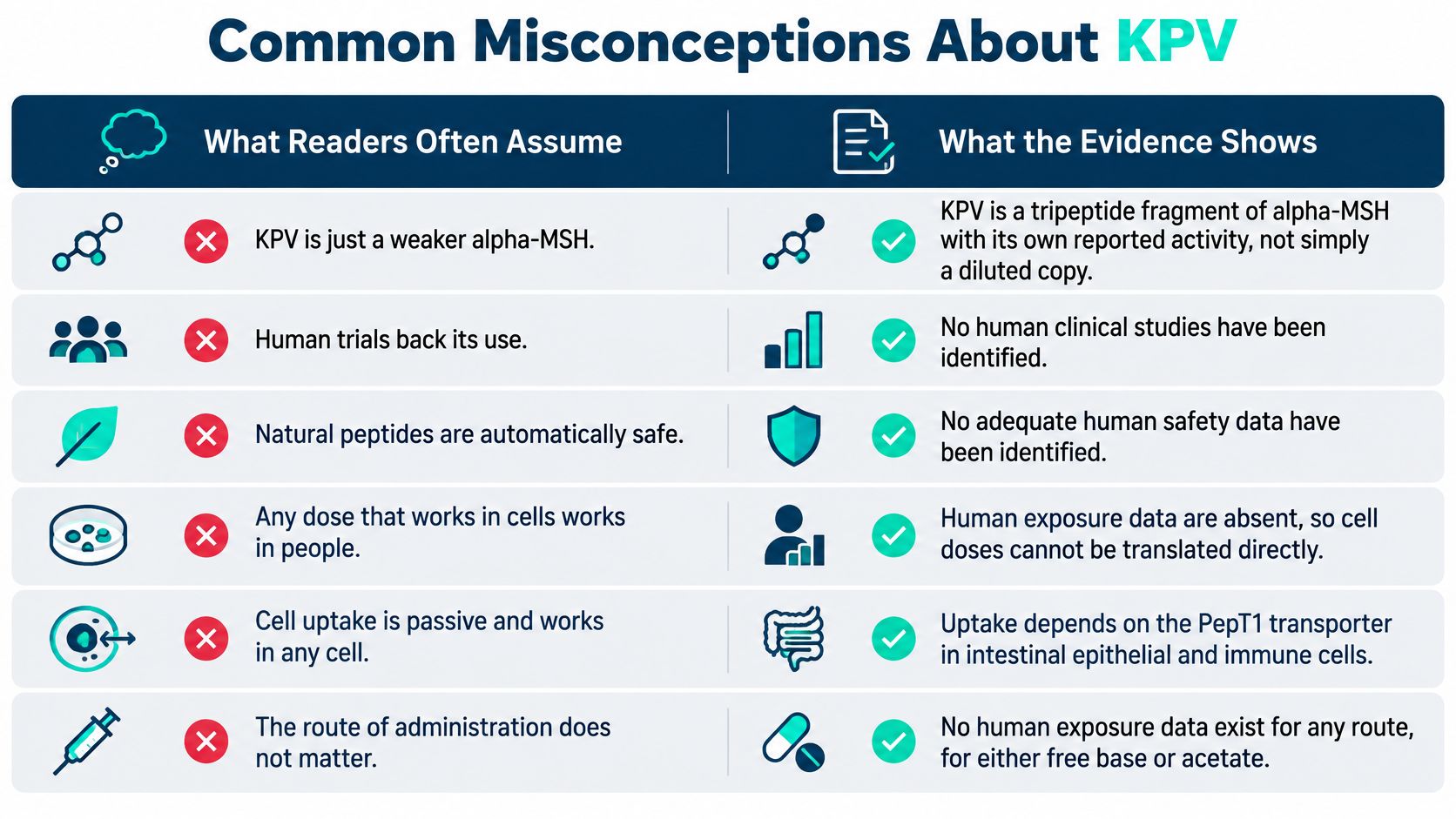
What model was used? What concentration was tested? What endpoint was measured? A claim that can't answer all three isn't describing an experiment. It's describing a hope.
The right next step depends on who you are. Here's one concrete action per reader type.
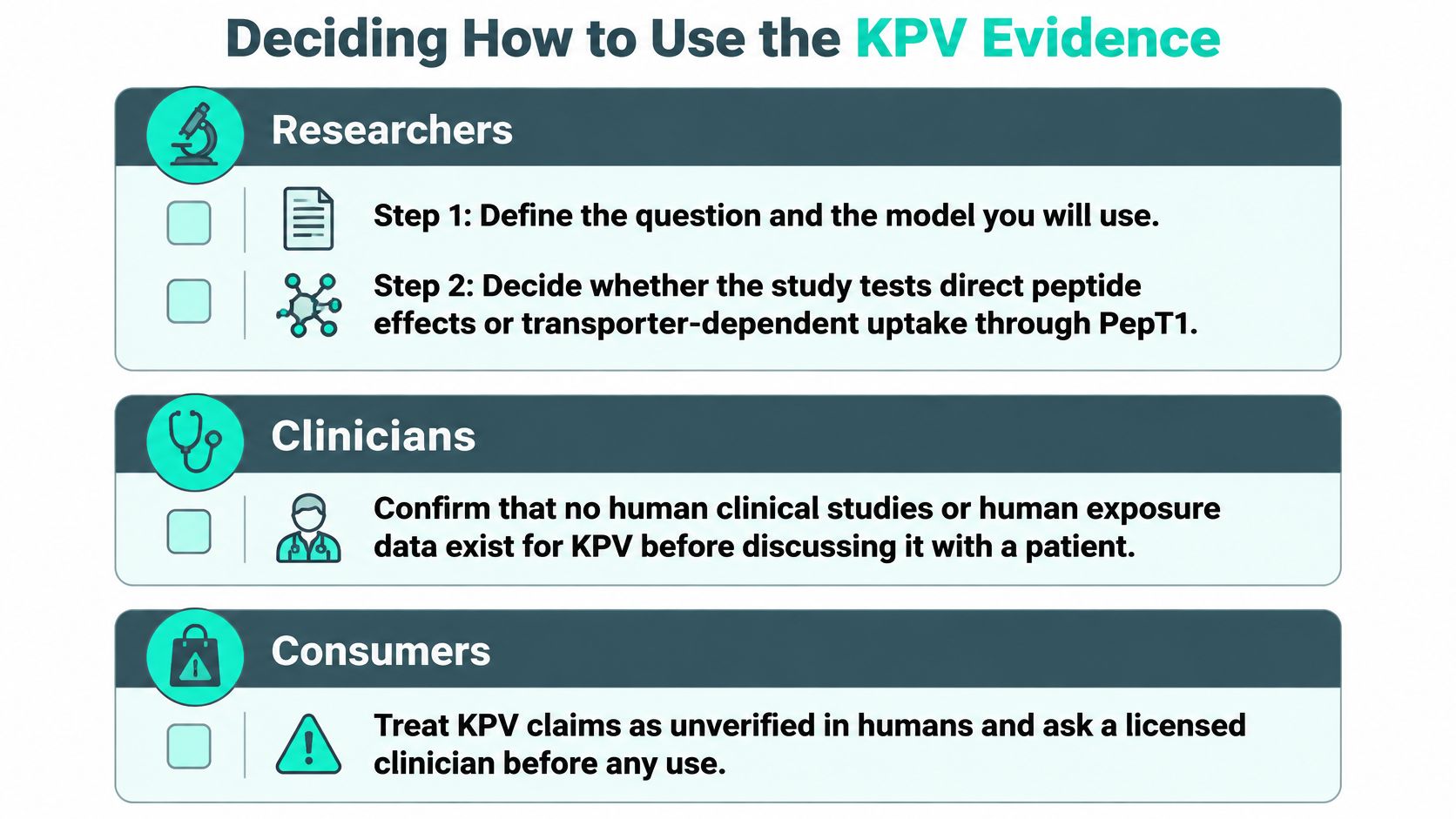
Start by defining the question and the model together. Decide up front whether you're testing direct peptide effects or transporter-dependent uptake through PepT1, because that decision sets your controls. Then build the full set: PepT1-expression controls, pathway-specific inhibitors, vehicle controls and a concentration-response curve.
Documentation matters as much as design. Demand a certificate of analysis tied to the lot number, showing the analytical method, the identity confirmation and the test date. Record storage conditions and chain of custody. Peptides are sensitive to handling, and a result you can't trace back to a characterised lot isn't reproducible.
Practical rule: if a supplier can't tell you which lot your certificate refers to, you don't have documentation. You have a brochure.
Compare certificates of analysis rather than marketing copy. Look at the stated purity method, the identity test used and whether the lot number on the certificate matches the vial. Check that products carry a research-use-only label, which is how we label every peptide we supply.
Treat any confident claim as unproven until it cites a human study. Given that no human exposure data has been identified, that test will fail almost every time. Anecdotes about what someone felt are not evidence of cause, and they can't tell you what was in the vial.
KPV is a well-defined three-amino-acid fragment with a credible preclinical story and an unproven human one. That's not a reason to dismiss it. It's a reason to describe it accurately, and to keep the lab bench and the clinic in separate sentences.
None of this is a clinical recommendation. KPV is a laboratory research subject, and treating it as anything more outruns the evidence.
Celonyx Labs supplies research peptides to laboratories and preclinical teams, with every product labeled For Research Use Only and quality documentation built for experimental work rather than consumer use. If you're planning KPV-adjacent studies and need material you can trace to a characterised lot, browse the catalog and confirm the specifications before you order. Visit Celonyx Labs to see current availability and request the documentation your protocol requires.
If KPV is one of the smallest peptide sequences ever reported to inhibit inflammation, why

Compare peptide supplier batch consistency by lot records, testing methods, and traceability. Choose documented evidence

Choose a growth hormone secretagogue peptide blend by research fit, not ingredient count. Compare four
FOR RESEARCH USE ONLY. Products sold by Celonyx Labs are intended exclusively for laboratory and scientific research. They are not intended for human or veterinary use, consumption, diagnosis, treatment, cure, or prevention of any disease. By purchasing from this site, you acknowledge that you understand the intended research purpose of these materials and agree to comply with all applicable laws and regulations.