
Is bacteriostatic water the same as sterile water? No 2026
Is bacteriostatic water the same as sterile water? No. Compare preservatives, vial handling and peptide
Research peptides are synthetic amino acid chains used exclusively for in vitro and preclinical laboratory experiments to investigate biological processes, and they are distinct from regulated therapeutic peptides intended for human use. In practice, they usually fall under fewer than 50 amino acids, while approved peptide medicines sit in a very different regulatory category that has already produced over 100 approved peptide therapies and, since 2000, approximately 30 peptide drugs approved for conditions ranging from multiple myeloma to osteoporosis.
You may be reading this because a peptide order is sitting in your cart, a vendor has sent over a one-page purity claim, and you're trying to decide whether that is enough to trust months of cell work, binding studies, or animal pilot data to a single vial. That is the core question behind "what are research peptides." Not just what they are chemically, but whether what arrives in your lab is documented well enough to support reproducible science.
Most failed peptide experiments don't fail because the target was uninteresting. They fail because one uncontrolled variable entered too early. The sequence was wrong. The purity was overstated. The powder absorbed moisture. The reconstituted stock sat too long. Or the Certificate of Analysis looked official but wasn't tied to the lot in hand.
That is why researchers need to think about peptides as both biological tools and auditable materials. If the documentation chain is weak, the biology becomes hard to interpret.
A common lab story goes like this. The assay worked in optimization, then drifted during repeats, then collapsed when another batch arrived. Weeks later, the problem turns out not to be the biology, but the reagent.
Peptides are especially unforgiving in that kind of workflow. They can be powerful tools for interrogating signaling, receptor binding, immune recognition, and target engagement, but they are also sensitive to synthesis quality, storage conditions, and documentation gaps. A peptide that is slightly impure or partially degraded can still produce a signal. That is what makes it dangerous. It can generate data that look plausible while insidiously contaminating the conclusion.
The broader peptide field is legitimate and clinically important. According to McGill's overview of peptide research and regulation, the FDA has approved over 100 peptide therapies based on sufficient evidence, while the online market for research peptides remains largely unregulated, with many compounds lacking standardized dosing or long-term safety data. For researchers, that distinction matters because an approved therapeutic and a research-use peptide may look similar on paper while existing in completely different quality systems.
A research peptide is not merely "a peptide someone is studying." In lab practice, it means a peptide supplied for in vitro or preclinical use, not for administration to humans. It is a research material whose value depends on sequence fidelity, lot consistency, analytical verification, and proper handling after receipt.
Practical rule: If you can't trace identity, purity, and handling from vendor to bench, you don't have a trustworthy reagent. You have a variable.
That is the answer postdocs usually need. What are research peptides? They are highly specific experimental tools. But they only behave like tools when the sourcing and documentation are good enough to defend your results.
Chemically, peptides are short chains of amino acids. In research practice, that definition is too thin to be useful. What matters is how the chain length, sequence, folding tendency, and modifications shape the experiment you are trying to run.
A simple way to think about it is this: amino acids are letters, peptides are words, and proteins are long sentences. The shorter format doesn't make peptides simplistic. It makes them precise. They are large enough to engage biological surfaces that many small molecules struggle to bind, but small enough to synthesize and modify with much more control than full proteins.
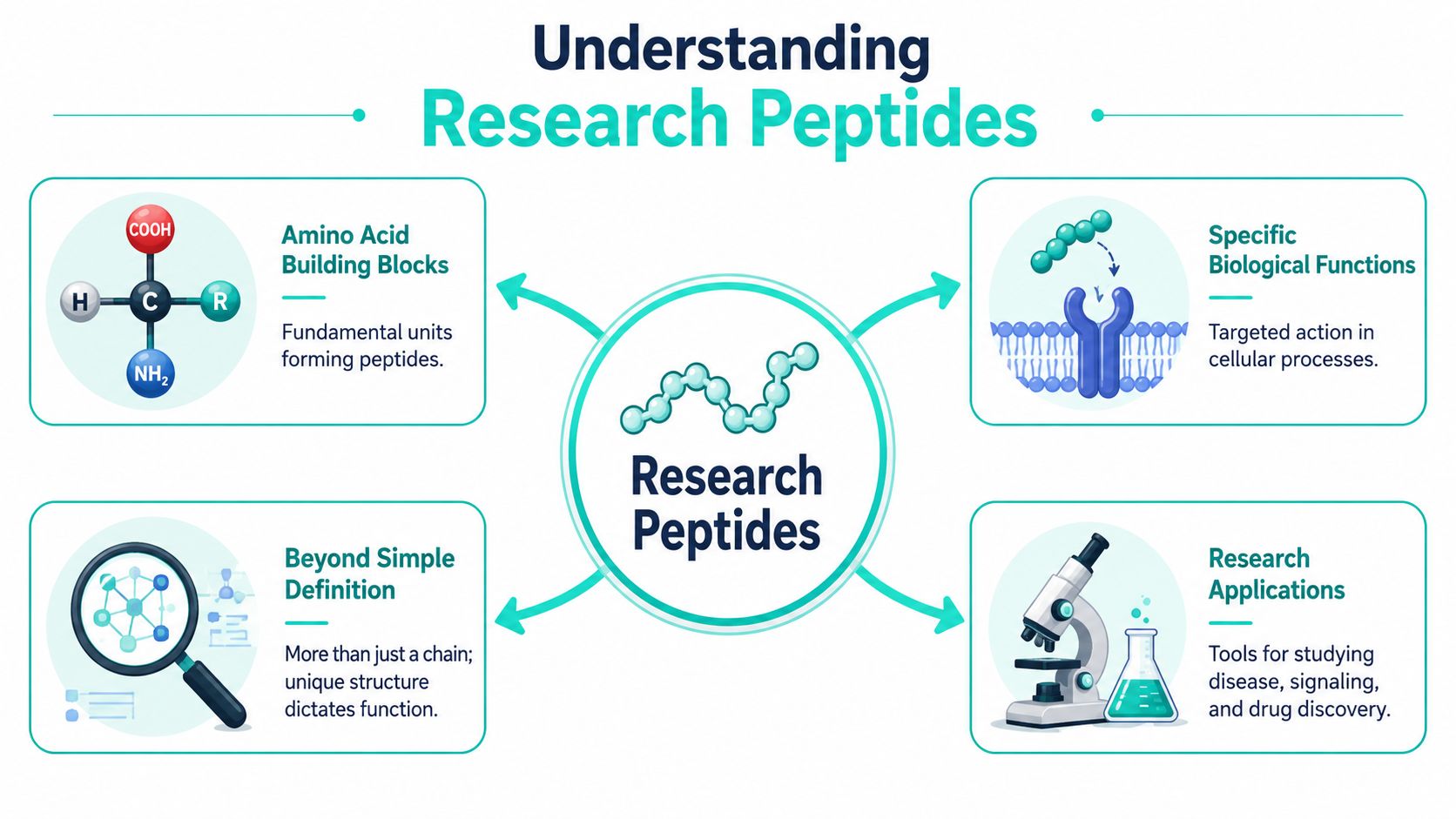
The technical benchmark commonly used in research is that peptides are chains under 50 amino acids and typically below 5,000 Da, while proteins are much larger and usually exceed 10,000 Da. That size range is one reason peptides occupy such a useful middle ground in discovery work.
Their functional diversity comes from the way they interact with biological targets. Research peptides can modulate G-protein coupled receptors, enzymes, and ion channels, and they can also disrupt protein-protein interactions on broad surfaces that are difficult for many small molecules to address. That is a major reason they are used in mechanistic biology and early drug discovery.
Some of the most useful research peptides aren't just linear strings of natural amino acids. Labs often seek sequences that include non-natural amino acids or cyclization strategies because those features can improve stability and sharpen target selectivity by locking the peptide into a more defined structure.
A small molecule is often easier to formulate and screen at scale, but it may not engage the surface you care about. A full protein may preserve biological complexity, but it can be much harder to make, characterize, and modify. Peptides sit in the middle.
They are particularly useful when you need one of the following:
A peptide isn't valuable because it is short. It's valuable because its sequence and conformation can be engineered to ask a very narrow biological question.
That is why "what are research peptides" has to be answered functionally, not just chemically. In a serious lab, a research peptide is a deliberately designed molecular probe.
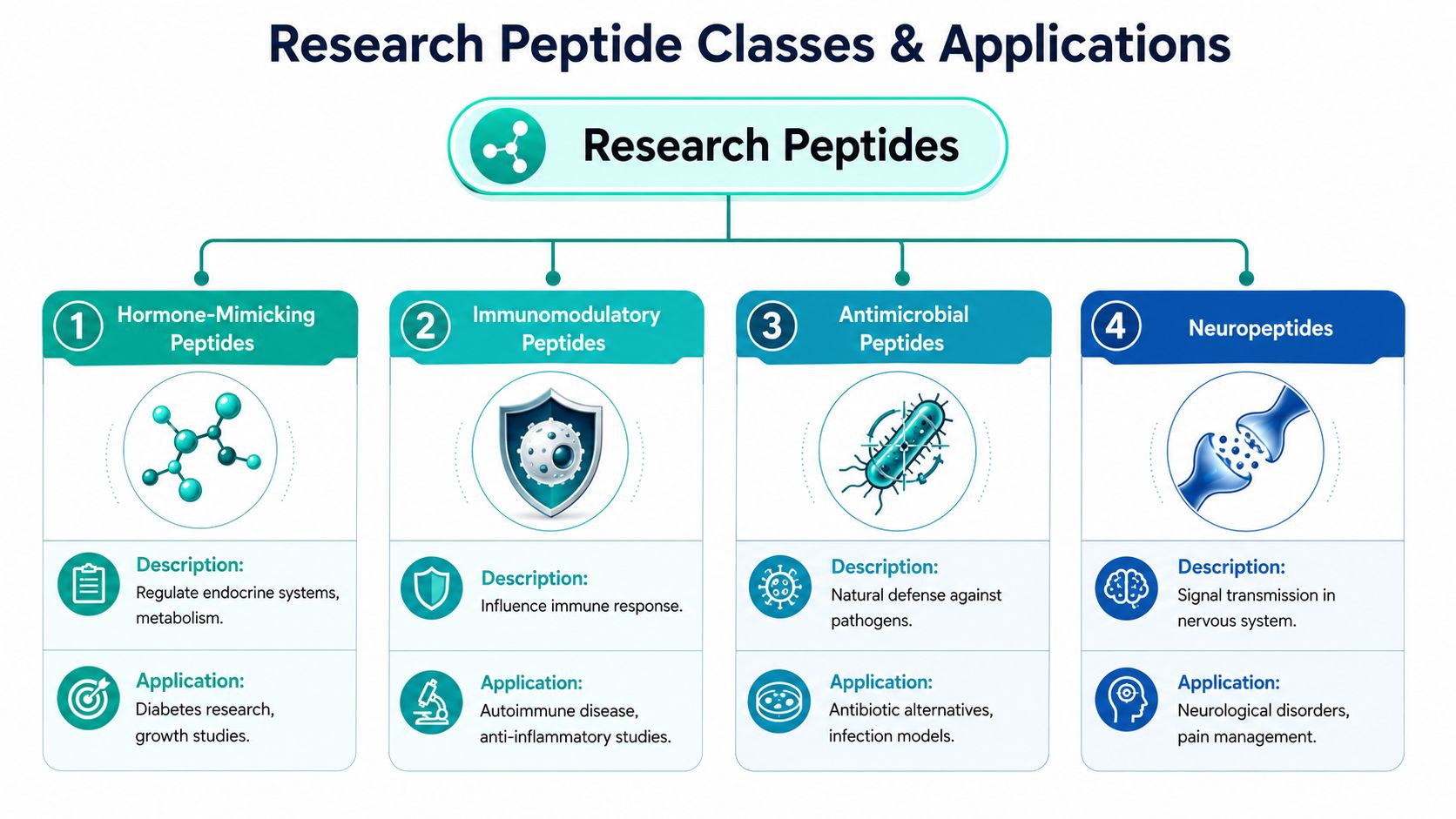
Peptides become easier to understand when grouped by what they help you study. That classification is more useful than trying to memorize names in isolation.
This is the category many researchers recognize first because approved peptide drugs have already shown how important it is. The global market for approved peptide drugs exceeded $70 billion in worldwide sales in 2019, and the top-selling non-insulin peptide drugs that year included GLP-1 analogues such as Trulicity, Victoza, and Rybelsus, as detailed in this peer-reviewed review of therapeutic peptides. That commercial success matters because it confirms the biological relevance of peptide-mediated pathways.
In the lab, metabolic peptides are often used to study receptor pharmacology, endocrine feedback, insulin signaling, appetite regulation, and downstream pathway activation. Researchers use them to ask narrow mechanistic questions, not to infer broad clinical outcomes from a single in vitro result.
Neuropeptides are useful when the experiment centers on communication rather than static binding. They help model how cells signal through receptor systems, especially where fast changes in pathway activity matter.
These peptides are often chosen because peptides can engage targets on large, flat interaction surfaces and modulate GPCR biology in ways that many small molecules cannot. In discovery programs, modified peptide scaffolds also help researchers probe selectivity. Adding non-natural amino acids or using cyclization can improve stability and reduce unwanted binding, which is valuable when you need cleaner data from a crowded signaling background.
This category attracts the most noise online and requires the most discipline in the lab. Compounds such as BPC-157 and TB-500 are frequently marketed for injury recovery and anti-aging, but the McGill review notes that these unregulated research peptides are sold without sufficient human clinical trial data and may carry risks related to contamination, unknown purity, and side effects in unmonitored use.
That doesn't mean they are scientifically irrelevant. It means they belong in controlled research contexts, not in vague claims. In preclinical settings, repair-associated peptides may be used to explore cell migration, inflammatory signaling, tissue remodeling, and wound biology. Immunomodulatory and antimicrobial peptides, meanwhile, are useful for studying host defense, barrier function, and inflammatory responses.
A practical way to map common classes is below:
| Class | What researchers study with it | Common research context |
|---|---|---|
| Hormone-mimicking peptides | Endocrine signaling and receptor activation | Metabolism and growth pathways |
| Neuropeptides | Synaptic and receptor-mediated signaling | Pain, behavior, neural communication |
| Immunomodulatory peptides | Immune pathway modulation | Inflammation and autoimmune models |
| Antimicrobial peptides | Host defense and pathogen interaction | Infection models and resistance studies |
The peptide class should match the biological question. Buying by popularity usually produces noisy data.
When a vendor says a peptide is high quality, treat that as an opening claim, not a conclusion. In research settings, 99% purity is the standard benchmark for laboratory use because lower-purity material introduces side products that can alter receptor binding, signaling behavior, and batch reproducibility.
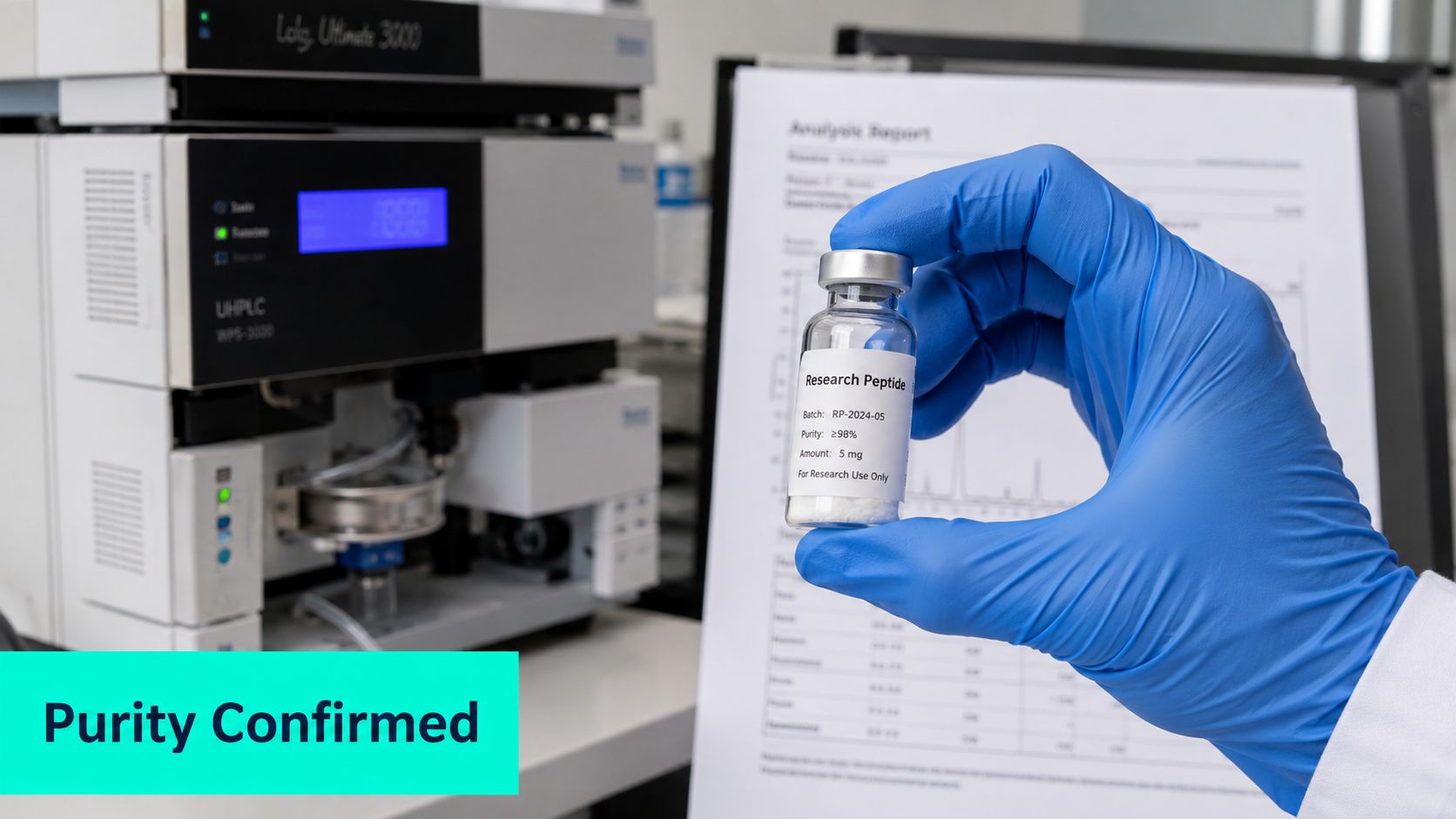
Impurities are not abstract. They include incomplete synthesis products, deletion sequences, and related contaminants that may still be biologically active. If your assay reads out pathway activation, one impurity can distort the apparent potency or specificity of the main sequence.
That is why purity should never be separated from identity confirmation. The operational standard is third-party validation using HPLC and Mass Spectrometry before the peptide enters preclinical R&D. HPLC addresses purity profile. MS supports sequence identity. You need both.
The bigger trust problem is that vendors often stop at the phrase "third-party tested." That phrase only matters if the report is tied to the lot you are buying. According to the verified industry note on the Third-Party Auditing Transparency Deficit, a 2025 study in the Journal of Pharmaceutical Analysis found that up to 30% of research-grade peptides had purity discrepancies upon independent re-testing. That is exactly why a generic marketing statement is not enough.
A proper Certificate of Analysis should let you verify the material in your freezer, not just reassure procurement. At minimum, look for:
Later in vendor review, I also ask a simple question: will they share the underlying analytical record without deflection? Suppliers that are confident in their process usually answer cleanly.
For a visual walk-through of why documentation matters at the bench, this overview is useful:
Bench reality: A one-page purity summary without lot traceability is a marketing asset, not a quality system.
A good peptide can become a bad reagent after delivery. That transition happens faster than many early-career researchers expect.
For laboratory applications, the benchmark remains 99% purity, but maintaining usable integrity after receipt depends on handling discipline. Reconstituted peptides should be aliquoted and stored at -20°C to -80°C to reduce hydrolysis and aggregation, which are primary degradation mechanisms in aqueous solution.
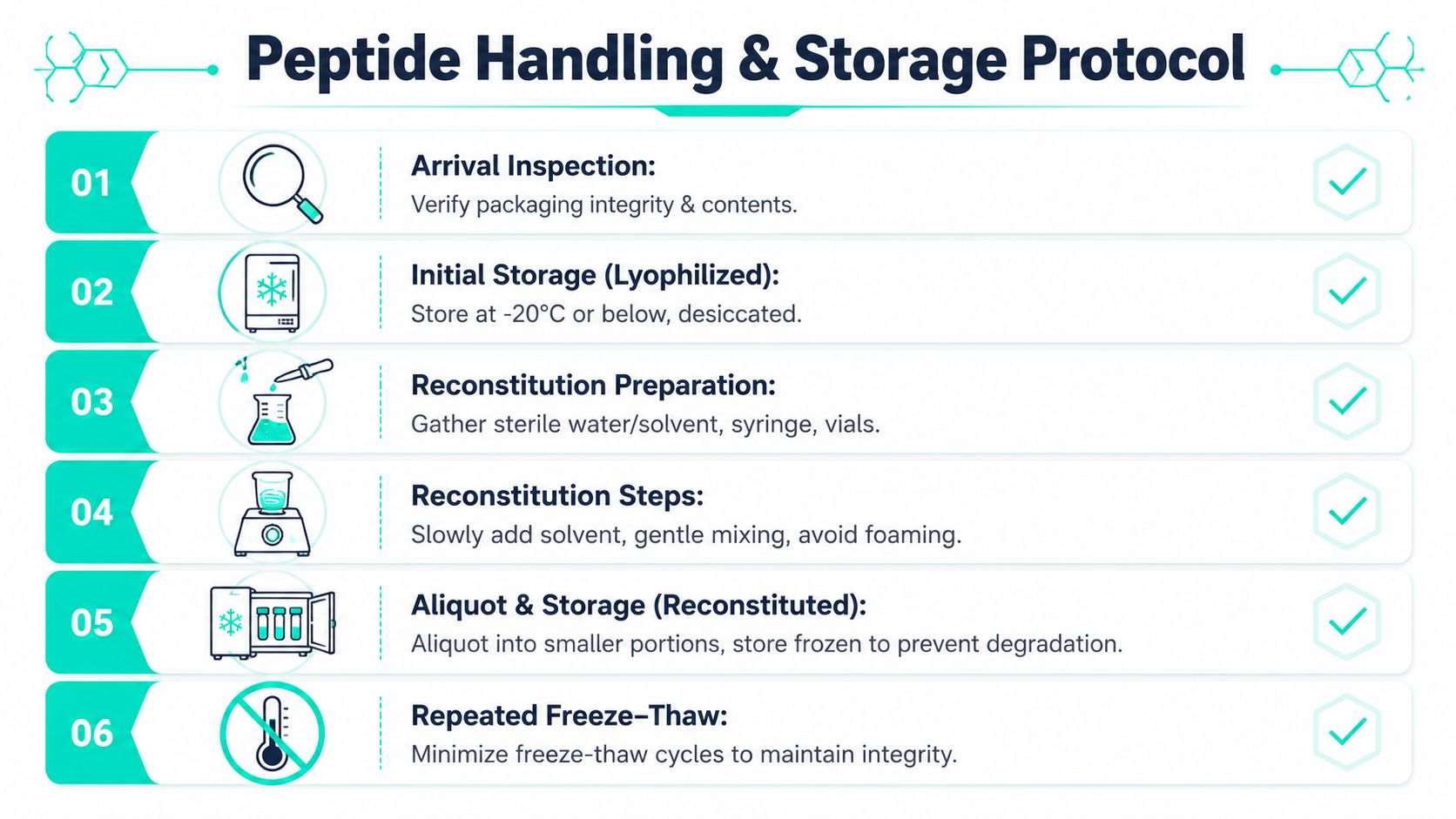
Don't start with reconstitution. Start with inspection.
A common mistake is leaving the vial at room temperature while calculations, labels, and solvent prep happen around it. Prepare first, then open.
Reconstitution should be planned around use, not convenience. If the stock concentration is uncertain or the solvent is chosen casually, every downstream dilution inherits that error.
A practical workflow looks like this:
Frozen aliquots protect the experiment you haven't run yet.
If your lab works across multiple users, record reconstitution date, solvent, concentration, and storage location in a shared log. Peptide integrity problems often look like scientific disagreement until someone reconstructs the handling history.
The sourcing failure usually happens before the box arrives. A postdoc finds a peptide that fits the budget, the PO goes through, and only later does someone ask whether the CoA is lot-specific, whether the chromatogram is real, or whether the sequence identity was confirmed by MS. At that point, the experiment already depends on paperwork that may not stand up to review.
Price rarely predicts whether a peptide will support reproducible work. Documentation does. A low-cost vial becomes expensive once it consumes assay time, animal allocations, technician hours, and troubleshooting effort. In practice, you are not only buying a sequence. You are buying an auditable chain that connects the purchase order, the lot number, the analytical record, and the material in the freezer.
I screen suppliers by asking whether they can prove what they shipped, not whether the website looks polished. Four checks usually sort serious vendors from resellers and marketing-first operations:
Celonyx Labs is one example of a supplier that publicly presents catalog information, support channels, store policies, and stated quality claims. That kind of visibility is helpful. It does not replace record review. The standard is still the same: the vendor should be able to tie the specific vial you receive to specific analytical evidence.
A short pre-purchase exchange can prevent weeks of avoidable cleanup. Ask direct questions and look closely at how precisely the supplier answers.
The trade-off is simple. Vendors with stronger documentation are not always the lowest bid, and they may take longer to answer technical questions. That extra time is usually cheap compared with repeating a study because the source material cannot be defended in a methods review, an internal audit, or a manuscript revision.
One compliance point also deserves careful handling. "Not for human use" labels are often explained poorly in sales copy and procurement threads. For many labs, that label restricts clinical or systemic administration in humans. It does not automatically bar in vitro work with human-derived cell lines. Your institution's policies, protocol approvals, and local rules still decide what is allowed.
That distinction affects sourcing because the wrong assumption can eliminate usable vendors or, worse, push a lab to buy material without asking the right compliance questions. Reliable peptide procurement is documentation work first, purchasing work second.
Researchers tend to ask the same few questions once procurement, legal review, and assay design converge. The answers are usually more operational than theoretical.
| Question | Answer |
|---|---|
| Can I use a research peptide in experiments with human cell lines? | Often, yes, for in vitro work. The "not for human use" label restricts clinical administration or systemic use in living humans, not necessarily preclinical assays with human-derived cells. Institutional and jurisdiction-specific rules still apply, so your compliance office should have the last word. |
| Is a 99% purity claim enough to approve a vendor? | No. 99% purity is the expected benchmark for laboratory applications, but it is only credible when backed by third-party HPLC and MS documentation tied to the lot you are purchasing. |
| What document matters most at purchase? | The lot-specific Certificate of Analysis. It should connect the vial in hand to the analytical result. If possible, ask for raw HPLC data, not only a summary statement. |
One more point deserves direct language. Research peptides are not interchangeable consumables. A peptide is part reagent, part documentation package, part handling protocol. If any one of those fails, your experiment may still run, but your interpretation weakens.
Buy peptides the way you would buy data integrity. Because that is what you are really purchasing.
If your lab needs research peptides for preclinical work, Celonyx Labs is one available option to review. Their site presents a research-use catalog, states 99% purity and independent third-party testing, and publishes contact and policy information that procurement teams can use as a starting point for documentation checks.
Enhanced by the Outrank tool
Is bacteriostatic water the same as sterile water? No. Compare preservatives, vial handling and peptide
How do you know if a peptide vial has gone bad? Quarantine changes, check storage
Can too much bacteriostatic water ruin a peptide vial? Yes, if it overfills the vial
FOR RESEARCH USE ONLY. Products sold by Celonyx Labs are intended exclusively for laboratory and scientific research. They are not intended for human or veterinary use, consumption, diagnosis, treatment, cure, or prevention of any disease. By purchasing from this site, you acknowledge that you understand the intended research purpose of these materials and agree to comply with all applicable laws and regulations.