

HPLC MS Analysis for Peptide Research: A 2026 Guide
You're standing at the bench with a peptide vial, a vendor purity claim, and a
The most common mistake in TB4 vs TB 500 discussions is also the one most likely to corrupt a study: treating them as interchangeable. They aren't. One is the full-length endogenous peptide, the other is a synthetic fragment designed to isolate a narrower functional domain. That difference doesn't just matter at the chemistry bench. It changes mechanism, tissue response, and what your readout is measuring.
The overlooked consequence is immunological. Many researchers assume the broader activity of TB-4 is automatically an advantage. In some models it is. In others, especially localized regenerative work, that breadth becomes a liability because it introduces signaling effects beyond the repair process you're trying to observe. If the experiment is meant to isolate cytoskeletal remodeling, migration, or localized tissue repair, extra immune-modulating activity can become a confounder rather than a benefit.
Confusing TB-4 with TB-500 can invalidate a research program. If the hypothesis depends on full-pathway activation, using a shortened fragment strips away biological functions you may have assumed were present. If the hypothesis depends on controlling immune interference, using the full-length peptide can add variables your design never accounted for.
A large share of the confusion comes from commercial language. Some vendors and discussions use the names loosely, but the compounds are not the same molecule and shouldn't be treated as synonyms. In practice, that naming slippage can produce false comparisons between studies that were not testing equivalent materials.
| Feature | TB-4 | TB-500 |
|---|---|---|
| Molecular identity | Full-length endogenous peptide | Synthetic fragment |
| Biological scope | Broader, multi-pathway activity | Narrower, targeted activity |
| Best fit in research | Models requiring full signaling context | Models requiring tighter control of variables |
| Main experimental risk | Immune and pathway confounding | Over-extrapolation from TB-4 data |
Before selecting either compound, decide what your model is supposed to isolate.
Practical rule: In peptide research, a naming shortcut can become a mechanistic error.
That's the central issue in any serious TB4 vs TB 500 analysis. The meaningful distinction isn't branding. It's whether you want the full endogenous signaling environment or a deliberately reduced functional fragment.
The structural gap between these peptides is not subtle. According to Innerbody's TB-4 and TB-500 comparison, thymosin beta-4 is a naturally occurring endogenous protein of exactly 43 amino acids with a molecular weight of approximately 4,964 Da, while TB-500 is a synthetic 7-amino-acid fragment comprising residues 17–23 with a molecular weight of roughly 843 Da. That means TB-500 is not a reformulation of TB-4. It is a reduced construct built from one selected region of the larger peptide.
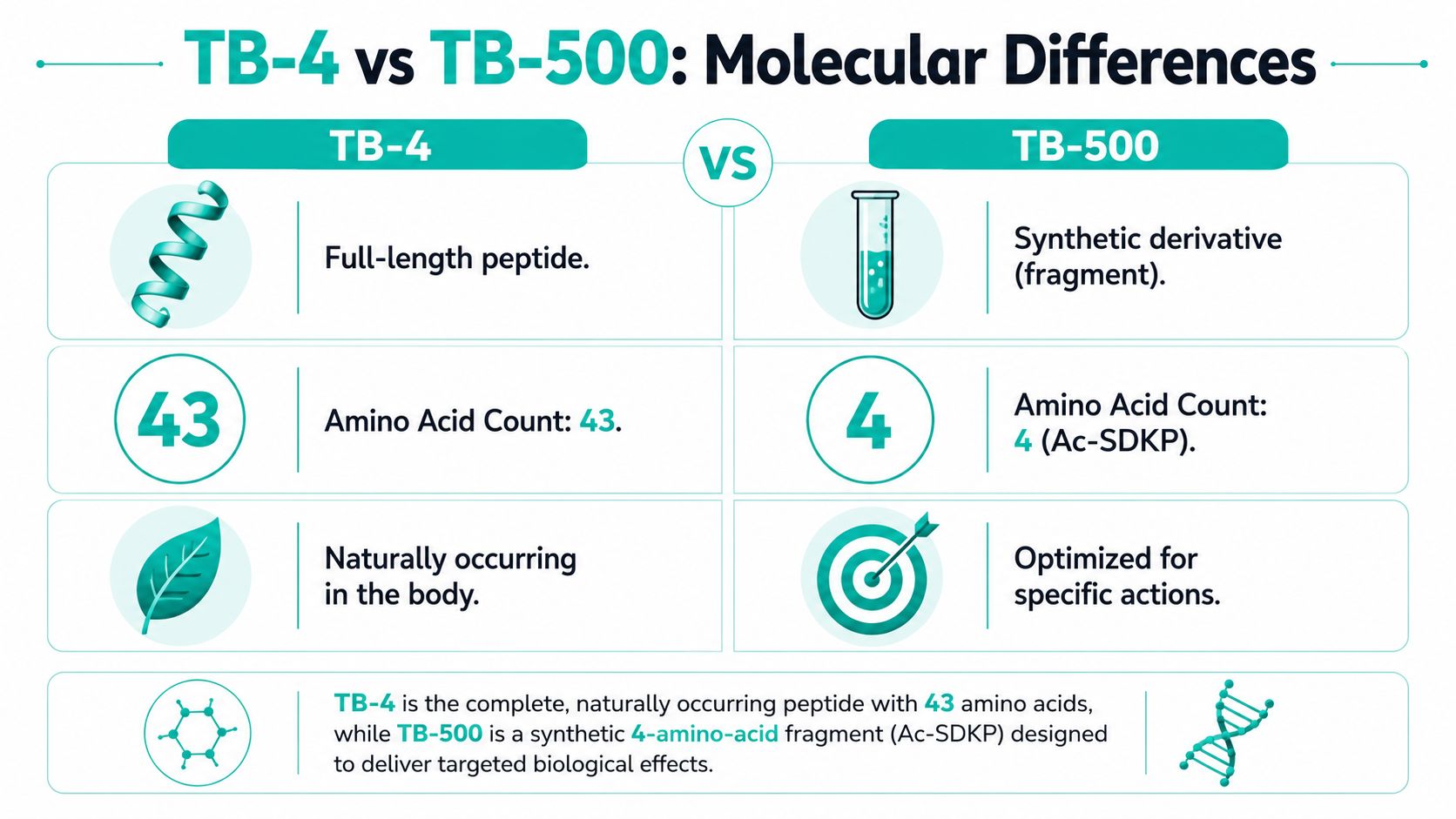
TB-4 exists naturally in the body. TB-500 is lab-created. That origin matters because endogenous peptides often carry multiple interacting domains that evolved to participate in more than one biological process, while synthetic fragments are usually designed to preserve one functional region and discard the rest.
In this case, TB-500 isolates the actin-binding domain associated with pro-migratory and tissue-repair signaling. TB-4 retains that domain but also includes the broader sequence context absent from the fragment. When consulting materials discussing thymosin beta-4 in laboratory contexts, researchers should keep that distinction front and center when interpreting product labels or study descriptions.
A smaller fragment changes more than mass and synthesis workflow. It changes what your intervention can plausibly do.
TB-500's truncated structure gives it a more targeted profile and is described as having higher solubility and targeted stability in the verified data. TB-4, by contrast, preserves the full molecular architecture associated with broader biological activity. If your assay is built to test whether a full peptide shifts several pathways at once, a fragment won't stand in for it. If your assay is built to limit off-target biology, the fragment may be the more disciplined choice.
Consider the design consequence in simple terms:
Use the full-length peptide when sequence completeness is part of the hypothesis. Use the fragment when sequence reduction is the point.
That's why structural literacy matters in TB4 vs TB 500. The peptide you choose defines the biological question you are really asking, whether you intended that or not.
The mechanistic split follows directly from the structural split. As summarized by Dosage Peptide's overview of TB-4 versus TB-500, TB-4 demonstrates broad systemic biological activity, including activation of ILK/PINCH/Akt signaling, while TB-500 primarily retains the actin-binding domain responsible for G-actin sequestration and cell migration and lacks the N-terminal fragment associated with anti-fibrotic and anti-inflammatory effects. That's the decisive point for experimental design.
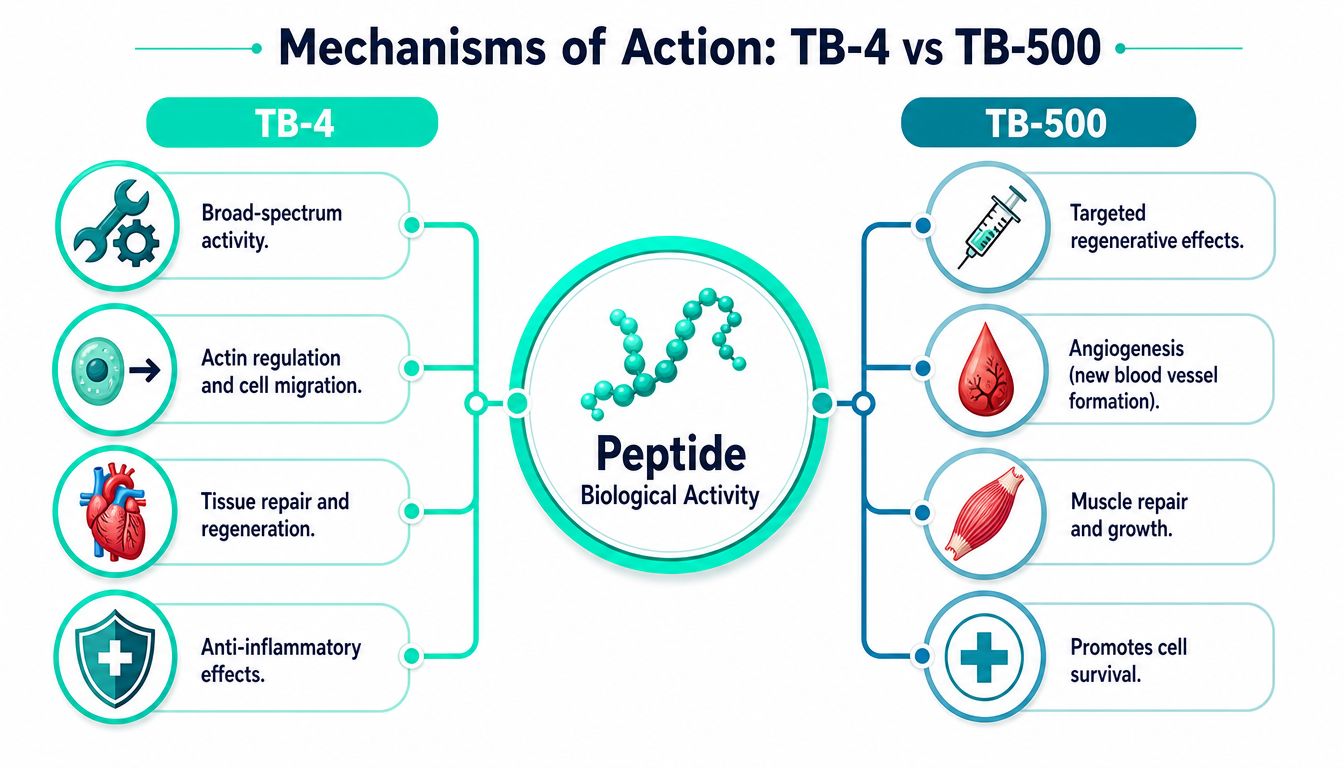
Full-length TB-4 doesn't just interact with cytoskeletal behavior. It participates in a broader signaling environment that includes inflammatory and anti-fibrotic dimensions. That makes it attractive in models where repair is inseparable from immune coordination, extracellular remodeling, or broader tissue-level orchestration.
Many simplified buyer guides err at this point. They treat “more active” as automatically “better.” But broader activity means more possible sources of variance. In a wound-healing or systemic regeneration model, that may be desirable because the biology itself is broad. In a reductionist tendon or ligament model, it may blur the interpretation of what drove the endpoint.
TB-500's appeal is not that it does everything TB-4 does in a smaller package. The appeal is that it doesn't. By retaining the actin-related core and shedding the wider sequence context, it offers a more focused way to study migration-linked and localized repair phenomena without assuming the full anti-inflammatory or anti-fibrotic profile of TB-4.
Researchers often describe this operationally rather than philosophically. They want less biological noise. A targeted fragment can help achieve that, particularly in models where immune modulation would cloud the attribution of effect. If you're reviewing background material on what TB-500 peptide is used for in research contexts, that narrower mechanistic intent is the key lens to use.
| Mechanistic dimension | TB-4 | TB-500 |
|---|---|---|
| Actin-related effects | Present | Present |
| Cell migration signaling | Present | Present |
| Anti-inflammatory capacity | Broader profile | Reduced relative scope |
| Anti-fibrotic capacity | Present in full-length context | Lacking the N-terminal component linked to those effects |
| Experimental interpretation | Rich but more confounded | Cleaner but narrower |
The practical implication is easy to miss: a positive result with TB-4 may reflect several overlapping biological processes, while a positive result with TB-500 is easier to attribute to a tighter set of mechanisms. That doesn't make TB-500 superior in general. It makes it superior when interpretability under controlled immune conditions matters most.
One reason TB-4 continues to dominate evidence-based discussions is simple. It has human clinical data. TB-500 does not. According to All About Peptides' review of TB4 and TB-500, human clinical trials show that topical and ophthalmic TB4 increased pressure-ulcer wound healing by 42–61% and reduced dry eye symptoms by 35–59%, while no human clinical trials exist for the TB-500 fragment. The same source states that intravenous TB4 has shown safety tolerability at doses up to 1,260 mg with no serious adverse events.

If your study needs a peptide with direct human validation, TB-4 is the one with the stronger footing. That matters in translational work, especially when you need to justify why a biological effect observed in preclinical systems is plausible in a human therapeutic context.
It also affects how confidently you can frame null results. If TB-4 fails in a model despite broader prior evidence, that finding means something. A null result with TB-500 is harder to interpret because the human evidence base is absent and the fragment itself has a narrower, less clinically characterized profile.
A separate preclinical point also matters. Verified data notes a 6-month mouse study in dystrophin-deficient mice in which Tβ4 improved skeletal muscle fiber regeneration, again reinforcing that the more complete peptide has the deeper evidence history in broad regenerative contexts.
TB-500 still has a role in research, but the role is methodological rather than clinically settled. It is often favored in focused musculoskeletal settings because a narrow mechanism can be an advantage when the objective is experimental control, not maximal pathway engagement.
That distinction is useful when designing pilot studies. If you want to observe whether localized migration-linked repair signals move in the expected direction without broader immune-layer effects, TB-500 can be a cleaner probe. If you want to model complex healing where inflammation, angiogenesis, and remodeling are entangled by design, TB-4 remains the more appropriate molecule.
A concise explainer can help orient non-specialist collaborators before protocol review:
A stronger evidence base doesn't automatically mean a better experimental tool. It means the tool has been validated in a different way.
That's the quiet conclusion many readers miss in TB4 vs TB 500 comparisons. TB-4 wins on breadth of evidence. TB-500 may still win on experimental cleanliness, depending on what you're trying to isolate.
Procurement is not an administrative afterthought. It is part of study integrity. Verified data states that TB-4 is typically 2 to 3 times more expensive than TB-500, with 2024 wholesale ranges of USD 180–250 per 10 mg for TB-4 and USD 60–90 per 10 mg for TB-500, and that both generally require greater than 98% purity, while GMP-certified TB-4 often reaches 99.5%+ purity and TB-500 typically averages 98–99% according to the peptide market and regulatory overview cited here.

The price gap reflects synthesis complexity, not marketing rhetoric. Producing the full 43-amino-acid peptide is more demanding than synthesizing a 7-amino-acid fragment. For principal investigators, that means budget pressure can cause teams to gravitate toward the fragment even when the biology calls for the full sequence.
That tradeoff needs to be explicit in protocol review. If you downshift from TB-4 to TB-500 for cost reasons, you haven't chosen a cheaper lot. You've changed the intervention.
A disciplined sourcing checklist helps:
For researchers evaluating vendor standards, this guide to sourcing GMP-adjacent research peptides is useful as a framework for what documentation to request.
Neither peptide is FDA-approved for human use in the verified data. The same source also states that TB-500 is prohibited by the World Anti-Doping Agency under the S2 category. Those facts don't just belong in compliance memos. They shape manuscript language, institutional review, and how carefully teams must separate research use from human-use claims.
Compliance note: Don't let marketing vocabulary bleed into experimental reporting. Regulatory status and research status are not the same thing.
The cleanest practice is to describe both compounds strictly as investigational research materials and to avoid importing assumptions from sports, wellness, or retail peptide markets into scientific interpretation.
At the bench, the biggest error isn't usually dramatic degradation. It's inconsistency. Teams use different solvents, different wait times after reconstitution, different storage intervals, and then compare outcomes as if the peptide exposures were equivalent. They often aren't.
Because this section isn't tied to verified quantitative handling data, the most defensible guidance is procedural. Treat both peptides as materials that require a standardized internal handling SOP. That SOP should specify reconstitution medium, mixing method, aliquoting practice, storage container, light exposure, thaw policy, and maximum permitted hold times after reconstitution. If one lab member flicks and rests a vial while another vortexes and doses immediately, you've already introduced avoidable variability.
The practical challenge differs by study type. In short screening assays, the main risk is preparation inconsistency across replicates. In longer animal studies, the greater risk is lot drift and variable handling across dosing days.
Use handling discipline that matches the model:
A common mistake in TB4 vs TB 500 work is treating formulation convenience as biologically irrelevant. It isn't. If one material is easier to solubilize or handle reproducibly, that operational difference can influence observed effect size and study noise.
Teams get more reliable data when they predefine the operational details most likely to drift. I'd lock these before initiating any experimental series:
Material identity records
Record peptide name, stated sequence, lot, and certificate details in the same document used for dosing logs.
Single reconstitution protocol
Write one protocol and require everyone to use it. Don't allow informal bench variation.
Aliquoting policy
Decide whether all vials will be single-use or multi-use and keep that rule constant.
Sample timing
Keep the interval from reconstitution to administration consistent within and across cohorts.
Exclusion criteria
Predefine when a preparation is discarded, such as visible particulates, labeling ambiguity, or handling deviations.
Consistency at the bench is what lets you argue that a biological difference is real and not self-inflicted.
That matters even more with closely related peptides. When compounds differ in mechanism, any procedural looseness makes interpretation harder, because you can no longer tell whether divergence came from biology or from preparation.
The right choice depends less on popularity than on what would count as a confound in your model. In light of this, the usual TB4 vs TB 500 comparison often becomes too shallow. Most summaries stop at “TB-4 is broader, TB-500 is targeted.” That's true, but incomplete. The key decision point is whether broader immune activity helps answer your question or makes the answer harder to trust.
According to RealPeptides' discussion of the difference between TB-4 and TB-500, labs consistently prefer TB-500 in studies where immune variables must be controlled, such as tendon or ligament repair, while TB-4's full immunological profile is required in models where immune modulation is integral to the outcome, such as reducing cardiac infarct size. That is the most useful distinction in practice.
If your model aims to isolate localized regeneration, TB-500 often gives you the cleaner experiment. It narrows the intervention toward cytoskeletal remodeling and migration-linked repair without bringing the full immunological breadth of TB-4 into the system.
That can improve interpretability in studies such as:
The advantage isn't that TB-500 is universally better. The advantage is that it can remove one class of experimental ambiguity.
Some studies need the whole peptide precisely because the broader response is the biology of interest. If the endpoint depends on anti-inflammatory, angiogenic, anti-fibrotic, or more integrated repair signaling, stripping the molecule down to its actin-binding core may undercut the model.
TB-4 is the stronger choice when:
This is the conclusion many researchers don't reach on their own: TB-500 can be the more scientifically rigorous choice precisely because it is less encompassing. In controlled regenerative models, less biology can mean better attribution. TB-4 remains indispensable when the omitted biology is the experiment.
If you want one decision rule, use this one. Select TB-500 when immune modulation would contaminate the readout. Select TB-4 when immune modulation is part of the mechanism you need to preserve.
Celonyx Labs supplies research peptides for laboratory investigators and publishes product quality information, catalog access, and support resources through the Celonyx Labs website. If your team is evaluating peptide sourcing for preclinical work, it's worth reviewing their documentation, third-party testing references, and purchasing policies before finalizing procurement.
You're standing at the bench with a peptide vial, a vendor purity claim, and a

PBS is a water-based salt solution of NaCl, KCl, Na2HPO4, and KH2PO4, adjusted to about

You're standing at the bench with a lipolysis assay ready to run, and the core
FOR RESEARCH USE ONLY. Products sold by Celonyx Labs are intended exclusively for laboratory and scientific research. They are not intended for human or veterinary use, consumption, diagnosis, treatment, cure, or prevention of any disease. By purchasing from this site, you acknowledge that you understand the intended research purpose of these materials and agree to comply with all applicable laws and regulations.