

HPLC MS Analysis for Peptide Research: A 2026 Guide
You're standing at the bench with a peptide vial, a vendor purity claim, and a

The surprising part about TB-500 isn't its promise. It's how often people talk about it as if that promise has already been proven in humans. It hasn't. The strongest support for TB-500 comes from animal and other preclinical work, while a 2024 review noted that human orthopaedic data for TB-4 and TB-500 are lacking and that no large-scale randomized double-blind human trials exist for sports injuries.
That gap matters. If you're asking what is TB-500 peptide, the right answer isn't just a definition. It's a definition plus context. In a lab, TB-500 is best understood as a research compound with an interesting biological rationale, incomplete human evidence, and a very real need for careful sourcing, documentation, and handling if you want interpretable results.
TB-500 is one of those compounds that can sound straightforward at first and become more complicated the closer you look. People often describe it in terms of healing, recovery, tissue repair, flexibility, and inflammation. Those ideas come from preclinical observations and proposed mechanisms, not from the kind of human trial record that would let a careful scientist call those outcomes established in patients.
That distinction isn't academic. It affects how you design experiments, how you describe your findings, and how you choose material for the study. If a new lab member asks whether TB-500 "works," the scientifically honest answer is that it has shown intriguing activity in preclinical settings, but it remains unproven for human orthopaedic use.
Practical rule: Treat TB-500 as a hypothesis-supporting tool in research, not as a clinically validated shortcut to tissue regeneration.
The confusion often starts with language. Preclinical success can sound persuasive because the mechanisms are biologically plausible. Angiogenesis, cell migration, and tissue remodeling are all real processes. But plausibility isn't proof, and mechanism isn't outcome. A well-run laboratory keeps those categories separate.
For researchers, that means three things:
Inquiries into what TB-500 peptide is often seek a simple answer. The more useful answer is this: TB-500 is a synthetic peptide fragment with promising preclinical biology, limited human data, and a research value that depends heavily on rigorous handling and procurement.
Precision starts at the name. If a lab cannot define what TB-500 is at the sequence level, every downstream result sits on uncertain ground.
TB-500 is described as a synthetic heptapeptide, meaning it contains seven amino acids, with the sequence Ac-LKKTETQ. It is associated with a fragment derived from thymosin beta-4, a much larger naturally occurring peptide present in many cell types. That relationship explains why the two names are often blurred together in informal discussions. In a research setting, they should be kept separate.
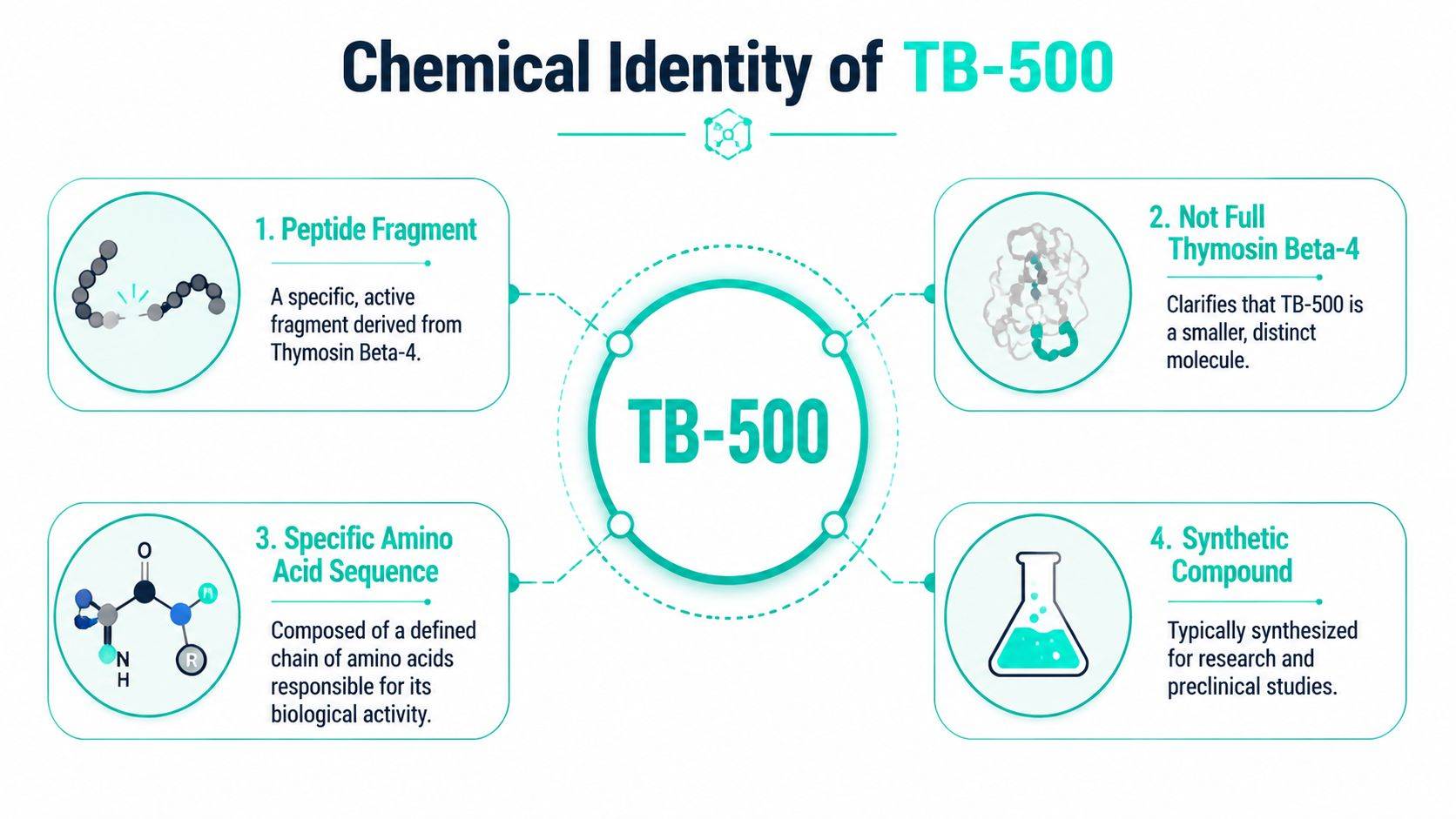
A fragment is not a shorthand version of the parent molecule. It is a different research material with its own identity, its own manufacturing path, and its own verification requirements.
That distinction matters because new researchers often hear "TB-500" and assume they are effectively studying full thymosin beta-4 in a smaller package. The chemistry does not support that shortcut. A short synthetic fragment can differ from the parent compound in folding behavior, stability, analytical profile, and possibly biological behavior. Preclinical interest does not erase those differences. It makes them more important to document.
Procurement errors often begin with loose naming. A vial labeled broadly as a thymosin-related peptide may not match the exact sequence, terminal modification, salt form, or purity profile assumed by the protocol. In peptide research, those are not minor details. They are experimental variables.
Conceptual similarity to a larger peptide does not make two materials interchangeable in a laboratory study.
The term heptapeptide indicates the chain length. For TB-500, the reported sequence includes an N-acetyl group, shown by the prefix Ac-. That modification is part of the chemical identity and should be treated the same way you would treat any other defining feature of a test article.
For lab work, the practical questions are straightforward. Did the supplier provide the exact sequence claimed? Was the terminal modification confirmed? Does the certificate of analysis align with the lot in hand? Was identity checked by an appropriate analytical method rather than assumed from a label?
| Feature | Why it matters in research |
|---|---|
| Defined short sequence | Puts more weight on identity confirmation by analytical testing |
| Synthetic origin | Introduces supplier-dependent variation in synthesis quality and lot consistency |
| Fragment of a larger peptide | Limits direct assumptions about how full thymosin beta-4 would behave |
| Specific N-terminal modification | Requires confirmation that the material matches the intended chemical form |
A useful comparison is a lab protocol excerpted from a larger methods paper. The excerpt may capture one important step, but it does not automatically reproduce the behavior of the full protocol under every condition. TB-500 is discussed in relation to thymosin beta-4 in much the same way. Related, yes. Identical, no.
That is why responsible TB-500 research begins with verification before interpretation. Sequence, modification, purity, and batch documentation should match the material named in the study plan. Without that foundation, the gap between preclinical promise and reliable evidence only gets wider.
The main scientific interest in TB-500 comes from a simple idea with complicated implications. In preclinical models, researchers study it because repair is not one process. It is a sequence of coordinated events that includes cell movement, local vascular support, inflammatory signaling, and tissue remodeling. TB-500 has been discussed in that context because related peptides have shown associations with several of those repair-linked processes in animal and cell-based work.
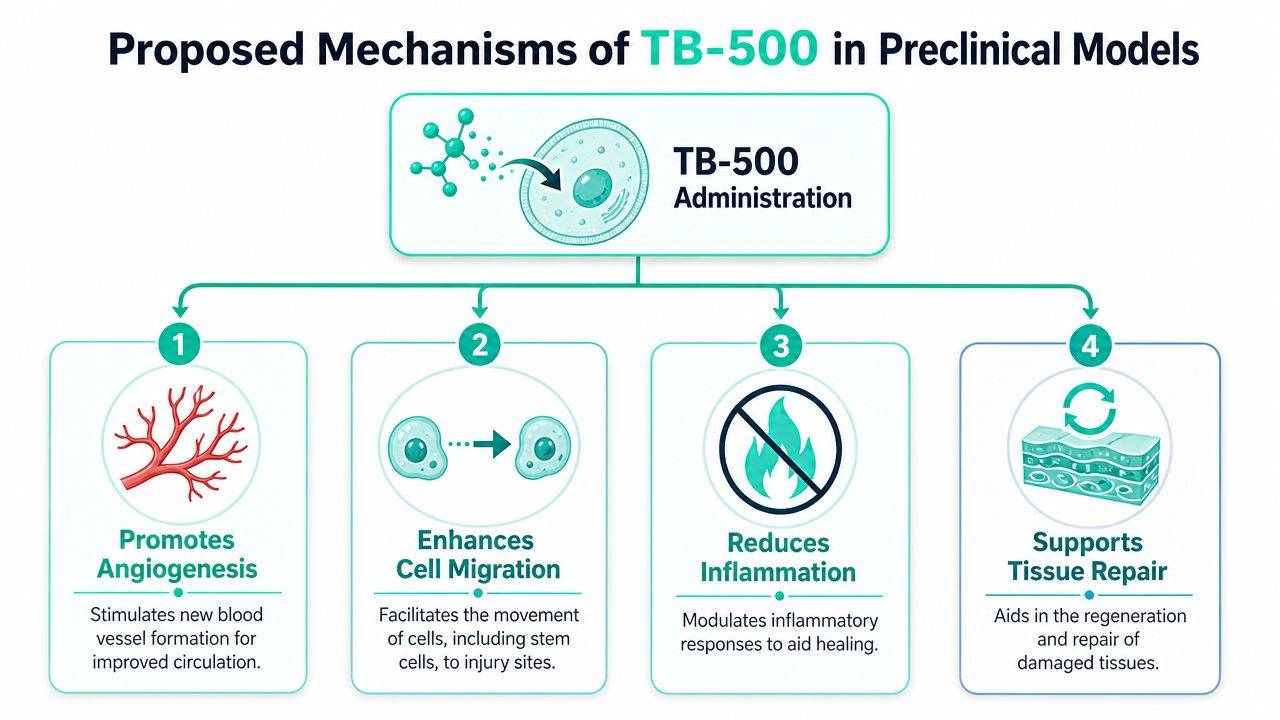
A new researcher can easily get tripped up here. A plausible mechanism is not the same thing as a confirmed therapeutic effect in humans. What preclinical work offers is a hypothesis map. It shows where scientists think the peptide may act and which biological processes are worth measuring under controlled laboratory conditions.
A useful comparison is a repair crew responding to structural damage in a building. Workers need access to the site, supplies need to arrive, debris has to be cleared in the right amount, and rebuilding has to stay organized. Tissue repair works in a similar way. Cells must reach the injured area, blood supply has to support them, inflammatory signals need to be regulated rather than eliminated, and matrix remodeling has to proceed without producing poorly organized tissue.
Later in the section, this visual gives a compact view of that model:
The recurring mechanistic themes in preclinical papers usually fall into four categories:
Those categories fit established repair biology, which is exactly why they attract research attention. They also create a common misunderstanding. A mechanism that makes sense on paper can still fail when tested across species, tissues, dose schedules, or endpoints. That gap is the central issue with TB-500 research today.
For that reason, the responsible reading of this literature is narrow and disciplined. TB-500 may be associated with repair-related processes in preclinical models. Human clinical efficacy has not been established. In a laboratory setting, that means the compound should be handled as a test article for mechanistic investigation, with assay design, material verification, and result interpretation built around uncertainty rather than assumption.
The preclinical literature around TB-500 is broad in theme, even when it's thin in human translation. Researchers have focused on soft tissue injury, wound repair, and recovery-related biology because those are the places where angiogenesis, cell migration, and remodeling can be studied in a measurable way.

A practical way to read the field is by model type rather than by hype phrase.
Muscle-related studies tend to examine recovery after injury and whether repair progresses with less disorganized tissue.
Tendon and ligament models are attractive because they heal slowly and often incompletely, making them useful for studying remodeling biology.
Wound-healing work looks at tissue closure, local vascular support, and repair organization.
Cardiac and other exploratory contexts appear in the broader thymosin beta-4 discussion, though interpretation requires extra caution when moving from one tissue class to another.
This isn't a mature clinical evidence base. It's a map of where scientists have asked mechanistic questions.
Preclinical peptide research can fail for a simple reason. The vial may not contain what the label implies, or it may contain the right peptide with variable impurity profiles that change biological readouts. When that happens, the experiment doesn't just become noisy. It becomes hard to interpret.
That's why batch-specific identity and purity verification should be treated as absolutely essential. If you're comparing tissue response across conditions, you need confidence that the active material is the same from run to run and lot to lot.
A sound lab practice includes:
When a peptide is central to the hypothesis, supplier documentation becomes part of the experimental method.
That mindset is what separates exploratory enthusiasm from reproducible research.
A peptide experiment starts long before pipetting. It starts when someone decides whether the vial is trustworthy. For TB-500, that judgment shouldn't rest on branding, attractive packaging, or broad claims about excellence. It should rest on documentation that lets another scientist review what was purchased and why it was considered fit for research.
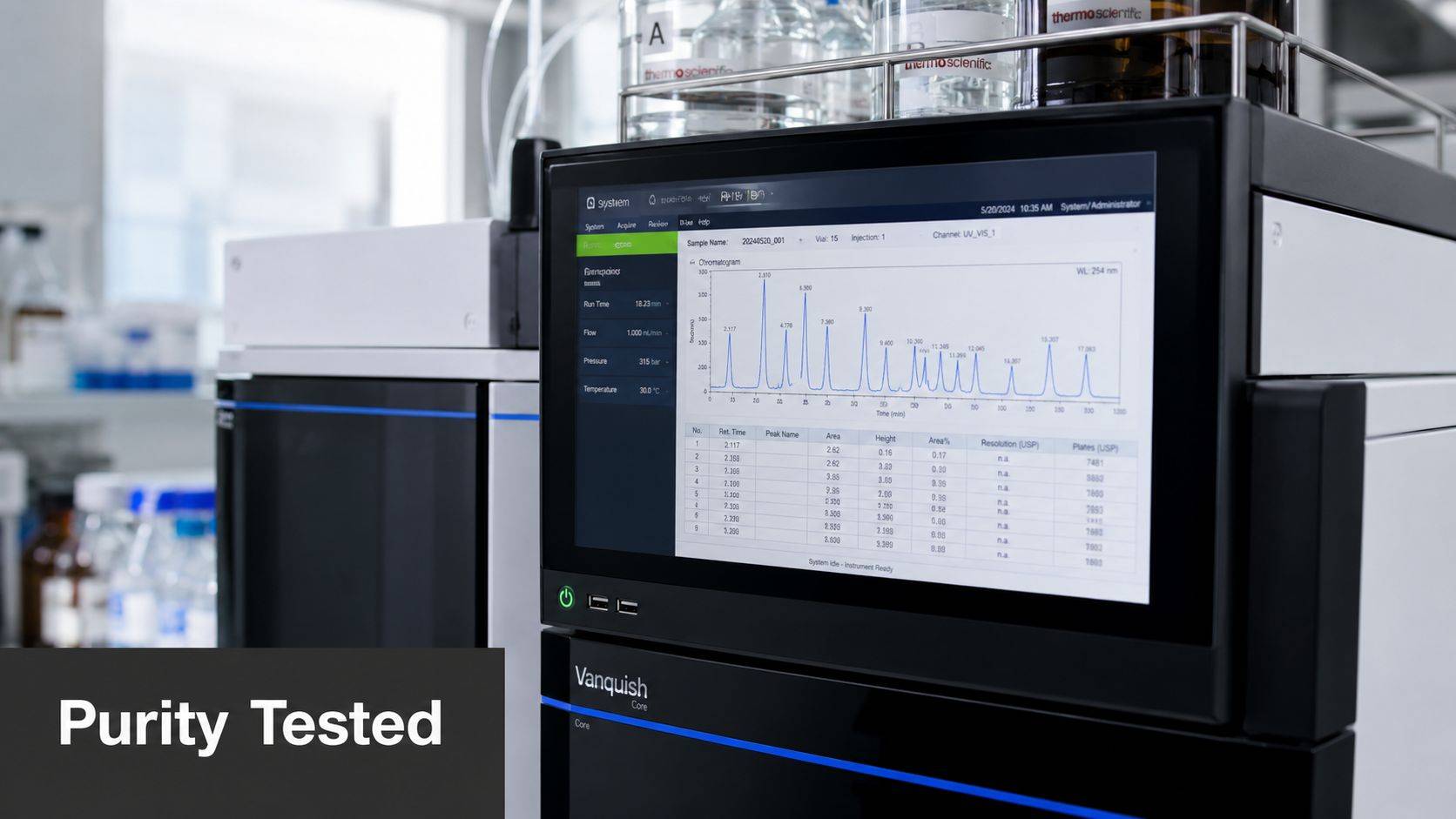
The first document to request is a Certificate of Analysis, usually called a COA. A useful COA is batch-specific and tied to the exact material you received. It shouldn't read like a template detached from the lot number in your hand.
A careful reviewer looks for a few basics:
A second layer is independent third-party testing. Internal testing is useful, but external verification reduces the incentive problem. If the peptide identity is important enough to publish on, it is important enough to verify beyond the seller's own statement.
Quality doesn't stop at procurement. A well-made peptide can still be degraded by poor bench habits. The common failures are simple. Repeated warming and cooling, contamination during reconstitution, vague labeling, and storing working solutions longer than the protocol can justify.
Use a written handling routine:
A lab that skips these basics often ends up blaming the molecule for what was really a process failure.
At the bench, TB-500 is usually encountered as a lyophilized powder. The point of the protocol isn't to make the process look complex. It's to reduce avoidable degradation and keep every prepared sample traceable.
Store the unopened lyophilized material according to your laboratory's peptide SOP and the supplier's batch documentation. Keep the storage conditions consistent across lots used in the same project. Variability introduced at this stage can spread through the whole experiment.
When you're ready to prepare a working solution, write the plan down before opening the vial. That includes the solvent, target concentration, aliquot strategy, labeling format, and intended use window. The most common handling mistake is reconstituting first and deciding details later.
A straightforward routine looks like this:
Handling protocol also sits inside a compliance framework. TB-500 is not just another generic reagent. It carries regulatory and ethical issues that affect acquisition, storage records, intended use statements, and study oversight.
The practical rule is simple. If your documentation isn't strong enough for an internal audit, it isn't strong enough for a sensitive research compound. Procurement records, inventory logs, use authorization, and disposal procedures should all be part of the same controlled system.
The largest risk with TB-500 is not only what researchers do not know about it. It is the temptation to treat preclinical promise as if it were established human evidence.
That distinction has to stay visible in every part of a project. TB-500 is discussed in repair and recovery terms, but discussion is not validation. For laboratory teams, the responsible position is clear. Handle it as a research material with unresolved human safety and efficacy questions, not as a clinically established intervention.
The practical regulatory point is simple. TB-500 is not FDA-approved for any medical use in humans, and public discussion around compounding and oversight reflects that unsettled status, according to the orthopaedic and compounding overview discussing FDA status and the scheduled July 23–24, 2026 Pharmacy Compounding Advisory Committee meeting after its April 2026 removal from Category 2. The same source also highlights the absence of long-term human safety data.
That gap matters more than many new researchers expect. A strong animal or cell-culture signal can suggest a mechanism worth studying, but it does not answer the questions that matter for human use. Dose tolerance, off-target effects, interaction risks, and longer-term outcomes all require direct clinical evidence. For TB-500, that evidence remains limited.
Sports regulation adds another layer. As noted earlier, TB-500 has been treated as a banned substance in anti-doping settings. Even in a basic research lab, that status should change how carefully the material is labeled, stored, described in records, and discussed outside the institution.
Good ethics begins with accurate description. A compound studied for possible effects is not the same as a compound proven safe and effective in humans.
Oversight should match the model being used. Cell experiments, animal studies, and any work involving human specimens or participants each trigger different review requirements. The safest habit is to write the intended use in plain language, keep protocol deviations documented, and remove any wording that could be read as promotion of unapproved human use.
Procurement is not a clerical step. It is part of experimental validity.
A mislabeled or poorly characterized peptide can distort results before the first assay starts. In that sense, vendor review works like instrument calibration. If the starting material is uncertain, every downstream observation becomes harder to trust, no matter how careful the bench work is.
A responsible purchasing review should answer several questions before an order is approved:
This is how a lab closes the gap between scientific interest and defensible research practice. With TB-500, careful sourcing and careful language are not side issues. They are part of doing credible work at all.
Is TB-500 the same thing as thymosin beta-4?
No. TB-500 is a synthetic fragment derived from thymosin beta-4, not the full parent protein. That difference affects how researchers should describe, source, and interpret the material.
Why do so many people talk about it as a healing peptide?
Because the preclinical story is compelling. Animal and model-system work suggest repair-related effects, which makes the compound attractive. But those signals don't replace rigorous human outcome data.
Why is the phrase "what is TB-500 peptide" harder to answer than it sounds?
Because the answer has two layers. Chemically, it's a defined synthetic peptide fragment. Scientifically, it's a promising but not clinically established research compound.
Why is WADA's ban relevant?
It signals that regulators in sport view the compound seriously enough to prohibit it in competition. For researchers, that means extra care with labeling, communication, and intended use boundaries.
If a compound sits in a gray zone between scientific interest and public hype, the lab has to be the adult in the room.
Can a lab publish work involving a research-only peptide?
Yes, but the burden of documentation is higher than many teams expect. The manuscript should clearly state the material identity, supplier, lot tracking, analytical verification available to the researchers, preparation method, and study limitations.
What should be recorded during procurement?
Keep the order record, shipment details, vial labels, lot numbers, COA, any third-party testing reports, and internal receipt log together. Fragmented records are a common source of trouble during review.
What's the difference between lyophilized and reconstituted peptide in practical terms?
Lyophilized peptide is the dry form supplied for storage and later preparation. Reconstituted peptide is the dissolved working form. The moment you reconstitute it, handling discipline becomes much more important because contamination and instability risks rise.
Does human safety data exist?
There is limited human information discussed in the available material, but not the kind of broad, definitive dataset that would justify confident clinical claims. That means researchers should avoid overstating safety as well as efficacy.
What's the most important procurement question to ask before buying?
Ask for batch-specific identity and purity evidence. If the answer is vague, promotional, or delayed, that's a problem.
What mindset should a new lab member bring to TB-500 research?
Curious, skeptical, and procedural. TB-500 is worth studying precisely because the biology is interesting and the human evidence gap is still open.
If your team needs research peptides with clear documentation, Celonyx Labs is a resource to review. The company supplies research peptides to laboratories and investigators through an online catalog and presents stated quality attributes including 99% purity and independent third-party testing. For any vendor, including Celonyx Labs, the right approach is the same: verify the batch-specific paperwork, confirm the analytical support, and make sure the material fits your laboratory's SOPs before it enters a study.
You're standing at the bench with a peptide vial, a vendor purity claim, and a

PBS is a water-based salt solution of NaCl, KCl, Na2HPO4, and KH2PO4, adjusted to about

You're standing at the bench with a lipolysis assay ready to run, and the core
FOR RESEARCH USE ONLY. Products sold by Celonyx Labs are intended exclusively for laboratory and scientific research. They are not intended for human or veterinary use, consumption, diagnosis, treatment, cure, or prevention of any disease. By purchasing from this site, you acknowledge that you understand the intended research purpose of these materials and agree to comply with all applicable laws and regulations.