

6 Acetic Acid: What It Means and Where It Fits in Research
What does “6 acetic acid” tell you about the bottle on your bench? Not much,
A peptide shipment can arrive looking perfectly normal while the handling around it reduces its value. The cold pack is warm, the vial sits on the receiving bench during a meeting, someone opens it before the lot record is complete, and the remainder returns to a freezer without a cycle count or clear location. By the time the experiment fails, nobody can reconstruct what happened.
That's the peptide vial storage problem. The freezer temperature matters, but so do the first hour after receipt, moisture exposure, repeated openings, freeze-thaw history, and the quality of your records. A workable protocol protects the vial through every handoff, from delivery dock to freezer, from first access to final disposal.
The package lands on the bench just before a scheduled run. The outer box is intact, but the cold pack has softened, and the receiving technician is tempted to put everything in the freezer first and finish the paperwork later. That shortcut creates the first undocumented gap.
Start by treating receipt as a decision point, not an administrative task. Photograph the unopened package, the packing material, any temperature indicator, and the vial itself. Check the vial against the order and accompanying documentation. The peptide identity, lot number, vial count, and stated physical condition should agree before the material enters routine stock. If the shipment includes a certificate of analysis or handling instruction, attach it to the receiving record rather than leaving it in the box.
A sealed vial with an intact stopper, readable label, and no obvious evidence of moisture or physical damage can usually move directly into its assigned cold-storage path after documentation. If the temperature indicator suggests an excursion, the cold pack is fully thawed, the vial has been crushed, or the lyophilized material looks collapsed or wet, quarantine it before anyone opens or reconstitutes it.
Quarantine doesn't mean the material is unusable. It means the lab preserves the evidence needed for a defensible decision. Keep the vial isolated, record who handled it and when, and contact the supplier with photographs and the shipment details. Don't “test” a questionable vial by consuming it in an experiment. That destroys the option of a vendor investigation.
For an unopened lyophilized vial, the safest immediate action is usually to keep it sealed, dry, dark, and frozen. Long-term guidance favors about −20°C, with −80°C used for especially fragile sequences or archival storage. The peptide purchasing and handling resources from Celonyx Labs can be part of a procurement workflow, but the receiving lab still needs its own acceptance criteria and chain-of-custody record.
Don't aliquot a vial merely because it arrived. First determine whether the planned experiment needs the entire amount, whether the sequence has special handling constraints, and whether opening it now will expose the remaining powder to humidity. If the vial can remain sealed until use, that is often the better choice. The first hour should end with one of three outcomes: accepted and stored, quarantined for review, or rejected with a documented reason.
Temperature selection only makes sense after you identify the peptide's physical state. A dry lyophilized cake, a concentrated stock, and a dilute working solution aren't interchangeable materials, even if they carry the same peptide name and lot number.
For unopened lyophilized peptides, −20°C is the routine long-term setting. A major 2026 storage guide describes about 1–3 years of typical stability for most research peptides at that temperature, while −80°C can extend stability to 5+ years or beyond a decade for some formulations. These are practical guidance ranges, not guarantees. Sequence susceptibility, residual moisture, packaging, and handling history still matter. See the lyophilized peptide storage guidance when assigning a storage path.
Room temperature is suitable only for short holding periods, such as transit or brief bench handling. The same 2026 guidance describes room-temperature exposure as generally a matter of weeks rather than months, and gives the widely used rule of thumb that each 10°C increase roughly doubles chemical degradation rates according to the storage stability guide. That doesn't mean a vial becomes unusable the moment it warms. It means warm exposure consumes stability margin, and the lab should document it rather than pretending it didn't occur.
| Peptide State | Temperature | Max Storage Time | Typical Use Case |
|---|---|---|---|
| Unopened, lyophilized | −20°C | About 1–3 years for typical stability | Routine long-term research stock |
| Unopened, lyophilized | −80°C | 5+ years, or longer for some formulations | Fragile sequences and archival material |
| Lyophilized, short holding period | Room temperature | Generally weeks rather than months | Transit, inspection, brief handling |
| Reconstituted solution | 4°C | Short-term use, commonly days | Immediate working solution |
| Reconstituted high-concentration stock | −20°C to −80°C | Shorter than dry storage, sequence-dependent | Frozen stock prepared for later dilution |
The comparison is a storage framework, not a substitute for peptide-specific instructions. A review of peptide handling recommends lyophilized storage at −20°C to −80°C for long-term storage exceeding 6 months, with shorter windows for liquid material in its technical review. Another stability guide places short-term liquid storage at 4°C or frozen for up to 3 months, medium-term frozen high-concentration stock at 3 months to 1 year, and long-term storage above 1 year in lyophilized form in its stability hierarchy.
Temperature isn't the only control. Keep dry vials tightly capped, shield them from light, and use a secondary container with desiccant. Let a frozen vial equilibrate to room temperature before opening. Opening it while cold invites condensation, and moisture is one of the fastest ways to turn a stable cake into an uncertain sample.
Aliquoting is useful only when it's done at the right moment. For a dry vial, opening and transferring powder creates moisture and loss risks, so the decision depends on the quantity, the experiment schedule, and whether the material can be handled accurately without leaving a contaminated or poorly sealed remainder.
For a reconstituted stock, the decision is clearer. Prepare portions that match real experimental use, not an arbitrary volume that leaves every tube half full. A small volume can concentrate solute through evaporation and make pipetting error more consequential. A large volume creates unnecessary waste when the experiment needs only a fraction. Use the solvent specified by the peptide documentation, and verify that the tube material and closure are compatible with that solvent and the intended temperature.
Prepare the workspace first. Pre-chill compatible cryovials, arrange the rack, and have the label and log ready before the parent vial leaves storage.
Label before filling. Put the peptide identity, lot number, concentration, solvent, preparation date, intended storage temperature, and aliquot identifier on each tube. A tube that's “temporarily” unlabeled becomes a permanent ambiguity faster than you might expect.
Minimize exposure. Work efficiently, keep containers closed when they aren't being filled, and avoid unnecessary air headspace. For oxidation-sensitive material, ask whether the supplier or protocol specifies an inert-gas headspace.
Mix without creating a new problem. Use the validated dissolution method for the sequence. Don't assume vigorous vortexing, sonication, or a solvent that worked for another peptide is automatically appropriate.
Freeze once, then transfer. Flash-freeze the filled aliquots on dry ice or in a −80°C freezer, according to the laboratory's validated procedure, then move them to their assigned storage location. Record the parent vial ID and each child aliquot ID.
The critical rule is simple: aliquot before the working stock starts traveling between freezers and benches. Each opening, partial thaw, and return to storage adds uncertainty. The parent vial should become a reserve, not a daily-use container. The peptide storage container guidance is useful when choosing compatible containers and building the first-access record.
Don't aliquot reflexively when the material is unopened lyophilized powder and the sequence can remain stable in its original vial. In that situation, preserving the sealed, dry cake may be safer than transferring it. Aliquoting is a control for repeated solution handling, not a ritual that improves every sample.
Freeze-thaw damage is cumulative. It isn't a single temperature threshold that separates a safe vial from a failed one. During freezing, ice formation excludes dissolved material into concentrated liquid regions. During thawing, the peptide passes through changing concentration, surface, and solvent conditions. Repeating that sequence gives aggregation and chemical degradation more opportunities to develop.
The most reliable control is to count cycles, not rely on memory. Mark each thaw on the vial or its secondary container and record it in the digital log. Keep the parent material reserved for re-aliquoting, and retrieve a working aliquot for routine use. A working stock that has seen repeated handling should be retired according to the lab's validated SOP rather than returned indefinitely to circulation.
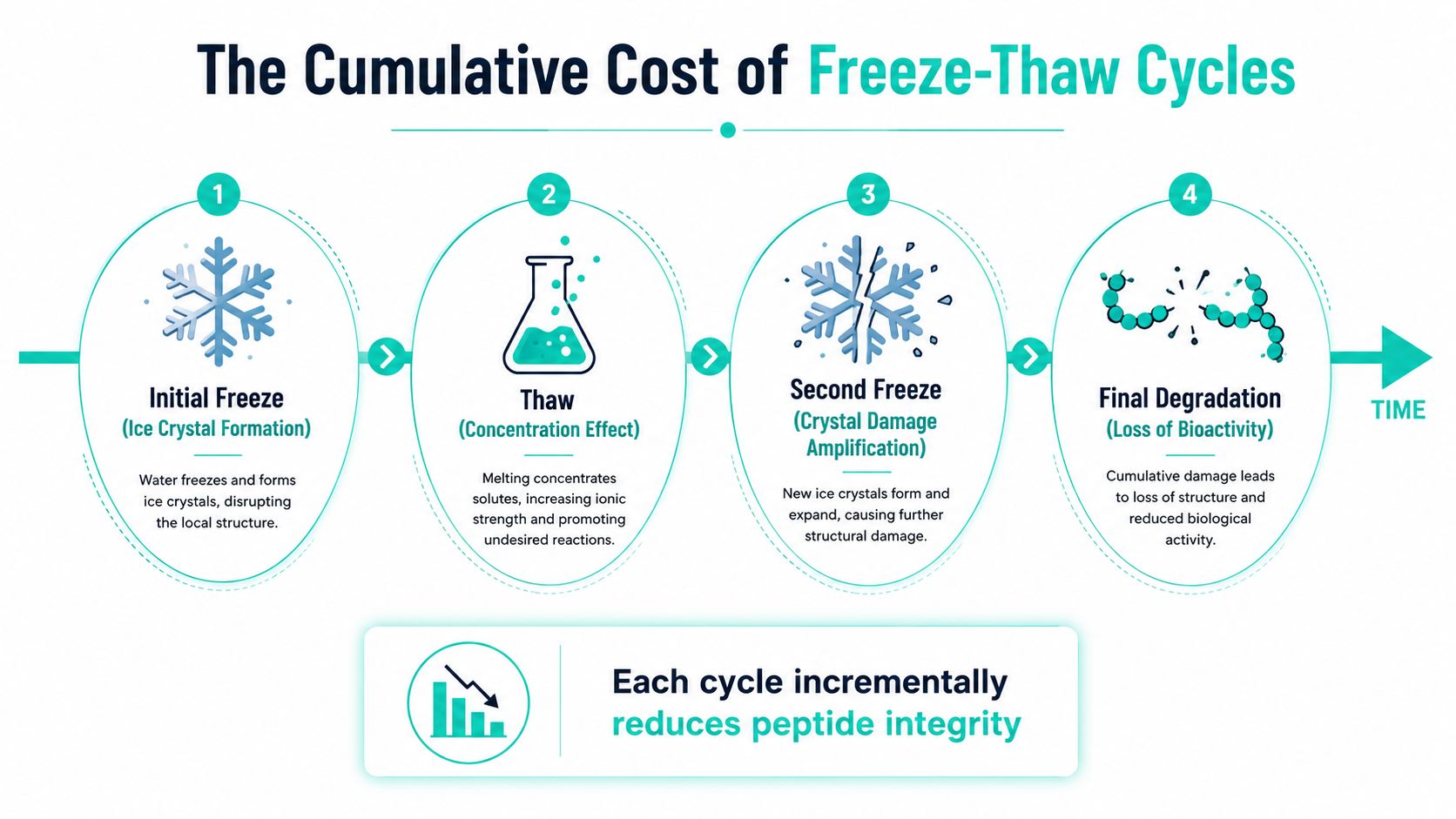
Thaw the aliquot under the procedure approved for that peptide. A controlled thaw at 4°C can be preferable to leaving a tube on a warm bench, but the correct approach depends on the formulation and experiment. Partial thawing is especially difficult to manage because the remaining solid and liquid portions can have different concentrations. Don't withdraw material from a partly thawed tube and then refreeze the remainder unless the protocol explicitly permits it.
Short, less aggregation-prone sequences may tolerate handling better than longer or structurally sensitive sequences, but that isn't permission to treat them as indestructible. Sequence-specific instability can involve oxidation-prone residues, moisture sensitivity, or aggregation behavior that isn't visible in the vial.
A practical stock hierarchy looks like this:
A −20°C freezer may be convenient for routine access, but it can expose material to more temperature fluctuation than a stable −80°C system, particularly near the door or during frequent retrieval. The right freezer is the one your lab can monitor, map, and use consistently.
A vial without a reliable history is not a well-controlled reagent. The label doesn't need to contain every detail, but it must let the next person identify the material, understand its state, and find the rest of the record without guessing.
Use cryo-safe labels and alcohol-resistant ink. Label the vial and the secondary box, rack, or carrier. A clear vial label can still fail operationally if the box has been moved and the inventory system doesn't show the new location.
At first receipt, record the peptide name, lot number, supplier, date received, physical state, and storage assignment. After reconstitution, add the concentration, solvent, preparation date, and handler initials. Every aliquot needs a parent-vial relationship, not just a copied peptide name.
| Field | Physical Label | Digital Log Entry |
|---|---|---|
| Peptide identity | Name or approved short code | Full name, sequence or internal identifier |
| Lot | Lot number | Lot number and supplier documentation |
| State | Lyophilized or solution | State, preparation history, and current status |
| Concentration | Required for solutions | Concentration, units, and calculation record |
| Solvent | Short solvent code | Full solvent description and protocol reference |
| Dates | Received, prepared, or retest date as applicable | All relevant dates and source documents |
| Handling | Cycle count and handler initials | Cycle history, deviations, and responsible person |
| Location | Box, rack, or freezer code | Exact freezer, shelf, rack, and slot ID |
A receiving entry might read: “Peptide code, lot number, received date, sealed lyophilized vial, package condition acceptable, temperature indicator reviewed, assigned freezer and slot, handler initials.” A re-aliquoting entry should identify the parent vial, preparation date, solvent, concentration, child aliquot IDs, storage location, and the person who performed the transfer.
Practical rule: If a second scientist can't reconstruct the vial's identity and handling history without asking the original handler, the record isn't complete.
A shared spreadsheet can work for a small group, while a LIMS is more appropriate when many users, lots, and freezer locations must stay synchronized. Review temperature records, label legibility, freezer maps, and physical vial counts together. Check door seals and frost accumulation during the audit, because equipment condition can undermine a good storage plan.
When a result looks wrong, the record should help distinguish peptide degradation from an assay problem. Without lot and cycle history, the lab may repeat a failed experiment with the same compromised material and lose more time before anyone recognizes the pattern.
The receiving bench is where many storage failures become irreversible. A warm gel pack doesn't prove that a peptide is unusable, and a cold pack doesn't prove that the shipment stayed within an acceptable condition. The vial's seal, physical appearance, documentation, and exposure history all matter.
Open the package where you can photograph it before rearranging the contents. Inspect the temperature indicator, note the condition of the cold pack, and compare the shipment with the packing slip. If the vial is liquid, weighing it against the documented shipment information may help identify solvent loss. For a lyophilized vial, inspect the cake for collapse, melt-back, discoloration, or visible moisture, and check the stopper and seal for signs that the original closure or vacuum may have been compromised.
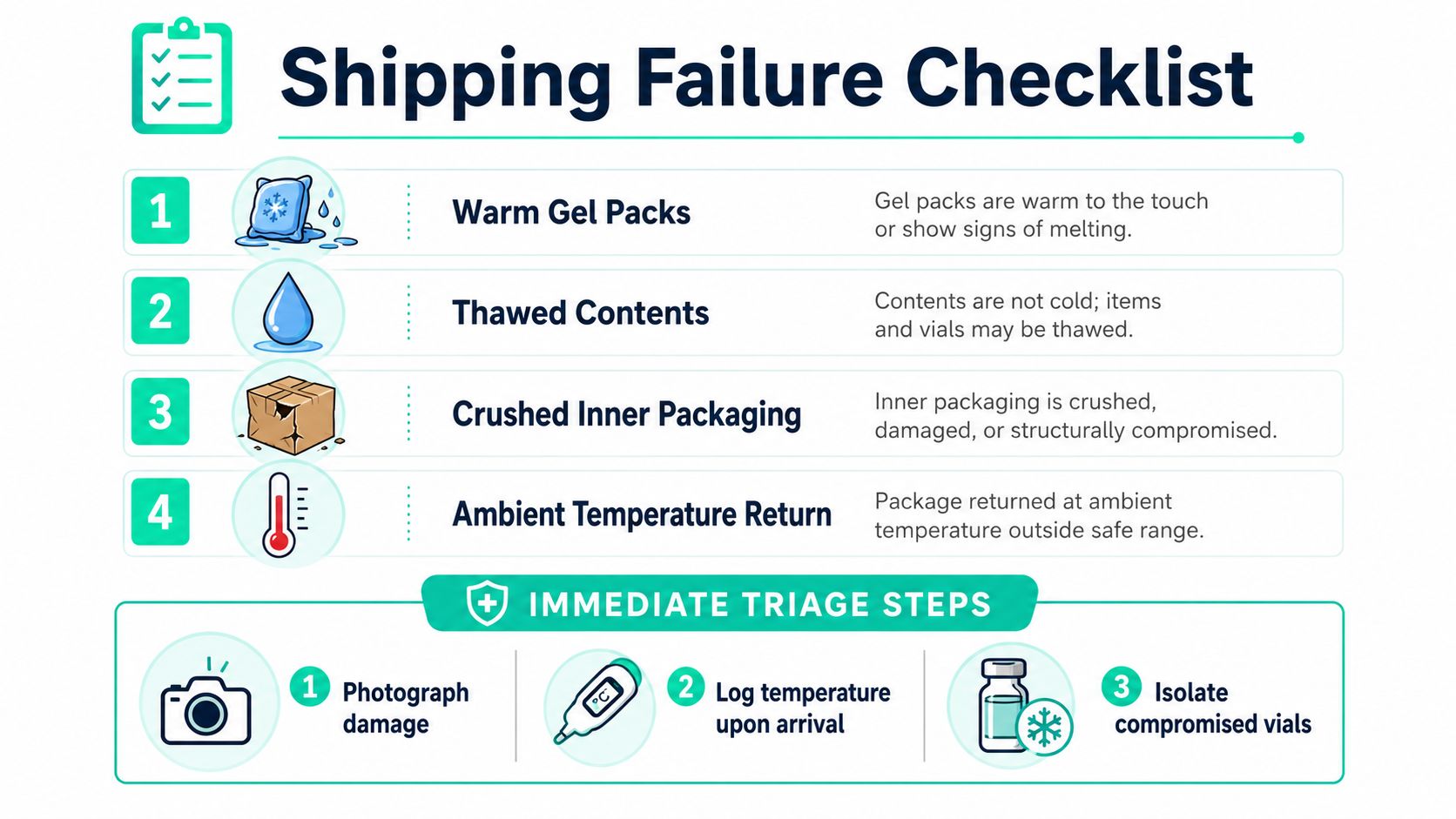
A scuffed label or minor outer-box dent may be cosmetic if the vial remains sealed, legible, and physically intact. A crushed inner box, cracked container, loose stopper, wet cake, or unexplained temperature excursion deserves quarantine. Don't rub away residue or discard packing material before documenting it. Those details may support a claim or explain why the vial's condition changed.
The receiving record should include:
Use the vial only when the acceptance criteria are met and the documentation supports that decision. Quarantine when evidence is incomplete or damage might affect integrity. Dispose of material when the lab's SOP or supplier assessment determines that it can't be defended for the intended experiment.
The video below can serve as a visual reminder for teams training new receivers, but it shouldn't replace the laboratory's written triage rules.
Shipping at room temperature can be acceptable for several days when the vial stays sealed and the sequence and humidity conditions support it, but receipt still requires prompt transfer to appropriate cold storage. The key question isn't whether the package felt cool. It's whether the lab can document what happened and justify the next action.
A storage SOP fails at its handoffs. The receiving technician logs the shipment, another person moves the vial, a third person reconstitutes it, and a fourth retrieves an aliquot without updating the cycle count. Each action may look harmless alone. Together, they create a material history nobody can verify.
Build the protocol backward from those handoffs. The master record should connect the original shipment to the parent vial, each aliquot, each location change, and the final disposition. That chain makes the freezer part of a controlled process rather than a cold drawer where samples disappear.
The written procedure should define:
A quarterly review should compare the physical inventory with the digital log. Check whether labels remain readable, whether freezer racks still match the map, whether door seals show frost buildup, and whether temperature records contain unexplained gaps. Resolve discrepancies while the people involved still remember the movement.
New staff need more than a tour of the freezer. Train them on the vendor's packaging patterns, the lab's quarantine process, the difference between a parent vial and a working aliquot, and the failure modes that have already caused confusion. Keep those observations in the SOP or an approved deviation log, not in one person's memory.
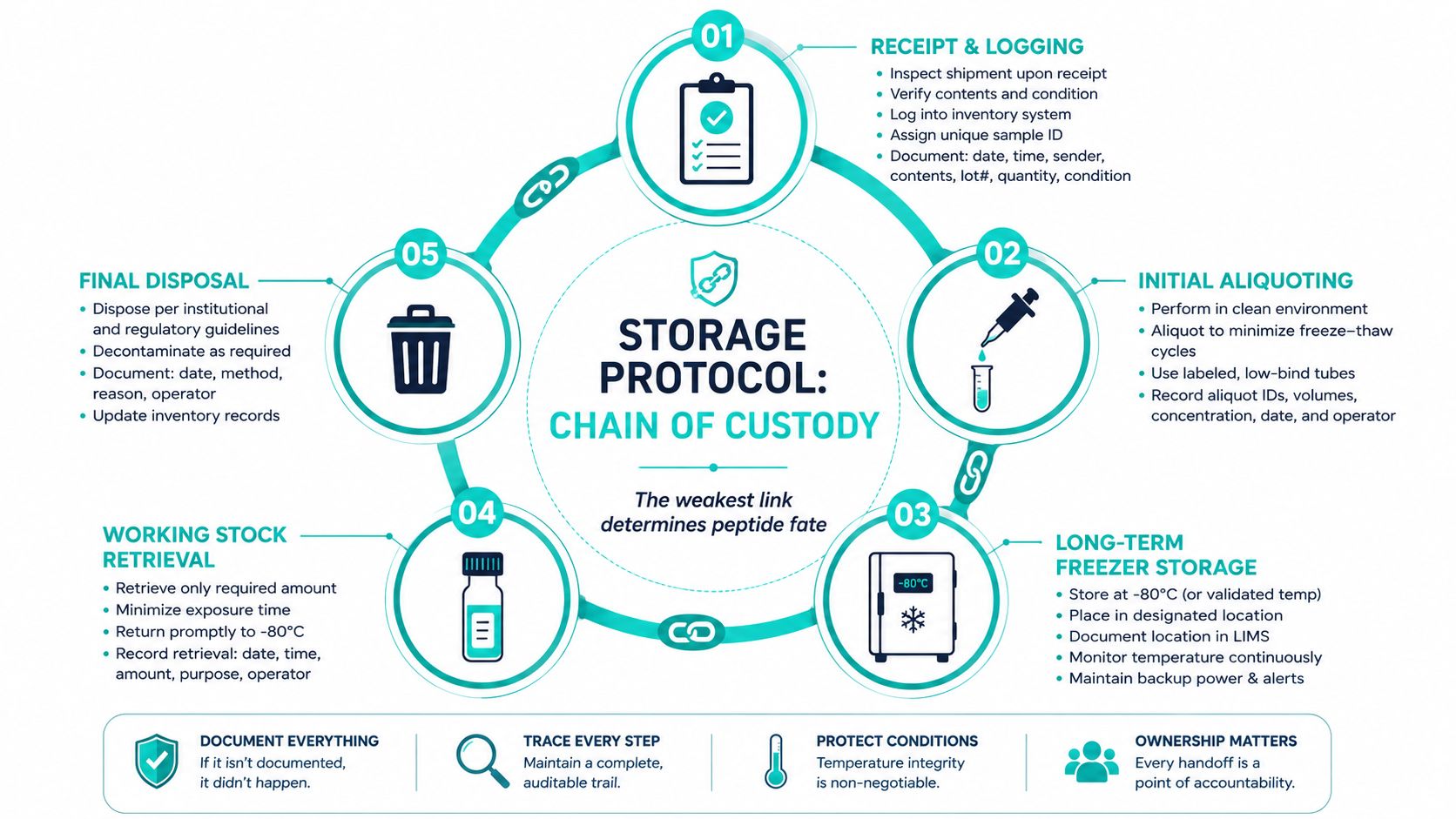
The protocol should change when the workflow exposes a weakness. If staff repeatedly forget to record a location, redesign the location field. If working aliquots return to the freezer without cycle counts, place the counter on the physical label and make the log entry part of the retrieval step. A living SOP records what people do and converts recurring mistakes into controls.
Celonyx Labs supplies research peptides through an online catalog and provides product and order support for laboratory workflows, with stated quality information including 99% purity and independent third-party testing. Review the available materials and handling expectations, then visit Celonyx Labs to evaluate whether its procurement options fit your peptide vial storage process.
What does “6 acetic acid” tell you about the bottle on your bench? Not much,

Best sterility testing kits for 2026 peptide labs: Endosafe nexgen-PTS wins on speed, Steritest for

Compare the best peptide reference standards for analytical research in 2026, ranked by purity, COA
FOR RESEARCH USE ONLY. Products sold by Celonyx Labs are intended exclusively for laboratory and scientific research. They are not intended for human or veterinary use, consumption, diagnosis, treatment, cure, or prevention of any disease. By purchasing from this site, you acknowledge that you understand the intended research purpose of these materials and agree to comply with all applicable laws and regulations.