

Is bacteriostatic water the same as sterile water? No 2026
Is bacteriostatic water the same as sterile water? No. Compare preservatives, vial handling and peptide

You're probably in one of two situations right now. Either you've found a peptide you need for a live project and you're trying to decide which online supplier won't compromise your assay, or you already bought one, the package is on the way, and you're wondering whether the vendor's “99% purity” claim holds up once the vial reaches your lab.
That concern is justified. In peptide work, procurement errors don't stay in procurement. They show up later as noisy binding data, failed controls, unstable reconstitution, unexplained variability between repeats, and weeks of wasted bench time. New researchers often focus on the product page. Experienced labs focus on the entire chain: supplier transparency, batch documentation, regulatory classification, shipping conditions, receipt inspection, and storage discipline.
If you need to buy peptides online for legitimate research, treat the purchase like any other high-risk experimental input. The peptide isn't just a reagent. It's a potential confounder.
A failed peptide experiment rarely announces its cause. The readout drifts, the replicate spread widens, or the expected response never appears. Only later does someone ask the question that should have been asked before checkout: what if the material itself was the problem?
That question matters more now because the online peptide ecosystem is getting larger, noisier, and harder to sift through. The peptide supplements market projection from Future Market Insights says the global market is projected to grow from USD 4.1 billion in 2025 to USD 11.2 billion by 2035, with a 10.4% CAGR. More products, more storefronts, and more marketing claims mean researchers have to sort serious scientific suppliers from sellers who only look credible at first glance.
The danger isn't just buying a weak product. It's importing an uncontrolled variable into your study.
Practical rule: If you can't defend the sourcing decision in a lab meeting, an audit, or a manuscript methods section, don't put that peptide into an experiment.
In practice, most failures tied to online peptide procurement come from a short list of avoidable mistakes:
Researchers who buy peptides online successfully do something different. They build a procurement process that screens the supplier, inspects the documentation, and controls handling after delivery. That process takes more time upfront, but it protects the two resources labs run out of first: reliable data and investigator time.
A peptide supplier should be easy to verify through conventional means. If a company is hard to pin down before the sale, it usually gets worse after the sale.
Begin with the basics. Look for a physical business address, a direct phone number, and a clearly identified support channel that isn't just a web form. You're not checking these boxes for appearance. You're checking whether there's an accountable operation behind the catalog.
A serious supplier also publishes its institutional-facing policies in plain view. That includes shipping, returns, refunds, terms, and privacy. Labs buy under process. Vendors that support research procurement usually know that purchasing staff, compliance teams, and principal investigators need documents they can review before an order is approved.
Watch for mismatch signals. If a website uses heavy lifestyle language, vague claims, or pushes urgency harder than documentation, treat it cautiously. The best suppliers make it easy to inspect how they operate.
The most useful early test is simple. Request batch-specific, third-party analytical documentation for the exact peptide you plan to order. Not a generic sample PDF. Not a template. Not a screenshot with no lot number. You want records tied to an actual batch.
If support can't provide them promptly, or responds with evasive language, move on.
Here's what I tell new staff to look for before approving a first purchase:
A supplier that welcomes scrutiny is easier to work with than one that treats basic documentation as a special favor.
| Vetting Criterion | What to Look For | Why It Matters |
|---|---|---|
| Physical presence | Public address and direct phone number | Shows there's an identifiable operation behind the site |
| Published policies | Shipping, refund, return, privacy, and terms pages | Supports institutional review and sets expectations before purchase |
| Batch-specific testing | COA tied to the exact lot you'll receive | Reduces the risk of relying on generic marketing documents |
| Responsive technical support | Clear answers to questions about testing, handling, and fulfillment | Indicates whether problems can be resolved quickly |
| Research positioning | Research-focused language, documentation, and order support | Helps separate legitimate supply from grey-market resale |
| Shipping clarity | Packaging and temperature-control information | Signals whether the vendor understands peptide handling risk |
A weak vendor often fails at more than one of these points. That pattern matters. One missing document can be an oversight. A missing address, vague policy language, and no lot-specific data is a system problem.
Once the supplier sends a Certificate of Analysis, the burden shifts to you. A COA is only useful if you read it critically.
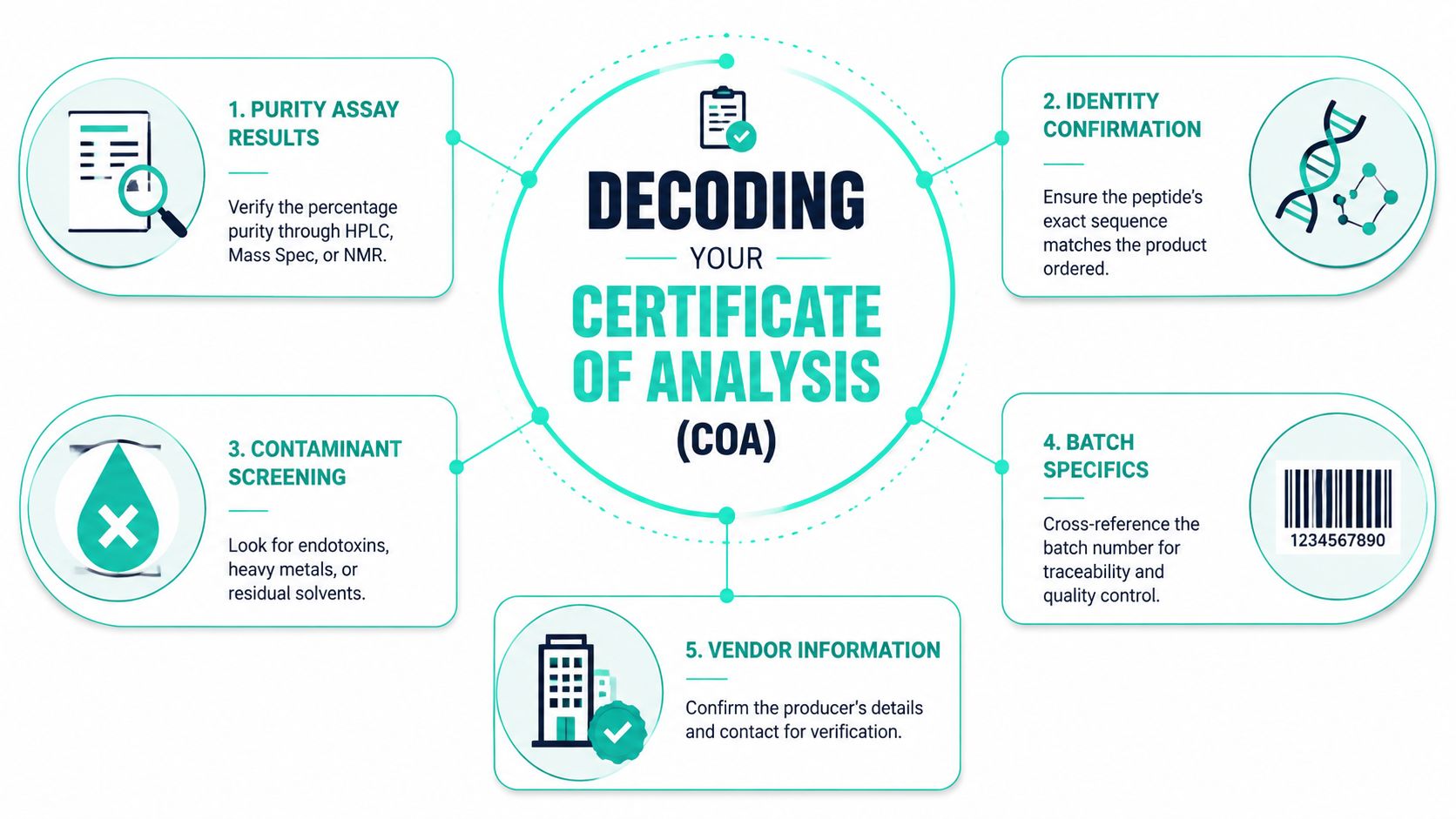
At minimum, the document should connect the product identity, lot or batch number, test method, test date, and result. If those pieces don't line up, the COA doesn't give you reliable traceability.
A strong COA lets you answer four questions quickly:
If the file gives you a purity value without any underlying analytical context, treat it as incomplete.
Researchers often stop at the headline purity figure. That's a mistake. The HPLC chromatogram deserves attention because it shows whether the sample is dominated by one clean peak or whether smaller impurity peaks are present around it.
When you review the chromatogram, check for these details:
A purity figure without a readable chromatogram asks you to trust the summary instead of the data. Don't do that.
Bench note: A peptide can be reported as high purity and still be wrong for your experiment if the remaining fraction contains the specific impurity that interferes with your assay.
Also check whether the testing date is recent enough to make sense for fulfillment. A stale COA isn't automatically invalid, but it raises questions about inventory age and storage history.
HPLC tells you about separation and relative purity. Mass spectrometry helps confirm identity. If the measured molecular weight doesn't align with the expected peptide mass, the supplier may have sent the wrong material, an incomplete synthesis product, or a degraded sample.
For routine review, you don't need to be a mass spectrometrist. You need to know what mismatch looks like. The reported mass should correspond to the expected peptide, accounting for the ionization pattern used in the method. If the COA includes mass data but no interpretation, ask support to explain how the reported signal confirms identity.
Use this quick review sequence before accepting any new peptide lot:
A trustworthy COA doesn't try to impress you. It lets you verify the material independently.
The phrase Research Use Only causes more confusion than it should. Many buyers read it as a sign that the product is intended for scientists, which sounds reassuring. It isn't.
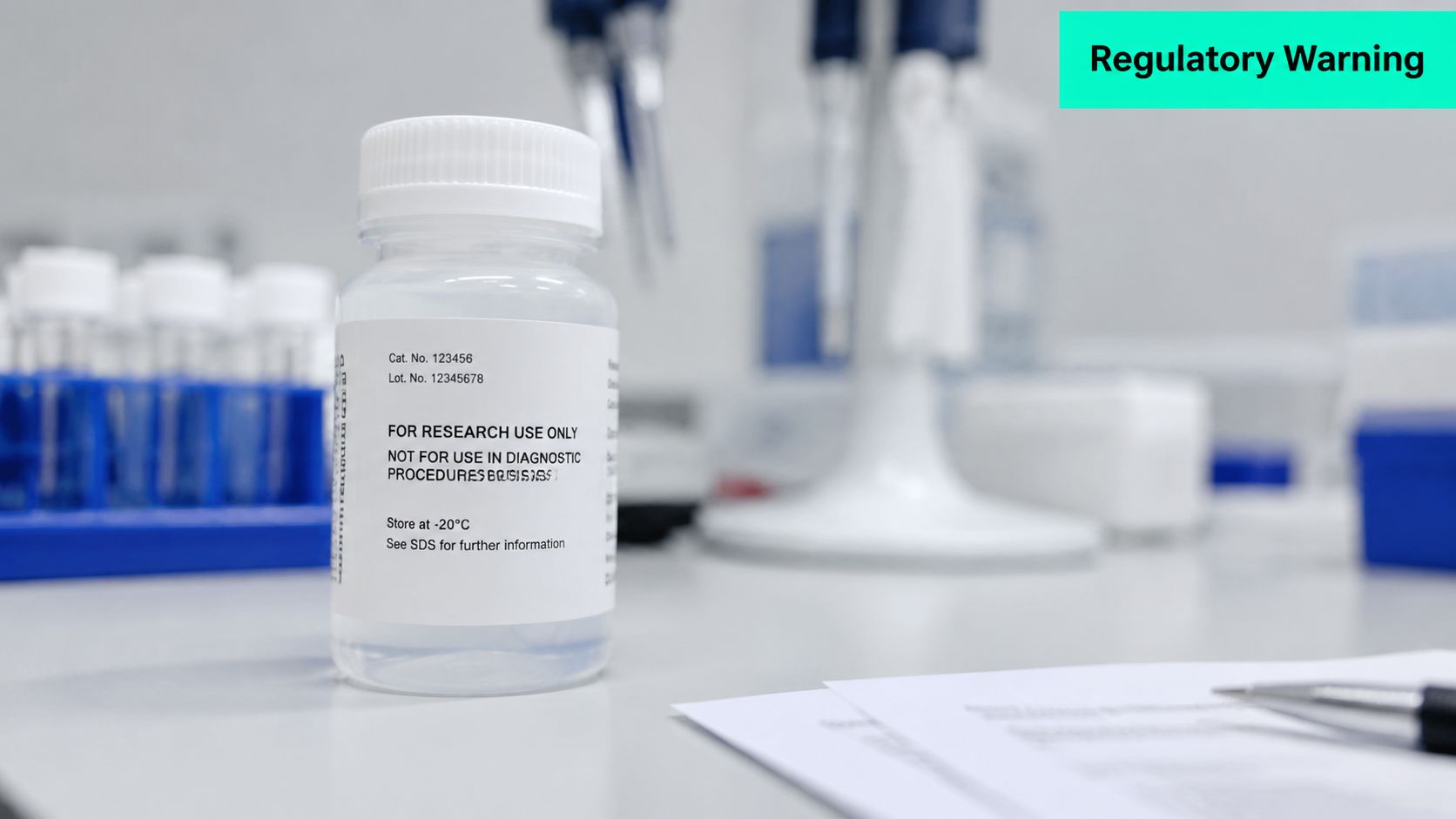
The Consumer Med Safety guidance on wellness peptides sold online states that the FDA explicitly warns that “research only” peptides sold online are dangerous because they have not been evaluated for safety and may be contaminated or contain the wrong ingredient. That's the point many buyers miss. RUO status does not mean reviewed, validated, or safe for human use. It means the opposite of that assumption.
The grey market often uses this label as a shield. A seller can present the language of research while attracting customers whose actual use has nothing to do with legitimate laboratory work. For a lab, that creates both practical and compliance risk. You don't want your procurement trail mixed up with vendors whose positioning blurs the line between research supply and informal self-experimentation.
RUO tells you what regulatory protection is absent. It does not tell you what quality controls are present.
That distinction matters for institutions. A peptide can be acceptable for a defined research application only if your lab can show why it was sourced, how it was documented, and how it will be used under the rules that apply to your work.
A well-run lab doesn't rely on a disclaimer. It builds a paper trail. That usually includes internal records for the scientific purpose of the purchase, the selected supplier, the analytical documents reviewed, and the handling steps taken after receipt.
In practical terms, keep these items together in your procurement record:
If a vendor appears to market to both researchers and end users seeking wellness outcomes, pause there. That mixed positioning complicates oversight and raises avoidable questions. Clean procurement is part of clean science.
A peptide can be manufactured correctly and still arrive unsuitable for use, which is a common pitfall for many labs. They evaluate the supplier and the COA, then treat shipping as routine fulfillment. It isn't.
Early in the handling chain, visual process helps. Use this as the working model:
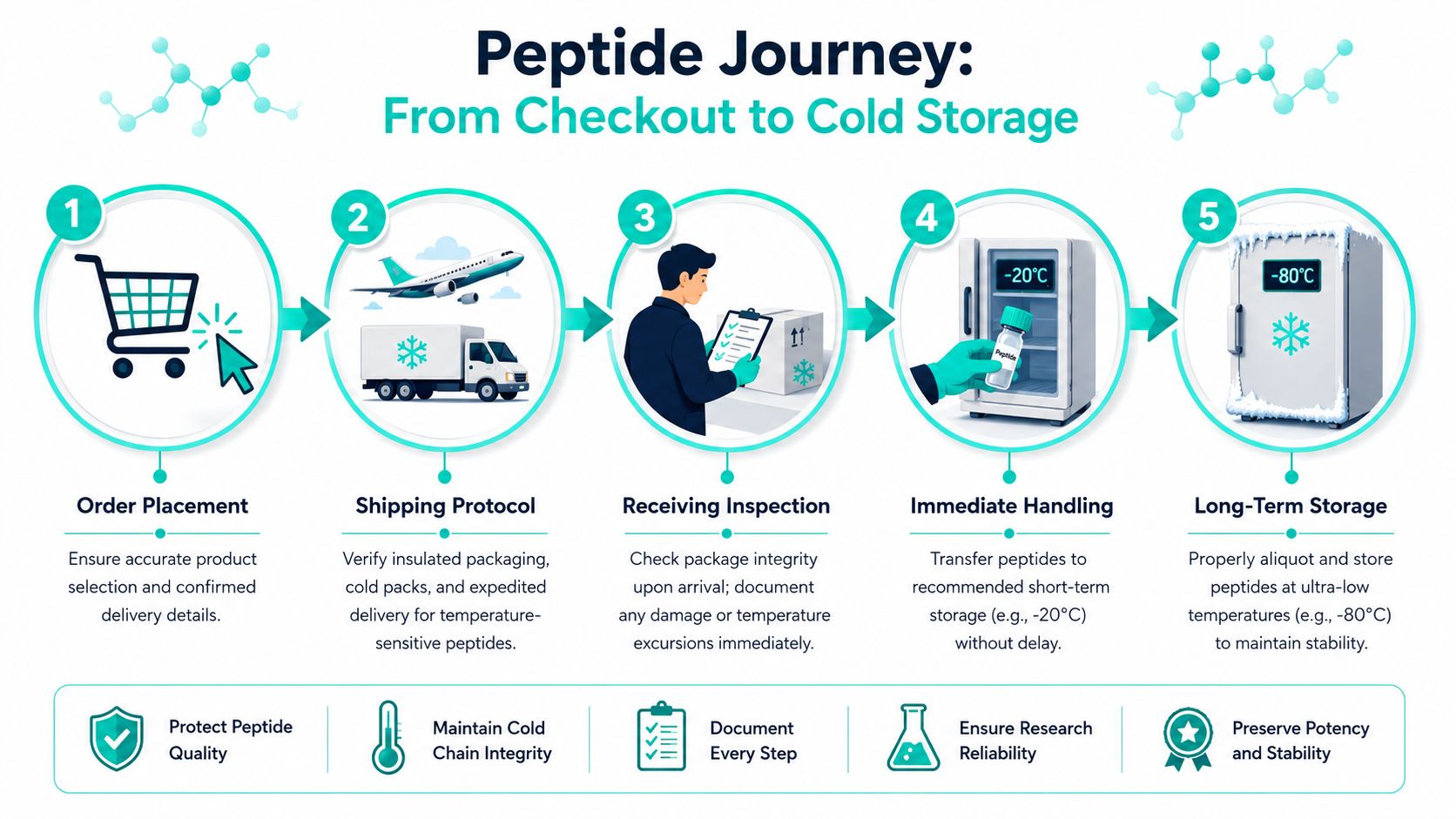
The medical safety discussion of peptide shipping and handling from Ubie Health notes that peptides are sensitive to temperature, and improper cold-chain shipping can degrade the compound, rendering it inactive or harmful. That's the logistics gap most product pages skip over. “Fast shipping” sounds good, but speed without verified temperature control can still leave a peptide exposed to damaging conditions.
That means you should ask very specific fulfillment questions before ordering temperature-sensitive material:
If support can't answer basic shipping-control questions, you're not buying a managed reagent. You're buying a gamble.
A quick technical refresher can help teams understand why this matters:
Receiving is part of quality control. Don't let packages sit in a mailroom, on a PI's desk, or at a reception counter while the team is in meetings.
On arrival, inspect and document:
A peptide shipment should have an owner before it ships. If no one is assigned to receive and store it, expect preventable handling errors.
If something looks wrong, document it before the material is redistributed, reboxed, or casually stored. Photos, timestamps, and written notes matter if you later need to question the lot.
Good labs lose good material through bad storage all the time. The most common failures are repeated freeze-thaw exposure, vague labeling after reconstitution, and leaving partially used vials in whatever freezer space happens to be available.
Treat storage as a controlled step:
What works is discipline. What doesn't is relying on memory, verbal handoff, or “we'll label it later.” The peptide you ordered is only the starting point. The peptide you test depends on every handling step after that.
Buying peptides online becomes manageable when you stop treating each purchase as a fresh judgment call. The labs that avoid repeat mistakes convert hard-earned caution into a routine workflow.
A workable peptide procurement SOP doesn't need to be complicated. It needs to be followed. The strongest version usually includes five checkpoints:
Supplier screen before approval
Verify business identity, support access, published policies, and whether batch-specific documentation is available.
Document review before payment
Check the COA for lot traceability, analytical method visibility, and identity support.
Compliance review before use
Confirm the order fits the lab's research purpose and internal controls for RUO material.
Receiving inspection on delivery day
Assign one person to inspect, document, and store the shipment immediately.
Storage and use controls after intake
Aliquot, label, and track the material like any other assay-critical reagent.
This process changes the role of procurement. Instead of hoping the reagent works, your lab removes known sources of preventable failure. That improves reproducibility, simplifies troubleshooting, and makes it easier to defend your methods when results matter.
The labs that struggle usually aren't careless. They're busy. They let urgency outrun review, and procurement becomes the soft spot in the experimental chain. Peptides punish that habit quickly.
Build the workflow once. Then make every new order pass through it.
If your lab needs a peptide supplier that supports a documentation-first purchasing process, Celonyx Labs is worth evaluating. Their published policies, listed business contact details, online catalog, and stated third-party testing give researchers the basic materials needed for supplier review before an order is placed.
Is bacteriostatic water the same as sterile water? No. Compare preservatives, vial handling and peptide

How do you know if a peptide vial has gone bad? Quarantine changes, check storage

Can too much bacteriostatic water ruin a peptide vial? Yes, if it overfills the vial
FOR RESEARCH USE ONLY. Products sold by Celonyx Labs are intended exclusively for laboratory and scientific research. They are not intended for human or veterinary use, consumption, diagnosis, treatment, cure, or prevention of any disease. By purchasing from this site, you acknowledge that you understand the intended research purpose of these materials and agree to comply with all applicable laws and regulations.