6 Acetic Acid: What It Means and Where It Fits in Research
What does “6 acetic acid” tell you about the bottle on your bench? Not much,
What does “6 acetic acid” tell you about the bottle on your bench? Not much, unless you know whether the number describes percent weight per volume, percent weight per weight, assay, or an informal dilution. Treating the phrase as a typo can lead you to the wrong grade, the wrong handling assumptions, and a Certificate of Analysis that doesn't support your method.
In a research setting, the phrase usually points toward a recognized low-concentration commercial specification, commonly expressed as 6.0 g of acetic acid per 100 mL. PubChem lists 6% as a commercial grade and identifies NF diluted acetic acid at 6.0 g/100 mL (PubChem compound record for acetic acid). That distinction matters. A supplier's 6% product isn't automatically equivalent to glacial acetic acid diluted informally in the laboratory, and it isn't automatically interchangeable with food vinegar.
What does “6 acetic acid” mean on a supplier page? In practice, it is purchasing shorthand for 6% acetic acid, not a chemical name. Before approving an order, ask one direct question: 6% on what basis? A specification of 6.0 g/100 mL expresses weight per volume. A different product may report percentage by weight. Those values are not automatically interchangeable because the denominator differs.
The recognized low-concentration commercial benchmark is NF diluted acetic acid at 6.0 g/100 mL. The NF specification gives you a fixed reference for comparing a supplier's product page, technical data sheet, and lot-specific COA. Because the NF value is defined volumetrically, a product described as 6% w/w is not equivalent merely because the nominal number matches.
Glacial acetic acid is an almost pure form used as a concentrated reagent and industrial feedstock. Its handling demands are substantially greater than those of a dilute aqueous solution. Household vinegar is a food product with acetic acid in the low single-digit range, but its label and impurity profile are not designed to support a controlled research method.
A 6% product occupies a practical middle position. It supplies a defined concentration above ordinary vinegar-type material without relying on an informal bench dilution of concentrated acid. That can reduce weighing and dilution errors, simplify routine preparation, and make batch records easier to audit. The concentration alone, however, does not establish reagent grade or suitability for every method.
The Virginia Department of Health advises that concentrated acetic acid can irritate or burn skin and eyes. Dilution lowers the hazard, but it does not make handling casual. Use the supplier's safety data and your laboratory's controls to determine appropriate storage, PPE, and spill response.
Bench rule: Never approve “6% acetic acid” from the label alone. Confirm the concentration basis, grade, lot number, and supporting COA.
Your review should answer three questions. Does the concentration match the method? Do the listed impurities fit the application? Can you trace the exact lot from delivery through use? If any answer is no, the bottle is not fully qualified for a controlled workflow.
What connects ancient vinegar with a modern 6% commercial grade? The chemistry is the same, but the controls around concentration, purity, and documentation are very different. Acetic acid first appeared as a fermentation product long before laboratories and petrochemical plants. Vinegar-type material was produced as far back as the third millennium BCE, and acetic acid is commonly described as the first acid made in large quantities in human history (historical and industrial overview of acetic acid). Early material was aqueous and impure, with composition shaped by fermentation, storage, and processing.
Industrial manufacturing later changed both scale and supply. Global demand reached about 17.88 million metric tonnes per year in 2023, compared with earlier estimates of about 5 million tonnes per year during 2003 to 2005. Large-scale production now relies mainly on petrochemical routes, especially methanol carbonylation, rather than the fermentation process associated with vinegar.
A junior researcher may see several percentages and assume they represent interchangeable grades. They do not. Concentration is one product attribute. Grade, impurity limits, intended use, and the governing specification provide the rest of the qualification.
Percentages such as "30%" or "56%" identify concentration only. They do not establish a universal grade, assay tolerance, or applicable standard. Use the supplier's specification sheet and the lot-specific COA to determine what was sold.
| Grade | Typical % w/v | Assay Tolerance | Primary Use | Governing Standard |
|---|---|---|---|---|
| Food vinegar | Low single-digit range | Product-specific | Food and household use | Food labeling requirements |
| NF diluted acetic acid | 6.0 g/100 mL | Monograph or supplier specification | Pharmaceutical and laboratory workflows | NF where specifically stated |
| Reagent or technical solution | Supplier-defined | Supplier-defined | Process, cleaning, or research preparation | Applicable supplier standard |
| Glacial acetic acid | Near-pure material | Supplier-defined | Synthesis and concentrated reagent work | ACS, NF, or technical specification where stated |
Six percent sits on a practical low-to-middle rung. It is a recognized diluted commercial specification, not merely an informal vinegar description. The qualifier still matters: NF, ACS, technical, and food specifications answer different quality questions. Before accepting a bottle, compare its stated basis, assay limits, impurity requirements, and lot documentation with the method's requirements.
A 6% solution is useful when the protocol needs a controlled acidic environment without requiring the researcher to handle a concentrated stock at every step. The exact application depends on the method, but the decision principle stays consistent: choose the lowest concentration that delivers the required chemistry and the impurity control the method can tolerate.
In histology, dilute acetic acid can support tissue-processing workflows where acid exposure needs to be controlled. Researchers may use it in decalcification, stain differentiation, or nuclear staining procedures, but the method must define exposure time, temperature, tissue type, and washing steps. A concentration that works gently for one specimen can damage morphology if the contact time or temperature changes.
The solution's value is reproducibility. A prepared 6% product gives the operator a known starting point instead of relying on the variable composition of vinegar or an undocumented dilution made from a concentrated bottle.
Some microbiology protocols use dilute organic acid solutions for selective washing, pretreatment, or reduction of background growth. The method should specify whether the target organisms remain viable and whether the acid treatment changes recovery. Do not substitute a 6% solution for a protocol that calls for a different concentration just because both products carry the word “acetic.”
Analytical workflows may also use acetic acid for mobile-phase acidification, buffered-matrix adjustment, or controlled hydrolysis. For HPLC, the important details include concentration basis, solvent grade, filtration, and compatibility with the detector and column. For peptide work, solvent selection must follow the method rather than assumption. Celonyx Labs discusses the distinction between acidic acetic acid water and bacteriostatic water in its acetic acid versus bacteriostatic water solvent guide.
Acetic acid is a weak acid, so its effect depends on concentration, pH, temperature, matrix composition, and the presence of conjugate bases. A 6% solution isn't “mild vinegar.” It has a defined acid content that can change buffer capacity, protein behavior, extraction conditions, or hydrolysis kinetics.
Use a 6% material when the protocol or validated method calls for it. Record the product grade, lot, concentration basis, preparation date, and any dilution you make. Those details turn a bottle into a traceable reagent rather than an unexplained variable.
A product page tells you what the supplier intends to sell. A Certificate of Analysis tells you what the supplier says about a particular lot. For research purchasing, the second document matters more.
Start with the assay line. A well-described 6% product should state whether the value is w/v or w/w, identify the test method or reference method where applicable, and provide an acceptance range. A practical review benchmark is a stated result within 5.8 to 6.2%, when that range matches the supplier's declared basis and specification. The benchmark reflects the requested low-strength grade, not a universal acceptance limit for every application.
The acid doesn't arrive alone. Impurities can originate in the concentrated acetic acid used to make the solution, the dilution water, the container, or the manufacturing process.
Look for limits or results for:
Don't accept a COA that lists only “pass.” You need to know what was tested, against which limit, and whether the result applies to the lot you received.
A credible document should connect the result to the container in your hand. Check the lot number, manufacturing date, expiry or retest date, storage conditions, product name, concentration basis, and authorized signatory or electronic approval. A signature line doesn't make inaccurate data valid, but it shows that the supplier has assigned responsibility for releasing the document.
| Parameter | Lot A, strong COA | Lot B, weak COA |
|---|---|---|
| Concentration basis | Clearly states 6.0 g/100 mL w/v | Says “6%” without basis |
| Assay result | Reports a lot result and acceptance range | Reports “passes” only |
| Chloride and sulfate | Individual limits and results | Not listed |
| Heavy metals | Method and limit identified | “Complies” without detail |
| Residue on evaporation | Numerical result or defined limit | Not reported |
| Lot traceability | Lot, manufacture, expiry, and release approval | Lot shown, dates missing |
| Storage | Sealed-container storage instruction | Generic “store properly” |
Lot A is better qualified because it lets you compare the material with your method. Lot B may still represent a usable product, but the document doesn't give you enough information to make that decision confidently.
Documentation rule: If the COA can't identify the lot, concentration basis, test result, and release authority, treat it as incomplete until the supplier corrects it.
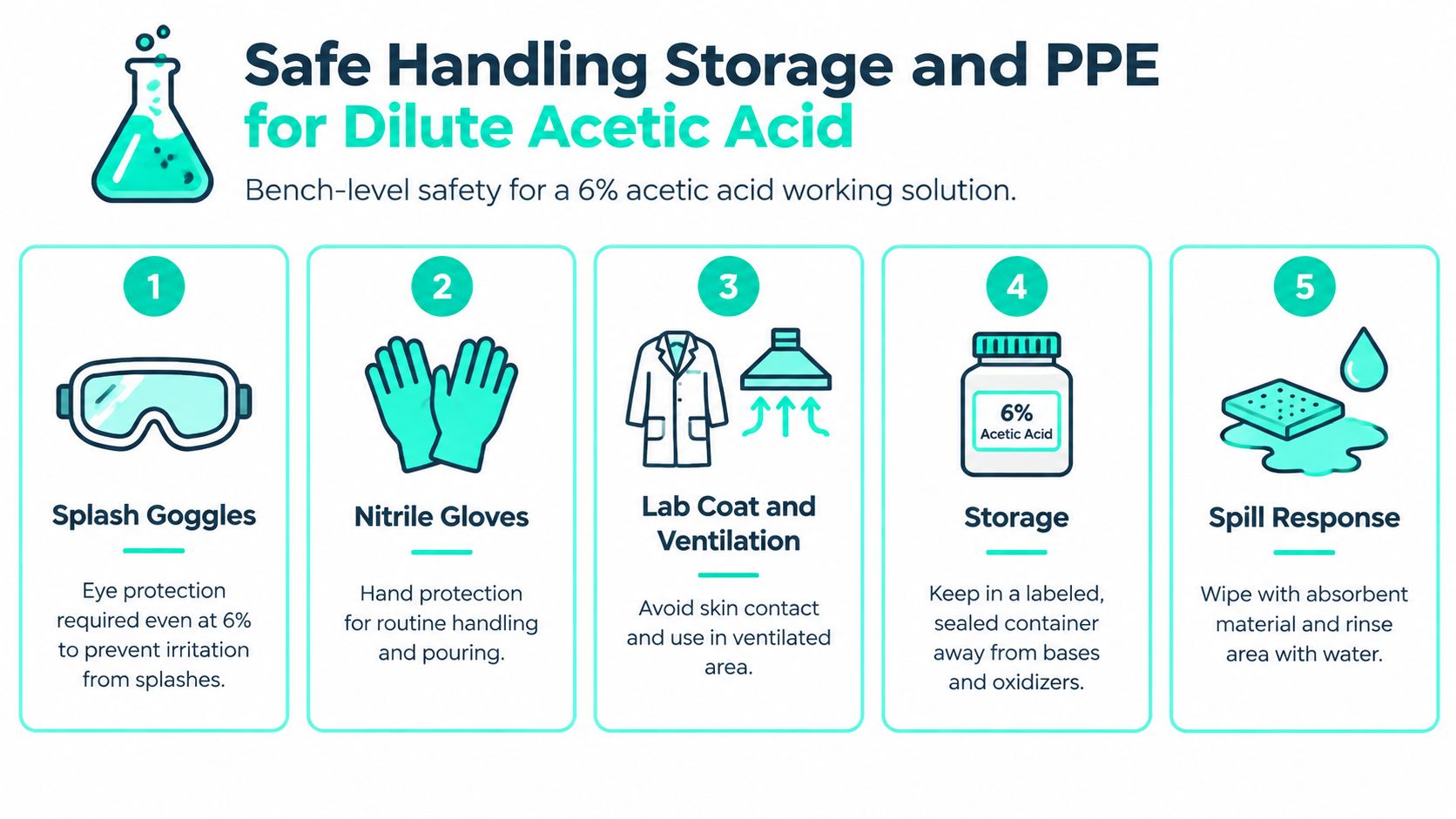
Could a solution specified as 6% still injure you? Yes. Dilution lowers the hazard compared with concentrated or glacial acetic acid, but splashes can irritate eyes and skin. Heating, repeated transfers, vigorous mixing, and open-container work increase exposure potential. Review the Virginia's acetic acid safety guidance alongside the product SDS and your institution's risk assessment.
For routine pouring and transfer, wear splash goggles, nitrile gloves, and a lab coat. A well-ventilated bench suits ordinary closed-container work. Perform heating, vigorous mixing, and open-container operations in a fume hood. The label concentration does not replace the SDS, task assessment, or required laboratory training.
Use a compatible, clearly labeled container, such as suitable amber glass or HDPE. Close the cap whenever the solution is not in use. Keep it away from bases, strong oxidizers, and amines, and place the container in secondary containment. Laboratories storing several acid products can browse acid resistant cabinets when evaluating storage arrangements.
Before starting work, locate the eyewash and confirm that it is immediately accessible from the bench. For a small spill, follow your site's procedure. Controlled neutralization with dilute sodium bicarbonate may be permitted, followed by absorbent cleanup and a water rinse. Do not improvise for a large spill, irritating vapor, or contact with incompatible materials. Your laboratory should define escalation and reporting requirements.
Waste handling needs the same discipline. Do not pour the solution down the drain unless local rules and your institution's chemical-waste procedure permit dilute aqueous organic acids. Keep waste away from bleach, oxidizers, and unknown liquids. If the solution is used with peptide materials, keep its chemical handling plan separate from the reconstitution steps in this guide to reconstituting peptides.
The following video can supplement, but never replace, the SDS and laboratory training.
A supplier-issued COA answers one question: what did the supplier's quality system report for this lot? Independent testing asks the same or related questions through a laboratory that isn't the manufacturer. That extra layer is most valuable when you're qualifying a new vendor, validating a method, investigating inconsistent results, or supporting a regulated or published workflow.
For concentration, an independent laboratory can use acid-base titration. Titration confirms acid content, but it doesn't identify every impurity in the bottle. A sample can meet an assay target while still carrying contaminants that matter to your application.
For elemental contamination, laboratories may use ICP-MS or ICP-OES. A 6% aqueous acid matrix can complicate trace-metal work because the dilution water and container can contribute to the signal. Ask about blanks, sample preparation, detection limits, and whether the reported result is below detection or merely not tested.
Organic impurity testing may use HPLC or GC. Depending on the production route and specification, the laboratory might examine residual compounds such as formate, glycol, or aldehydes. The method must identify the analytes and reporting limits. “Organic impurities tested” isn't enough.
An ISO 17025 accredited laboratory operates under a recognized framework for laboratory competence, methods, equipment, records, and quality controls. An unaccredited certificate may still provide useful information, but it carries less formal weight when the data support a regulatory filing, a quality investigation, or a publication method section.
Ask for the complete report, not a cropped summary. Check the laboratory identity, sample identification, receipt condition, test date, method references, units, detection limits, uncertainty where reported, and authorization. For a practical comparison of external verification logic, see this guide on verifying third-party-tested peptides.
Risk-based choice: Routine purchases from a qualified vendor may not need independent testing. New suppliers, unusual applications, and high-consequence workflows deserve a stronger verification plan.
Third-party data don't replace good storage, lot control, or a fit-for-purpose grade. They help you determine whether the supplier's stated quality is supported by evidence that you can inspect and retain.
Treat the purchase order as the first quality-control record. A quick review can prevent the most expensive mistake in this category, receiving a product whose label sounds right but whose concentration basis or documentation doesn't fit the method.
Confirm the grade. Decide whether the work requires NF, ACS, technical, or another named specification. Don't use “laboratory grade” as a substitute for a defined standard.
Confirm the concentration basis. Require the supplier to state whether the product is 6.0 g/100 mL w/v, 6% w/w, or another basis. If your method calls for the NF-style benchmark, make sure the product description and COA use compatible language.
Review the COA before ordering. Look for the assay result, acceptance range, impurity limits, test methods, lot number, manufacture date, expiry or retest date, storage instructions, and authorized release.
Check the supplier's traceability. Confirm that the container will carry the same lot identifier shown on the COA. Review packaging, tamper evidence, SDS version, shipping classification, and the supplier's process for handling damaged or leaking containers.
Prepare the safety controls. Have goggles, gloves, a lab coat, compatible storage, secondary containment, spill materials, and an accessible eyewash ready before delivery. A chemical shouldn't arrive before the bench is prepared for it.
Order a sensible quantity. Match the volume to the work and storage capacity. If the product requires special packaging or temperature control, confirm those logistics and any minimum order requirements in advance.
For broader documentation practices, the Verbal Experiment supply chain guide offers useful context on maintaining records across purchasing and receipt.
Two procurement errors appear repeatedly. The first is ordering glacial acetic acid when the method specifies a 6% working solution. The second is accepting a COA that doesn't belong to the delivered lot, or a document whose date and product identity can't be reconciled with the container.
Before finance sees the request, save the product specification, SDS, and lot-specific COA with the purchase record. When the bottle arrives, photograph the label, verify the lot, inspect the seal, and record the receipt date. That small amount of discipline protects your method from an avoidable reagent variable.
Celonyx Labs supplies research peptides through an online catalog and describes product quality using stated 99% purity and independent third-party testing, with ordering and customer support available through its website. Visit Celonyx Labs to review its research products and quality documentation before planning your next peptide workflow.
What does “6 acetic acid” tell you about the bottle on your bench? Not much,

Best sterility testing kits for 2026 peptide labs: Endosafe nexgen-PTS wins on speed, Steritest for

Compare the best peptide reference standards for analytical research in 2026, ranked by purity, COA
FOR RESEARCH USE ONLY. Products sold by Celonyx Labs are intended exclusively for laboratory and scientific research. They are not intended for human or veterinary use, consumption, diagnosis, treatment, cure, or prevention of any disease. By purchasing from this site, you acknowledge that you understand the intended research purpose of these materials and agree to comply with all applicable laws and regulations.