
How to Buy Peptides: A Lab Buyer’s Guide
It's Tuesday morning, and you need five custom peptides on the bench by Friday. Three
It's Tuesday morning, and you need five custom peptides on the bench by Friday. Three vendor tabs are open. One advertises an attractive price, another highlights a purity percentage, and a third promises fast shipping. None of that tells you whether the material will arrive with usable documentation, whether the lot will match the certificate, or whether anyone will answer when the shipment has a problem.
That's the procurement reality behind how to buy peptides responsibly. The purchase decision isn't just about finding a product page. It's about protecting the experiment, the budget approval, and your institution's compliance record. The modern peptide synthesis market is already a substantial international industry, with multiple 2026 estimates placing its 2025 value between roughly USD 0.9 billion and USD 1.8 billion, and projections generally rising through the next several years (Mordor Intelligence's peptide synthesis market overview). Mature supply chains create higher expectations. Suppliers should be able to document what they sell, how they ship it, and what happens when an order fails.
Before entering a credit card number, run the supplier and product through four gates: supplier legitimacy, product documentation, shipping feasibility, and post-sale accountability. These checks are deliberately boring. They're also where most preventable procurement failures occur.
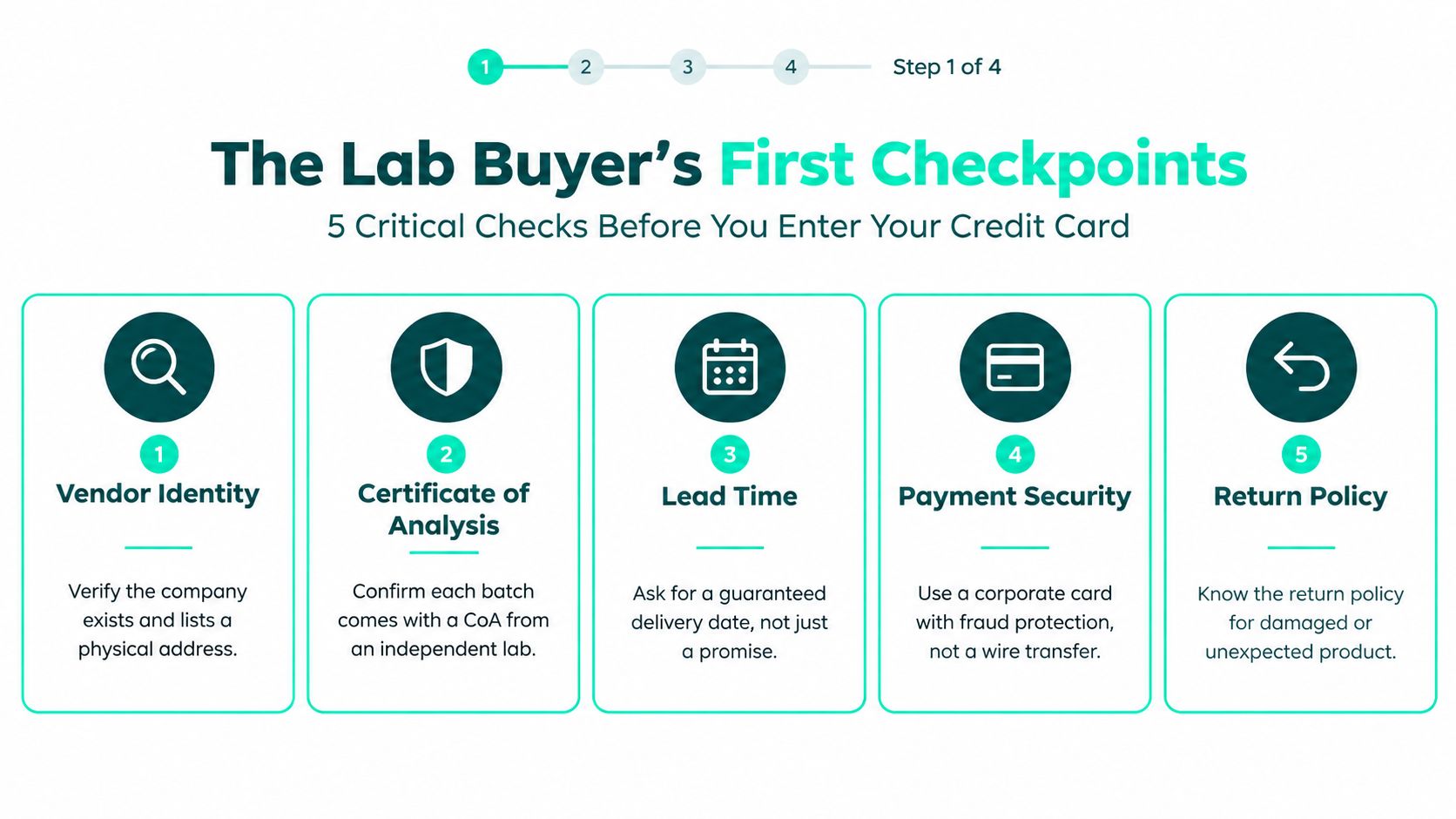
Confirm that the company identifies itself clearly. Look for a business name, physical address, working phone number, and a contact path for quality or compliance questions. A polished storefront isn't proof of legitimacy, and a low introductory price doesn't compensate for an untraceable supplier.
Ask for a batch-tied certificate of analysis, not a generic product statement. The lot number on the document must be capable of matching the vial you receive. Documentation should identify the analytical methods used and provide an identity check, rather than relying only on a headline purity claim.
A peptide order can fail even when the material is acceptable. Confirm the actual lead time, receiving address, delivery restrictions, signature requirements, packaging approach, and what the vendor does if the shipment is delayed or arrives compromised. Your institutional dock may close earlier than the carrier's route, and a promised dispatch date isn't the same as a usable delivery date.
Read the refund, replacement, and dispute terms before payment. If a vendor says all sales are final, refuses to address failed testing, or makes you hunt for the dispute window, treat that as a procurement risk.
Procurement rule: Price and advertised purity get a supplier onto the shortlist. Documentation and policy clarity decide whether the supplier stays there.
The rest of the purchase should follow this same gating logic. Vet the business first, inspect the COA second, confirm the delivery workflow third, and settle payment only after the paperwork supports the order.
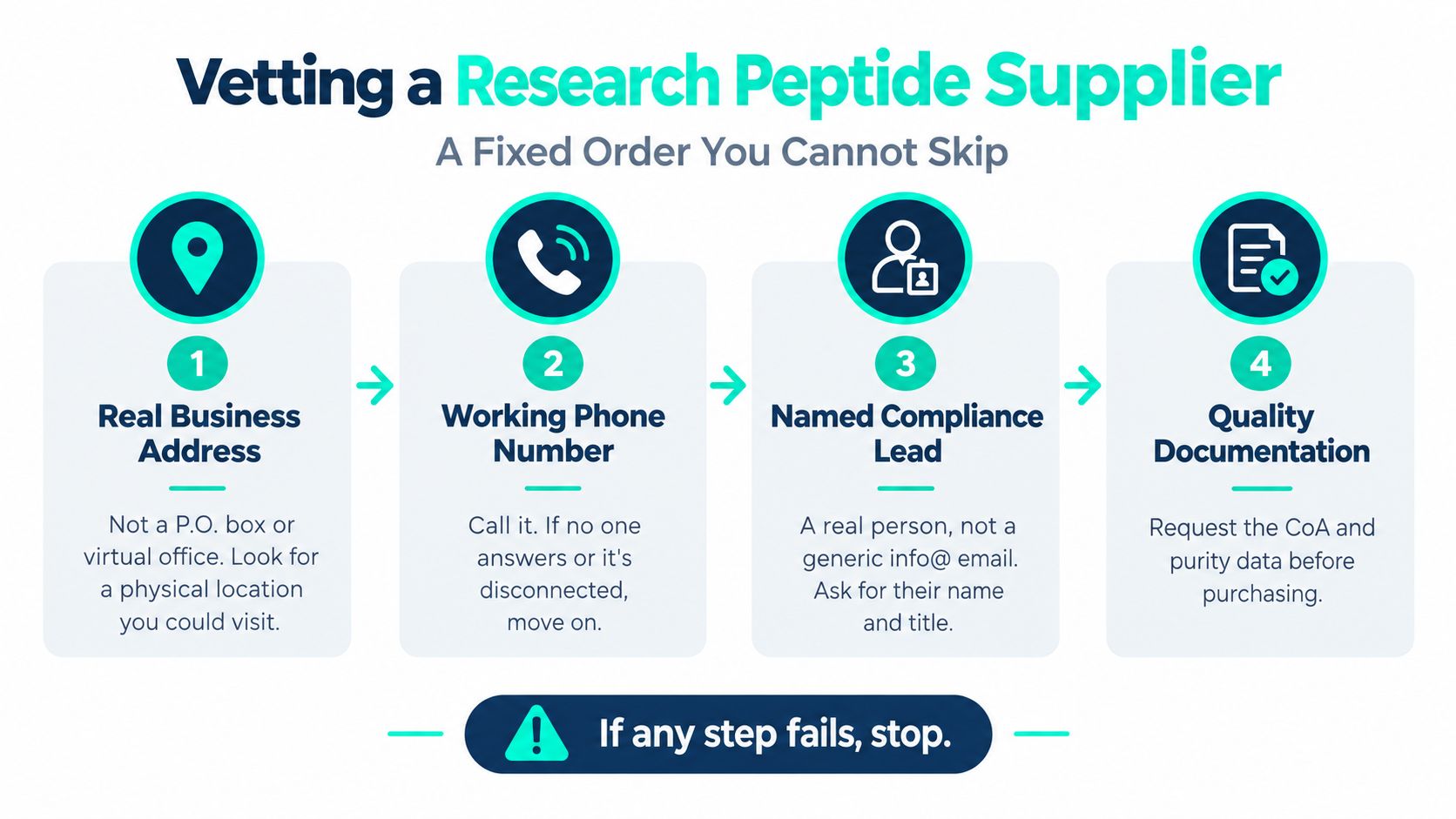
Supplier vetting works best in a fixed order. Don't start with reviews or a discount code. Start with the contact trail, because every later quality question depends on having a real organization willing to answer it.
A credible supplier should publish a physical business address and a working telephone number. Call the number. Ask who handles quality documentation and request the name and title of that person. A generic contact form or an email address with no accountable contact makes escalation difficult when a lot is delayed, mislabeled, or disputed.
The terms page should also be easy to find and readable. Check whether it explains research-use restrictions, storage and handling expectations, shipping limitations, intellectual-property terms, and customer responsibilities. “Research use only” describes intended use, but it doesn't erase the need for accurate declarations, traceable sourcing, or lawful import documentation. Regulatory scrutiny has intensified, including FDA attention to peptide-related immunogenicity and compounding frameworks that distinguish bulk drug substances by their regulatory and safety status (FDA scientific and regulatory considerations).
The refund and reshipment policy matters more than a polished FAQ. Look for a documented process covering damaged vials, incorrect products, mismatched lots, failed purity testing, and shipments that don't arrive within the stated window. “All sales final” is not a quality assurance system.
A reasonable policy should tell you what evidence the supplier needs, how quickly you must report a problem, and whether the remedy is a replacement, credit, or refund. Save a copy of the policy with the purchase record because websites change.
For temperature-sensitive materials and specialized laboratory logistics, cryogenic supplier tips can provide useful procurement context beyond the peptide category itself. You should also document your own approval path using a formal vendor qualification process rather than treating a first successful delivery as permanent approval.
Third-party testing transparency is the final filter. COAs should be available before checkout, linked to a specific lot, and retrievable without a special request after a problem occurs. If any of the four areas is vague, the discount doesn't matter.
A COA isn't useful because it has a laboratory logo at the top. It's useful when you can connect the document to the exact material in your receiving record.
At minimum, check the lot number, test date, analytical method, and identity confirmation. The lot number should match the vial label and packing documentation. The test date should make sense relative to manufacture and shipment. The document should name methods such as HPLC, mass spectrometry, or both, rather than presenting an unexplained purity result.
Identity confirmation deserves special attention. A chromatogram can show a dominant signal without proving that the material is the compound named on the label. Mass spectrometry or an appropriate amino-acid analysis provides a stronger basis for confirming identity than a vague “fingerprint” statement.
The easiest number to advertise is purity. It's also the weakest number when it stands alone. A claim such as “purity above 98%” doesn't tell you whether the PDF belongs to your lot, which method produced the result, or whether the primary peak represents the intended peptide.
| COA Field | Full Lab COA | Purity-Only Claim |
|---|---|---|
| Lot identification | Matches the vial, invoice, and receiving record | May be absent or generic |
| Test date | Shows when the specific lot was analyzed | Often omitted |
| Analytical method | Names HPLC, MS, or another defined method | No method described |
| Identity confirmation | Provides mass-spectrometry or comparable evidence | Purity is treated as identity |
| Traceability | Document can be retrieved before and after purchase | PDF may be unavailable until requested |
| Review value | Supports comparison between lots and vendors | Supports marketing, not an audit trail |
Reject the document if the lot number is missing, the method is undefined, or the PDF cannot be matched to the vial you're buying. Don't accept a vendor's promise to “send the COA later” when the document is central to your approval decision. For a practical example of the records researchers should examine, review peptide test results and compare the level of detail with the supplier's own paperwork.
A research-grade peptide has documentation that follows the batch. A research-claimed peptide has a label and a sales description. Those are not equivalent.
Treat fulfillment as a controlled sequence, not a single checkout event. The order should move from an approved purchase request to a confirmed order, then to documented receipt and inspection.
Start with a confirmed purchase order or online submission that states the sequence or catalog identifier, quantity, requested purity specification, and delivery address. Require an order confirmation email that includes the expected ship date and, when available, the batch or lot reference. If the vendor can't confirm what lot will ship, record that uncertainty before approval.
When the package arrives, inspect it before placing the material into storage. Check for sealed vials, intact labels, appropriate desiccant, temperature indicators when relevant, and batch-matched documentation inside the box or in the electronic order record. Photograph damaged packaging, leaking containers, crushed cartons, or labels that don't match the paperwork.
Receiving rule: Don't resolve a damaged or mismatched shipment verbally and then move on. Create a dated record while the evidence is still available.
Expedited shipping is justified when the order is difficult to replace, the material is thermally sensitive, the quantity is substantial, or a grant or instrument schedule leaves little recovery time. Standard ground service can be adequate when the material is stable under the supplier's stated conditions and the laboratory has receiving coverage. The correct choice depends on the material and the consequence of delay, not on a blanket preference for the fastest option.
| Shipping Tier | Best Use Case | Cost Premium | Risk Threshold |
|---|---|---|---|
| Standard service | Stable material and flexible bench schedule | Lower | Acceptable when delay won't disrupt work |
| Expedited service | Compressed research timeline or limited receiving window | Higher | Appropriate when delay creates material or scheduling risk |
| Overnight service | Time-critical receipt or sensitive shipment | Highest | Reserve for orders where recovery is difficult |
For a broader view of order confirmation, packing, dispatch, and delivery controls, the AUSFF e commerce fulfillment guide offers useful process context. Before dispatch, verify the institutional address, dock hours, contact name, and signature requirements. Flag building closures immediately. If a shipment arrives warm, damaged, or with the wrong lot, photograph everything, notify the vendor within the stated dispute window, and file a carrier claim when appropriate. Keep copies of the notification and response in the order folder. Internal planning around fast shipping companies can also help your team compare delivery options before a deadline becomes urgent.
Checkout is where otherwise sound procurement often becomes messy. A lab needs more than a successful card authorization. It needs records that accounts payable, grant administrators, and auditors can understand later.
Before paying, confirm that the vendor can produce a clean PDF receipt or invoice tied to the order and batch number. The line item should identify the material clearly enough for your institution's accounting system, rather than using an ambiguous description such as “lab supplies.” If your organization uses NetSuite or SAP, ask whether the invoice can include the purchase order number, ship-to location, tax status, and separate freight charges.
Tax-exempt documentation should be handled before the first order, not after the card has been charged. Ask whether the supplier accepts purchase orders and whether NET-30 terms are available. If the vendor accepts only card payments, establish that limitation early so the request doesn't stall in an approval queue.
Use a PCI-compliant payment gateway and keep payment records inside the institution's approved system. Tokenized saved payment details can make repeat orders easier, but the lab should still control who can access the account and who can submit purchases.
With a new supplier, avoid wire transfers until the first order has cleared cleanly and the vendor has demonstrated responsive support. A corporate card provides a clearer dispute path than an irreversible transfer. That matters when a supplier refuses to reship, sends a mismatched lot, or fails to provide the documentation promised before payment.
Common checkout problems are usually administrative:
Create a dedicated procurement folder keyed to the batch number. Store the quote, approval, order confirmation, receipt, COA, shipping record, and support correspondence together. That simple habit turns a one-time purchase into a traceable institutional record.
The fastest way to assess a supplier is to ask a difficult question before paying. A homepage can look professional for months. A support response reveals whether the organization can handle a real laboratory request.
Send a concise pre-order message and ask for the lot-specific COA before checkout. Ask which independent laboratory performed the HPLC and mass-spectrometry work, whether the same lot will ship if the product goes on back order, and what evidence the vendor requires to replace a damaged vial. You're testing both knowledge and process.
Ask for the catalog number, available lot, expected ship date, and document associated with that lot. A credible response should contain specific answers and usable attachments or links. It shouldn't repeat a marketing phrase about high purity or tell you to place the order first.
Use the communication channel that fits your institution, phone, email, or live chat. The channel itself isn't the test. The substance is. A phone call that produces no name, no document, and no follow-up is no better than a generic form response.
Support test: Ask a question that requires the vendor to consult a record. The answer tells you more than a collection of customer testimonials.
Watch for warning signs:
Treat pre-sales support as a free consultation. You're not asking for special treatment. You're determining whether the supplier can support the documentation and communication burden that comes with laboratory purchasing. If the vendor is evasive before receiving payment, expect more friction after it.
A good checklist should be short enough to use and strict enough to stop an avoidable order. Put each question into your SOP or shared drive and require a pass or fail response before releasing the purchase order.
For broader guidance on building repeatable purchasing controls, procurement best practices 2026 offers useful process ideas. Reuse this checklist for repeat vendors, not just first orders. A supplier can change its testing partner, fulfillment location, payment process, or return terms, so the vendor file should contain current COAs, invoices, and shipping logs.
The lab that documents each gate can defend its purchase decision. The lab that skips one eventually spends more time resolving mismatched lots, missing records, and support disputes than it saved at checkout.
Celonyx Labs provides an online catalog for research peptides, published ordering and shipping policies, customer support, and stated independent third-party testing information. Review the documentation and procurement details at Celonyx Labs before deciding whether its workflow fits your laboratory's approval, receiving, and record-keeping requirements.
It's Tuesday morning, and you need five custom peptides on the bench by Friday. Three

Comparing Ibisci.com alternatives in 2026? Celonyx Labs delivers 99% pure, third-party tested research peptides with

Compare nationwidepeptides.com alternatives for 2026, including Celonyx Labs, Core Peptides, and Peptide Sciences, with honest
FOR RESEARCH USE ONLY. Products sold by Celonyx Labs are intended exclusively for laboratory and scientific research. They are not intended for human or veterinary use, consumption, diagnosis, treatment, cure, or prevention of any disease. By purchasing from this site, you acknowledge that you understand the intended research purpose of these materials and agree to comply with all applicable laws and regulations.