

Research Peptides for University Labs: Verify First (2026)
Research peptides for university labs require documented purity, lot traceability, and controlled handling. Use this

Research peptides for veterinary research programs are laboratory-grade peptide compounds supplied for use in animal-model studies, not for treating live animals in a clinical setting. Sourcing them for a vet research program means matching species-relevant study design with third-party purity verification, not picking whichever vial ships fastest.
Animal-model studies run on cohorts, not single subjects, which means every peptide batch used across that cohort has to be chemically identical to the one before it. A purity swing between batch one and batch four doesn't just add noise, it invalidates the comparison the study was built to make.
That's the constraint that separates veterinary research sourcing from a one-off retail purchase. A researcher buying a single vial can tolerate some variability. A program running a 12-week metabolic or tissue-repair cohort in 2026 cannot, because the data has to hold up under peer review or internal audit. Celonyx Labs built its catalog around that requirement: every listed peptide ships with third-party testing documentation tied to its batch, which is the baseline a veterinary research protocol needs before the peptide ever reaches a bench.
The sequence below is the same one a well-run lab uses whether it's sourcing from a catalog supplier or a custom synthesis lab. Work through it in order; skipping steps 1 and 2 to jump straight to a vendor is the single most common way cohort data ends up unusable.
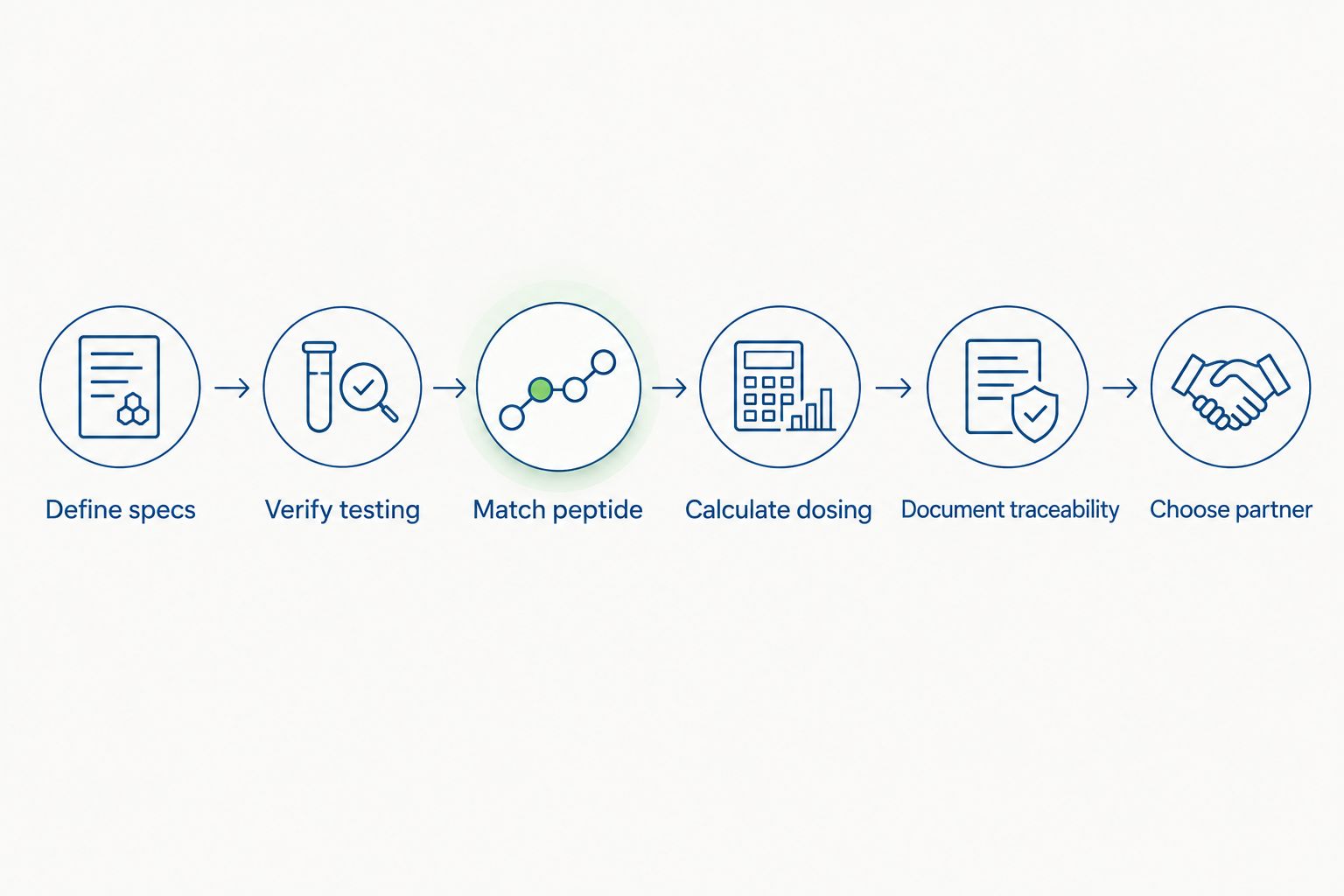
Write the specification down before opening a supplier's site. A specification you can point to later is what keeps a multi-cohort study defensible.
A certificate of analysis without a batch number attached to it isn't documentation, it's marketing copy. Ask for the batch-specific COA before the order ships, not after.
Different research questions pull from different peptide categories. Tissue-repair studies typically work with BPC-157 or TB-500 research peptides. Metabolic and GLP-1 receptor research uses compounds like retatrutide, tirzepatide, or cagrilintide. Immune-function studies lean on thymosin alpha-1, and growth-hormone axis research uses secretagogues like ipamorelin. Matching the compound to the mechanism your protocol is actually testing avoids a mismatch that shows up as noise in the results months later.
Dosing errors in veterinary research almost never come from the peptide itself, they come from reconstitution math done under time pressure. Standardize the reconstitution step before the first cohort starts, and use the same diluent lot across the study where possible.
For the mechanics of getting this step right, the bacteriostatic water for peptide reconstitution guide walks through diluent selection and handling in more detail.
A study that runs 8 to 16 weeks needs a storage plan that survives that entire window, not just the first shipment. Lyophilized peptide is stable far longer than reconstituted solution, and most cohort studies lose more integrity to a freezer door left open than to vendor quality.

An IACUC review or an internal audit will ask where a specific batch came from and how it was handled between receipt and use. Build that record from day one instead of reconstructing it later.
Once the specification, documentation, and handling protocol are locked in, the sourcing decision gets simpler: find a supplier that can deliver the same batch quality on the fifth order as the first. Celonyx Labs positions its catalog around exactly that repeatability, with 99%-pure, third-party-tested research peptides and documentation attached at the batch level rather than the product line. That matters more for a veterinary research program running sequential cohorts through 2026 than any single price comparison does.
| Option | Best for | Key limitation |
|---|---|---|
| Standing catalog supplier (Celonyx Labs) | Repeat cohort studies needing consistent, documented batches | Limited to listed compounds, not custom sequences |
| Custom peptide synthesis lab | Novel or modified sequences not sold commercially | Longer lead times, heavier per-batch documentation burden |
| University or core facility synthesis | Programs with in-house HPLC/mass spec access | Capacity-limited, often queued behind other departments |
| General online marketplace | One-off, small-quantity purchases outside a formal cohort | Inconsistent COA practices and batch-to-batch variance |
Verdict: a standing catalog supplier with batch-level COAs wins for any veterinary research program running more than one cohort. Custom synthesis only earns its lead time and cost when the sequence itself isn't commercially available.
“A certificate of analysis without a batch number attached to it isn’t documentation, it’s marketing copy.”
Source consistent research peptides
Browse batch-documented, third-party-tested peptides for veterinary research protocols.
What are research peptides for veterinary research?
They are laboratory-grade peptide compounds used in animal-model studies to investigate mechanisms like tissue repair, metabolic signaling, or immune function. They are supplied for research use only, not for treating live animals clinically.
Is 99% purity enough for a veterinary research protocol?
99% purity is the standard threshold most research peptide protocols require in 2026, but the number only means something when it’s tied to a batch-specific certificate of analysis. A purity claim without a lot number isn’t verifiable.
How should peptides be reconstituted for cohort studies?
Bacteriostatic water is the standard diluent for most research peptides, and the concentration should be calculated per vial before dosing starts. Standardizing this step across every subject in the cohort prevents dosing drift.
Can BPC-157 or TB-500 be used in veterinary tissue-repair research?
Both are commonly used research peptides in tissue-repair study protocols, sold strictly for laboratory research use. Sourcing should include batch-level COA verification regardless of which compound the model calls for.
How long do lyophilized research peptides stay stable?
Lyophilized peptide is far more stable than reconstituted solution and typically holds up well under proper cold storage for the length of most study timelines. Reconstituted solution has a much shorter usable window and should be discarded on schedule.
What documentation does a veterinary research program need to keep?
A batch number, certificate of analysis, receipt date, and storage log for every peptide used in the study, filed alongside the raw data. This record is what an internal audit or IACUC review will ask for first.
Is Celonyx Labs suitable for sourcing veterinary research peptides?
Celonyx Labs supplies 99%-pure, third-party-tested research peptides with batch-level documentation, which fits the repeatability a multi-cohort veterinary research program needs. It sources from a fixed catalog, so custom or modified sequences still require a synthesis lab.
What’s the biggest sourcing mistake in veterinary research programs?
Switching vendors mid-study to save money, which breaks the batch consistency a cohort study depends on for valid comparisons. Locking in one documented supplier before the study starts avoids this entirely.
The purity percentage on a label is the least useful number on it. The batch number is the one that lets a researcher trace a result back to a physical vial six months later when a reviewer asks how the data was generated — and that's the number most programs forget to log until it's too late.
Research peptides for university labs require documented purity, lot traceability, and controlled handling. Use this

Peptide reconstitution for biotech startups in 2026: diluent choice, concentration math, storage windows, and the

Research peptides for veterinary research need batch-level COAs and standardized handling. See the sourcing steps,
FOR RESEARCH USE ONLY. Products sold by Celonyx Labs are intended exclusively for laboratory and scientific research. They are not intended for human or veterinary use, consumption, diagnosis, treatment, cure, or prevention of any disease. By purchasing from this site, you acknowledge that you understand the intended research purpose of these materials and agree to comply with all applicable laws and regulations.