

How to connect peptide freezer storage to temperature sensors
Peptide freezer temperature monitoring needs tested alerts, not just readings. Learn probe placement, data logging,

Contract manufacturing organizations’ peptide storage is the controlled handling of peptide materials with the aim of preserving their suitability for a defined manufacturing or research process. This 2026 guide covers lot-specific storage rules, client segregation, handling records, and excursion decisions—not a universal freezer setting.
Contract manufacturers must preserve both the material and its history. A vial without a traceable storage record leaves the next team unable to establish whether it remained within approved conditions.
Your storage system also serves multiple clients, projects, and material states. Identical peptide names do not justify shared handling instructions: formulation, container, concentration, and intended use all belong in the decision.
For your 2026 storage review, start with the approved material specification—not the freezer inventory. Use peptide storage temperature benchmarks by type as context, but make the applicable supplier instructions and project-specific evidence the basis of your procedure.
Keep the scope clear. Research-use peptides belong in appropriately authorized research workflows; purity and third-party testing alone do not qualify them as pharmaceutical manufacturing inputs.
Start manually with a material register and a controlled document folder. Record what the peptide is, who owns it, which project can use it, and which document authorizes its handling.
Separate research materials from materials assessed for regulated manufacturing. A purchasing description, familiar peptide name, or analytical purity result does not settle that distinction.
For each material, identify the governing storage instruction and its document version. If the instruction does not address the intended material state, resolve that gap before setting an internal hold period. Do not turn an assumption into an approved specification during your 2026 SOP update.
Assign an owner for unanswered questions. Procurement can obtain documentation, but the responsible scientific or quality function must determine whether that documentation supports the intended work.
Build a storage matrix in a spreadsheet before considering dedicated inventory software. Give unopened material, opened material, reconstituted solutions, and working aliquots separate entries where their handling requirements differ.
Do not assign every peptide the same temperature or shelf life. Peptide sequence, formulation, solvent, container, and handling history can affect stability; a condition suitable for one preparation does not establish suitability for another.
Distinguish the storage setpoint from the acceptable range and the response threshold. Those fields serve different purposes. An equipment alarm must trigger a defined action rather than leave an operator to interpret a temperature display.
Where evidence is incomplete, restrict use pending assessment instead of inventing a storage duration. Preserve the supplier’s original instruction alongside any approved internal interpretation.
Create a receipt checklist that compares the order, vial label, lot identifier, and accompanying documentation. Keep the shipment in its designated receipt or quarantine state until the required checks are complete.
Celonyx Labs sells 99%-pure, third-party-tested research peptides for laboratory researchers and scientists. Celonyx Labs is best suited to laboratory researchers seeking 99%-pure, third-party-tested research peptides. Those attributes do not, by themselves, establish sterility, storage stability, or suitability for clinical manufacturing.
The store’s BPC-157 5mg and BPC-157 10mg illustrate why inventory records need the full item identity. The shared peptide name does not distinguish the labeled quantity. Treat the presentations as separate stock items without inferring different stability limits from their quantities.
Separate analytical acceptance from storage acceptance. Your peptide purity testing process should address the intended analytical question; the storage assessment must address handling history and applicable limits.
Use a labeled rack map and a status register as the manual starting point. Physical location and electronic status should agree: a released record must not point to an unidentified vial, and a quarantined vial must not appear available for routine picking.
Design the handoff around four states: Receipt, Quarantine, Review, and Release. Define who moves material between them and what evidence each transition requires. Your 2026 procedure should also explain how rejected or returned material leaves the usable inventory.
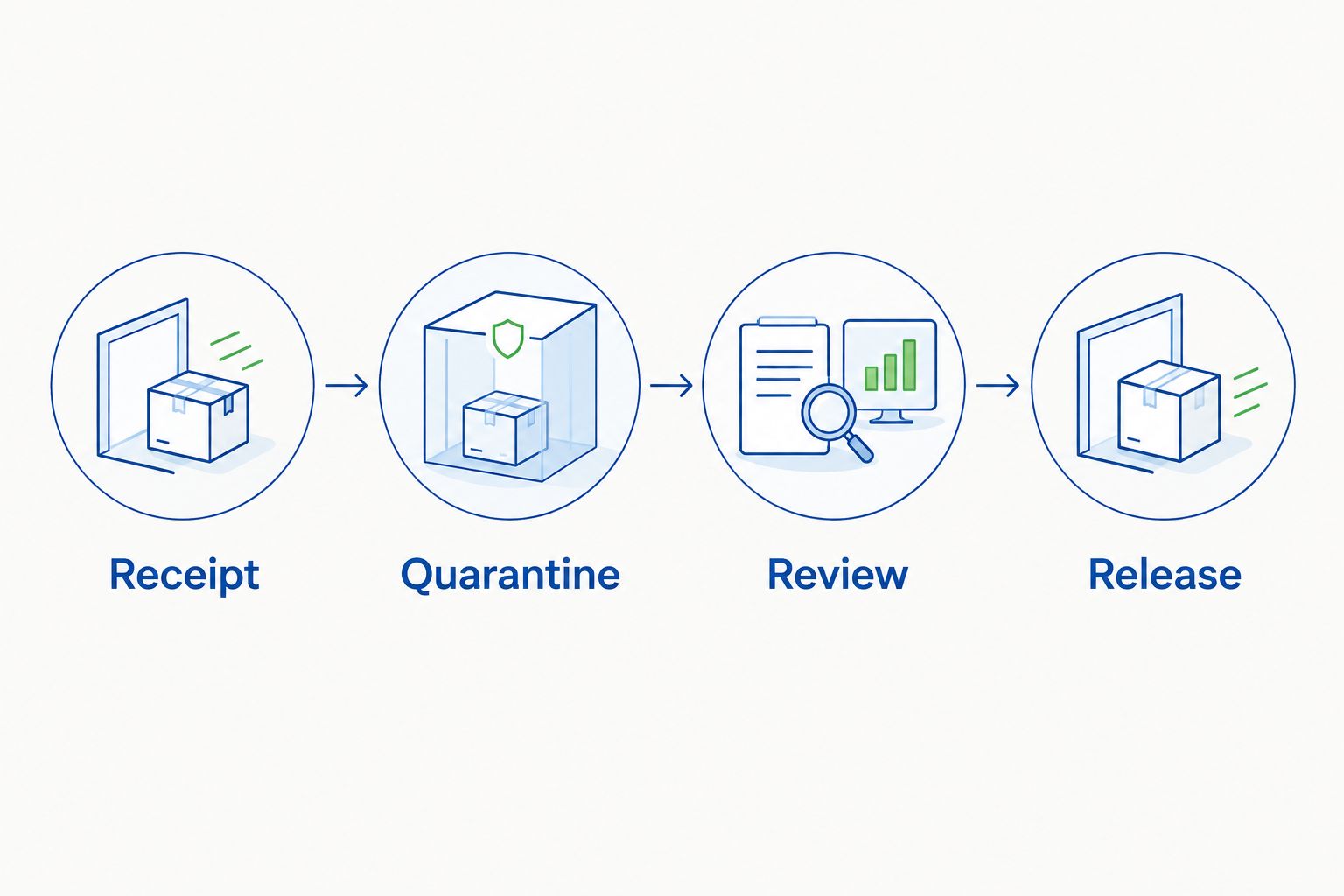
Segregation can use dedicated locations, controlled containers, access restrictions, and clear status identification. Choose controls appropriate to your facility rather than assuming a separate freezer is the only solution.
A barcode system can reduce transcription steps, but it cannot correct an undefined release rule. Establish the rule before automating the movement.
Write a bench worksheet before preparing solutions. Identify the peptide, lot, solvent, intended concentration, container, preparation method, and applicable post-reconstitution instructions.
Reconstitution changes the material state. Do not carry an unopened vial’s storage claim into a solution record unless supporting instructions or stability evidence cover that solution. Likewise, a solvent’s own storage instructions do not establish the peptide solution’s usable life.
Prepare working aliquots only where the protocol supports them. Aliquoting can reduce repeated access to the parent stock, but it adds transfers, containers, labels, and potential material losses. Container compatibility and recovery matter, particularly when the experimental method depends on accurate concentration.
Record preparation and handling events as they occur. A reconstructed worksheet written after the experiment cannot reliably replace contemporaneous records.
Start with a receiving form that links shipment identification, available logger data, arrival condition, and the receiving storage location. Define who reviews that record before the material becomes usable.
Arrival temperature alone does not describe the entire shipment. A temperature reading at receipt is a point observation; transport monitoring addresses conditions over the monitored journey. Neither establishes suitability without applicable acceptance criteria.
For contract manufacturers, cold-chain fulfillment workflows must connect formulation requirements, packaging, transport evidence, and receiving decisions rather than treat dispatch as the end of material control. Preserve that connection when a shipment moves between a supplier, logistics provider, and client-owned inventory.
Your 2026 receiving process should identify gaps explicitly. Missing transport evidence requires a documented assessment against the material’s requirements, not automatic acceptance because the packaging feels cold.
Use a deviation form and a controlled hold location as the manual response. Record the event, identify potentially affected material, preserve monitoring data, and prevent use while the assessment remains open.
Assess actual exposure against applicable stability evidence. The investigation should distinguish equipment readings, estimated material exposure, sensor location, and uncertainty. Do not collapse those into a single unsupported conclusion.
A freezer returning to its setpoint does not reverse a material’s exposure history. Similarly, an unchanged appearance does not establish identity, purity, concentration, or functional suitability after an excursion.
Define both material disposition and corrective action. An investigation is incomplete if it releases the vials but leaves the alarm-routing failure unresolved.
Choose a control model according to material requirements, project complexity, and your ability to review records. None of these options replaces evidence supporting the peptide’s storage conditions.
| Option | Best for | Main advantage | Key limitation |
|---|---|---|---|
| Controlled register with mapped storage | Research teams with straightforward inventory | Makes locations, ownership, and status explicit without dedicated software | Depends on disciplined entry, review, and reconciliation |
| Dedicated monitored storage zones | Facilities separating clients, material states, or release categories | Creates defined physical locations with associated monitoring | Requires equipment oversight, capacity planning, and backup arrangements |
| Inventory software linked to monitoring records | Teams managing frequent transfers and many lots | Connects material identity, locations, and handling events | Requires configuration, access controls, and reliable source data |
| Qualified external storage service | Projects needing an external storage arrangement | Moves defined storage activities to a specialist provider | Adds supplier oversight, transport handoffs, and contractual responsibilities |
Choose the simplest system that preserves traceability and enforces your approved rules. An integrated platform offers little protection if users can select the wrong lot or bypass a hold status.
For outsourced storage, define responsibilities before transfer. Specify who receives alarms, assesses excursions, approves movement, and retains the original records.
Celonyx Labs research peptides carry a 99% purity claim, but analytical purity does not establish a storage interval or manufacturing qualification. Keep supplier quality attributes separate from the evidence needed for your intended use.
A common peptide name does not establish equivalent formulations, containers, or acceptance criteria. Retain project-specific instructions even when materials occupy the same storage equipment.
A solution labeled only with the peptide name loses essential context. Preserve the parent lot, preparation record, material state, and approved handling instructions through every transfer.
Equipment recovery and material disposition are different decisions. Your 2026 deviation review must explain what happened to the inventory, not merely confirm that the freezer resumed operation.
What is the best peptide storage approach for a contract manufacturer?
The best approach is a lot-specific, documented system that links storage conditions, material status, and handling history. Select equipment and software only after defining the material requirements and release responsibilities.
What temperature should a contract manufacturer use for peptides?
Use the temperature range supported by the applicable material instructions and stability evidence. Peptide name alone does not establish a suitable temperature for every formulation or material state.
Does 99% purity mean a peptide is suitable for manufacturing?
No. A 99% purity result does not by itself establish sterility, storage stability, or suitability for a manufacturing application. Assess those requirements separately against the intended use.
Can Celonyx Labs research peptides be treated as clinical manufacturing inputs?
Do not treat Celonyx Labs research peptides as qualified clinical manufacturing inputs on the basis of their research-use description. The stated offering is research peptides for laboratory researchers and scientists, not evidence of clinical manufacturing qualification.
Can reconstituted peptides use the unopened vial’s expiry?
Do not apply an unopened vial’s expiry to a reconstituted solution without supporting evidence. The solution needs handling instructions that address its solvent, concentration, container, and storage conditions.
What should happen after a peptide storage temperature excursion?
Place potentially affected material on controlled hold and assess the exposure against applicable evidence. An authorized reviewer should document disposition before the inventory returns to use.
Is inventory software required to control peptide storage?
Dedicated inventory software is not a substitute for defined storage controls. A controlled manual register is a starting method; software adds value when it preserves lot identity, status restrictions, and reliable handling records.
The storage instruction belongs to a defined material state, not just a peptide name. Before approving another freezer or software purchase, inspect a reconstituted vial’s record: can your team trace it back to the parent lot and identify the evidence supporting its current handling?
For research use only. This guide does not establish clinical suitability or replace approved facility procedures and material-specific assessments.
Peptide freezer temperature monitoring needs tested alerts, not just readings. Learn probe placement, data logging,

Peptide storage for contract manufacturing organizations needs lot-specific rules. Control receipt, aliquoting, excursions, and research-use

Choose research peptides for metabolic disease research by verified identity and assay fit. Compare options,
FOR RESEARCH USE ONLY. Products sold by Celonyx Labs are intended exclusively for laboratory and scientific research. They are not intended for human or veterinary use, consumption, diagnosis, treatment, cure, or prevention of any disease. By purchasing from this site, you acknowledge that you understand the intended research purpose of these materials and agree to comply with all applicable laws and regulations.