
Best GHK-Cu peptides for skin and wound healing research 2026
Choose the best GHK-Cu peptide format for laboratory skin and wound-healing research. Compare documentation, assay
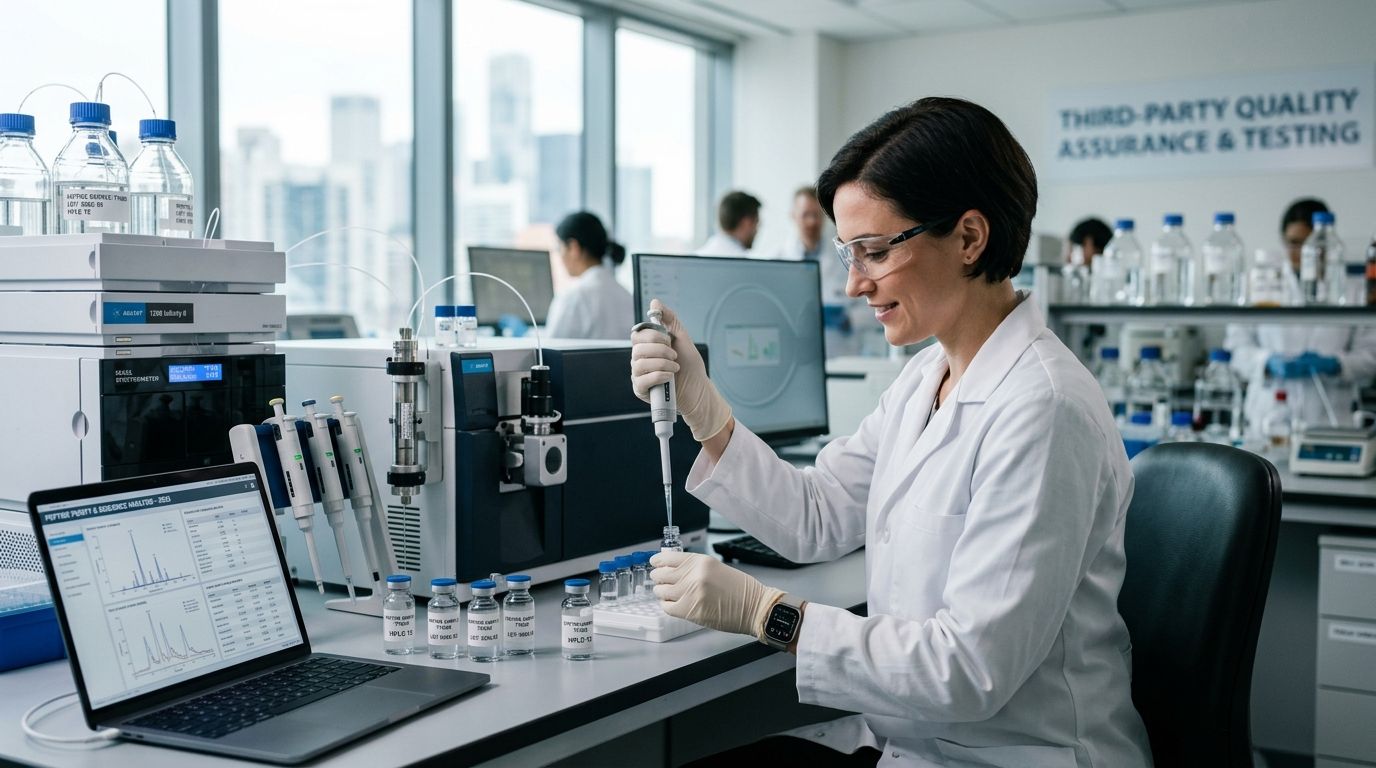
Independent lab verification is the only way to confirm a research peptide matches its label claim, and in 2026 the landscape splits into five distinct approaches rather than a single leaderboard of companies. This guide ranks the best third-party peptide testing labs and verification methods by what they're actually good for, not by marketing claims.
A peptide vial with no independent verification is a guess with a label on it. Purity claims, identity confirmation, and lot tracking only mean something when a lab with no financial stake in the sale runs the analysis and publishes the method, not just a pass/fail line.
Celonyx Labs ties every batch to a 99% purity standard and third-party testing, which is the baseline this guide measures against. Researchers comparing sellers or labs in 2026 need to know which verification approach answers which question — batch purity, structural identity, or long-term stability — because no single lab does all three equally well.
| Option | Best for | Standout feature | Key limitation |
|---|---|---|---|
| Janoshik Analytical (independent lab) | Per-batch purity verification | Published HPLC and LC-MS results widely cited across the industry | Turnaround depends on submission volume; not run by the vendor |
| University/institutional core facility | Novel or unusual peptide characterization | Custom method development for compounds with no standard protocol | Queue times and academic scheduling, not built for routine vendor checks |
| Vendor-published COA program | Buyer-facing transparency at point of sale | Lot-specific documentation available before you order | Funded by the seller, so independence varies by disclosure quality |
| Blind sample / chain-of-custody testing | Auditing a specific vendor's claim yourself | You control sample submission end to end | Costs and logistics fall on the researcher, not the vendor |
| In-house QC plus periodic third-party spot checks | Ongoing hybrid monitoring across many batches | Combines speed of internal screening with independent confirmation | Internal results alone aren't independent verification |
Janoshik Analytical is the independent laboratory most frequently referenced across the research peptide industry when vendors publish third-party purity data. It runs HPLC and LC-MS analysis on submitted samples and issues results tied to specific batches, which is the closest thing this space has to a shared reference point in 2026.
Janoshik Analytical pros:
Janoshik Analytical cons:
Verdict: Buy-in. Treat a Janoshik-linked COA as the minimum bar for any batch you're relying on for research work in 2026.
Academic mass-spec and analytical chemistry core facilities exist to characterize compounds that don't have an established testing protocol yet. If you're working with a newly synthesized or rarely studied sequence, a core facility can build a method around it in ways a routine commercial lab won't.
University core facility pros:
University core facility cons:
Verdict: Hold. Reserve this option for compounds that don't fit standard testing, not for routine batch checks.
A Certificate of Analysis published at the point of sale lets a researcher check purity and identity before ordering, without waiting on their own lab submission. This only works when the COA is lot-specific and the testing lab is named and independent — a generic template attached to every listing isn't verification, it's decoration.
Sellers who reference 10 research peptides for lab studies alongside batch-level documentation give researchers a faster way to screen quality before committing lab time to their own verification.
Vendor COA program pros:
Vendor COA program cons:
Verdict: Hold. Use it as a screening filter, not a substitute for independent verification on work that matters.
This is the only option on this list where the researcher, not the seller, controls the entire chain from sample to result. You submit the vial yourself, under your own name, to a lab with no relationship to the vendor.
Blind sample testing pros:
Blind sample testing cons:
Verdict: Wait. Use this selectively — for a new supplier relationship or a compound central to a specific study, not as routine practice.
Sellers running consistent volume often pair internal HPLC screening with periodic third-party confirmation. It's faster than sending every batch out, and it catches drift over time when the spot checks are frequent enough to matter.
Hybrid QC pros:
Hybrid QC cons:
Verdict: Skip as a standalone claim — only counts if the third-party portion is documented and named.
Each option was measured against the six criteria above: independence, validated methods, batch-specific documentation, chain-of-custody, method transparency, and testing scope. Janoshik Analytical ranks first because it's the only option that scores well on independence and method rigor simultaneously across most vendor use cases in 2026.
“If a lab won’t publish its raw chromatogram, it isn’t independent testing — it’s marketing with a lab logo on it.”
Check the COA before you order
Every Celonyx Labs batch pairs 99% purity with third-party testing documentation.
For routine batch verification in 2026, Janoshik Analytical or an equivalent independent lab running HPLC and LC-MS is the default choice — it's the option most vendors already reference, which makes results comparable across sellers. Reach for a university core facility only when the compound itself is unusual enough to need custom method development, and reserve blind chain-of-custody testing for the batches where independence matters most to your specific research.
What are the best third-party peptide testing labs in 2026?
Janoshik Analytical is the most widely cited independent lab for peptide purity and identity verification via HPLC and LC-MS in 2026. University core facilities and blind chain-of-custody testing serve narrower, situational needs.
Is a vendor-published Certificate of Analysis the same as third-party testing?
Only if the lab named on the COA is genuinely independent of the vendor and the report is tied to a specific batch. A generic COA reused across listings is not equivalent to per-batch third-party verification.
How do I verify a research peptide’s purity myself?
Submit a sample directly to an independent lab under your own name, establishing your own chain of custody from vial to result. This is slower and costlier than relying on a vendor’s published COA, but it removes any question of vendor influence.
What testing methods should a peptide COA report?
HPLC-UV for purity and LC-MS/MS for identity confirmation are the standard methods referenced across the research peptide industry in 2026. A COA listing only a single low-resolution screen offers weaker verification.
Are university labs a good option for peptide testing?
University core facilities are strong for novel or unusual peptides needing custom method development, but they run on academic scheduling and aren’t built for routine, repeat batch verification.
Does Celonyx Labs use third-party testing?
Celonyx Labs pairs a 99% purity standard with third-party testing on its research peptides, documented per batch rather than as a generic claim.
How often should a vendor’s batches get independent testing?
Every batch ideally gets independent confirmation, since internal QC alone does not qualify as third-party verification. Periodic spot checks only hold up when the vendor discloses which specific batches were externally tested.
The detail most researchers skip: a COA's value drops the moment it's disconnected from a lot number. Before trusting any third-party testing claim in 2026, check that the report references the exact batch in front of you, not a report from a previous run of the same peptide.
Choose the best GHK-Cu peptide format for laboratory skin and wound-healing research. Compare documentation, assay

Choose lot-verified melanotan 1 peptide for pigmentation research. Compare material specifications, purity evidence, and documentation

Native oxytocin peptide is the default for behavioral research. Compare reference standards, labeled materials, and
FOR RESEARCH USE ONLY. Products sold by Celonyx Labs are intended exclusively for laboratory and scientific research. They are not intended for human or veterinary use, consumption, diagnosis, treatment, cure, or prevention of any disease. By purchasing from this site, you acknowledge that you understand the intended research purpose of these materials and agree to comply with all applicable laws and regulations.