

Integrity Research BPC 157: How to Judge Vendor Claims
The advice you'll hear most often about buying BPC-157 for the bench is short: demand

Stop asking whether a MIC Blend Peptide works until you've answered a more basic question. Is the material in the vial a peptide at all, and would another laboratory recognize the same product from the same name? Popular advice skips that step, treats purity as proof, and moves straight to outcomes. A laboratory can't reproduce an experiment if the input isn't defined. For MIC, identity, composition, and documentation come before any claim about activity.
Two products can share the label MIC and still not be the same experiment. A MIC blend is a lipotropic nutrient formulation, not a peptide, so the practical question is whether the formulas are close enough for another laboratory to rebuild the material and rerun the work. The letters generally refer to methionine, inositol, and choline. Some commercial formulations add vitamin B12 or other B vitamins, which means the short name can hide different ingredient lists. The CardioMender review of lipotropic injections reports that no human clinical trial had tested MIC or lipotropic injections as a combination for weight loss.
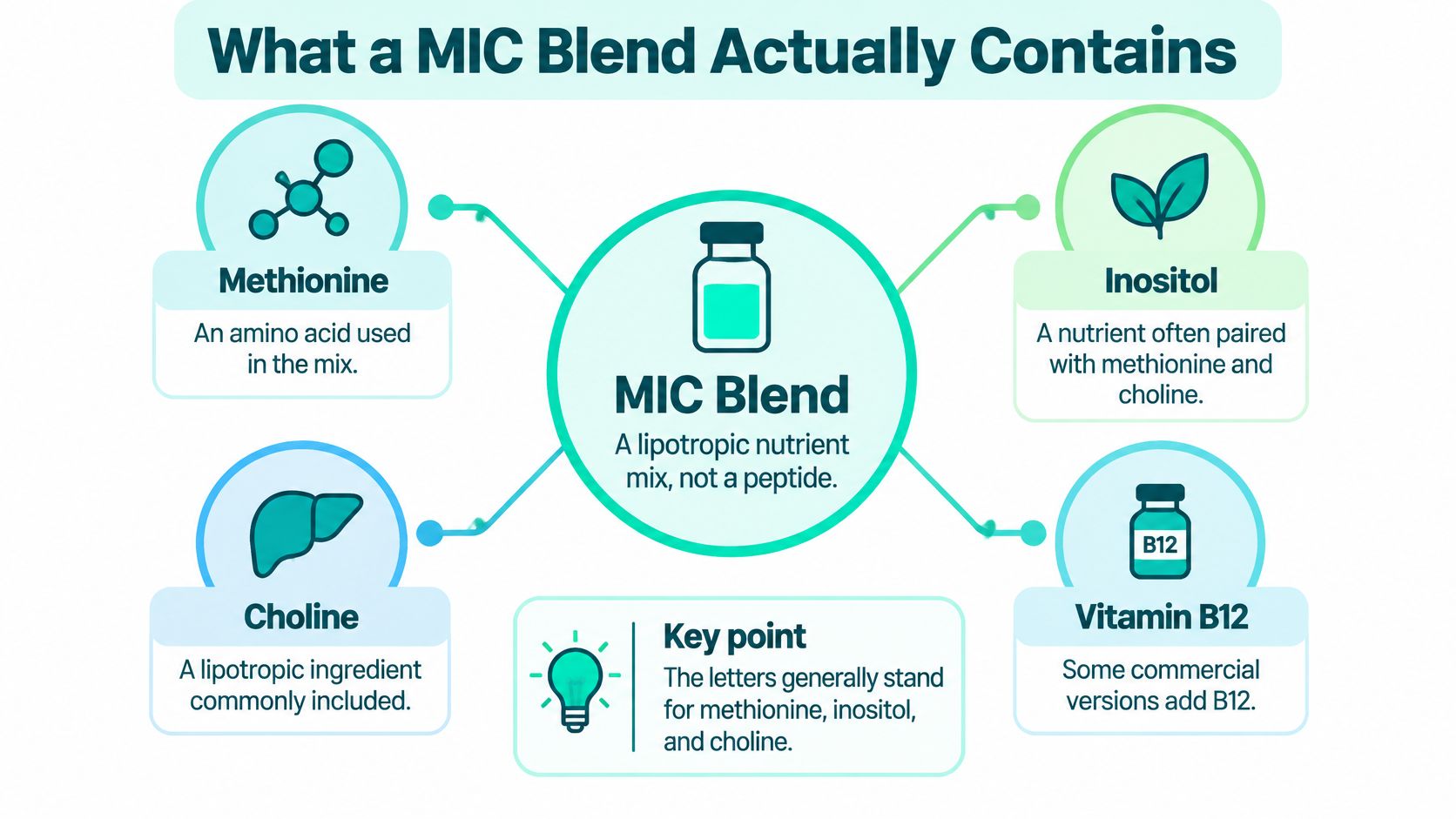
A peptide is a chain of amino acids with a defined sequence, so one name can point to one molecular structure. MIC names a bundle. Its components are small molecules rather than amino-acid chains that meet the usual biochemical definition of peptides, and each component has separate chemistry and a separate biological role.
| Component | Chemical class | Documented role | Human evidence type |
|---|---|---|---|
| L-methionine | Amino acid (small molecule) | Methyl-donor pathways | Mostly oral supplementation or deficiency studies |
| Inositol | Cyclic sugar alcohol | Membrane phosphoinositide signaling | Mostly oral or condition-specific studies |
| Choline | Essential nutrient | Phospholipid synthesis and hepatic lipid export | Deficiency studies and parenteral nutrition cases |
| Vitamin B12 (some blends only) | Vitamin | Cofactor for methionine synthase | Deficiency-related evidence; no fat-loss trial |
That table shows why MIC Blend Peptide is a misleading shorthand. Methionine contributes to methyl-donor metabolism. Choline supports phospholipid synthesis and the movement of lipids out of the liver. Inositol takes part in membrane signaling, while B12, when present, serves as a cofactor for methionine synthase. Those are related metabolic functions. They are not one receptor-selective mechanism, and they do not create a single molecular target. A result from one labeled blend therefore says nothing about another blend unless the formulas match.
Evidence for individual ingredients also does not transfer automatically to a compounded injectable blend. Much of it comes from oral supplementation or specific deficiency-related conditions, so the route, dose, formulation, and population all change at once. Available evidence does not establish that injected MIC combinations produce clinically meaningful weight loss. The defensible description is an investigational nutrient blend, not an established peptide drug or a validated weight-loss therapy.
A methods record should name every ingredient, salt form, concentration, and route of administration. It should also state whether B12 is present, because a blend with B12 and a blend without it are not compositionally identical. Unstated ratios make cross-study comparison impossible even when both vials use the same three letters.
The same conversion applies wherever commercial copy uses Lipo-C nomenclature: turn the label into an exact chemical description before comparing results.
A blend name is not a molecular identity. If the record says only "MIC," another laboratory can't rebuild the material.
Product identity, sterility, and analytical characterization must be documented separately. None of them can be inferred from three letters on a vial.
In microbiology, MIC means minimum inhibitory concentration. That's the lowest concentration of an antimicrobial that prevents visible growth of a defined organism under specified test conditions. It has no relationship to methionine, inositol, and choline, but the shared abbreviation creates a real documentation risk.
The laboratory report below belongs to the microbiology meaning, where the organism and antimicrobial susceptibility result define the measurement.
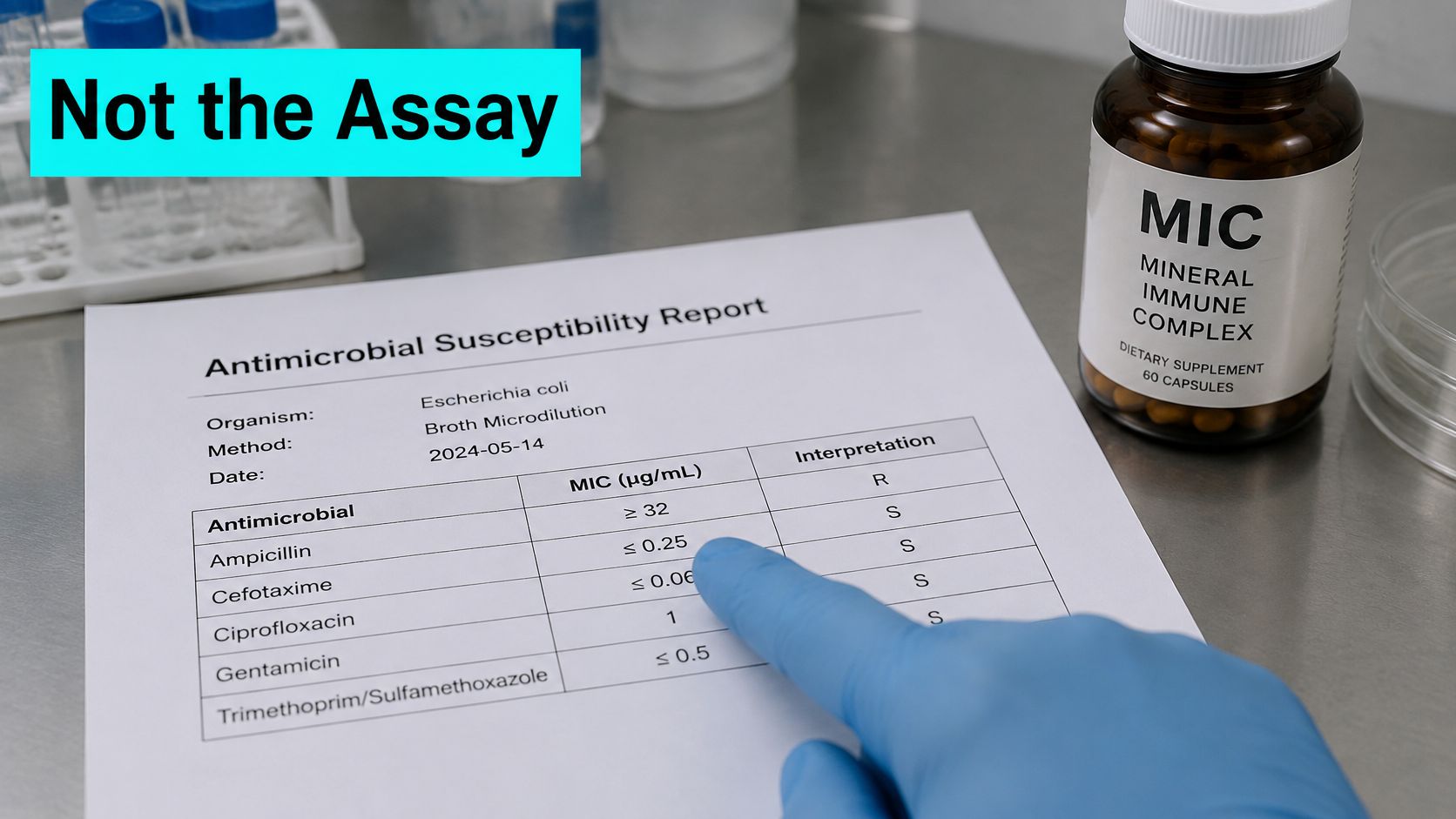
Say a technician prepares a two-fold dilution series of an antibiotic against one named bacterial strain. The first well with no visible growth supplies an MIC value for that substance, organism, inoculum, medium, incubation period, and endpoint. Change the organism or conditions and the value may change. A lipotropic blend has no equivalent endpoint because its initials match the assay abbreviation.
A protocol that says only "test the MIC" is ambiguous. It could request a susceptibility assay, identify the material to be tested, or confuse the two. Spell out the meaning in the protocol title, sample label, electronic notebook, and results table. Don't rely on local habit to carry the distinction across teams.
The two meanings can meet in one legitimate case. If you want to test whether a methionine, inositol, and choline preparation inhibits microbial growth, that's a separate antimicrobial experiment. It requires the standard dilution method, a named organism, solvent and vehicle controls, growth controls, and a defined endpoint. The blend becomes the test substance, while minimum inhibitory concentration remains the measurement.
The video below is useful context for keeping assay terminology tied to a defined procedure rather than to a product nickname.
Plain rule: Never report an MIC value without naming both the organism and the substance tested.
That single sentence prevents a nutrient blend from being mistaken for an antimicrobial result.
The evidence base for MIC blends is thinner than product labels suggest. The best historical support for the ingredients concerns nutrient deficiency and liver physiology, not fat loss. A Peptide Scouter summary of Lipo-C evidence describes a 1991 study in which healthy men placed on a choline-deficient diet for approximately three weeks developed early signs of liver dysfunction. That result supports choline's necessity. It does not show that extra choline, combined with two other nutrients and injected into well-nourished adults, reduces body fat. It also says nothing about whether two products labeled MIC share the same composition.
A small clinical observation in patients on long-term parenteral nutrition linked low plasma choline to liver fat and reported improvement after intravenous choline. The setting is condition-specific, and the group was small. That observation strengthens the liver rationale. It cannot establish the effect of a standardized blend in a different population.
| Evidence | Population | What it shows | Limit |
|---|---|---|---|
| 1991 choline-deficient diet study | Healthy men on the diet for about three weeks | Early signs of liver dysfunction | Deficiency model, not a blend test |
| Clinical observation in parenteral nutrition | Patients on long-term parenteral nutrition | Low plasma choline tracked with liver fat; improvement after intravenous choline | Small, condition-specific |
| Historical methionine-inositol-choline study | Small cohorts, including a myocardial infarction subgroup | Lipid-related changes reported in small cohorts | Predates modern trial standards; not an injectable |
| Combined MIC injection for weight loss | No human trial found | No outcome data | Evidence gap; no randomized controlled trials |
The historical combination study is weaker still. Small cohorts and older methods make it hypothesis-generating at best, not confirmation of a modern injectable product. Formulation, purity controls, endpoints, and reporting standards also differ from what a laboratory would require now. A MIC blend is a lipotropic nutrient mix, not a peptide. That distinction matters when someone tries to transfer evidence from one ingredient, or from one finished blend, to another product with a different ratio, salt form, or solvent.
Apply three checks before citing any ingredient study in support of a blend:
If any answer differs from your proposed use, treat the result as background rather than direct evidence. That discipline also improves the discussion section of a manuscript, where discussion writing guidance for doctoral researchers can help separate a finding from an interpretation that goes beyond it.
No randomized controlled trials demonstrate that a MIC blend improves body weight, body-fat percentage, or metabolic outcomes in generally well-nourished adults. Methionine, inositol, and choline have established biochemical roles. Whether a particular injectable combination is safe or effective remains a formulation-specific question requiring controlled studies, validated assays, and appropriate endpoints.
A headline 99% purity figure answers one analytical question, not the safety or suitability question for a sensitive biological experiment. FDA material says risks in compounded peptide products can include aggregation, peptide-related impurities, immunogenicity, incomplete characterization, contamination, and route-specific uncertainty, according to the FDA page on certain bulk drug substances used in compounding. Those examples don't concern MIC specifically, but the analytical lesson applies to any research material: one purity number doesn't characterize the whole product.
HPLC purity generally describes the share of the main chromatographic peak in the tested sample. It doesn't by itself demonstrate sterility, low endotoxin, correct identity, structural integrity, stability after reconstitution, or absence of process contaminants. A sample can produce a clean main peak and still be unsuitable for cell or animal work because of a variable the chromatogram wasn't designed to measure.
| Claim or test | What it establishes | What it does not establish |
|---|---|---|
| HPLC purity of 99% | Share of the main peak in the tested sample | Sterility, endotoxin level, identity, stability after reconstitution |
| Mass spectrometry identity match | Expected molecular masses are present | Ingredient ratios, concentration or absence of contaminants |
| Lot-specific certificate of analysis | Results tied to one tested batch | Future batches made the same way |
| Generic third-party testing label | An outside lab was involved | Which tests ran, on which lot, by which method |
| Single-ingredient stability data | How one component behaves alone | How the full blend behaves over storage |
Blending adds its own risks. pH, excipients, concentration, adsorption, degradation, and interactions among components can alter the material after individual ingredients pass their own tests. That is why blend-level stability matters, and readers comparing methods can use how peptide stability is tested as background on why storage and analytical conditions need to be stated rather than assumed.
High purity can reduce one confounder while leaving dose accuracy, biological compatibility, and batch reproducibility unanswered.
Those unanswered questions are often more consequential than the headline number. If concentration is wrong, your dose is wrong. If endotoxin is high, a cell response may reflect contamination rather than the nutrients. If the mixture degrades during storage, later replicates no longer test the starting material.
Treat a purity claim as the beginning of verification, not its conclusion. Ask which sample was tested, by which method, under what conditions, and what the test could not detect. A supplier that can't answer those questions hasn't given you a usable quality package, whatever percentage appears on the product page.
Accept a MIC Blend Peptide product only after the documentation matches the physical vial and the intended experiment. A Peptide Scouter summary of MIC B12 notes the blend typically comprises L-methionine, inositol, and choline, with some commercial formulations adding vitamin B12, and recommends recording exact identities, salt forms, concentrations, solvent, pH, sterility, endotoxin data, and batch-specific chromatography. Use that list as your receiving standard.
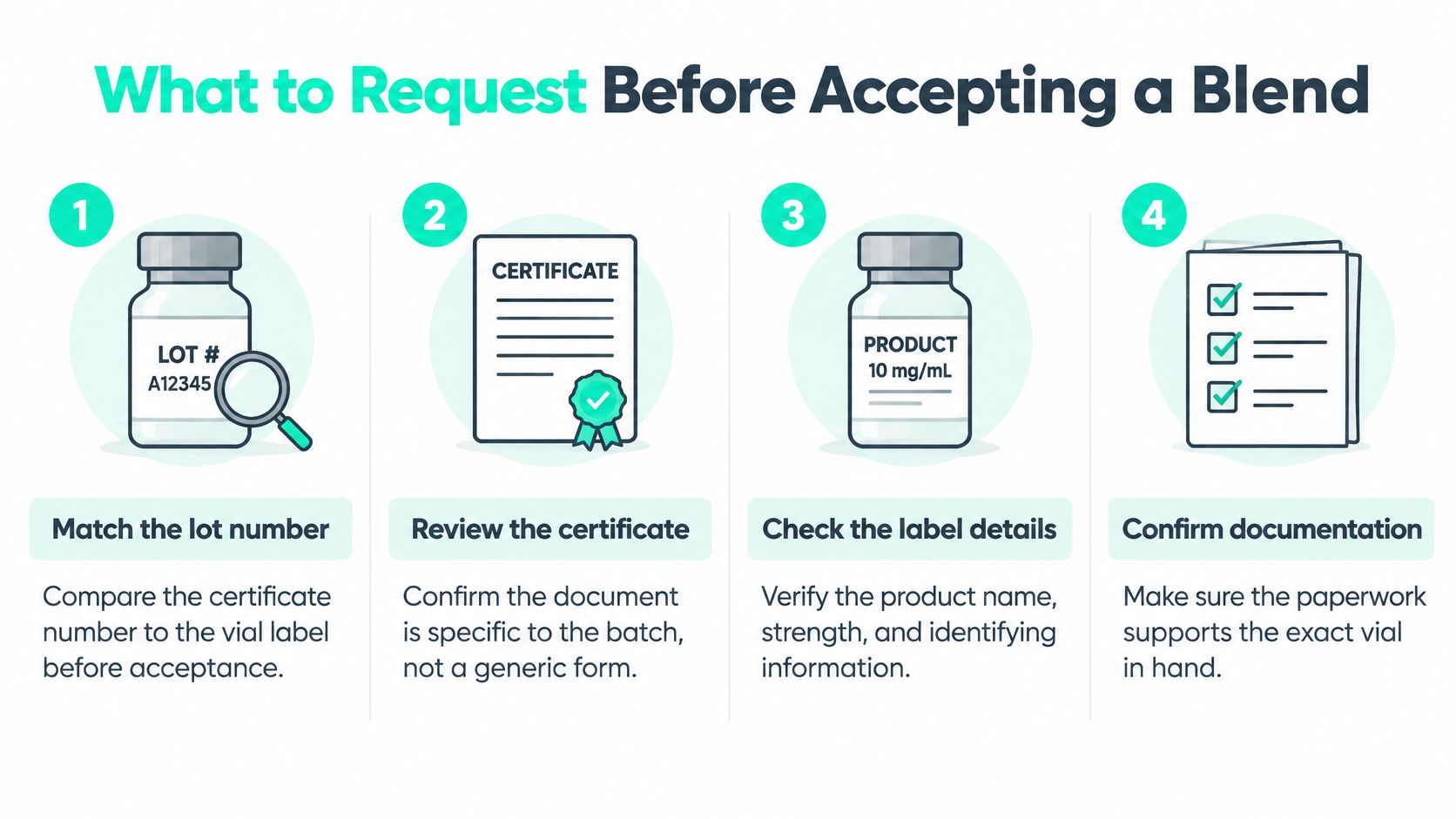
Step 8 needs data for the complete mixture. A stability study on choline alone doesn't tell you how methionine, inositol, choline, solvent, and excipients behave together. Likewise, a certificate without chromatographic conditions may show a number while withholding the information needed to judge it. Our peptide certificate of analysis guide gives receiving staff a document-level reference for checking whether a certificate identifies the lot, method, and results clearly.
Keep the receiving record with the experimental record. Include supplier, product name, lot, receipt date, storage location, certificate date, composition, and every test result supplied. If a vial is aliquoted, give each aliquot a traceable identifier and record the parent lot, preparation date, solvent, concentration, and freeze-thaw count.
Hold rule: If any required step is missing, quarantine the lot and don't start the experiment.
That delay is cheaper than repeating work after discovering that the certificate belonged to another batch or that a key ingredient was absent.
The central question isn't whether a product called MIC "works." It's whether different products carrying that name are compositionally comparable enough to support reproducible experiments. An RxLineup summary of B12 lipotropic products states that no FDA-approved methionine-inositol-choline combination exists and that compounded MIC blends are not reviewed by FDA for safety, effectiveness, or manufacturing quality before use. The testing laboratory therefore carries the comparability work itself.
One MIC product may use different ratios, concentrations, or salt forms from another. One may include B12 while another doesn't. Solvent and pH may also differ. If two studies use the same three-letter name for different mixtures, pooling their results creates a false replication. The material changed, even if the label didn't.
A chromatogram also needs interpretation in context. Peak identity, integration, method conditions, and batch linkage determine what the trace can support, which is why guidance on how to interpret HPLC chromatograms is relevant before treating a purity percentage as comparable across vendors. A vendor's purity figure can't establish biological activity, pharmacokinetics, dose response, or human efficacy.
Apply a strict comparability rule. If two lots or vendors differ in ingredient ratio, salt form, concentration, B12 content, solvent, or pH, treat them as separate materials. Analyze them separately, report them separately, and don't average away the formulation difference. A positive result from one mixture is evidence about that mixture under those conditions, not evidence about every product sold as a MIC Blend Peptide.
Reproducibility begins when another laboratory can reconstruct your material without asking what "MIC" meant in your notebook.
A complete methods section should state full composition and concentrations, any added B12, solvent, pH, sterility status, endotoxin result, analytical method, supplier, and lot. It should also distinguish chemical identity, intended research endpoint, and clinical claim. That separation keeps a narrow laboratory observation from being inflated into proof of fat loss, increased energy, or healthy aging.
Don't buy or test a product sold as a MIC blend until its identity and documentation pass three checks. First, the document names each component and ratio. Second, the certificate is tied to the exact lot. Third, the protocol states a research endpoint that the experiment can measure. A product label alone doesn't establish any of those points.
Put five questions to the supplier:
We label all Celonyx Labs peptides "For Research Use Only," and our homepage lists 99% purity as a headline feature. Treat both statements as claims that still require lot-specific documentation. The product list available here doesn't establish a MIC blend offering, so confirm availability and exact composition directly with us before designing work around a presumed product.
Take one action this week: request the full documentation package for the exact lot under consideration. Hold purchasing and testing until composition, identity, contamination status, handling limits, and blend stability are documented well enough for another laboratory to reproduce the material.
Before you order materials for a study of a MIC Blend Peptide, ask us for the lot-specific documentation you'd need to define the input and defend the result. Visit Celonyx Labs to review our research-use catalog and contact the team about composition, analytical records, and current availability.
The advice you'll hear most often about buying BPC-157 for the bench is short: demand

Can cagrilintide be combined with GLP-1 peptides? Yes, in controlled research. Understand mechanisms, study controls,

Can Selank be combined with nootropic peptides? Yes, in controlled laboratory studies. Learn the controls,
FOR RESEARCH USE ONLY. Products sold by Celonyx Labs are intended exclusively for laboratory and scientific research. They are not intended for human or veterinary use, consumption, diagnosis, treatment, cure, or prevention of any disease. By purchasing from this site, you acknowledge that you understand the intended research purpose of these materials and agree to comply with all applicable laws and regulations.