
Is Tesofensine a Peptide? the Lab Answer
Tesofensine is not a peptide: it is a synthetic small molecule with the formula C17H23Cl2NO

The most common advice about buying research peptides is to check for a high purity percentage. That's only the start of the review. A peptide certificate of analysis needs to establish what was tested, which batch it came from, what each measurement means, and whether the results support your experiment.
Read the document as an analytical chemist would: don't ask whether the largest number looks reassuring. Ask whether the evidence supports the conclusion you're about to draw from it.
A usable certificate connects sample identity, analytical results, and batch accountability. The table below is a procurement checklist, not a claim that every research application requires the same testing panel.
| Element | What It Proves | What a Usable Entry Shows |
|---|---|---|
| Lot or batch number | Links results to the physical vial; without it, applicability is unverified | Matches the vial label and order record |
| Test date and expiry or retest date | Establishes when testing occurred; without dating, currency is unclear | Test date after synthesis, with a justified expiry or retest date, or an explicit statement that none is assigned |
| Product name and sequence | Defines the intended analyte; a name alone can conceal structural ambiguity | Sequence or molecular formula, modifications, salt form, and theoretical mass |
| HPLC or UHPLC purity | Describes chromatographic composition; an unexplained percentage has no clear basis | Percentage plus method reference, column, wavelength, and calculation basis |
| Mass spectrometry identity | Supports molecular-mass agreement; without it, the main peak lacks mass confirmation | Observed mass compared with theoretical mass using a stated tolerance |
| Water content | Quantifies moisture; omission leaves part of the weighed mass unexplained | Percentage with method, such as Karl Fischer titration |
| Counterion content | Quantifies salt-associated mass; omission obstructs content calculations | Acetate or trifluoroacetate reported separately from chromatographic purity |
| Net peptide content | Establishes peptide mass per unit material; omission can distort solution preparation | Measured content or sufficient, clearly defined calculation inputs |
| Impurity profile | Describes related substances; a total alone conceals individual components | Individual impurity results, identities where established, and reporting limits |
| Approving laboratory and analyst | Establishes accountability; an unattributed result is difficult to authenticate | Named laboratory, authorized analyst or reviewer, approval date, and signature |
A missing result and an unperformed test aren't interchangeable. Ask the supplier to distinguish not tested, below the reporting limit, and tested but omitted from the summary. Those statements support different purchasing decisions.
Keep an unaltered original in your procurement records. If you circulate a copy with purchasing contacts or commercial details removed, the PDFWix guide to secure PDF redaction offers practical document-handling guidance; don't obscure lot identifiers, methods, results, or approval information needed for verification.
Review rule: Treat a document with several essential fields missing as an incomplete analytical summary, not sufficient evidence for acceptance.
Completeness still doesn't guarantee suitability. A fully populated certificate can use a method that's poorly matched to the peptide or omit a test your experiment specifically requires.
A peptide certificate of analysis is a batch-specific quality record that ties reported test results to identified material. It isn't a general promise about everything sold under a product name.
The analytical foundation is fitness for purpose: the ICH Q2(R2) guideline sets out validation principles for procedures used to establish identity, assay or potency, purity, and impurities, including appropriate spectroscopic and spectrometric procedures. Applying those principles means asking whether a method can support its stated analytical purpose, not merely whether an instrument generated a result.
Consider a vial labeled lot A accompanied by a certificate for lot B. Even if the certificate reports excellent results, it doesn't establish the quality of lot A. The supplier must resolve the mismatch through documented lot linkage, not verbal reassurance that both batches are equivalent.
The same issue arises when a supplier tests bulk material and subsequently divides it into smaller containers. The buyer needs a defensible connection between the tested bulk lot and the supplied vial. A useful introduction to this terminology is the explanation of batch and batches in peptide documentation.
For a purchasing reviewer, the essential chain is:
A generic purity claim leaves an important question unanswered: percentage of what?
Chromatographic area percentage compares integrated detector responses. Mass fraction describes material by weight. An assay or content result quantifies the analyte against a stated basis, often using a reference standard.
Those measurements can produce different results for the same material without any laboratory error. Trouble starts when a supplier presents them as interchangeable.
Your purchasing specification should therefore name the measurement you need. If the experiment requires a known peptide mass, requesting only chromatographic purity leaves the central quantitative question unresolved.
Organize the testing package by identity, purity, content, and safety-relevant attributes. These categories answer different questions, so a strong result in one category doesn't compensate for an absent result in another.
Identity testing supports the proposed molecular structure. Purity testing resolves and measures related components under specified conditions. Content testing establishes how much peptide is present by weight, while safety-relevant testing addresses contaminants that may interfere with the intended experimental system.
There's no defensible universal research-grade limit for every peptide. Use the following specification rules instead of assuming that a familiar purity floor guarantees suitability.
| Test | What It Measures | Typical Specification | Buyer Note |
|---|---|---|---|
| Reversed-phase HPLC or UHPLC | Chromatographic purity, often by area percentage | A predefined main-peak criterion plus limits for relevant impurities | Require the method, column, wavelength, and integration basis |
| LC-MS or MS | Molecular-mass identity | Observed mass within a justified tolerance of theoretical mass | Check whether the result uses average or monoisotopic mass |
| Amino acid analysis | Residue composition and, with suitable calibration, content | Composition consistent with the expected sequence within stated analytical tolerances | Useful as complementary evidence for higher-risk material |
| Karl Fischer titration | Water content | A justified moisture limit and an actual reported result | Use the measured result in content calculations |
| Gas chromatography | Residual solvents | Solvent-specific limits justified for the intended application | Request the solvent panel and reporting limits |
| LAL assay | Bacterial endotoxin | An experiment-specific limit with clearly stated units | Check suitability for the sample matrix |
| Visual and solubility check | Physical appearance and dissolution behavior | Matches the product-specific description under defined conditions | Record solvent, concentration, and any visible insoluble material |
Avoid accepting a visual specification that only says powder or clear solution. A solubility result needs preparation conditions; otherwise, you can't reproduce the observation.
For quantitative binding or biochemical assays, demand evidence that establishes both the analyte's identity and its concentration basis. For gravimetric solution preparation, water and counterions become important because they contribute to the mass placed on the balance.
For cell-based or in vivo research, evaluate endotoxin separately from peptide-related impurities. An attractive chromatogram isn't evidence that endotoxin testing occurred.
Don't describe omitted counterion, solvent, or endotoxin results as acceptable by default. Record whether each test is required, available, or outstanding. The appropriate specification follows the experimental question, not the supplier's standard certificate template.
Start with the analytical conditions rather than the tallest peak. FDA analytical-procedure guidance treats purity as meaningful after impurity characterization using properly validated methods and calls for enough procedural detail to reproduce the analysis.
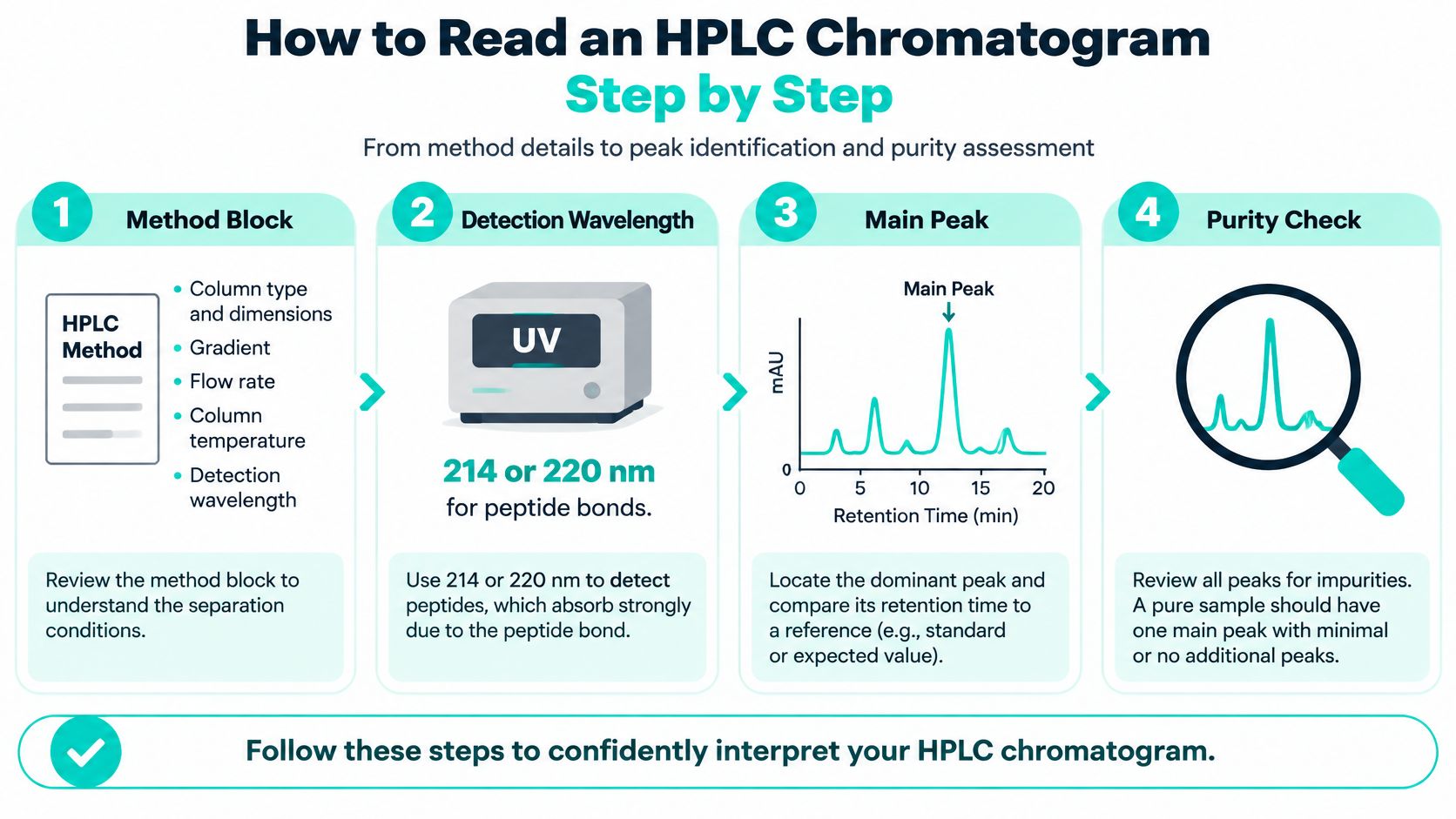
Check the method block. Find the column type and dimensions, mobile phases, gradient, flow rate, column temperature, and detection wavelength. If the certificate only gives an internal method identifier, request the supporting method details needed to interpret the result.
Locate the main peak. Compare its retention time with a reference standard analyzed under the same conditions. A retention-time resemblance supports comparison, but it doesn't independently establish molecular identity.
Read the area percentage and confirm the calculation basis. Determine which peaks entered the denominator and whether the laboratory excluded solvent, blank, or system peaks. Area percentage, mass balance, and corrected assay aren't interchangeable reporting bases.
List reportable impurity peaks with their retention times. Use the method's reporting threshold and your application-specific specification rather than treating every visible fluctuation as a quantified impurity. Preserve unknown peaks as unknowns unless supporting analytical evidence establishes their identities.
Inspect integration and baseline. Look for shoulders, broad tails, split peaks, and integration boundaries that could change the reported area. These features warrant investigation, although peak shape alone doesn't diagnose a particular impurity.
Confirm the chromatogram's lot linkage. Match the sample identifier to the certificate and supplied material. If the plot uses a laboratory sample code, request its documented connection to the supplier's lot.
For a constructed example, suppose the main peak accounts for 98.6% of the integrated area and a separately characterized oxidized impurity accounts for 0.42%. Record both entries, rather than reducing the result to a rounded purity claim.
The remaining integrated area is 1.4%, calculated as the whole chromatographic area minus the main peak. After subtracting the oxidized component, 0.98% remains attributable to other integrated components in this example.
That arithmetic is an area accounting exercise, not a weighing calculation. It doesn't establish the mass of oxidized peptide or prove that every relevant contaminant generated a measurable detector response.
A clean-looking chromatogram is evidence about separation under the stated conditions, not a complete inventory of everything in the vial.
Where co-elution is a concern, request supporting peak-purity evaluation using diode-array or mass-spectrometric data. Interpret that assessment within the method's capabilities rather than as an absolute guarantee.
Mass spectrometry supports identity through molecular-mass evidence; it doesn't independently establish purity. A matching mass is important, but the acceptance decision must also account for the expected sequence, modifications, and analytical tolerance.
The ICH Q6A specification guideline emphasizes identification methods that discriminate between closely related structures and pairs identity considerations with impurity controls. That distinction matters for peptides because different structures can share a molecular mass or produce similar chromatographic behavior.
Start by identifying which theoretical mass the laboratory calculated. Monoisotopic mass uses a specified isotopic composition, whereas average mass reflects isotope-weighted atomic masses. Comparing one basis with the other can create an apparent discrepancy that isn't evidence of a defective sample.
A spectrum reports mass-to-charge relationships. Peptides can carry multiple charges, so several signals may represent the same molecule rather than separate impurities.
A deconvoluted result translates an assigned charge-state pattern into an estimated neutral molecular mass. Request both the reported mass and enough spectral information to assess whether that assignment is credible.
The practical distinction between the techniques is developed in this guide to HPLC and MS analysis. Use the techniques together, while retaining their separate evidentiary roles.
| Observed vs Theoretical Mass | Likely Cause | Action |
|---|---|---|
| Within stated tolerance | The intended molecular composition may be present | Accept the mass result if sequence, modifications, and other identity evidence agree |
| Lower by one residue mass | A truncated or deleted sequence is possible | Request targeted investigation or retesting; reject confirmed wrong material |
| Unexpected higher mass | A modification, adduct, or assignment error is possible | Ask the laboratory to identify the species before disposition |
| Multiple unexplained masses | Related species, adducts, or sample complexity | Request assignments and comparison with chromatographic components |
Don't assign a chemical modification solely from a plausible mass difference. The laboratory should consider the sequence, sample preparation, ion chemistry, and confirmatory evidence.
For higher-risk material, orthogonal confirmation can combine reference-standard chromatography, LC-MS or LC-MS/MS, and additional techniques such as amino acid analysis, NMR, peptide mapping, or chiral testing where warranted.
A matching intact mass doesn't automatically resolve sequence order or stereochemistry. Accept the identity package only when it discriminates sufficiently for your application; request a retest when the assignment is ambiguous, and reject a lot when confirmed identity doesn't match the ordered material.
A headline chromatographic purity result can coexist with substantially lower peptide content by weight. Lyophilized material can include water and counterions such as acetate or trifluoroacetate, neither of which should be counted as peptide.
The FDA analytical-validation guidance provides the framework for evaluating specificity and method fitness; analytically, area-normalized results require caution when detector responses differ, impurities remain unresolved, or nonpeptide material contributes to sample mass.
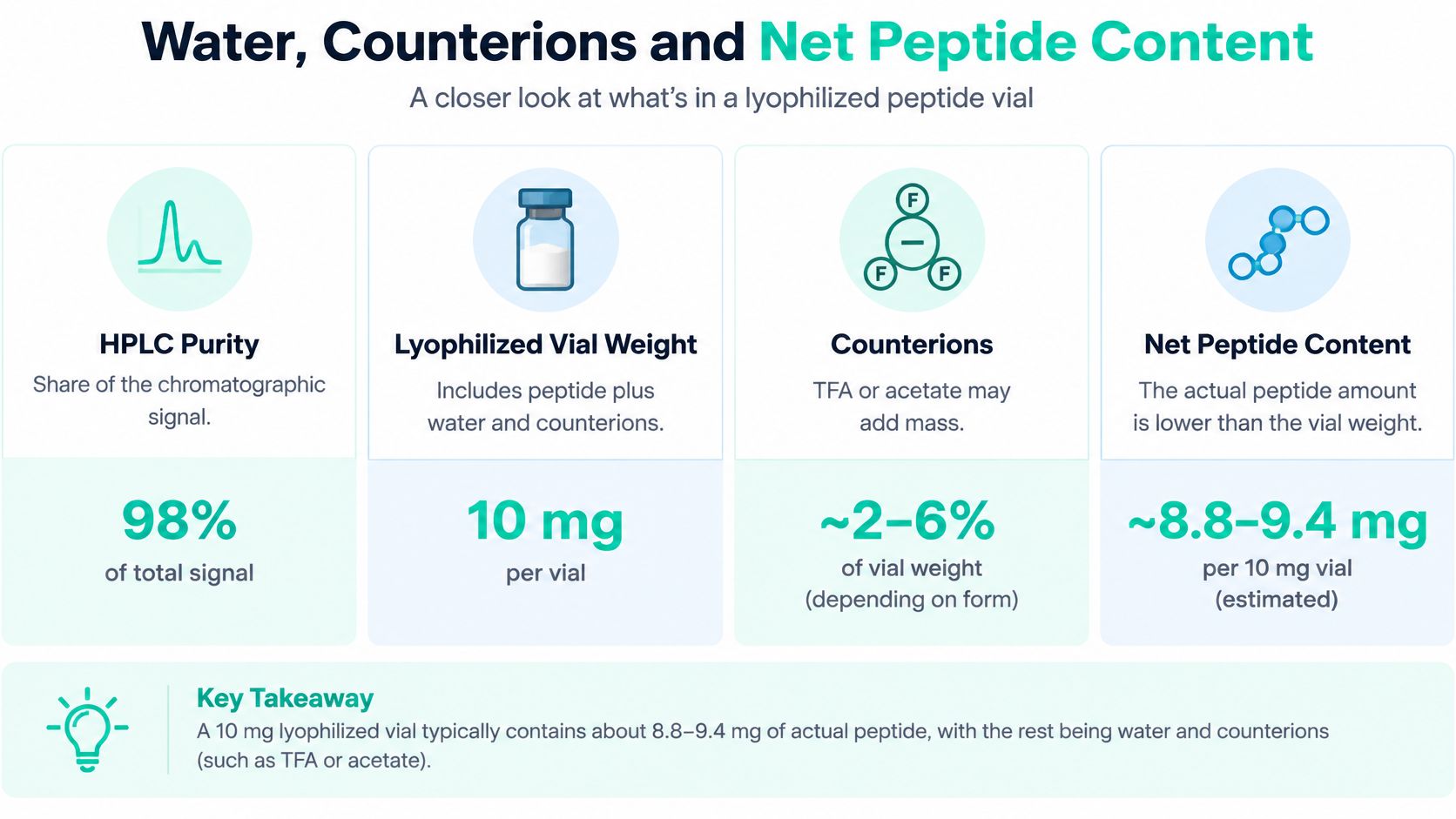
For the hypothetical calculations below, assume water and counterion results are fractions of the as-received material, all other nonpeptide mass is negligible, and chromatographic area fraction approximates the desired peptide's fraction of the remaining material.
Under those assumptions:
Approximate desired-peptide fraction = chromatographic purity × (1 − water fraction − counterion fraction)
All values in this table are constructed examples, not measured batches or typical composition claims.
| Scenario | HPLC Purity | Water | Counterion | Approximate Net Peptide |
|---|---|---|---|---|
| Acetate salt, low water | 99% | 3% | 8% | 88.11%, about 88% |
| TFA salt, moderate water | 99% | 6% | 15% | 78.21%, about 78% |
| Hygroscopic sample | 98% | 12% | 10% | 76.44%, about 76% |
| Water not reported | 99% | Not reported | Not reported | Cannot be calculated |
For the acetate example, the remaining fraction is 0.89, and multiplying by 0.99 gives 0.8811. The chromatographic figure therefore shouldn't be used directly as a mass-content value.
For the TFA example, the remaining fraction is 0.79; multiplying by 0.99 gives 0.7821. The sample can satisfy its chromatographic specification while requiring a substantial correction in gravimetric preparation.
The hygroscopic example produces 0.98 × 0.78 = 0.7644. In the final row, missing inputs prevent a defensible calculation rather than merely reducing its precision.
For quantitative work, calculate the required gross mass from a validated content result wherever possible:
Gross material required = desired peptide mass ÷ peptide mass fraction
Don't apply a water or counterion correction twice if the reported assay already incorporates it. Ask whether the result is as received, dried basis, counterion-free basis, or another defined convention.
This approximate calculation also fails if unmeasured solvents, inorganic material, or unequal detector responses materially affect the result. A direct, suitable assay is stronger evidence than a convenient multiplication built on incomplete inputs.
The following review uses a constructed certificate, not a real commercial lot. The accompanying image is illustrative and isn't the source of these example results.
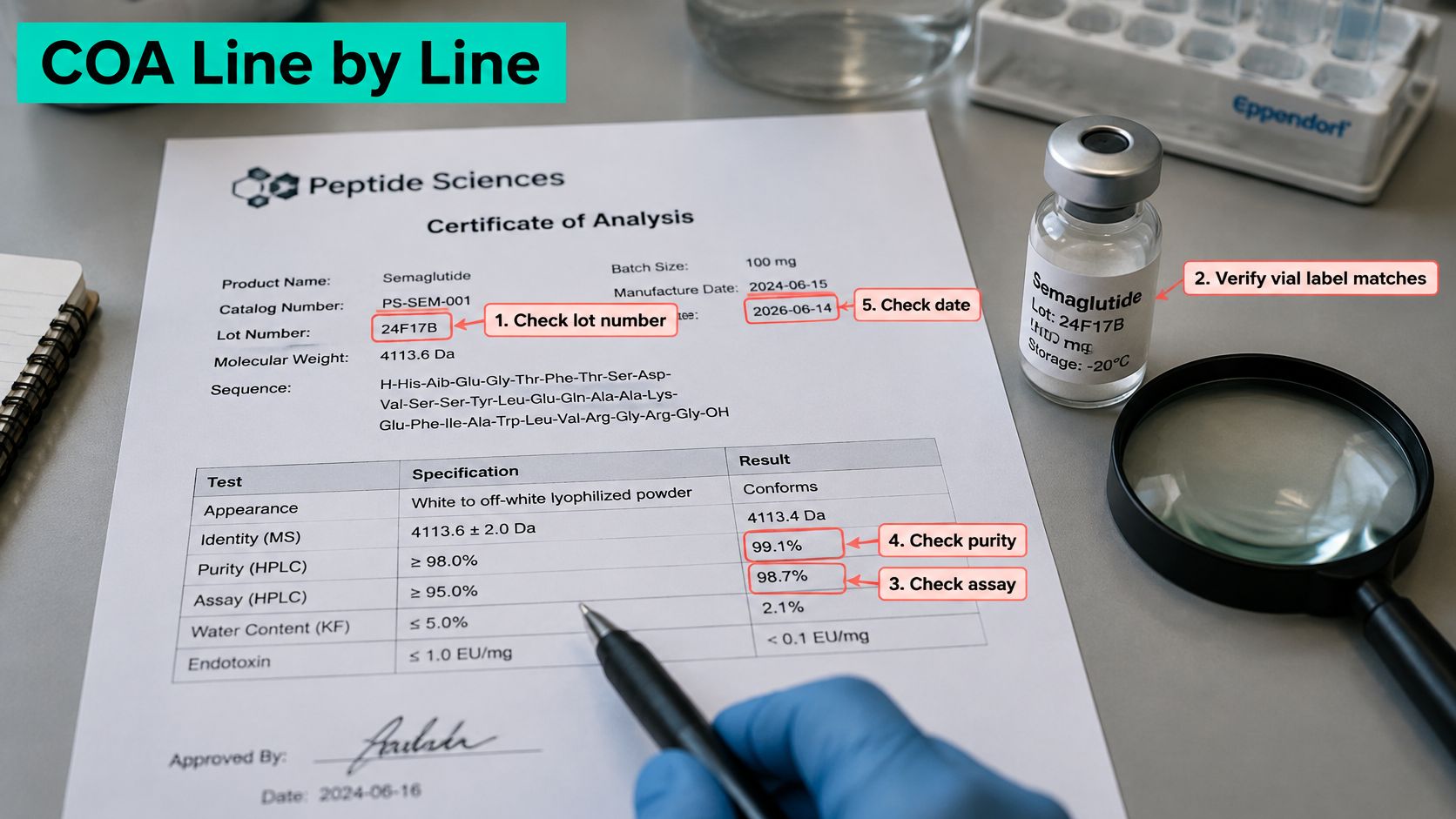
Lot identifier. The example certificate's lot matches both the vial label and purchase record. Save that connection with the receiving record, including any laboratory sample identifier used on the analytical attachments.
Test date. In this hypothetical document, testing occurred on 12 March 2026. Compare that date with synthesis, dispatch, and receipt records, and request the basis for any assigned expiry or retest date rather than assuming the test date defines usable shelf life.
LC-MS identity. The observed molecular mass matches the theoretical mass within the laboratory's stated tolerance. The reviewer checks that both use the same mass convention and that the expected terminal modifications and salt description are correctly distinguished from the molecular-mass calculation.
HPLC purity. The constructed result is 98.6% area purity at 214 nm. Acceptance still requires the referenced method, integration rules, and applicable specification; the wavelength is a method condition, not independent proof of identity.
Largest impurity. The example lists an oxidized form at 0.42%. The reviewer asks what established that assignment and checks it against the individual-impurity limit, rather than assuming that acceptable total purity automatically makes each impurity acceptable.
Water and TFA. The constructed Karl Fischer result is 4% water, and the counterion result is 12% TFA. Both must state their reporting basis before the reviewer combines them with any other result.
Estimated net content. Using the conditional approximation described for these examples, 0.986 × (1 − 0.04 − 0.12) = 0.82824, or approximately 83% desired peptide by weight. Record this as a calculated estimate with assumptions, not as a directly measured assay.
Approval. The final entry names the testing laboratory and authorized analyst or reviewer, with an approval date and signature. If approval is electronic, retain the issued document and its verification details rather than relying on a cropped screenshot.
Release is not stability: Passing a test on the stated date doesn't establish performance after every possible shipping or storage condition.
FDA peptide-specific guidance includes release and near-end-of-shelf-life comparisons for the relevant peptide product assessment. That illustrates why release testing and stability evidence answer different questions.
If your experiment depends on prolonged storage, reconstitution, or repeated freeze-thaw exposure, request time-point results under relevant conditions. A supplier's general storage instruction isn't equivalent to demonstrated post-storage identity, purity, or potency.
A high purity result can be analytically accurate and still be insufficient evidence for accepting a peptide. The problem may lie in interpretation, documentation, or the connection between the tested sample and supplied material.
FDA peptide materials describe reporting peptide-related impurities at or above 0.10% and identifying and characterizing impurities above 0.50% in relevant comparative assessments. These are context-specific assessment expectations, not universal statutory acceptance limits for every research vial.
Administrative omissions such as missing lot numbers, dates, approvers, and retest information also require resolution, but they aren't the only reasons a certificate can fail review.
According to The Peptide List's account of Janoshik Analytical testing, Janoshik reported in 2024 that 43% of the research peptides it tested failed to meet their labeled purity claims. That finding describes the tested samples, not a random estimate of the entire peptide market.
It supports a practical conclusion: verify the evidence attached to the material you're buying. It doesn't justify treating every supplier as unreliable or every laboratory result as definitive.
Any material red flag warrants a supplier query before use. Request the batch-specific chromatogram and mass spectrum, ask a precise question about the discrepancy, and retain the written response with the procurement decision.
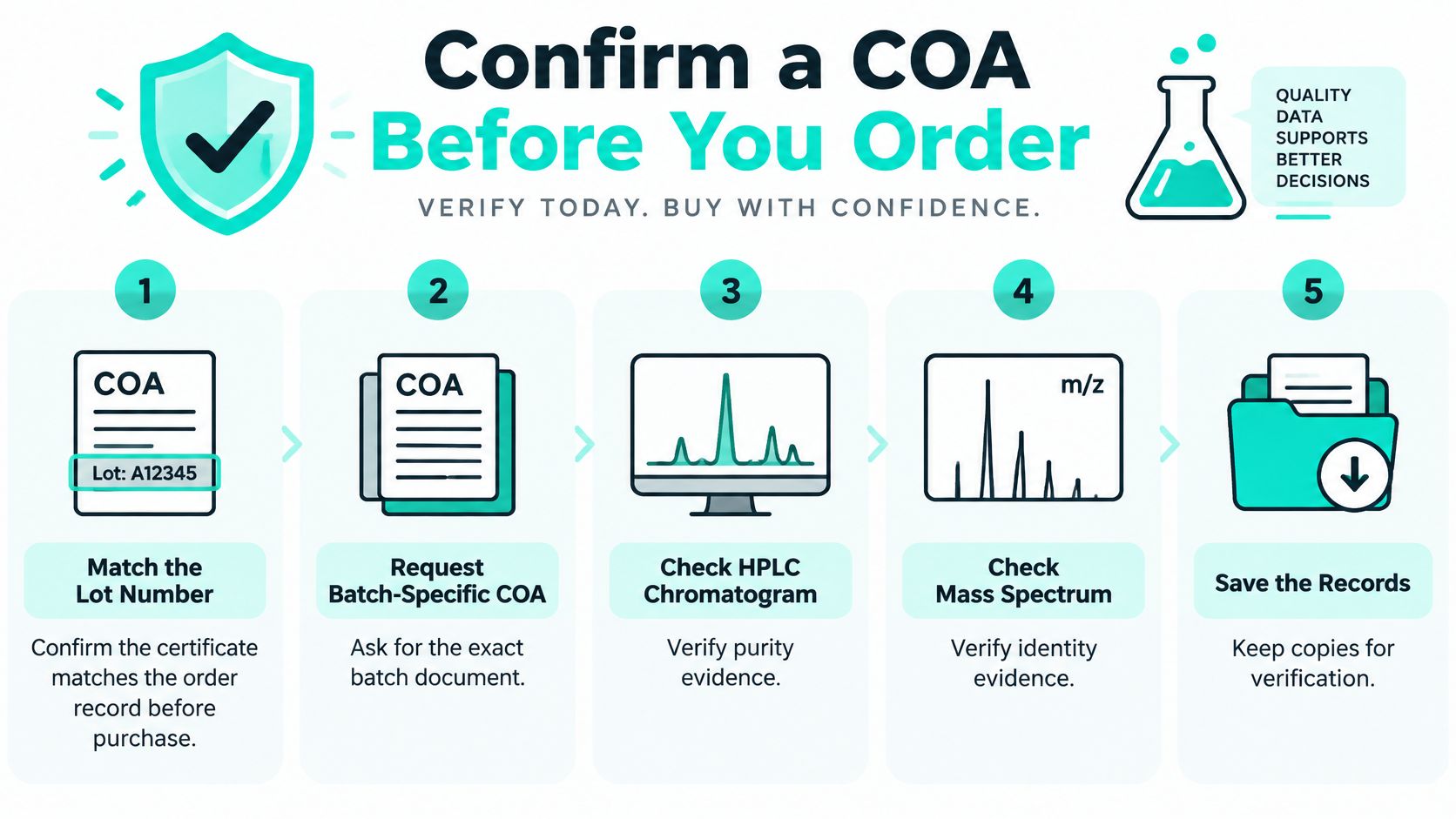
Contact the issuing laboratory through independently verified contact details where possible. As of 2026, PeptideBase reported that 407 of 1,554 certificates, or 26%, in its database had been matched against issuing-laboratory records; unmatched does not automatically mean fraudulent.
When selecting verification support, compare the capabilities described in this guide to peptide testing laboratories. For additional reviewer training, Novagenesis Biopharma's guide to understanding peptide CoA results can complement your laboratory's acceptance procedure.
Academic laboratories should establish batch-linked identity and chromatographic evidence as a baseline. Preclinical pharmaceutical and biotech teams should add application-appropriate content, impurity, and stability requirements; CROs should retain reproducible method details and approval records.
Biomedical startups planning cell or in vivo experiments should explicitly assess endotoxin requirements. Procurement offices should preserve lot records alongside refund, return, and shipping terms, applying the same scrutiny to every supplier's purity and independent-testing claims.
Accept when every required check passes, query resolvable omissions, and reject material when identity or lot linkage fails.
Celonyx Labs supplies research peptides through an online catalog and provides customer support for product and order questions. Visit Celonyx Labs to review available research products and request the lot-specific analytical documentation your laboratory needs before purchasing.
Tesofensine is not a peptide: it is a synthetic small molecule with the formula C17H23Cl2NO

Choose research peptides for oncology research by identity, batch evidence, and assay fit. Learn quality

Celonyx Labs vs Vitality Medical: choose research peptides or medical supplies. Compare intended use, quality
FOR RESEARCH USE ONLY. Products sold by Celonyx Labs are intended exclusively for laboratory and scientific research. They are not intended for human or veterinary use, consumption, diagnosis, treatment, cure, or prevention of any disease. By purchasing from this site, you acknowledge that you understand the intended research purpose of these materials and agree to comply with all applicable laws and regulations.