How to Interpret HPLC Chromatograms Step by Step
The most popular advice for reading an HPLC chromatogram is also the least reliable: find
GMP-adjacent peptides are research-grade compounds produced under manufacturing conditions that mirror Good Manufacturing Practice standards without carrying full pharmaceutical GMP certification. Sourcing GMP adjacent research peptides correctly means verifying batch-specific documentation, validated analytical methods, and production infrastructure before a single vial reaches your lab. The difference between a reliable peptide and a problematic one rarely shows up in a headline purity number. It shows up in the audit trail. This guide covers exactly what to demand from suppliers, how to read manufacturing signals, and where sourcing workflows break down.
The single most important quality indicator in GMP-adjacent peptide sourcing is a batch-specific Certificate of Analysis (COA) linked directly to the vial’s lot number. Batch-tied COA scrutiny is the foundation of any defensible procurement process. A generic COA, one that lists purity without specifying the lot, test date, or analytical method, tells you almost nothing about the material in your hand.
Every COA you accept should include the following: the exact lot or batch number matching the vial label, the test date, the purity method (HPLC or UPLC), and identity confirmation via mass spectrometry (MS) or LC-MS tied to that same batch. Documentation matching batch and method is what separates an auditable procurement record from a marketing document. Without it, you cannot trace an experimental anomaly back to a specific material lot.
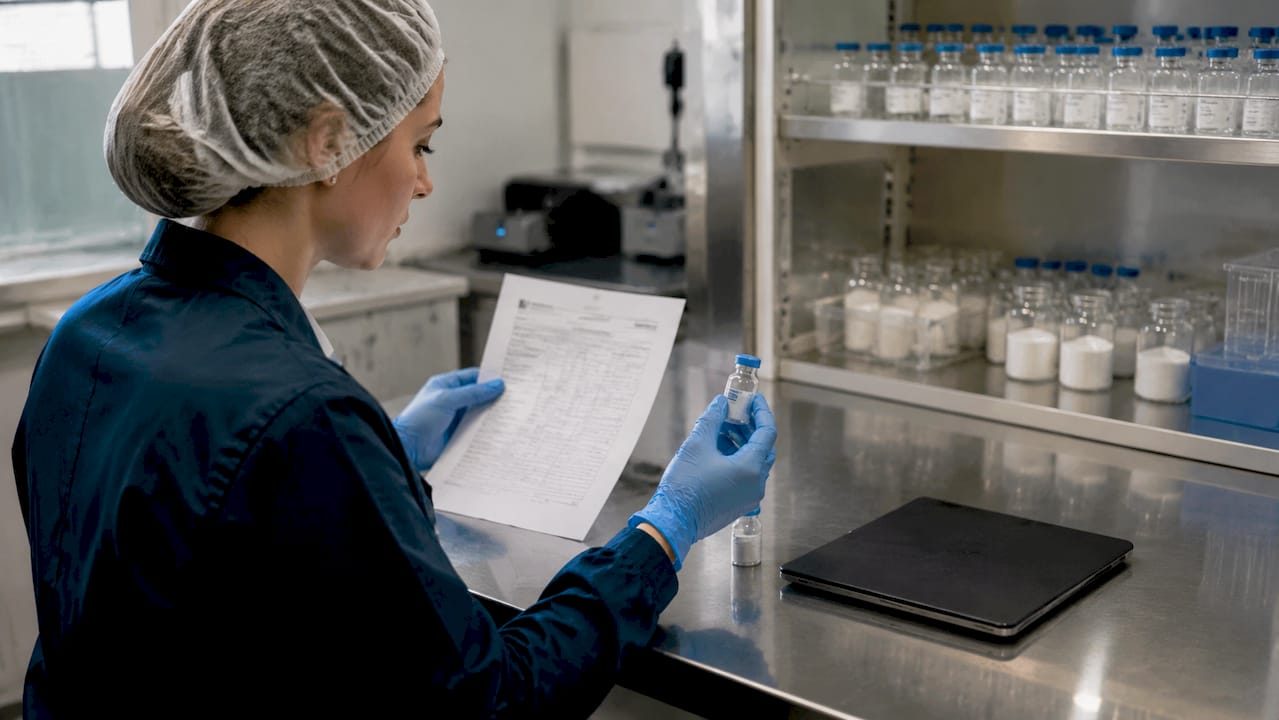
Pro Tip: Request the raw HPLC chromatogram alongside the COA summary page. A supplier confident in their analytical data will send both without hesitation.
The table below shows the key documentation elements and what each one signals about supplier quality.
| Documentation element | What it signals |
|---|---|
| Lot-specific COA | Material is traceable to a single production batch |
| HPLC/UPLC purity method stated | Purity was measured by a validated, quantitative method |
| MS or LC-MS identity confirmation | Peptide sequence and molecular weight are verified |
| Test date on COA | Results are current and not recycled from a prior batch |
| Analyst name or lab identifier | An accountable party performed and signed off on testing |
Recycled or undated COAs are a disqualifying red flag. Generic or mismatched COAs compromise auditability even when the purity number looks excellent. Treat documentation control as a quality system indicator, not a formality.
Pilot-scale GMP manufacturing is the clearest infrastructure signal that a peptide producer operates at a level consistent with GMP-adjacent quality. Pilot-scale GMP plants with multi-10 kg capacity, integrated cleanroom environments, and automated processing represent the production tier that generates consistent, well-documented peptide batches. Smaller bench top operations simply cannot replicate the process controls that make batch-to-batch reproducibility achievable.
Cleanroom classification matters. Grade D or Class C environments control particulate contamination during synthesis, purification, and packaging. Automated sterile lyophilization and integrated purification within a controlled environment contribute directly to peptide purity and consistency. A supplier who cannot describe their cleanroom classification or lyophilization process in specific terms is unlikely to meet GMP-adjacent standards.
Pro Tip: Ask suppliers directly: “What is your cleanroom classification for final fill and packaging?” Vague answers like “controlled conditions” are not equivalent to a stated Grade D or Class C designation.
The synthesis method also matters. Solid-phase peptide synthesis (SPPS) is the industry standard for research-grade peptides. Liquid-phase peptide synthesis (LPPS) and enzyme-assisted synthesis are used for specific sequences and scale requirements. Knowing which method a supplier uses for your target peptide tells you whether their process is appropriate for the sequence complexity involved.
| Facility attribute | What it indicates |
|---|---|
| Multi-10 kg reactor capacity | Consistent batch scale; not a one-off production run |
| Grade D/Class C cleanroom | Controlled particulate environment during synthesis and packaging |
| Automated sterile lyophilization | Reproducible drying process; reduces operator-dependent variation |
| Integrated purification (HPLC prep) | In-house control over purity without outsourcing a critical step |
| SPPS or LPPS synthesis capability | Appropriate method for research peptide sequence complexity |
A supplier operating a pilot-scale GMP plant with these attributes is not just producing a purer peptide. They are producing a peptide whose quality can be defended, reproduced, and traced.
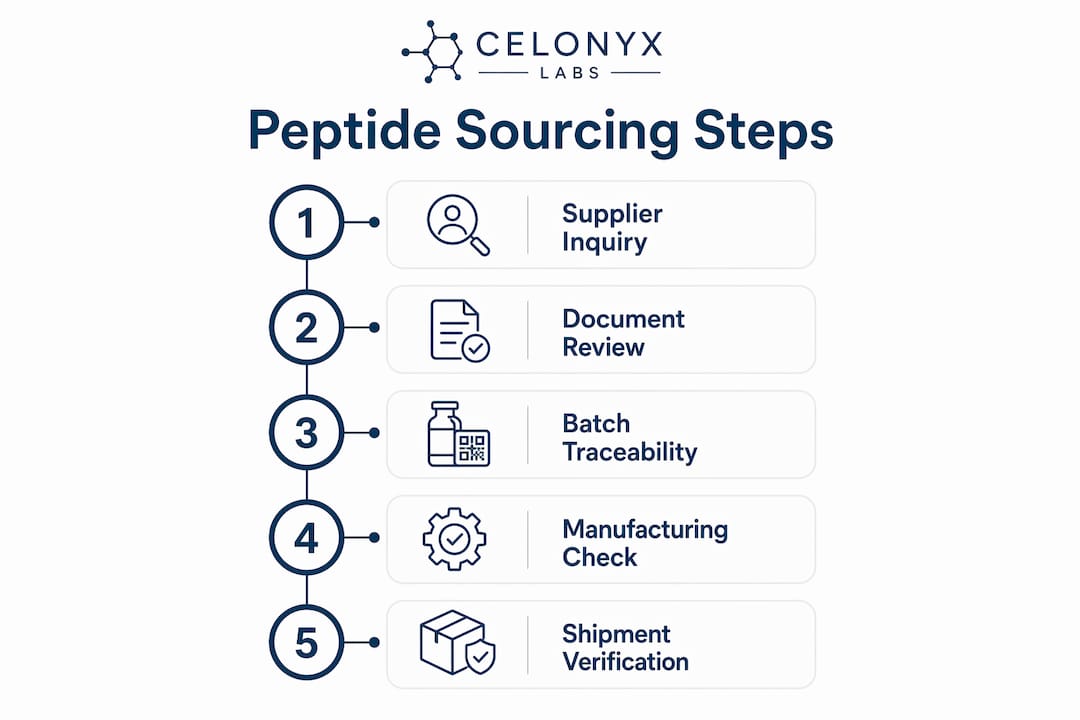
Effective research peptide sourcing starts before you submit a purchase order. Supplier credibility assessment, documentation verification, and procurement logistics all require active attention. Supplier qualification should evaluate communication quality, MOQ logic, lead time realism, and packaging capability alongside documentation standards.
Start with a direct inquiry. A supplier’s response time, technical depth, and willingness to share documentation before purchase are reliable indicators of their operational standards. Suppliers who deflect documentation requests or offer only marketing materials at the inquiry stage rarely improve after payment.
Pro Tip: Place a small first order before committing to bulk quantities. Verify that the COA, vial label, packing list, and invoice all carry matching lot numbers before scaling your procurement.
The checklist below covers the critical verification steps for each order:
Shipment paperwork matching COA lot numbers is not a bureaucratic detail. It is the link that makes your entire document chain auditable. If a lot of number on the packing list does not match the COA, stop and resolve the discrepancy before using the material.
Maintaining a controlled document repository for all received peptide documentation supports reproducibility over time. When assay performance drifts or an experiment fails to replicate, the first place to look is the material record. A complete document chain lets you rule out peptide variability quickly and confidently.
The most common mistake researchers make is accepting a COA without checking whether it is batch-specific. A supplier can produce a legitimate-looking COA for a reference standard and attach it to every shipment regardless of actual batch. Batch-level traceability requires that the COA was generated from the specific lot being shipped, not from a prior production run.
Red flags that warrant immediate supplier escalation:
A COA with no test date, no lot number, or a lot number that does not match the vial label is a documentation failure. A supplier who cannot explain the discrepancy or provide a corrected document within 48 hours should be removed from your approved supplier list. Research-grade peptides must be verified as appropriate for laboratory use before any experimental application. Never use a peptide in an assay when its documentation chain is incomplete.
Lot number mismatches between the vial, COA, and shipping documents are a second common failure. This mismatch can occur through supplier error or through the use of pooled inventory from multiple production batches. Either scenario breaks the audit trail. The fix is a written policy requiring lot number verification at receipt, before the material enters your inventory.
Supplier marketing claims about purity are not a substitute for documentation. FDA’s 21 CFR Part 211 requires comprehensive quality systems covering facilities, equipment, and documentation practices. GMP-adjacent sourcing mirrors this framework at the research level. Treat procurement as a quality system exercise, not a price comparison.
Sourcing GMP-adjacent research peptides requires batch-specific documentation, verified manufacturing infrastructure, and a controlled document chain to support reproducibility and audit readiness.
| Point | Details |
|---|---|
| Batch-specific COA is non-negotiable | Every COA must include the lot number, test date, purity method, and MS identity confirmation. |
| Manufacturing scale signals quality | Pilot-scale GMP plants with cleanroom environments and automated lyophilization produce more consistent peptides. |
| Document chain must match end to end | Vial label, COA, packing list, and invoice must all carry the same lot number. |
| Supplier qualification goes beyond purity | Evaluate communication, MOQs, lead times, and documentation practices before committing to a supplier. |
| Treat sourcing as a quality system | GMP-adjacent procurement mirrors FDA 21 CFR Part 211 principles at the research level. |
The researchers I see struggle most with peptide sourcing are not the ones who chose the wrong purity grade. They are the ones who accepted a COA at face value and never built a document chain. When an assay drifts six months into a project, they have no way to determine whether the peptide changed, the protocol changed, or both. That is an expensive and avoidable problem.
Building a relationship with a supplier who treats documentation as seriously as you do changes the entire dynamic. You stop chasing paperwork and start having technical conversations. You know the lot number before the shipment arrives. You can cross-reference analytical reports against your own in-house QC data. That level of transparency is what separates a procurement partner from a vendor.
Manufacturing scale also shapes my confidence in a supplier more than any single purity number. A producer operating a pilot-scale GMP facility with cleanroom controls and automated lyophilization has invested in process consistency. That investment shows up in batch-to-batch reproducibility, which is exactly what advanced research demands.
My honest recommendation: treat every new peptide supplier as a quality audit, not a shopping experience. Request documentation before you order. Verify lot numbers at receipt. Store every record. The researchers who do this consistently are the ones whose results hold up to scrutiny.
— tj
Researchers who need GMP-adjacent quality without the procurement guesswork will find Celonyxlabs built for exactly that standard. Every product in the Celonyxlabs catalog is backed by third-party testing and independent lab results, with batch-level documentation available for verification.
Celonyxlabs maintains 99% purity standards across its research peptide catalog, with transparent COA access and fast shipping that keeps time-sensitive projects on schedule. Products like BPC-157 10mg exemplify the documentation and packaging standards that GMP-adjacent sourcing demands. Researchers and procurement teams can browse the full peptide product range to find compounds that match their specific research requirements, backed by the documentation chain that makes results defensible.
GMP-adjacent describes peptides produced under manufacturing conditions that mirror Good Manufacturing Practice standards, including cleanroom environments, validated analytical methods, and batch-specific documentation, without carrying full pharmaceutical GMP certification.
A valid COA must include the exact lot or batch number, test date, purity method (HPLC or UPLC), and identity confirmation via MS or LC-MS tied to that specific batch. Generic or recycled COAs are not acceptable for auditable research procurement.
Ask the supplier directly about their cleanroom classification, synthesis method (SPPS or LPPS), lyophilization process, and batch capacity. Suppliers operating pilot-scale GMP plants with Grade D or Class C cleanrooms can answer these questions with specifics.
Lot numbers must match across the vial label, COA, packing list, and invoice to create an unbroken audit trail. A mismatch breaks traceability and means you cannot confirm the analyzed material is the material you received.
Purity is a necessary but insufficient qualifier. Documentation and auditability over marketing claims or purity alone determine whether a supplier meets GMP-adjacent standards for advanced research applications.
The most popular advice for reading an HPLC chromatogram is also the least reliable: find
You've just opened a shipment and found a small vial labeled AOD 9604 5mg. The
Tesamorelin and sermorelin are compared for the same reason that weak evidence gets mistaken for
FOR RESEARCH USE ONLY. Products sold by Celonyx Labs are intended exclusively for laboratory and scientific research. They are not intended for human or veterinary use, consumption, diagnosis, treatment, cure, or prevention of any disease. By purchasing from this site, you acknowledge that you understand the intended research purpose of these materials and agree to comply with all applicable laws and regulations.