

1500 Mg Glutathione: What That Strength Really Means
You're comparing two bottles on a supplement shelf. One says 500 mg glutathione. The other
Tesamorelin and sermorelin are compared for the same reason that weak evidence gets mistaken for equivalence: they act on the same hormonal axis, but they do not occupy the same evidence tier. Tesamorelin has modern adult outcome data and an FDA-approved indication, while sermorelin is the minimal bioactive GHRH fragment, so any serious comparison has to start with what each compound can support in a research design. Because no published randomized controlled trial has directly compared them, most confident rankings are indirect inferences drawn from different populations, different endpoints, and different study eras, not a clean head-to-head result.
| Feature | Sermorelin | Tesamorelin |
|---|---|---|
| Core identity | 29-amino-acid synthetic GHRH analogue | Stabilized synthetic GHRH analogue |
| Best-supported role | Physiologic GH-axis probe | Visceral-fat reduction in HIV-associated lipodystrophy |
| Evidence depth | Thin contemporary adult evidence | FDA approval plus randomized trial program |
| Best use in research | Short-term GH secretagogue work | Adult metabolic and body-composition studies |
| Main interpretation risk | Overstating limited adult data | Overgeneralizing a labeled indication beyond its population |
The table is the cleanest way to read the comparison. One peptide is suited to narrow physiological probing, the other has been carried through regulatory review for a defined metabolic endpoint. Keep that asymmetry in view, and the literature becomes easier to interpret.
Sermorelin and Tesamorelin keep ending up in the same conversation because both act on the growth hormone-releasing hormone, or GHRH, axis, and both appear in adult body-composition discussions. That surface similarity can make them seem interchangeable. The evidence architectures differ by design, Sermorelin probes the axis; Tesamorelin targets visceral fat.
Sermorelin is best understood as the minimal bioactive fragment of endogenous GHRH, while Tesamorelin is the peptide with a modern clinical trajectory and a labeled metabolic use. That difference changes what each compound can credibly support in a research design. A lab using Sermorelin is usually probing pulsatile GH physiology. A lab evaluating Tesamorelin is usually asking whether a defined GHRH analogue can shift visceral adipose tissue under adult clinical conditions.
Practical rule: do not choose the peptide first and the question second. Choose the endpoint first, then ask which molecule has the evidence architecture to support it.
The comparison pages that flatten them into “better” and “worse” miss the main issue. Tesamorelin has adult randomized trial data and an FDA approval, while Sermorelin's contemporary adult data are much thinner and often appear in compounding or wellness contexts rather than in rigorous metabolic trials freemedicaljournals.com.
The absence of a direct trial matters more than casual readers realize. No published randomized controlled trial has directly compared Sermorelin and Tesamorelin, so any superiority claim is built by stitching together separate studies in different populations, different endpoints, and different study eras dosagepeptide.com. That is not the same thing as comparative efficacy.
A bench scientist would treat that as a design constraint, not a marketing inconvenience. If the compounds were tested in different ages, different disease states, and different endpoints, then averaging across them creates a false hierarchy. The cleaner question is narrower, and much more defensible, what can each peptide support without overreading the data?
Both peptides signal through the pituitary GHRH receptor, but their pharmacology is not interchangeable. Sermorelin is the 29-amino-acid synthetic analogue GHRH 1–29-NH2, a minimal fragment of the native hormone that is useful for probing the growth hormone axis in a controlled way clinicalpeptide.org. Tesamorelin is the structurally modified analogue, and that added stability is what separates a short receptor probe from a compound built for adult translational work. For the peptide design rationale and formulation context, see tesamorelin peptide science.
Sermorelin's value is that it preserves the native signaling pattern closely enough to activate pituitary somatotrophs and produce short, pulsatile GH release. That makes it useful for studying axis responsiveness without pretending to be a broad metabolic intervention. In the small adult study often cited in comparisons, 11 senior men given 2 mg daily for 6 weeks showed an 82% rise in overall GH exposure, while IGF-1 remained unchanged clinicalpeptide.org. The pattern is informative because it shows receptor engagement and endocrine output, but it does not establish persistent downstream remodeling.
The mechanistic reading is narrow and defensible. Sermorelin can show that the axis still responds to GHRH-like stimulation, and it does so in a way that preserves physiologic pulsatility. The adult literature available here does not let you infer a durable metabolic effect from that signal alone.
Tesamorelin sits further along the translational path because its structural modification increases resistance to degradation and supports a more sustained GH signal. That matters because the adult visceral-adipose program depended on a signal profile that could be carried through to a measurable tissue endpoint. The design logic behind that profile is described in this overview of tesamorelin peptide science, and the clinical evidence base reflects it.
The downstream chain is more coherent for Tesamorelin than for Sermorelin. Receptor activation leads to GH release, GH drives IGF-1 signaling, and the endpoint tested in adult trials was reduction in visceral adipose tissue. Sermorelin was never developed into that same endpoint framework, so claims that it should behave similarly rest on extrapolation rather than direct evidence.
Mechanistic shortcut: Sermorelin is the cleaner probe for the axis, Tesamorelin is the more developed tool for testing downstream metabolic change.
Binding the same receptor does not guarantee the same research value. A molecule can trigger the same receptor and still differ in signal durability, tissue exposure, and the endpoints it can credibly support. That is why mechanism-only comparisons leave too much out of view. Receptor binding explains the start of the signal. Outcome data determine whether it matters.
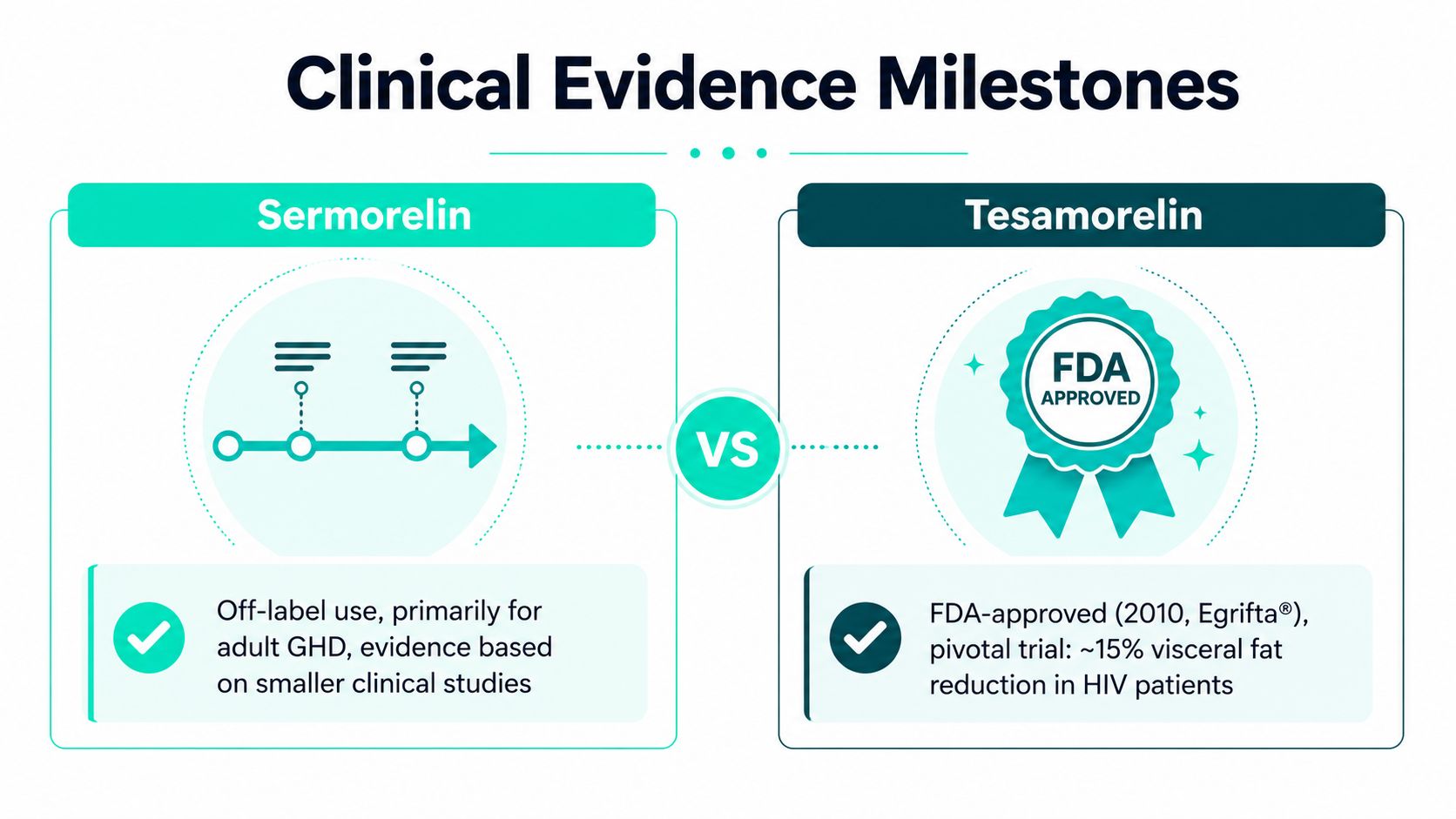
Tesamorelin's clinical milestone is not just that it showed activity. It reached U.S. FDA approval in 2010 as Egrifta for reducing excess visceral adipose tissue in adults with HIV-associated lipodystrophy. In the randomized trial program, the signal was tied to a measurable anatomic endpoint, with about a 15% reduction in visceral fat over 26 weeks versus roughly a 5% increase on placebo, along with improvements in triglycerides and the total-to-HDL cholesterol ratio. A later pooled analysis also reported that the drug consistently lowered visceral fat, trunk fat, and waist circumference while increasing lean body mass.
The important point is not that Tesamorelin works in adults. The more defensible conclusion is that its development program connected receptor activation to a durable metabolic endpoint in a defined population, which is a different evidentiary standard than showing a transient endocrine response. A review of the Egrifta program also reported common adverse events such as injection-site reactions and mild metabolic changes, a reminder that a clinically useful signal still has to be weighed against tolerability in the same adult cohort.
Evidence quality is no longer about detecting a signal. It is about demonstrating a durable adult metabolic endpoint. For Tesamorelin, that endpoint is clear enough to support a specific medical use case, even though the population is narrow and the inference should not be stretched beyond it.
Sermorelin sits in a different evidentiary class. It is the 29-amino-acid synthetic analogue of endogenous GHRH, which makes it a useful probe for GH-axis biology, but the adult literature described in the comparison sources is much thinner and does not map onto a comparable visceral-fat program. Its adult studies support the claim that it can stimulate the axis. They do not show that it changes the same body-composition endpoint that Tesamorelin was developed to test.
That difference matters because pharmacology and outcomes are not the same thing. A rise in GH exposure tells you the axis responded. It does not tell you whether the response is strong enough, sustained enough, or clinically relevant enough to alter adipose tissue in adults.
A direct side-by-side ranking is tempting, but it breaks down once the trial histories are separated. Tesamorelin has modern adult outcome data and an FDA-approved indication. Sermorelin has a more limited contemporary adult evidence base and is usually discussed in the context of physiology, off-label use, or wellness-oriented protocols. Those are not equivalent evidentiary foundations, so “better” only makes sense if the question is narrowed to a specific endpoint.
The cleaner interpretation is that the compounds answer different research questions. One has enough adult outcome data to support a metabolic claim in a defined clinical setting. The other is better suited to showing that the GH axis can be stimulated without claiming that a downstream adult body-composition outcome has been established.
Analyst's reading: the key comparison is not potency, it is what each compound can defensibly support in a research design. Tesamorelin supports an adult metabolic endpoint. Sermorelin supports a physiologic GH-axis readout.
The most defensible way to choose between these peptides is to start with the endpoint, not with an abstract potency ranking. If the research question is visceral adipose tissue in adults with HIV-associated lipodystrophy, Tesamorelin is the better-supported choice because its trial program was built around that outcome. If the question is short-term GH-axis stimulation, Sermorelin is the more direct probe because it is the minimal GHRH fragment.
That distinction matters more than the common “gentler” versus “stronger” framing. Sermorelin fits studies where the investigator wants to observe pulsatile endocrine response without attaching a stronger metabolic claim to the result. Tesamorelin fits studies where the investigator wants to test whether GH-axis stimulation changes a body-composition endpoint in adults under medical oversight. Those are different scientific questions, and collapsing them into one hierarchy obscures what each compound can support.
A practical way to separate the choices is to ask what kind of answer the protocol can defend.
A protocol-level example makes the difference easier to see. In a 6-week GH-secretagogue challenge design, Sermorelin can be used as a physiologic probe with baseline sampling, then serial GH and IGF-1 measurements after dosing, followed by repeat sampling at the same time points on later visits to see whether the axis response is reproducible. That design asks whether the pituitary responds in a patterned way. It does not try to infer a body-composition endpoint from a short endocrine readout.
Not every GH-related question belongs to either compound. If the research goal is sustained, long-duration GH exposure, neither molecule is the obvious first choice. A short-acting fragment answers a different question from a stabilized analogue with a specific metabolic label. The point is not universal superiority, it is fit between molecular design and experimental geometry.
The wrong peptide produces noise, not an answer.
Decision rule: choose Tesamorelin when the endpoint is anatomic and adult metabolic. Choose Sermorelin when the endpoint is mechanistic and physiologic.
A degraded Sermorelin vial can produce flat GH curves that resemble tachyphylaxis, which makes handling errors look like biology. That is why storage and reconstitution details matter before any endpoint is interpreted. Both compounds are typically supplied as lyophilized peptides, so cold-chain storage, protection from light, and moisture control still shape how much confidence a lab can place in the readout.
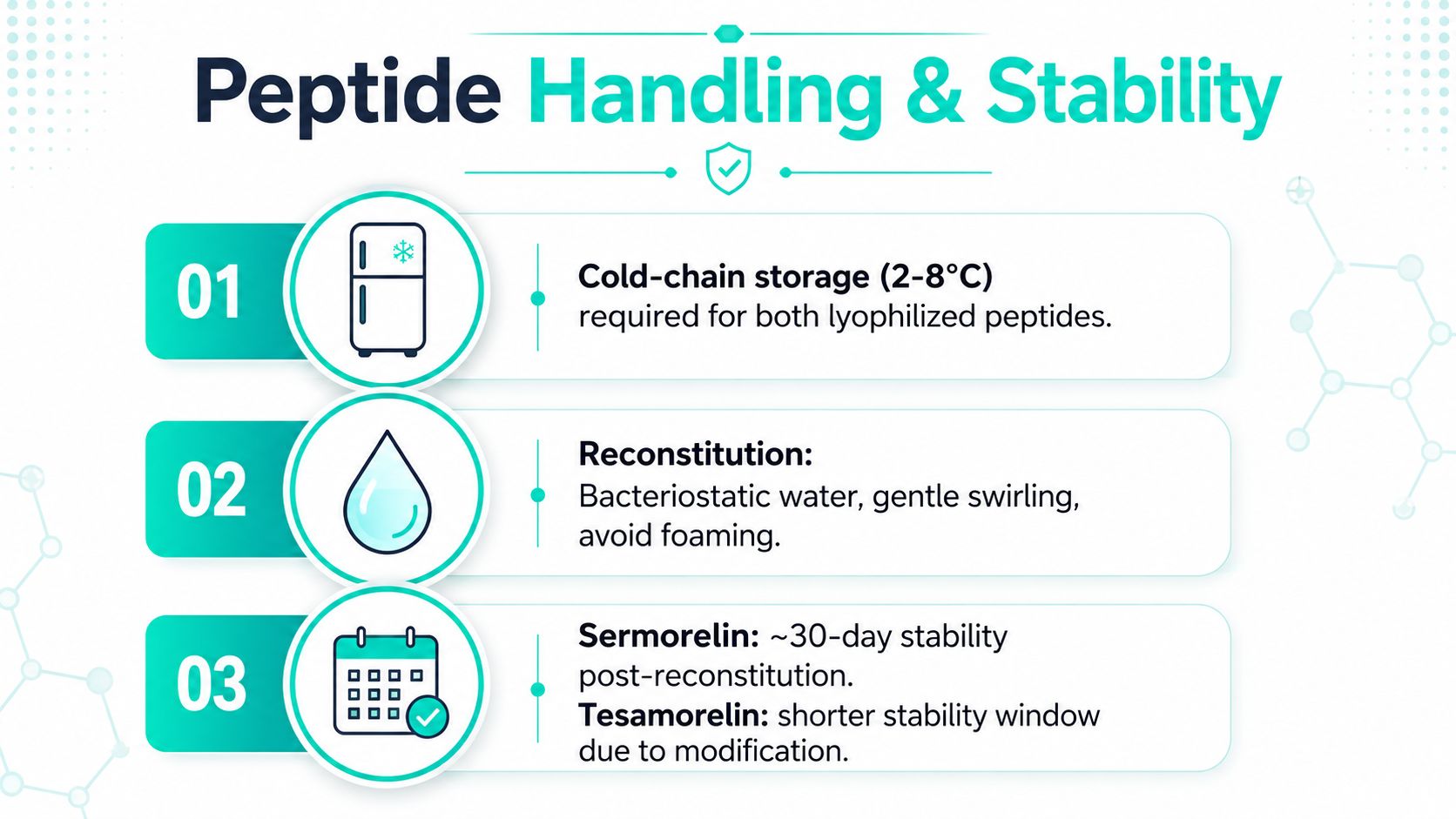
The first pass is practical. Confirm that the vial stayed refrigerated, inspect the powder for obvious compromise, and match the label to the purchase record before the material goes into inventory. Reconstitution should use the correct diluent, often bacteriostatic water if a multidose handling window is planned, and the vial should be mixed gently so the peptide does not foam celonyxlabs.com/peptide-reconstitution.
That handling sequence is where stability claims often drift away from bench reality. Vendor notes can be a useful starting point, but they should be checked against the actual documentation that came with the lot and against the intended use window for the study.
The two compounds do not sit in storage in exactly the same way. Sermorelin is a native fragment with a simpler structure, while Tesamorelin is a modified analogue, so labs often treat their post-reconstitution windows differently even when the underlying chemistry is not the only variable. If the vendor COA lists a 30-day post-reconstitution window, follow that label. If it does not, default to a more conservative window, 14 days for Sermorelin and 7 days for Tesamorelin.
A lab that records the reconstitution date on the vial itself avoids a common source of ambiguity. A spreadsheet entry can be correct and still be missed at the bench, while a dated label is visible during every dosing or sampling step.
The reconstitution workflow should also be documented in the same file as the COA and storage notes. That matters because the handling record becomes part of the interpretation record, especially if a result looks weaker than expected and the question is whether the peptide or the protocol was at fault.
Purity claims only matter when the analytical record is specific enough to audit. A vial advertised at 99% purity is not automatically suitable for a protocol unless that figure is tied to a named batch and supported by an actual test record, not a generic marketing sheet. The practical question is not whether the supplier says the material is pure, but what evidence shows that this lot is what it claims to be.
Ask for a lot-specific Certificate of Analysis, not a template PDF. The COA should match the vial lot number, identify the analytical method used, and let your lab archive the batch without ambiguity. HPLC and UPLC are not interchangeable in procurement, because the method details determine how well a lab can separate the target peptide from impurities, deletion sequences, and other closely related variants.
Method detail is where research-grade documentation usually separates itself from vendor copy. A COA that names a reversed-phase C18 column, gives the gradient window, and reports detection at a defined UV wavelength is more useful than a purity number alone, because it lets a reviewer judge whether the assay is likely to resolve the species that matter for this peptide class. If the report only lists a percentage with no chromatographic context, it is harder to know whether the result is analytically meaningful or just templated.
Mass spectrometry identity confirmation should sit alongside purity testing, not replace it. A mass spec result can support identity, but it does not by itself show whether the material is clean enough for a meaningful experiment. The stronger procurement packet is the one that lets a scientist answer three separate questions, identity, purity, and batch traceability.
The reason this matters in the Sermorelin vs Tesamorelin comparison is simple. The more targeted compound often brings a heavier monitoring burden, but that does not make it less practical. It means procurement quality has to be tighter, because the endpoint is more specific and the experiment is less forgiving.
For a deeper checklist on impurity documentation, see the procurement standards discussed in this peptide impurity profiling guide. The useful habit is to treat the COA as a scientific instrument, not a sales accessory.
The common framing says Tesamorelin is stronger, so it must be riskier, while Sermorelin is gentler, so it must be safer. That shorthand is too blunt to be useful. The actual trade-off is that Tesamorelin's use is tied to medical oversight and safety monitoring, while Sermorelin's broader off-label adult use rests more on preference-driven protocols than on substantial adult outcomes data freemedicaljournals.com.

Tesamorelin's stronger visceral-fat effect comes with a defined monitoring burden, which means IGF-1, fasting glucose, and lipid panels become part of the plan rather than an optional extra. That overhead is not a flaw, it's the price of working with a more targeted adult metabolic therapy. If a study or protocol can't support that monitoring structure, Tesamorelin is a poor fit no matter how attractive the efficacy data look on paper.
Sermorelin may look easier to manage because its adult use is less tightly bound to a labeled metabolic endpoint. But that apparent simplicity partly reflects an evidence gap, not a demonstrated safety advantage. The absence of a large adult outcomes program makes it easier to discuss in broad wellness terms, but it also makes it harder to claim a durable comparative advantage.
The most defensible conclusion is not that one peptide always beats the other. It's that Tesamorelin is easier to defend when the question is specific and medically bounded, while Sermorelin is easier to justify when the question is mechanistic and the goal is to stay close to native physiology.
For laboratories and research teams that need peptide materials paired with documented quality controls, Celonyx Labs supplies research peptides with stated 99% purity, third-party testing, and a catalog built for investigative work. If you're evaluating Sermorelin vs Tesamorelin for a study design, visit Celonyx Labs to review available research materials, quality documentation, and ordering details before you commit your protocol to a vial.
You're comparing two bottles on a supplement shelf. One says 500 mg glutathione. The other

Is bacteriostatic water the same as sterile water? No. Compare preservatives, vial handling and peptide

How do you know if a peptide vial has gone bad? Quarantine changes, check storage
FOR RESEARCH USE ONLY. Products sold by Celonyx Labs are intended exclusively for laboratory and scientific research. They are not intended for human or veterinary use, consumption, diagnosis, treatment, cure, or prevention of any disease. By purchasing from this site, you acknowledge that you understand the intended research purpose of these materials and agree to comply with all applicable laws and regulations.