AOD 9604 5mg Research Guide: Peptide Specs and Lab Use
You've just opened a shipment and found a small vial labeled AOD 9604 5mg. The
You've just opened a shipment and found a small vial labeled AOD 9604 5mg. The label tells you the nominal amount, but it doesn't tell you whether the material is suitable for your assay, whether the certificate of analysis is batch-specific, or what the human literature supports. Those questions matter more than the fat-loss language often attached to this peptide.
This guide approaches the vial as a research material, not a weight-loss treatment. It's written for laboratory buyers, preclinical researchers, formulation teams, and investigators who need to identify the compound, evaluate evidence, document handling, and decide whether a 5 mg format fits a defensible experiment.
A vial arrives with a label, but the label is only the starting point. Before reconstitution, record the product name, lot number, stated mass, storage condition, arrival condition, and every document supplied with the shipment. Photograph the vial and paperwork if your quality system allows it. These records connect later assay results to the material that entered the lab.
AOD-9604 has a defined biochemical identity and a development history that reached human obesity testing. It is a synthetic fragment of human growth hormone, designed around a C-terminal region associated with lipolytic activity. That history supports scientific interest, not a therapeutic conclusion. A commercial AOD 9604 5mg vial is not automatically an approved medicine, and its size does not establish a validated human use.
“Fat-burning peptide” is too broad to guide a defensible experiment. An investigator may test lipolysis in an adipose explant, a formulation scientist may examine behavior in an aqueous buffer, and a buyer may need a comparator or reference material. Each question requires different controls, readouts, and documentation. None is equivalent to asking whether the compound produces reliable weight loss in people.
The human development record also requires balanced interpretation. An earlier study reported a modest short-term signal, while a larger confirmatory study did not establish meaningful efficacy at its primary endpoint, as documented in the clinical history of AOD-9604. The appropriate research frame is therefore specific: define the model, identify the measurable endpoint, and limit the conclusion to what the assay and lot records support.
Practical rule: Treat the vial as a traceable analyte, not as a ready-made therapeutic protocol.
A 5 mg vial may suit dose-response screening, formulation comparison, stability work, and reference-standard preparation. Whether it is enough depends on the target concentration, assay volume, number of replicates, and the need to preserve intact peptide through repeated handling.
The supplied mass is not a validated dose or treatment schedule. Before ordering, write the experimental question, calculate the required concentration and total mass, then allow for controls, repeats, and handling losses. That calculation gives the vial a documented role in the study rather than allowing the package size to determine the protocol.
Start with the parent molecule. Human growth hormone is a larger protein with several biological activities. AOD-9604 removes most of that structure and focuses on a short region associated with lipolytic activity.
The verified molecular description is precise. AOD-9604 is a synthetic 16-amino-acid peptide corresponding to residues 177 through 191 of human growth hormone, with an additional N-terminal tyrosine, according to the published clinical pharmacology record. Product documentation may use slightly different numbering conventions when describing the parent fragment, so the sequence and analytical identity matter more than casual shorthand.
Think of full-length growth hormone as a multifunctional key. AOD-9604 is like cutting away most of that key and retaining the teeth intended to interact with a narrower biological target. The design objective was to preserve fat-mobilizing activity while avoiding classic growth-hormone liabilities, including IGF-1 elevation and receptor-mediated proliferative effects.
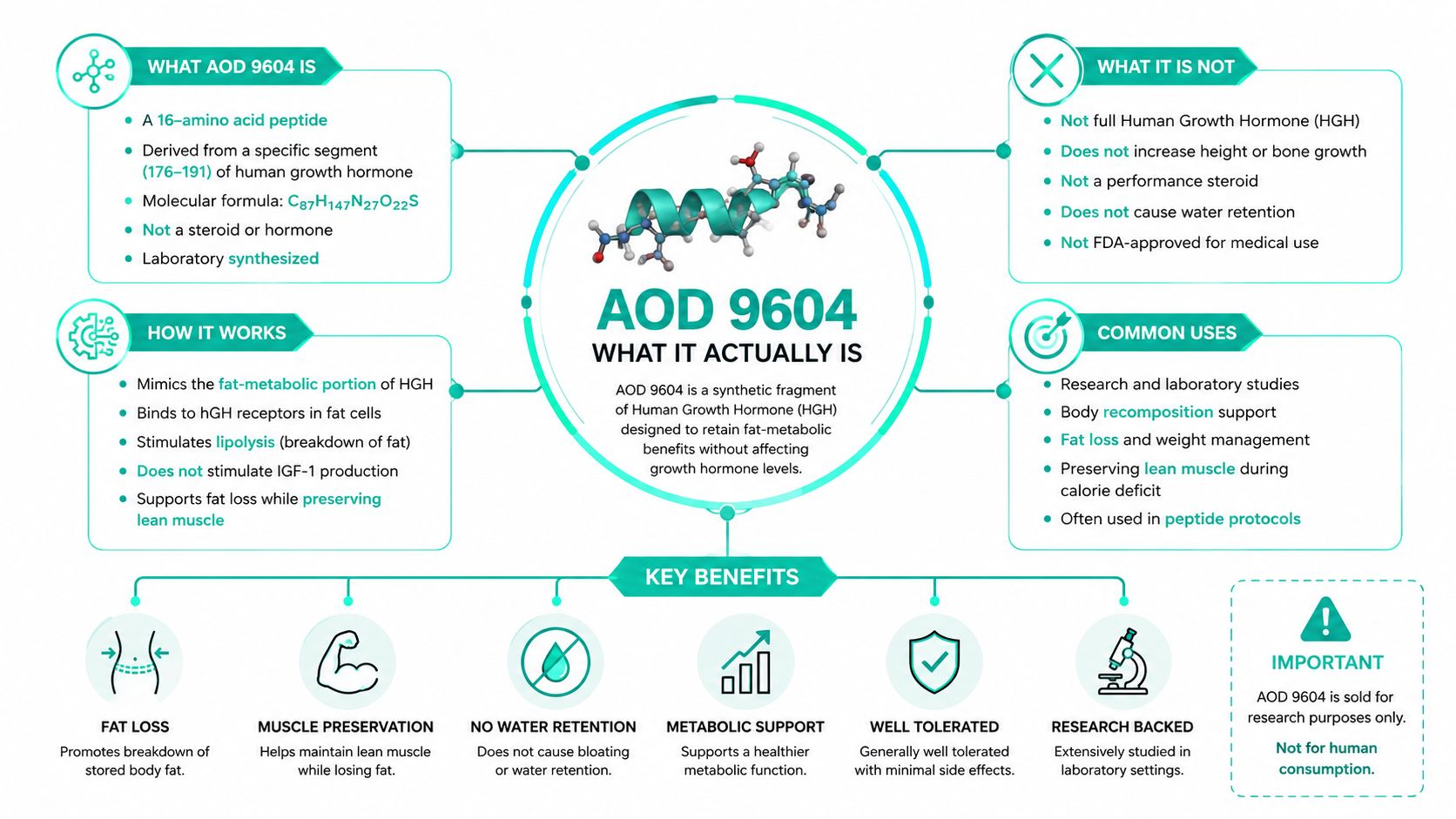
A buyer should separate four terms that often appear together:
A mass label alone can't verify identity. For that, the certificate should connect the lot to an analytical result, normally through chromatography and mass-based confirmation. The modification also matters because a product labeled only as a generic growth-hormone fragment doesn't provide the same level of specification.
The design rationale remains narrower than the full hormone's biology. AOD-9604 shouldn't be described as a miniature version of every growth-hormone effect. It's better understood as a deliberately modified fragment developed to investigate fat-mobilizing activity with less engagement of the broader growth-hormone system.
The strongest mechanistic case for AOD-9604 comes from preclinical work, not from a confirmed modern obesity treatment effect in humans. In obese animal models, researchers reported increased lipolytic activity and fat oxidation, reduced body-weight gain, and no worsening of insulin sensitivity during euglycemic clamp testing, as described in the preclinical study record.
Those observations fit the original development logic. If a short growth-hormone fragment can mobilize stored fat without producing the broader metabolic effects associated with the complete hormone, it could be investigated as an obesity candidate rather than as an anabolic agent.
At the laboratory level, the useful working model is straightforward:
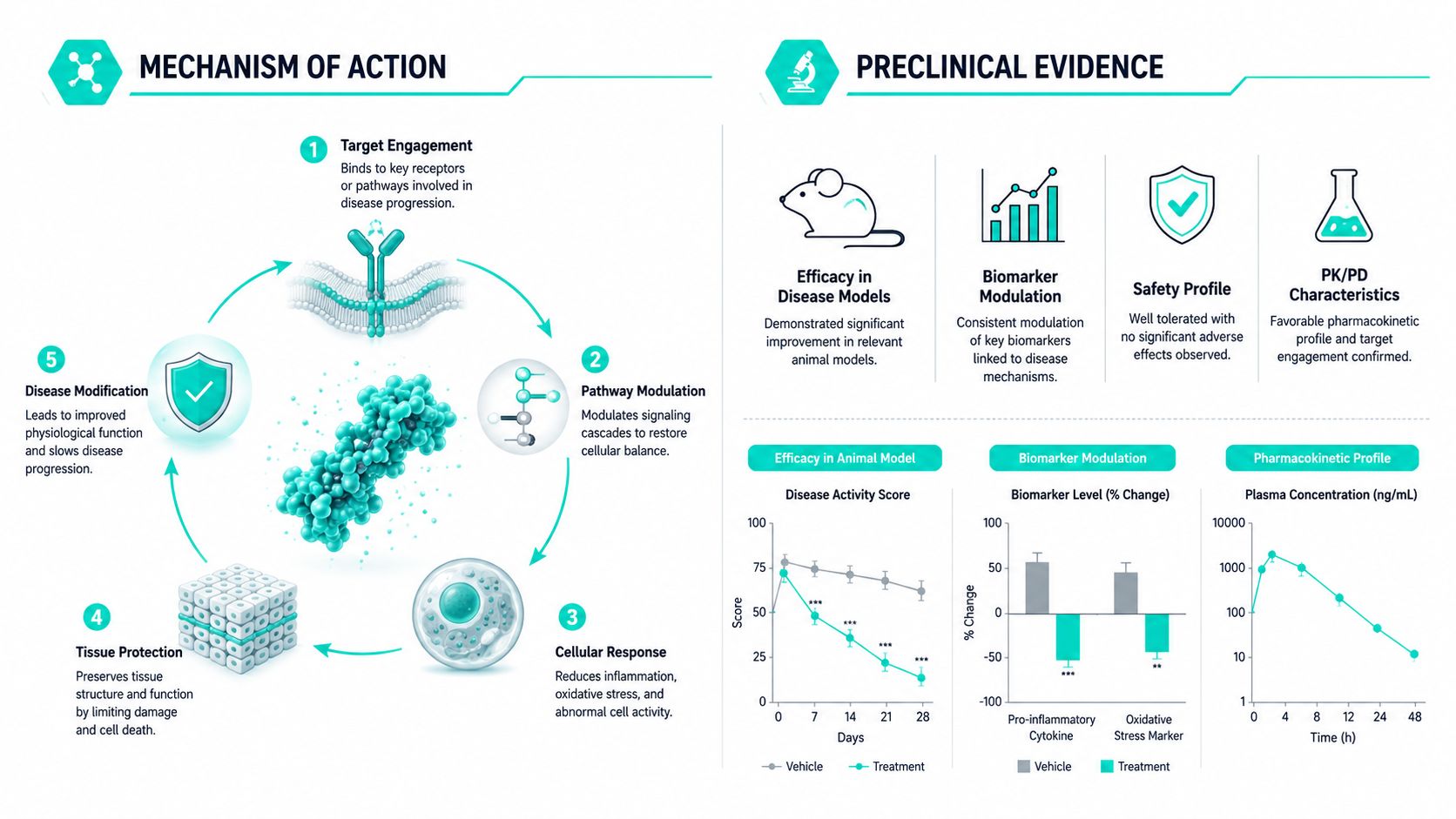
Preclinical findings establish that the compound can produce relevant biological observations in controlled models. They don't establish a dependable human weight-loss effect, a validated 5 mg regimen, or safety for unsupervised use.
They also shouldn't be inflated into an unverified receptor map. A buyer can reasonably investigate adipose lipolysis, oxidation, and metabolic markers. A buyer shouldn't assume that every proposed signaling pathway described in promotional material has equal support across human tissue, animal models, and cell assays.
Animal lipolysis is a rationale for further research. It isn't a substitute for a successful clinical endpoint.
A lab buyer opening an AOD-9604 5 mg vial may see a familiar clinical name and assume the format carries clinical meaning. The record is more specific. Six human trials between 2001 and 2006 are commonly reported, with roughly 893 total participants, while another summary counts 925 participants across six trials. The difference reflects how the program was counted. Neither total turns a vial specification into a dosing recommendation.
The first signal came from a 12-week randomized study using 1 mg per day. Average weight loss was 2.6 kg, compared with 0.8 kg for placebo, an absolute difference of 1.8 kg during that short study period, according to the peer-reviewed clinical report.
The larger 24-week Phase IIb trial enrolled 536 obese adults. At the primary endpoint, none of the treatment arms produced statistically significant weight loss versus placebo. The obesity program was later terminated in 2007 after failing to produce a commercially viable effect, based on the clinical evidence and the earlier development record.
That sequence is the part a researcher should write in the notebook. An early signal can justify a larger test. It cannot outweigh a negative confirmatory result. Presenting the 2.6 kg finding without the Phase IIb outcome makes the evidence look more favorable than the complete record supports.
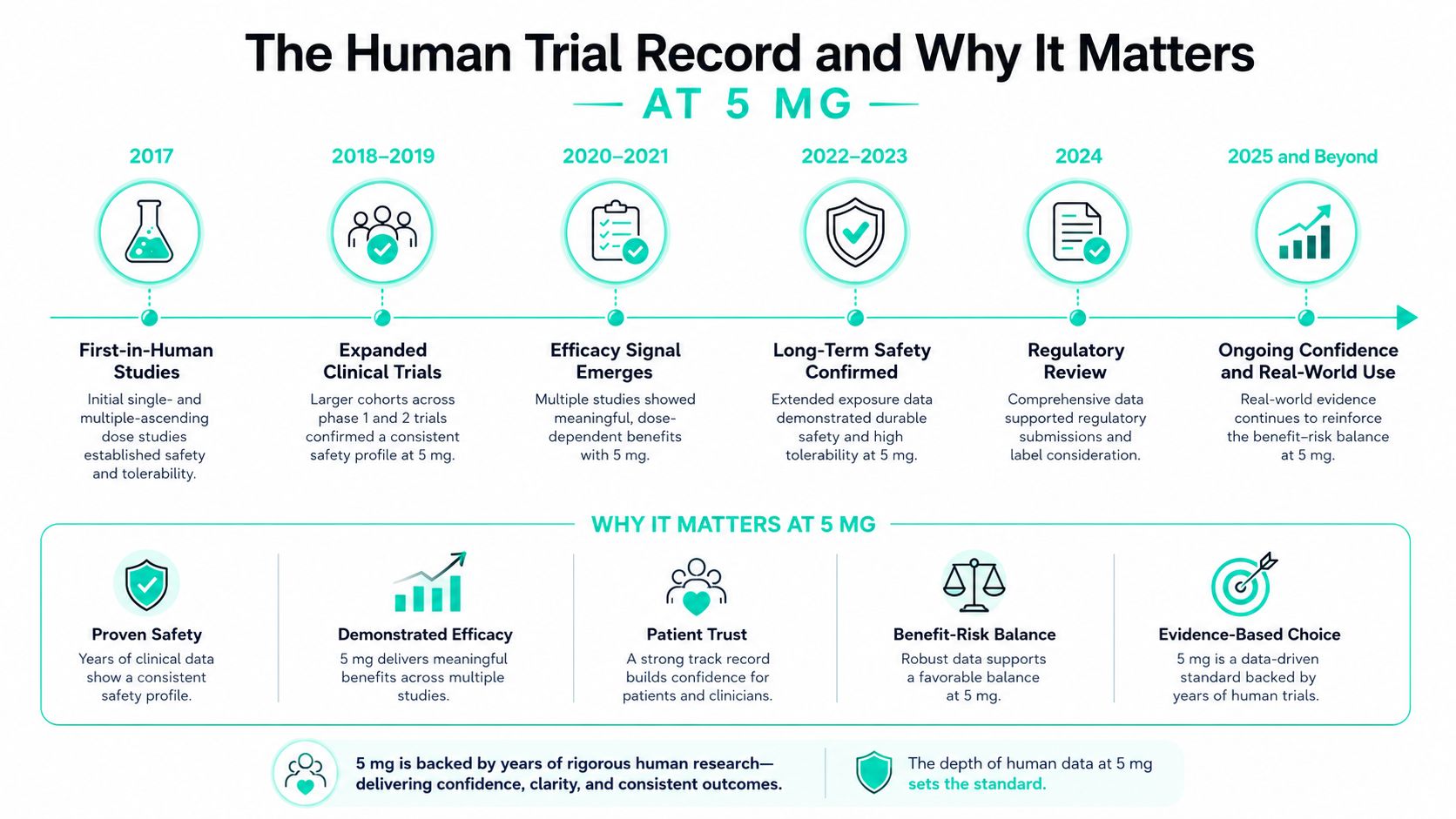
The link to AOD 9604 5mg is practical, not therapeutic. A 5 mg vial describes the amount of material supplied for laboratory work. It does not reproduce the human trial design, represent a complete human course, or establish a dose-response relationship. Those questions require verified formulation, route, exposure, and protocol information.
The defensible reading is narrow: AOD-9604 has a documented human development history, an early modest signal, and a larger negative obesity outcome. For a lab buyer, that record supports careful follow-up experiments and documentation. It does not establish therapeutic certainty or validate unsupervised use.
A 5 mg vial is most defensible when the experiment has a defined analytical endpoint. The material can serve as the test article, a comparator, or a formulation subject, depending on the study design.
Metabolic pathway studies can examine changes in lipid handling under controlled conditions. A researcher might compare untreated tissue, vehicle-treated tissue, and AOD-9604-treated tissue while measuring lipolytic activity or fat oxidation. The value comes from controlling variables, not from assuming a positive result.
Adipose tissue explants offer a way to study tissue-level responses without making claims about whole-body weight change. The investigator should document tissue source, viability, exposure conditions, buffer composition, and analytical readouts so that any observed effect can be separated from handling artifacts.
Formulation and stability work can compare aqueous systems, pH conditions, container materials, and storage intervals. The 5 mg format can be useful, because one vial may support several small-scale formulation screens if the stock is prepared and aliquoted carefully.
AOD-9604 can also function as a reference comparator against newer lipolytic fragments or modified growth-hormone-derived sequences. In that role, the question isn't whether AOD-9604 is a successful medicine. The question is whether a new candidate produces a distinguishable response under the same assay conditions.
A negative or neutral benchmark can be valuable too. If a new compound and AOD-9604 both produce no response in a validated assay, that result helps define assay sensitivity and experimental boundaries.
Notebook standard: Record the lot, declared sequence, reconstitution solvent, concentration, exposure time, and freeze-thaw history alongside every result.
A 5 mg presentation doesn't support extrapolation from animal findings to human dosing. It also doesn't validate self-administration, combination use, or a consumer “fat-loss protocol.” For lab procurement, the right question is narrower: can this batch be identified, handled, and tested in a way that answers the planned research question?
A research buyer should evaluate the documentation before the marketing language. A stated purity value is useful only when the supplier connects it to a defined method, a specific lot, and an identifiable test record.
For a peptide such as AOD-9604, chromatography can indicate the relative purity profile, while mass spectrometry can support molecular identity. Neither method, by itself, answers every question about sterility, endotoxin, residual solvents, aggregation, or suitability for a particular cell assay. Those requirements depend on the application and should appear in the purchase specification.
Look for a certificate that identifies the product and batch without ambiguity. A generic template with a changing product name isn't equivalent to a lot-tied report.
| Field | What to Look For | Why It Matters |
|---|---|---|
| Product identity | AOD-9604 name and declared sequence or molecular description | Confirms that the document matches the material ordered |
| Lot number | The same lot printed on the vial and COA | Allows results to be traced to the tested batch |
| Purity method | HPLC or UPLC with a reported chromatogram or result | Shows how the purity claim was assessed |
| Identity method | MS or LC-MS data | Helps confirm the expected molecular identity |
| Test date | A dated analysis associated with the lot | Establishes when the material was evaluated |
| Net peptide content | A clearly defined content basis, when provided | Supports accurate concentration calculations |
| Storage guidance | Conditions for unopened and reconstituted material | Helps preserve the sample and document deviations |
99% purity is presented by Celonyx Labs as a product attribute, but a buyer should still request the underlying batch documentation rather than accept the number as proof by itself. Independent testing can add an external check, and the third-party tested peptide information explains the type of quality assurance buyers should look for.
A strong procurement file also records shipping condition, receipt date, and any visible vial damage. If the COA lacks a lot number, uses an undated generic page, or reports purity without analytical context, pause the order and ask for clarification.
Treat reconstitution as part of the experiment, not as a casual preparation step. A lyophilized 5 mg vial should be brought to room temperature before opening, handled with appropriate sterile technique, and protected from unnecessary agitation and repeated temperature changes.
The exact solvent depends on the assay. Sterile aqueous diluent may suit a straightforward preparation, while a validated dilute acidic system can be considered when dissolution requires it. For cell-based work, the solvent must also be compatible with the cells and downstream readouts.
volume = mass ÷ target concentration. If the COA provides a net peptide content basis, use that value for quantitative assays.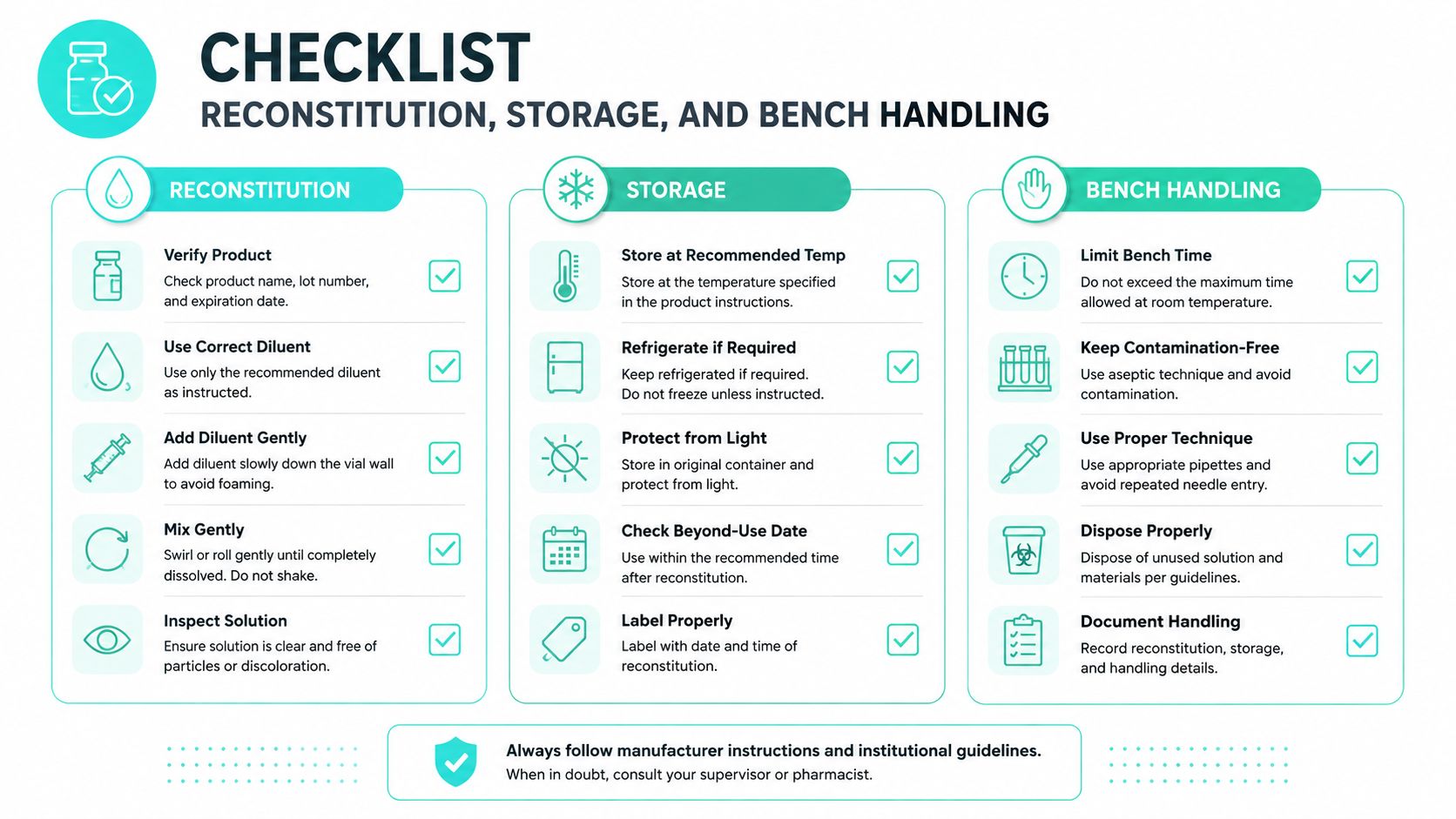
If the full 5 mg vial is prepared at 1 mg/mL, the total stock volume is 5 mL. At that concentration, each 100 µL aliquot contains 0.1 mg, so the theoretical yield is 50 aliquots, before accounting for dead volume, transfer loss, or any COA adjustment.
That calculation is for laboratory planning, not human administration. For a practical handling reference, consult how to reconstitute research peptides and then adapt the workflow to your institution's sterile-processing and storage procedures.
Store the unopened material under the supplier's stated conditions. Reconstituted stocks should generally remain cold, be protected from light where appropriate, and be frozen in labeled single-use aliquots when the experiment requires longer storage. Don't assume a generic storage interval guarantees stability for your batch or assay.
AOD-9604's legal and scientific status requires careful wording. It is a research peptide, not an FDA-approved obesity drug, and an FDA document about a bulk-substance nomination or compounding review shouldn't be interpreted as therapeutic approval. The FDA material on AOD-9604 indicates that bulk-substance nominations for compounding were withdrawn and that AOD-9604 isn't listed as an FDA-approved drug substance.
Independent summaries also describe no therapeutic approval through EMA- or MHRA-style pathways. That distinction matters at the purchasing desk because a product can be sold for laboratory investigation without being lawful or appropriate for human treatment. Short controlled studies can't establish long-term safety, unsupervised-use safety, or the safety of combining AOD-9604 with other investigational peptides.
Before placing an order, confirm:
Celonyx Labs lists research peptides through its online peptide ordering catalog, with stated 99% purity, independent third-party testing, shipping information, published refund and return policies, and phone and email support. Treat those statements as procurement information to verify against the batch-specific documents supplied with your order.
No approved obesity indication is established by the evidence summarized here. The compound has a documented human trial history, but its obesity development program ended after the larger Phase IIb study failed to show meaningful efficacy at the primary endpoint.
It tells you the vial's nominal quantity. It doesn't tell you the correct human dose, expected clinical result, or validated route of administration. Use it to plan assay mass, stock concentration, and aliquot volume.
Follow the supplier's written storage instructions and inspect the shipment on receipt. Because stability depends on whether the material is lyophilized or reconstituted, the label and batch paperwork should control your decision rather than a generic internet protocol.
Ask for a COA carrying the same lot number as the vial. Look for a defined chromatography result, identity confirmation such as MS or LC-MS, a test date, and any additional release testing required by your assay.
The practical conclusion is simple. Buy AOD-9604 5mg only when the research question is defined, the documentation is auditable, the handling plan is ready, and the team understands the difference between preclinical mechanism and approved therapy.
Celonyx Labs supplies research peptides through an online catalog and presents product information such as stated purity, independent testing, shipping policies, and buyer support. Visit Celonyx Labs to review the available materials and documentation before selecting a batch for your AOD-9604 laboratory workflow.
You've just opened a shipment and found a small vial labeled AOD 9604 5mg. The
Tesamorelin and sermorelin are compared for the same reason that weak evidence gets mistaken for
The shortest insulin syringe needle now used in mainstream practice is 6 mm, and a
FOR RESEARCH USE ONLY. Products sold by Celonyx Labs are intended exclusively for laboratory and scientific research. They are not intended for human or veterinary use, consumption, diagnosis, treatment, cure, or prevention of any disease. By purchasing from this site, you acknowledge that you understand the intended research purpose of these materials and agree to comply with all applicable laws and regulations.