

Aatbio.com alternatives in 2026
Compare aatbio.com alternatives for research peptides, custom synthesis, and assay reagents. Choose by material identity,

The question often arises, what does Selank peptide do as if it belongs in a single box: anxiolytic, nootropic, or immune modulator. That framing is too narrow. In lab work, the useful question is different: what kind of system-level signal does Selank introduce, and how should that shape your experiment?
Selank matters because it sits near a busy intersection. It traces back to tuftsin, a natural immune-related peptide, yet researchers study it for effects that touch stress response, cognition, and inflammatory signaling. That combination is exactly where many experiments become hard to interpret. If a compound changes behavior and cytokine tone at the same time, your design has to separate direct effects from downstream effects.
Think like a scientist setting up a difficult assay. Before asking whether Selank “works,” ask what readouts you're measuring, how stable the material is, whether route of administration changes exposure, and whether your model is primarily neurochemical, immunological, or both. Those choices decide whether your results say something meaningful or just add noise.
Selank is a synthetic peptide derived from tuftsin, which is part of why it draws attention from both neuroscience and immunology researchers. If you come from a receptor-pharmacology mindset, that can feel unusual. We're used to sorting compounds into bins: sedative, stimulant, anti-inflammatory, cognitive enhancer. Selank resists that simplification.
The reason is practical, not just conceptual. Stress biology doesn't split neatly into “brain” and “immune system” in real organisms. A stressed animal may show altered exploration, changed attention, different cytokine expression, and shifts in sickness behavior at the same time. A peptide modeled from an immune-associated motif but studied for anxiety-related outcomes naturally forces you to design broader assays.
Many readers expect an anti-anxiety compound to behave like a classic sedative. That expectation creates a common mistake in experimental planning. If your behavioral battery assumes reduced movement equals reduced anxiety, you may misread the result. With Selank, the interesting question isn't merely whether activity goes down. It's whether stress-linked dysregulation becomes more normalized without broad behavioral suppression.
That distinction changes your endpoint selection. You'd want tests that can separate calmness from motor slowing, and cognitive stabilization from nonspecific dampening.
Practical rule: Don't build a Selank study around one readout. Pair behavioral outcomes with molecular or immunological markers so you can tell whether the signal is coherent.
Tuftsin gives you a useful analogy. Think of tuftsin as a short native “message fragment” used in immune communication. Selank is a modified version that researchers investigate because it may keep that signaling logic while behaving differently enough to be useful experimentally. For a new lab member, the key point is this: origin suggests mechanism, but it doesn't prove target specificity.
That means your controls matter. Include vehicle controls, but also think about stress controls, inflammation controls, and timing controls. If you only compare treated versus untreated animals under one condition, you won't know whether Selank changed baseline behavior, stress adaptation, inflammatory tone, or all three.
Researchers are often most interested in Selank when they need a compound that may touch anxiety-relevant circuitry and immune signaling in the same experimental frame. This is a key reason to pay attention to it. Not because it fits a trend, but because it may help probe the biology linking stress and inflammatory regulation.
Selank is best understood as a systems modulator rather than a blunt on-off switch. If benzodiazepines are often described as pushing the brake pedal harder, Selank is more like a technician tuning a control panel so the system stops oscillating wildly. That analogy isn't perfect, but it helps explain why researchers discuss it in both neurochemical and immunological terms.
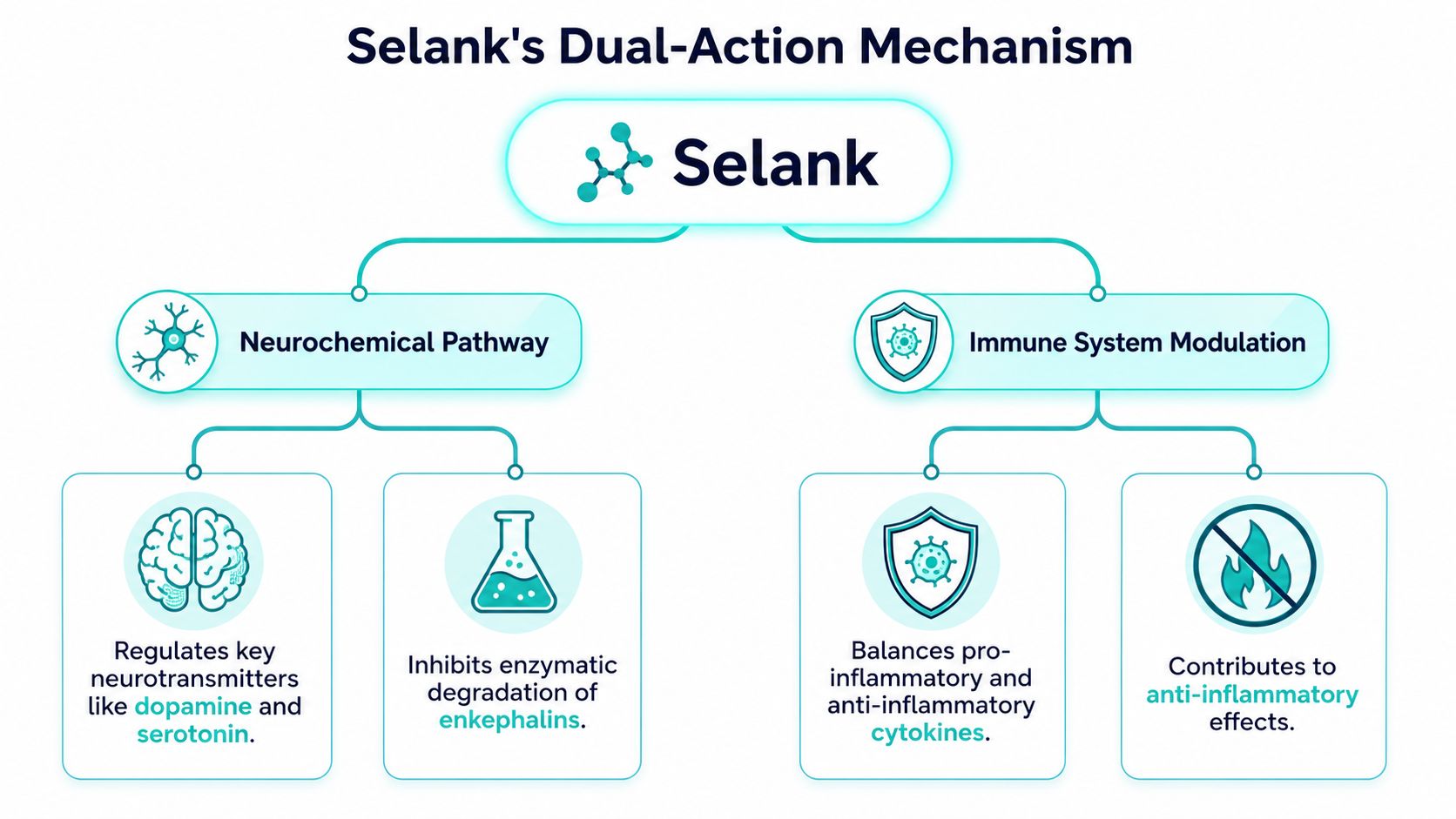
On the neurochemical side, Selank is commonly discussed in relation to monoamine signaling, enkephalin preservation, and broader regulation of inhibitory tone. Plainly stated, researchers don't treat it as a compound that merely floods the brain with one transmitter. They study it because it may alter how existing signaling systems are balanced and maintained.
A useful analogy is a lab incubator with unstable temperature control. One fix is to blast heat into the chamber. Another is to improve the controller so temperature swings narrow and conditions become more stable. Selank is usually framed closer to the second model. The appeal is not “more signal.” The appeal is better-regulated signal.
For experimental design, that means two things:
If your assay involves learning, attention, or stress adaptation, add repeated observations rather than one terminal snapshot. That helps you detect normalization instead of simple stimulation or sedation.
Selank's link to tuftsin keeps the immune pathway in view. Researchers discuss it as a compound that may influence cytokine balance rather than acting as a broad immune suppressant. That wording matters. “Suppressive” suggests one directional effect. “Balancing” suggests state dependence.
Think of cytokine networks like a group chat in which too many people are talking at once. The problem isn't silence versus noise. The problem is coordination. If signaling is exaggerated or poorly timed, physiology suffers. Selank is studied as a peptide that may help reduce disordered signaling rather than erase immune communication.
For lab practice, many studies exhibit a common weakness. Teams sometimes collect behavioral data and skip immune measurements, even though the mechanistic argument depends partly on immune modulation. If you want interpretable data, consider pairing your model with markers of inflammatory tone, glial activation, or stress-responsive immune transcripts, depending on platform and species.
A Selank experiment without pathway-relevant biomarkers often tells you less than you think.
The neurochemical and immune stories shouldn't be treated as separate chapters. In stress biology, they're often part of the same circuit. Peripheral immune activation can alter mood-relevant signaling. Chronic stress can shift immune tone. A peptide that touches both domains may produce effects that look “psychological” in one assay and “immunological” in another, while reflecting one integrated response pattern.
That has direct consequences for reproducibility:
When people ask what Selank peptide does, the best scientific answer is that it appears to modulate stress-relevant signaling across neural and immune domains. The “so what” is simple. Your experiment has to be built to detect coordination, not just a single dramatic output.
The published and discussed research around Selank clusters into three recurring themes: anxiety-related effects, cognitive effects, and immune-related effects. That doesn't mean every study cleanly separates them. In fact, one reason Selank remains interesting is that these categories often overlap.
Early in a project, it helps to decide whether you're using Selank as a probe of mechanism or as a comparator compound in a broader screening framework. If it's a mechanistic probe, you need richer phenotyping. If it's a comparator, your assay panel still needs to avoid collapsing distinct phenomena into one score.
A visual summary helps keep those domains separate before you interpret them together.
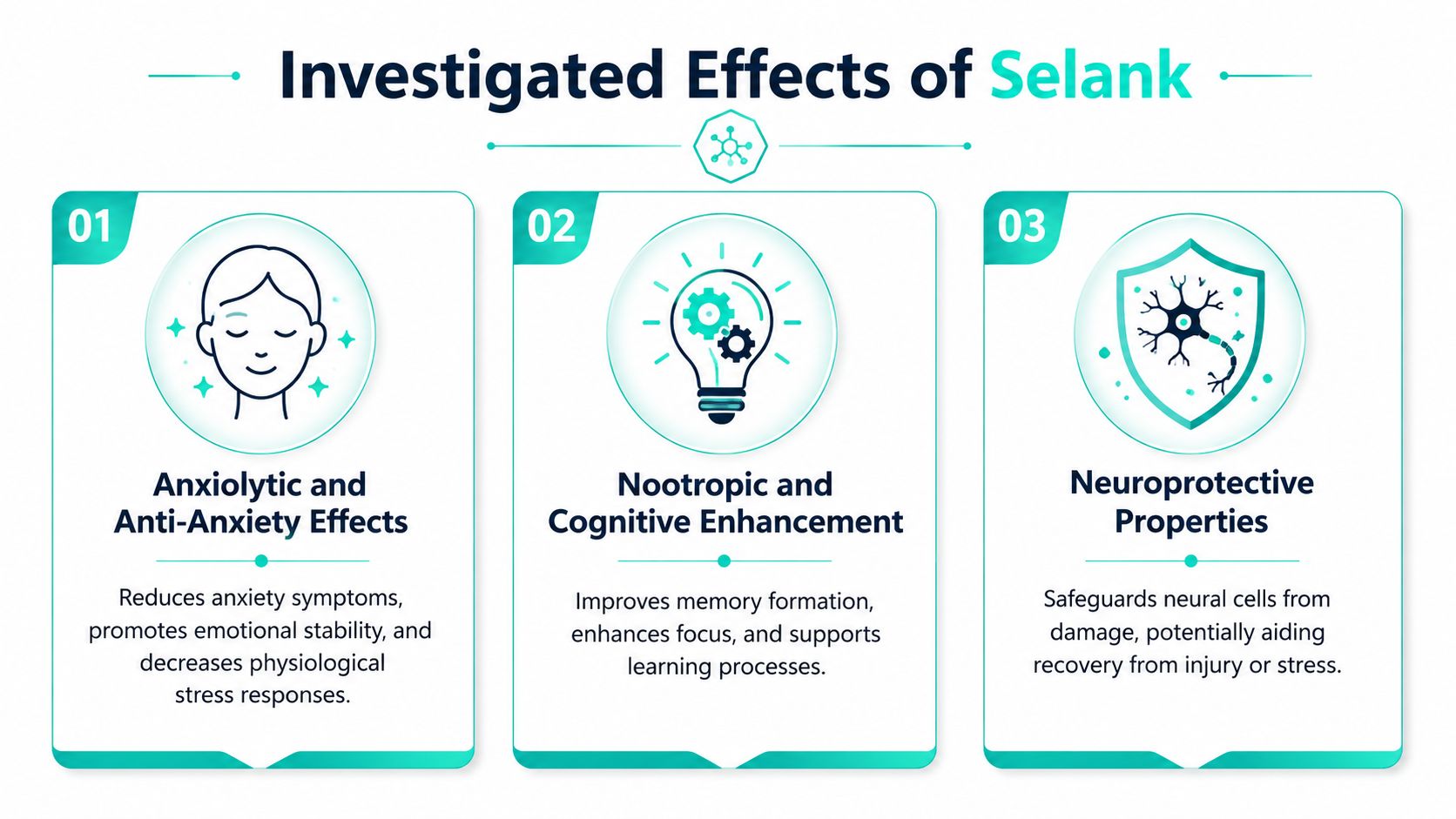
This is the effect domain commonly associated with searches for what does Selank peptide do. Researchers have investigated Selank for anxiety-related outcomes, especially where stress responsivity and emotional reactivity are central readouts. The recurring point in that literature is qualitative: Selank is often discussed as having an anxiolytic profile without the kind of broad sedation that can confound interpretation.
That's important because classic anti-anxiety pharmacology creates a methodological trap. If a subject moves less, explores less, or responds more slowly, are they calmer or just suppressed? Selank is scientifically interesting because investigators often want to know whether emotional regulation can improve without that heavy interpretive penalty.
For stronger study design, pair anxiety-related behavioral tasks with at least one non-overlapping measure such as:
Here's a useful benchmark in mindset, not in numbers: if your study can't distinguish anxiolysis from sedation, it can't say much about Selank.
Selank is also investigated for effects on attention, memory formation, and mental clarity, especially in settings where stress or physiological strain may impair normal function. That doesn't make it a generic “smart drug.” For researchers, the more careful hypothesis is that Selank may support cognitive performance when signaling systems are dysregulated.
Poor experimental framing causes exaggerated conclusions. If animals or participants improve after stress, the compound might be restoring function rather than boosting it above baseline. Those are different claims and should be treated differently.
A practical way to model this is to think about a microscope with drift. If you stabilize the stage, image quality improves. You haven't changed the specimen. You've reduced distortion. Selank is often more compelling as a stabilizer under challenge than as a universal enhancer.
To evaluate that properly, consider a comparison structure like this:
| Cognitive question | Better design choice | Weaker design choice |
|---|---|---|
| Does Selank improve attention under stress? | Include stress and non-stress groups | Test only one stressed group |
| Is memory improved or merely preserved? | Measure baseline and post-challenge performance | Measure only one end state |
| Are effects specific? | Add locomotor or arousal controls | Assume better task performance means cognition improved |
A brief explainer may help if your team is new to this area.
The immune side of Selank research is often under-discussed in general summaries, but it's one of the reasons the peptide is scientifically distinctive. Investigators study it for effects on cytokine expression and inflammatory regulation, and that opens a different kind of experimental opportunity.
If your lab works on stress-induced immune shifts, post-inflammatory behavioral change, or neuroimmune signaling, Selank can serve as a tool compound for asking whether those domains can be moved together. The challenge is that immune signaling is noisy and highly context dependent. Minor differences in housing, handling, pathogen burden, or assay timing can change the readout.
Lab note: If your immunological endpoint is central to the study, freeze your sampling schedule before you start. Don't adjust collection windows after seeing early behavioral data.
A careful summary of the evidence keeps one final point front and center. Selank remains an investigational compound in many research contexts, and its reported effects should be treated as signals under study, not settled therapeutic facts. That mindset protects both rigor and interpretation.
Route of administration shapes exposure, onset profile, tissue distribution, and handling stress. With Selank, researchers often focus on intranasal delivery because it's used in the literature and because it may support central nervous system access without the same path as standard oral delivery. For a lab team, the main lesson is simple: route isn't a technical footnote. It's part of the mechanism you're testing.
Intranasal work sounds straightforward until you try to standardize it across operators. Small differences in delivery angle, restraint time, formulation volume, or post-dose handling can add variability quickly. If one technician is gentle and fast while another takes longer, the animals may experience meaningfully different stress loads before the compound has any chance to act.
That means administration SOPs should be written with the same care as assay SOPs. Include operator training, dosing sequence, timing windows, and what counts as a failed administration.
A few protocol habits improve consistency:
Because no verified quantitative dataset is available here, the safest way to summarize dosing is qualitatively. Use the literature you trust to fill in exact values within your own protocol file, then lock those values before enrollment or animal assignment.
| Study Focus | Model | Administration Route | Reported Dosage Range (per day) |
|---|---|---|---|
| Anxiety-related behavioral work | Preclinical models | Intranasal commonly reported | Qualitatively, published studies report low-dose peptide administration schedules that are repeated consistently across the study period |
| Cognitive or stress-adaptation research | Preclinical models and investigational contexts | Intranasal commonly reported | Qualitatively, dosing is usually kept stable day to day rather than adjusted by observed response |
| Mechanistic neuroimmune studies | Experimental models | Intranasal and other research routes may appear | Qualitatively, researchers often choose a fixed daily exposure plan tied to biomarker sampling windows |
Keep your dose rationale separate from your outcome hypothesis. “It looked active in a pilot” isn't a reproducible justification.
One more caution matters here. Administration details aren't just procedural. They become part of the biological interpretation. If your route favors central exposure, your endpoint panel should reflect that. If your route introduces handling stress, your controls must capture that too.
Researchers often blend safety and legality into one conversation. They shouldn't. A compound can have a reported safety profile in the literature and still remain outside approved therapeutic use in a given jurisdiction. With Selank, keeping those topics separate prevents sloppy assumptions.

Selank is often discussed as notable for a non-sedating anxiolytic profile in comparison with conventional sedative anxiolytics. In practical lab terms, that means investigators pay close attention to whether reduced anxiety-like behavior appears alongside preserved motor performance and preserved task engagement.
That doesn't remove the need for caution. Good safety observation in research settings still includes local tolerability, behavioral abnormalities unrelated to the primary endpoint, dosing consistency, and any sign that the formulation or route is introducing confounds. If your study includes repeated administration, monitor whether effects remain stable or drift with time.
A strong internal safety review usually asks:
Legal and regulatory status is a different issue. Selank is not approved by the FDA for therapeutic use in the United States. For research organizations, that means your procurement, labeling, storage, recordkeeping, and use conditions need to align with investigational and laboratory-only handling standards as required by your institution and jurisdiction.
This has direct implications for lab operations:
The mistake to avoid is assuming “reported as well tolerated” means “administratively simple.” It doesn't. A well-run Selank study treats regulatory boundaries as seriously as assay design.
Most reproducibility failures don't start with the statistical test. They start with the material. If the peptide identity is uncertain, purity varies, or reconstitution practices drift from one batch to the next, the rest of the experiment can't rescue you.
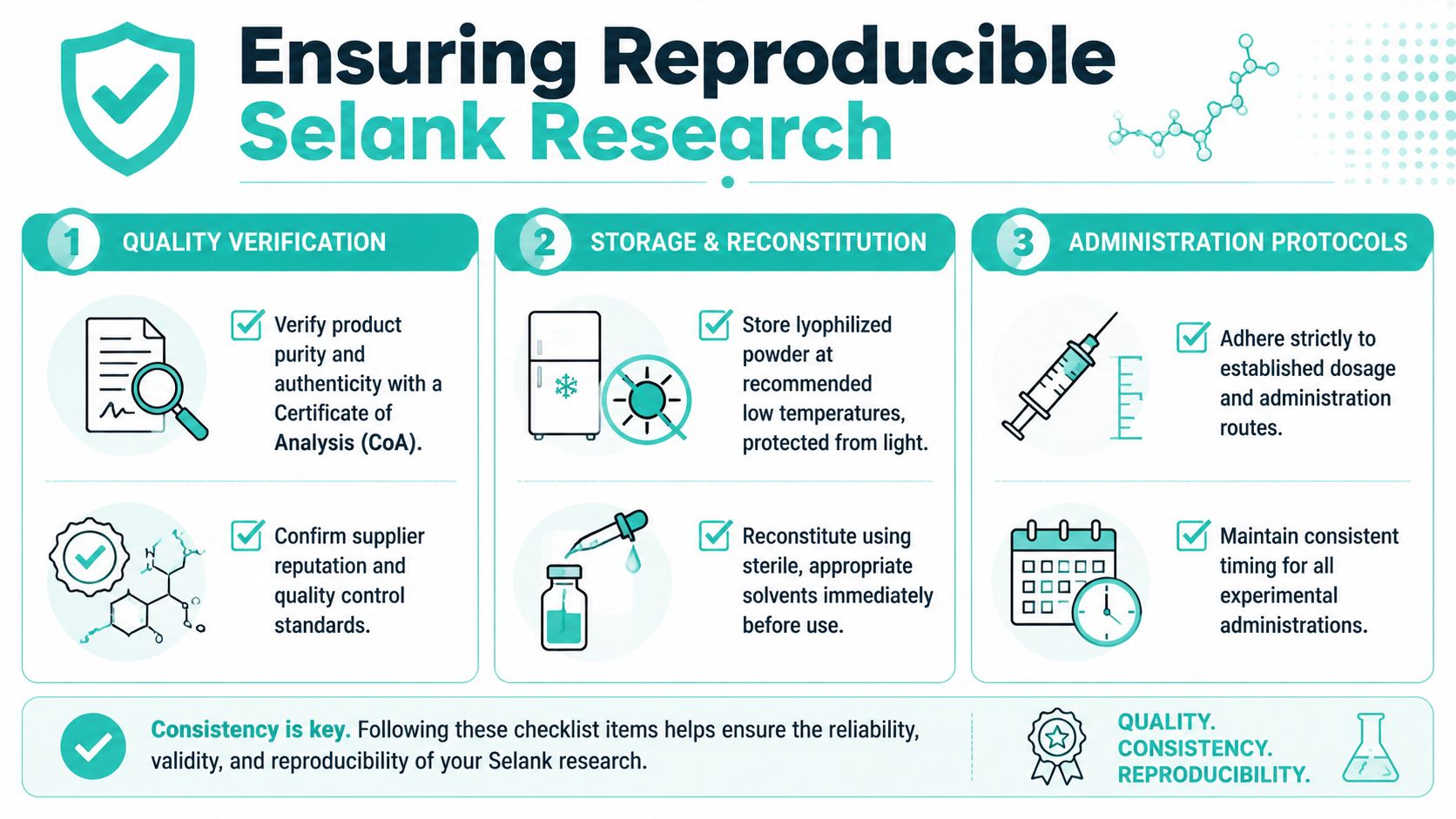
For Selank, identity confirmation and purity documentation are not optional. At minimum, researchers should look for batch-specific documentation such as a Certificate of Analysis, and they should know what they expect to see in it. High-performance liquid chromatography and mass spectrometry are common quality-control tools because they answer different questions. One speaks to purity profile. The other helps confirm molecular identity.
Use a checklist, not intuition:
Reproducibility begins before the vial is opened.
Even high-quality material can become a poor reagent through bad handling. Lyophilized peptides and reconstituted solutions don't behave the same way in storage, and repeated temperature fluctuations can create hidden variability. Teams often underestimate how much damage comes from casual bench handling, repeated freeze-thaw cycles, or loosely documented reconstitution steps.
Think of peptide handling like RNA handling. You wouldn't accept “roughly the same” as a standard for RNA integrity. Peptides deserve the same discipline.
A clean handling workflow usually includes:
| Step | Good practice | Common failure |
|---|---|---|
| Receipt | Log lot number and storage condition immediately | Leaving material at room conditions during intake |
| Reconstitution | Use a defined solvent and documented mixing method | Different technicians using different solvents or techniques |
| Aliquoting | Prepare single-use or limited-use aliquots when possible | Repeatedly thawing the same stock |
| Use in study | Keep timing and preparation consistent across cohorts | Preparing fresh material differently for each run |
The storage details your lab adopts should follow validated supplier guidance and your internal stability rules. If exact stability hasn't been established in your setting, treat that as an unresolved variable, not an inconvenience. Conservative handling beats confident guesswork every time.
Selank remains compelling because it pushes researchers to think across disciplinary lines. It isn't only a candidate anxiolytic signal, and it isn't only an immune-derived peptide scaffold. It's a useful probe for the biology that links stress, inflammatory tone, behavior, and cognitive performance.
The most promising future work will likely come from experiments that stop treating those domains as separate silos. Stress-induced immune suppression, post-viral cognitive changes, altered recovery after inflammatory challenge, and combination studies with other research compounds all raise interesting questions. The common requirement is better design. Richer biomarker panels, tighter handling control, stronger blinding, and preplanned analysis frameworks will matter more than broad claims.
For a new lab member, that's the enduring answer to what Selank peptide does. It appears to shift regulation across connected neural and immune systems. For a senior scientist, the next question is more important: can your model detect that shift cleanly enough to produce data worth trusting?
If your team is planning peptide-based experiments and needs research-grade materials with clear documentation, Celonyx Labs offers a catalog for laboratory investigators, along with third-party testing information, product support, and procurement details that can help streamline internal review before a study begins.
Compare aatbio.com alternatives for research peptides, custom synthesis, and assay reagents. Choose by material identity,

Celonyx Labs vs Thermo Fisher Scientific: choose focused peptide sourcing or broader lab supply. Compare

Compare thermofisher.com alternatives: Celonyx Labs for research peptides, Sigma-Aldrich for broader reagents. Check purity, identity,
FOR RESEARCH USE ONLY. Products sold by Celonyx Labs are intended exclusively for laboratory and scientific research. They are not intended for human or veterinary use, consumption, diagnosis, treatment, cure, or prevention of any disease. By purchasing from this site, you acknowledge that you understand the intended research purpose of these materials and agree to comply with all applicable laws and regulations.