

How to Mix Melanotan 2: A Complete Reconstitution Guide
Most advice on how to mix Melanotan 2 stops at “add water and swirl.” That

Most researchers encounter TB-500 in reverse order. They hear the regenerative claims first and the hard constraints later. The evidence base says the opposite is the safer starting point: TB-500 has more than three decades of preclinical data behind the broader research interest in this peptide family, yet the fragment itself has not been approved by the US FDA for any medical indication and lacks any published human efficacy record (JCSG review of TB-500; Apotheon evidence review).
That split is exactly why the TB 500 peptide remains scientifically interesting and operationally tricky. In a lab setting, the core questions aren't promotional. They are chemical identity, material quality, handling discipline, protocol fit, and regulatory boundaries. If any one of those is weak, the experiment becomes harder to interpret.
TB-500 is easy to discuss badly and harder to study well. The peptide attracts attention because it sits at the intersection of plausible biology, uneven evidence, aggressive marketing, and strict research-use boundaries. For a laboratory team, that combination creates risk. Poor assumptions at the start can distort study design, vendor selection, sample handling, and the claims attached to the final data.
Researchers continue to examine TB-500 because it is associated with a biologically interesting parent system. Work around Thymosin-β4 has long focused on actin dynamics, cell migration, and tissue-response signaling, so a related synthetic fragment naturally draws interest in repair and recovery models. That scientific context is enough to justify careful bench work. It is not enough to justify broad conclusions.
The main practical problem is interpretation. Preclinical signal is often discussed as if it were interchangeable with clinical validation, and the fragment is often discussed as if it were interchangeable with the parent protein. Neither shortcut holds up under technical review. If a group does not define exactly which molecule is being tested, under what conditions, and for what stated research purpose, the resulting data become difficult to defend.
The regulatory environment also needs clear handling. TB-500 is widely sold as a research compound, but it is not approved by the FDA for human or veterinary use. The parent protein has a separate research history, yet that does not give the fragment a published human efficacy record of its own. Some mechanistic work has also challenged simplified claims about regenerative effects, which is one reason experienced investigators treat the peptide as a narrow experimental variable rather than a broad therapeutic proxy.
I have seen more projects weakened by loose material control than by a lack of biological imagination.
A disciplined approach starts early. Confirm what the vendor is selling. Separate fragment-specific claims from literature on Thymosin-β4. Write protocols that acknowledge uncertainty, not marketing copy. In practice, teams that do this produce cleaner data, make fewer procurement mistakes, and spend less time explaining avoidable inconsistencies after the assay is finished.
TB-500 is a defined synthetic fragment, not a catchall name for Thymosin Beta-4 research.
TB-500 is a synthetic heptapeptide with the amino acid sequence Ac-LKKTETQ. It corresponds to a short region of the endogenous 43-amino-acid protein Thymosin Beta-4 and is typically described by researchers as the 17 to 23 fragment.
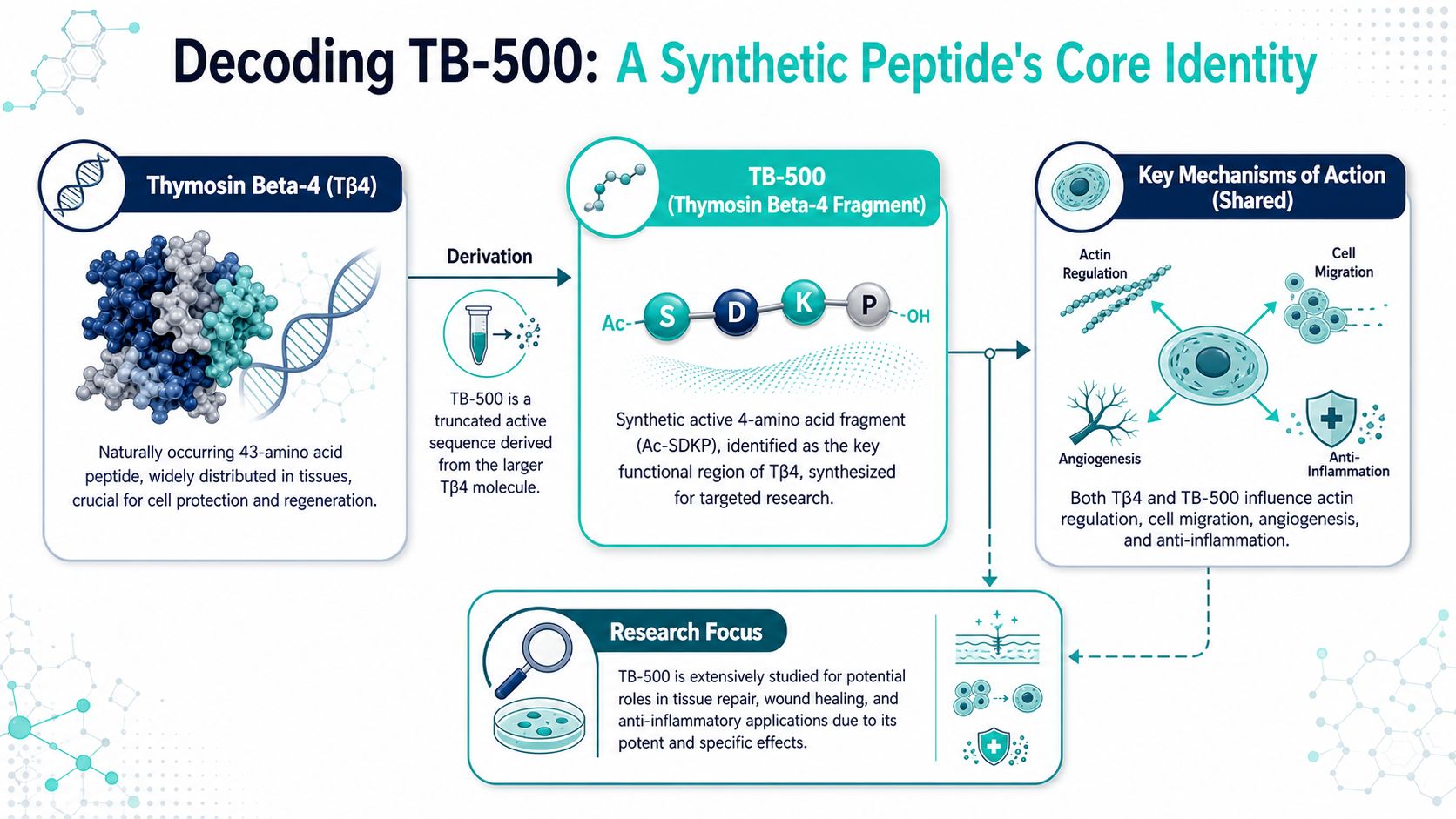
That definition matters at the bench. A sequence relationship does not make the fragment functionally interchangeable with the parent protein. If a publication reports an effect for full-length Thymosin Beta-4, the fragment should be treated as a separate test article with its own stability profile, distribution characteristics, and activity limits.
This is one of the first points I verify during method review. If the material list says "TB-500" but the protocol rationale cites only parent-protein literature, the study starts with an identity problem.
The N-terminal acetylation is part of the construct, not a minor labeling detail. It changes the molecule you are testing and can affect degradation behavior, handling expectations, and how closely one vendor's lot matches another.
The sequence motif LKKTET is the region usually discussed in relation to G-actin interaction and downstream effects on cytoskeletal behavior. In practical terms, that makes TB-500 more relevant to assays tied to cell migration, repair signaling, angiogenic response, and structural remodeling than to broad therapeutic claims.
For laboratory planning, the useful question is simple. Does the assay interrogate a mechanism that a short acetylated fragment could plausibly influence?
| Feature | What it means in practice |
|---|---|
| Synthetic heptapeptide | The test article is a short engineered fragment, not the full native protein |
| Ac-LKKTETQ sequence | Identity testing should confirm the exact sequence before use |
| Acetylated N-terminus | Procurement specs should distinguish this construct from non-acetylated variants or ambiguous listings |
| Actin-related mechanism | Assay design should center on motility, repair signaling, or structural response endpoints |
A surprising amount of poor peptide work begins with loose naming. "TB-500" on a vial label is not enough. Researchers need the exact sequence, the modification state, and documentation that the received material matches the ordered construct.
If the molecular identity is unclear, every downstream result becomes harder to interpret and harder to defend.
TB-500 is easiest to overstate at the exact point where a careful researcher should slow down. The preclinical record supports continued investigation, but it does not support casual transfer of claims from thymosin beta-4 to the shorter synthetic fragment without checking what was tested.
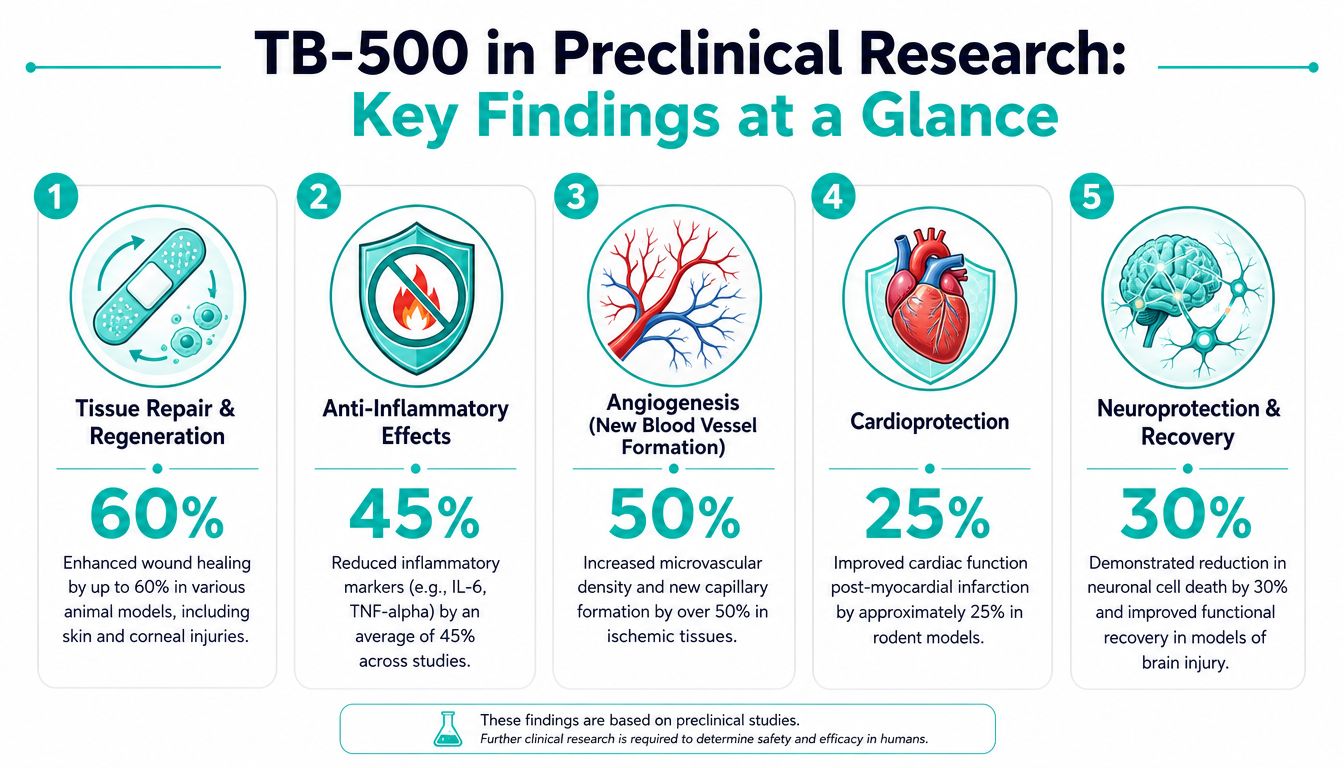
The strongest signal appears in models that measure repair-related biology rather than broad claims of systemic benefit. Investigators have studied this pathway in wound closure, cell migration, angiogenic signaling, inflammatory response, cardiac injury, and ocular or neural settings. Those categories are not equal in evidentiary weight, but they do point to a consistent experimental theme. Actin-associated biology and tissue response are the center of gravity.
For lab planning, that matters more than headline language. A migration assay, scratch model, ischemia-reperfusion design, or corneal injury model can produce interpretable results if the endpoint matches the proposed mechanism. A loosely defined "recovery" study usually cannot.
A practical way to sort the literature is by the readout each model used:
The useful question is not whether TB-500 has been discussed across many disease areas. It has. The useful question is whether a given paper tested the fragment, the parent protein, or a pathway inference built from both.
That distinction changes how much weight the result deserves.
The most common error is evidence substitution. Researchers, vendors, and gray-market commentary often cite thymosin beta-4 findings as if they establish fragment-specific efficacy, exposure, and safety. They do not. A short acetylated fragment may retain relevant biological activity, but it is still a different test article with different analytical and experimental constraints.
A second problem is model inflation. Positive cell-culture findings often get discussed as if they predict animal outcomes, and positive animal outcomes get discussed as if translation is only a matter of dose selection. That is not a minor wording issue. It affects protocol design, purchasing decisions, and the standard of documentation a lab should require before committing resources to a study series.
I treat the literature in three buckets: cell data, animal data, and human data on the exact molecule under study. If a paper cannot be placed cleanly into one of those buckets, its value for experimental planning drops fast.
Some of the more ambitious regenerative interpretations have also faced challenge from follow-up work in the broader pathway literature. That does not invalidate all earlier results. It does mean replication, endpoint selection, and reagent identity deserve more attention than they usually get in promotional summaries.
For investigators building preclinical studies, TB-500 is best handled as a targeted research tool, not a settled answer. Use tight endpoints, document the exact construct, and set concentrations with care before the first run. If your team is comparing batches or preparing multiple dose groups, an accurate peptide dosing calculator for lab reconstitution planning helps reduce one of the easiest sources of avoidable error.
The literature remains useful. The value comes from disciplined interpretation, not from the size of the claim.
Protocol quality determines whether TB-500 generates interpretable data or expensive noise.
With this peptide, the construct is only one part of the system. Route, vehicle, concentration, matrix effects, assay timing, and sample handling can shift the outcome before any biological conclusion is justified. Researchers who treat those factors as secondary usually end up arguing over signal that was created at the bench.
Human use parameters are not established for TB-500, and published pharmacokinetic characterization for the fragment remains limited. For laboratory work, that is not a reason to avoid the molecule. It is a reason to justify every protocol choice from the biology of the model, the exposure target, and the endpoint being measured, rather than copying informal use patterns from non-research sources.
A defensible plan usually addresses four decisions early:
The weakest TB-500 studies usually break down in familiar ways. Reconstitution is inconsistent across operators. The vehicle is changed mid-series. A peptide sits in solution longer than planned. Then the final report treats those deviations as minor. They are not minor if the goal is reproducibility.
Start with a feasibility run that answers basic handling questions under your lab's actual conditions. Confirm reconstitution behavior, inspect the solution, document mixing order, and record hold time from preparation to use. If the study involves several dose groups or aliquot schemes, a peptide calculator for accurate dosing and reconstitution planning helps reduce arithmetic errors that can subtly distort exposure.
Then tighten documentation. Record lot number, storage history, thaw count, diluent, prepared concentration, final administration volume, container type, and time from reconstitution to administration or assay use. In my experience, those records explain a large share of apparent batch-to-batch variation before any biological mechanism does.
A short checklist keeps the protocol auditable:
| Protocol element | Why it matters |
|---|---|
| Lot-specific documentation | Prevents batch mix-ups across repeat studies |
| Vehicle note | Clarifies solubility, tolerability, and formulation differences |
| Sampling schedule | Aligns collection windows with expected peptide behavior |
| Control selection | Reduces the risk of assigning vehicle or handling effects to the peptide |
For TB-500, procurement is not clerical work. It is part of experimental design. If the material is misidentified, contaminated, degraded, or poorly documented, the study doesn't become "less ideal." It becomes harder to trust.
That is why the Certificate of Analysis has to be treated as core documentation, not marketing filler. A usable COA should be lot-specific and should let a researcher confirm identity and purity by method, not by slogan. In practice, that means looking for mass spectrometry data to support identity and HPLC data to support purity. If a vendor only offers a generic statement of quality without batch traceability, that's a purchasing risk.
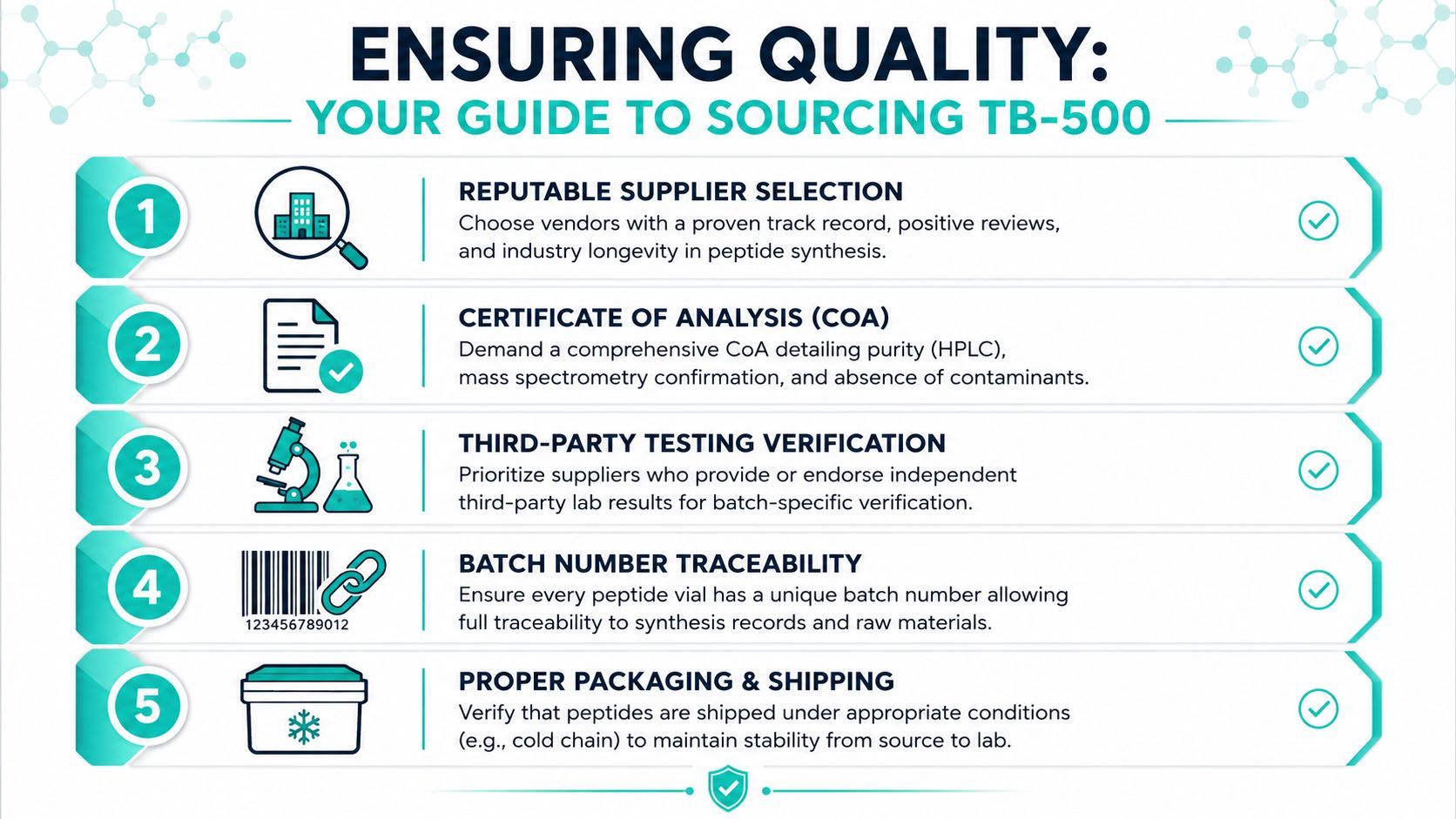
A practical procurement review often includes the same questions every time:
If your group is comparing suppliers, a vendor review page such as buy peptides online for research is only useful when it is backed by documentation you can inspect, not just by storefront language.
Low-confidence sourcing creates confounders that look like biology. An impure sample can produce off-target effects. A degraded sample can flatten the apparent response. A mislabeled sample can waste an entire project cycle because the team keeps optimizing around the wrong molecule.
Bench reality: Most "surprising" peptide data turns out to be less surprising once you audit identity, purity, and handling.
The damage isn't always obvious at first. A study might still produce a signal, but the signal may be driven by contaminants, inconsistent concentration, or batch drift. That makes replication difficult and cross-lab comparison nearly pointless.
Researchers should also separate research grade from research ready. A vial can arrive labeled correctly and still fail your internal standard for use if the documentation is incomplete or if storage history is unclear. Good procurement teams reject ambiguity early because it is cheaper than debugging it later.
A peptide can be analytically clean on paper and still become poor experimental material after one careless prep cycle. TB-500 handling should be written like an SOP and followed like one.
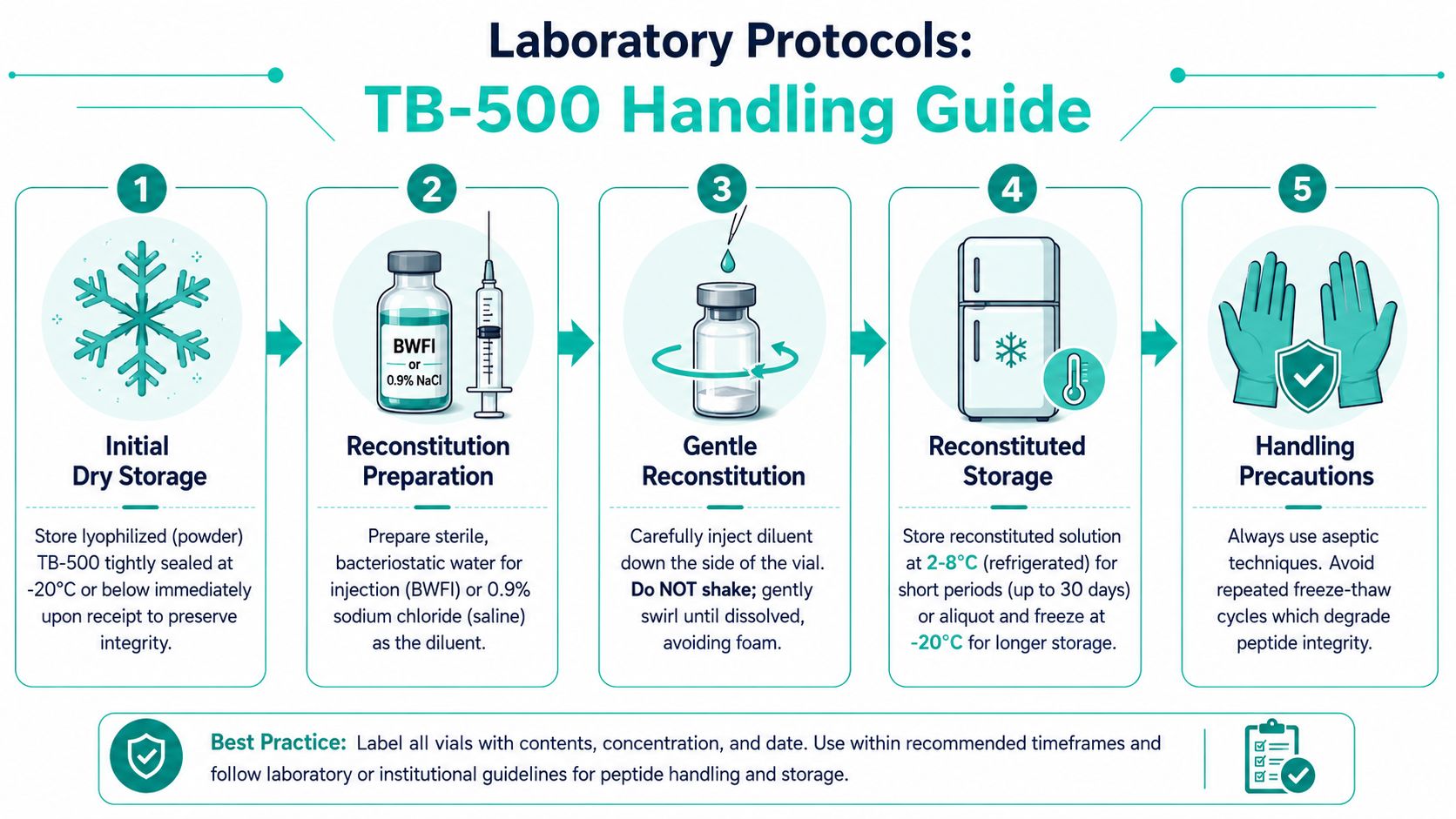
For research-grade integrity, TB-500 should be reconstituted in 0.1% acetic acid/saline, handled with gentle swirling rather than vortexing, passed through a 0.22 µm PVDF low-protein-binding filter, aliquoted into pre-chilled LoBind tubes, flash-frozen in liquid nitrogen, and stored at −80°C to maintain stability. The same handling guidance notes a preclinical in vivo half-life of approximately 2 to 3 hours for subcutaneous or intramuscular administration (Nova Vitality storage and stability datasheet).
The operational lesson is simple. Don't improvise.
A careful workflow usually looks like this:
For labs standardizing this process, a procedural reference on peptide reconstitution methods can help align technicians around the same prep language and calculations.
A brief visual walkthrough can help reinforce technique before staff perform the workflow at the bench.
The most common avoidable error is rough handling. Vortexing, repeated freeze-thaw cycles, warm-bench exposure, or storing reconstituted aliquots under casual refrigerator practices can all undermine reproducibility.
The second error is pretending storage is separate from pharmacology. It isn't. If the peptide clears quickly in vivo, timing and prep consistency become tightly linked. A loose reconstitution window can produce differences that look biological but are procedural.
Regulatory status is not a side issue with TB-500. It determines how a laboratory can describe, purchase, store, document, and study the material.
TB-500 is not approved by the US FDA for any medical indication. As noted earlier in the article, the FDA has treated it as a Category 2 bulk drug substance for compounding purposes, reflecting unresolved questions around safety and efficacy. For laboratory teams, the practical consequence is clear. This is a research material, not an approved therapeutic product.
That distinction affects more than labeling. It should shape purchase approvals, inventory controls, SOP language, staff training, and any communication that could blur the boundary between investigational use and clinical use. "For research use only" needs to appear as an operational rule, not a marketing phrase.
The sports medicine context points in the same direction. TB-500 has been treated as a non-approved substance in anti-doping frameworks cited earlier. That does not replace agency regulation, but it does show how other oversight bodies classify compounds with biological interest and no accepted clinical approval path.
The human safety file for TB-500 remains incomplete. There is no established clinical dosing standard, no validated route of administration for approved medical use, and no settled human pharmacokinetic profile for the TB-500 fragment itself. In practice, that means any attempt to discuss it in treatment terms outruns the evidence.
Preclinical findings can justify laboratory interest. They do not answer the questions that matter for human safety review. Exposure margins, tissue distribution, immunogenicity, long-term effects, and interaction risks remain inadequately characterized for real-world clinical decision-making.
One concern raised in the broader literature is angiogenic activity in the setting of undetected malignancy. That risk has not been quantified, and long-term human safety has not been established for fragment-focused use. A serious research program should record those uncertainties directly instead of smoothing them over with general claims about repair or recovery.
The practical standard is controlled uncertainty.
Write that uncertainty into the study file. Protocols, receiving records, vial labels, deviation logs, and investigator training should all use the same language: investigational status, no approved human indication, and unresolved safety questions. In my experience, that documentation discipline prevents two common failures. Informal scope creep in the lab, and procurement decisions that treat a peptide with unresolved status as if it were a routine reagent.
Procurement errors usually happen before a vial reaches the bench. The preventable failures are paperwork mismatch, weak traceability, and buying against marketing language instead of acceptance criteria.
What paperwork should accompany a TB-500 order?
Require a lot-specific certificate of analysis, batch or lot identification that matches the label, and enough analytical detail to support the identity and purity claim. If the COA is generic, undated, or disconnected from the physical unit received, quarantine the shipment and hold release.
How should the peptide be packaged and shipped?
Ask for shipping conditions before purchase, not after delivery. Temperature-sensitive material should arrive in packaging that protects product integrity and preserves chain of custody from dispatch through receipt. If the outer carton, cold-chain materials, or vial labels suggest mishandling, receiving staff should document the condition immediately and escalate it under the lab's deviation process.
What purity standard should a serious lab look for?
Use the lab's own specification. Vendor claims such as "high purity" are not enough. A meaningful purity statement is tied to lot-specific analytical documentation, the test method used, and the acceptance range your protocol can justify.
Should procurement teams ask about dosing guidance?
Keep the conversation focused on research supply. As noted earlier, TB-500 does not have an established clinical dosing standard, validated route of administration for approved human use, or a settled human pharmacokinetic profile for the fragment itself. A supplier that steers the discussion toward treatment language instead of analytical quality, labeling, and handling controls is creating compliance risk.
What signals a higher-risk supplier?
Several patterns deserve immediate scrutiny:
When should a lab reject a shipment outright?
Reject on receipt if the label does not match the order, the lot number conflicts with the COA, the container integrity is compromised, or shipping condition evidence suggests temperature abuse. Rejection is also appropriate when the vendor cannot resolve documentation gaps quickly and in writing.
Celonyx Labs supplies research peptides for laboratories and investigators and publishes ordering, policy, and support information through its Celonyx Labs website. For TB-500, the right purchasing standard is simple. Buy only against defined specifications, verify every lot, and keep the material inside a documented research-use framework.
Most advice on how to mix Melanotan 2 stops at “add water and swirl.” That
You're standing at the bench with a peptide vial, a vendor purity claim, and a

PBS is a water-based salt solution of NaCl, KCl, Na2HPO4, and KH2PO4, adjusted to about
FOR RESEARCH USE ONLY. Products sold by Celonyx Labs are intended exclusively for laboratory and scientific research. They are not intended for human or veterinary use, consumption, diagnosis, treatment, cure, or prevention of any disease. By purchasing from this site, you acknowledge that you understand the intended research purpose of these materials and agree to comply with all applicable laws and regulations.