
BPC 157 500mcg Explained: What the Evidence Shows
500 mcg equals 0.5 mg, a labeled research quantity, and no published human study establishes
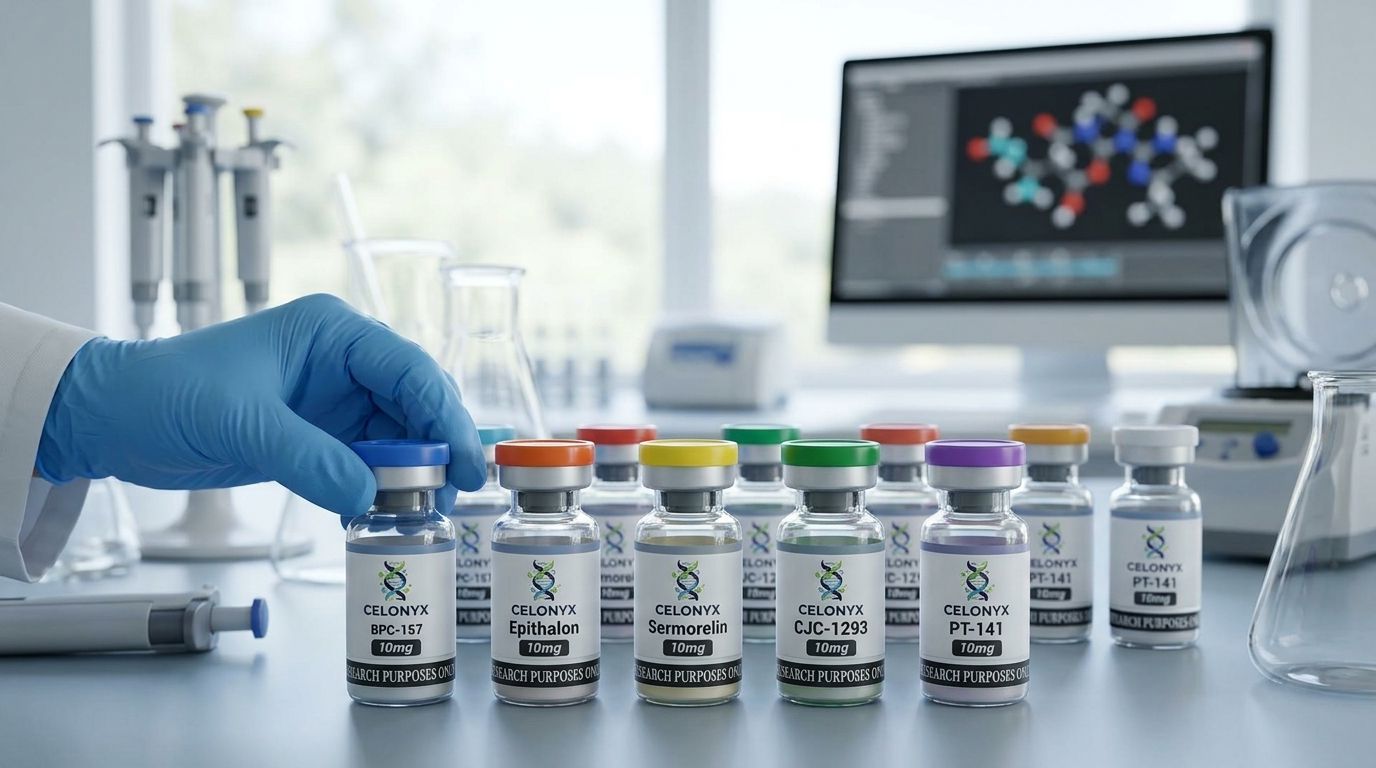
Ten compounds dominate current laboratory research protocols, and picking the wrong one wastes a research budget on a peptide with thin published literature or unreliable purity. This ranking sorts the ten peptides researchers request most for 2026 lab studies, based on depth of published research, receptor specificity, and how consistently a compound holds up across batches when third-party tested.
Research peptide sourcing got noisier heading into 2026, not simpler. More suppliers entered the market, and purity variance between vendors is the single biggest reason a study produces inconsistent results across replicates.
Every compound below is intended for laboratory and in-vitro research use only, not for human consumption. A supplier's own purity claim means little without an independent COA attached to the specific batch you receive — Celonyx Labs posts third-party testing on its research peptides for exactly this reason, and any vendor you evaluate should do the same.
The ranking below treats "best" as a function of research utility, not hype. A peptide with a thin body of published literature ranks lower here even if it's popular in forum discussion, because a research protocol needs citable mechanism data, not chatter.
The ranked verdict up top: BPC-157 is the best research peptide overall for tissue-repair models, TB-500 wins for wound-healing and angiogenesis research, and Semaglutide is the standout for GLP-1 receptor and metabolic pathway studies. Each of the other seven owns a distinct research niche below — no two compounds compete for the same use case.
| Peptide | Best for | Standout feature | Key limitation |
|---|---|---|---|
| BPC-157 | Tissue-repair research | Broad literature on gastric and tendon models | Mechanism still debated in some pathways |
| TB-500 | Wound-healing studies | Documented angiogenesis and actin-binding activity | Short reconstituted stability window |
| GHK-Cu | Skin and collagen research | Copper-peptide complex with decades of published data | Copper-binding requires careful handling |
| Semaglutide | Metabolic and GLP-1 studies | Well-characterized receptor agonist | Requires precise dosing protocols |
| Epithalon | Telomerase and aging research | Long history in Russian gerontology literature | Fewer Western peer-reviewed studies |
| Ipamorelin | Growth hormone secretion studies | Selective GH secretagogue, minimal off-target activity | Narrower research scope than GHRH analogs |
| CJC-1295 | GHRH pathway research | Extended half-life versus native GHRH | Often studied paired with a secretagogue |
| Melanotan II | Pigmentation research | Non-selective melanocortin receptor activity | Broader receptor binding than PT-141 |
| PT-141 (Bremelanotide) | Melanocortin receptor studies | Selective MC4-R binding profile | Narrower literature base than Melanotan II |
| Selank | Anxiolytic/behavioral research | Heptapeptide with published Russian clinical data | Limited Western regulatory documentation |
BPC-157 is a pentadecapeptide studied extensively in gastric ulcer and tendon-healing models. It shows up across a wide body of published research examining angiogenesis and tissue-protective pathways, which is why it sits at the top of this list for 2026 protocols.
BPC-157 pros:
BPC-157 cons:
Best for: tissue-repair and gastrointestinal research models. Verdict: Buy.
TB-500 (a synthetic fragment of Thymosin Beta-4) is studied for its actin-binding and angiogenesis-promoting activity in wound-healing research. It's a distinct research niche from BPC-157 — the two are often compared but target different mechanistic questions.
TB-500 pros:
TB-500 cons:
Best for: wound-healing and angiogenesis protocols. Verdict: Buy.
GHK-Cu is a copper-binding tripeptide with one of the longest published research histories on this list, dating back decades of dermatology and wound-repair literature.
GHK-Cu pros:
GHK-Cu cons:
Best for: skin, collagen, and wound-repair research. Verdict: Buy.
Semaglutide is a GLP-1 receptor agonist with a well-characterized mechanism, making it the top pick here for metabolic pathway research in 2026.
Semaglutide pros:
Semaglutide cons:
Best for: GLP-1 and metabolic pathway research. Verdict: Buy.
Epithalon has a long research history in Russian gerontology literature, with published work examining telomerase activity and pineal gland function.
Epithalon pros:
Epithalon cons:
Best for: aging and telomerase-focused research. Verdict: Consider.
Ipamorelin is a selective growth hormone secretagogue studied for its minimal effect on cortisol and prolactin compared to older secretagogues.
Ipamorelin pros:
Ipamorelin cons:
Best for: growth hormone secretion research. Verdict: Consider.
CJC-1295 is a GHRH analog with an extended half-life relative to native GHRH, making it a common pairing compound in growth-hormone pathway studies.
CJC-1295 pros:
CJC-1295 cons:
Best for: GHRH pathway and secretagogue-pairing research. Verdict: Consider.
Melanotan II is a non-selective melanocortin receptor agonist studied for its effect on pigmentation pathways.
Melanotan II pros:
Melanotan II cons:
Best for: pigmentation and melanocortin receptor research. Verdict: Consider.
PT-141 is a more selective melanocortin receptor agonist than Melanotan II, binding preferentially to the MC4-R subtype.
PT-141 pros:
PT-141 cons:
Best for: MC4-R-selective receptor research. Verdict: Consider.
Selank is a synthetic heptapeptide with published Russian clinical research on anxiolytic activity, rounding out the list for behavioral pathway studies.
Selank pros:
Selank cons:
Best for: anxiolytic and behavioral pathway research. Verdict: Consider.
Each compound was weighed against the same six criteria: verified purity, literature depth, receptor specificity, stability, batch consistency, and documented handling. BPC-157 and TB-500 top the list because their published research base is both deep and directly tied to a clear mechanistic question. Compounds further down the list, like Selank and PT-141, rank lower only because their research literature is narrower — not because the compound itself is lower quality.
“A supplier’s purity claim means nothing without a batch-specific COA attached to the peptide you actually received.”
For a lab defaulting to a general tissue-repair or gastrointestinal protocol in 2026, BPC-157 is the safest starting point given its literature depth. If the research question centers on wound healing or angiogenesis, TB-500 is the better fit. Metabolic and GLP-1 research points toward Semaglutide, while niche behavioral or pigmentation studies should look further down the list to Selank, Melanotan II, or PT-141 depending on the specific pathway. Whichever compound fits the protocol, source it with a batch-specific COA — Celonyx Labs tests its research peptides to 99% purity for exactly this reason.
Source verified research peptides
99% purity, third-party tested peptides for laboratory research use only.
What is the best research peptide overall in 2026?
BPC-157 is the best research peptide overall for 2026 lab studies because of its depth of published literature on tissue-repair and gastrointestinal models. TB-500 and Semaglutide lead in their own narrower research niches.
Is BPC-157 better than TB-500 for research?
They target different research questions rather than competing directly. BPC-157 has more literature on tissue repair and gastric models, while TB-500 is better documented for wound-healing and angiogenesis studies.
How much does a research peptide cost?
Pricing varies by supplier, compound, and quantity, so check current pricing directly on the supplier’s site rather than relying on a fixed figure.
What does 99% purity mean for a research peptide?
It means third-party testing confirmed the peptide sample is 99% free of contaminants and degradation byproducts on that specific batch. A COA specific to the batch you receive is the only way to verify this claim.
Are research peptides legal to purchase in 2026?
Research peptides sold for laboratory and in-vitro research use are legal to purchase in the US, but they are not approved for human consumption. Always confirm current regulatory status for the specific compound and your jurisdiction before ordering.
How should research peptides be stored?
Lyophilized (freeze-dried) peptides are generally stored frozen and remain stable for extended periods, while reconstituted solutions have a much shorter usable window even under refrigeration. Follow the supplier’s specific storage documentation for each compound.
What’s the difference between Melanotan II and PT-141?
Melanotan II binds melanocortin receptors non-selectively, while PT-141 (Bremelanotide) binds more selectively to the MC4-R subtype. Choose based on whether the research question requires broad or receptor-specific activation.
Do research peptides need a certificate of analysis?
Yes. A batch-specific COA from third-party testing is the only reliable way to confirm the purity and identity of a research peptide before it enters a protocol.
Most researchers overlook that lyophilized peptides and reconstituted peptide solutions have completely different stability profiles: the frozen powder form holds up far longer than the mixed solution, which typically needs to be used within weeks even when refrigerated. Budget your research timeline around the reconstituted window, not the shelf life printed for the lyophilized vial — that's the detail that ruins more 2026 protocols than a bad purity batch does.
500 mcg equals 0.5 mg, a labeled research quantity, and no published human study establishes

Choose the best GHK-Cu peptide format for laboratory skin and wound-healing research. Compare documentation, assay

Choose lot-verified melanotan 1 peptide for pigmentation research. Compare material specifications, purity evidence, and documentation
FOR RESEARCH USE ONLY. Products sold by Celonyx Labs are intended exclusively for laboratory and scientific research. They are not intended for human or veterinary use, consumption, diagnosis, treatment, cure, or prevention of any disease. By purchasing from this site, you acknowledge that you understand the intended research purpose of these materials and agree to comply with all applicable laws and regulations.