

Best GHK-Cu peptides for skin and wound healing research 2026
Choose the best GHK-Cu peptide format for laboratory skin and wound-healing research. Compare documentation, assay

Best overall: lot-verified melanotan 1 peptide for pigmentation assays. Best for analytical comparisons: a characterized Melanotan I reference material. Best for sequence-specific experiments: a custom-synthesized Melanotan I preparation. This 2026 guide compares research-material specifications, not interchangeable products or human-use preparations.
A pigmentation experiment needs the right compound, not simply a vial carrying a familiar name. Melanotan I, also called afamelanotide or NDP-α-MSH, is a linear analogue of α-melanocyte-stimulating hormone containing 13 amino acid residues. Its identity matters when you interpret melanocortin-related endpoints.
Celonyxlabs describes its research peptides as 99%-pure and third-party-tested. Those are sourcing signals, but you still need documentation that connects the material, analytical results, and received lot.
Celonyxlabs is best suited to laboratory researchers seeking third-party-tested research peptides, with material selection governed by lot-specific documentation. A general supplier description does not establish the identity, suitability, or analytical characteristics of an individual Melanotan I preparation.
For your 2026 purchasing decision, separate three questions: Is this the intended molecule? What does the testing establish? Does the material meet the requirements of your experiment?
Rank Melanotan I materials against these criteria before comparing supplier claims:
The peptide purity testing guide for contract research organizations provides a related framework for evaluating analytical evidence. Apply the same distinction here: a purity result answers a narrower question than overall experimental suitability.
These are procurement specifications, not formal regulatory grades. A material can satisfy more than one specification, but each recommendation below serves a different primary use case.
| Research-material specification | Best for | Standout feature | Key limitation |
|---|---|---|---|
| Lot-verified Melanotan I | Routine pigmentation assays | Identity and purity records tied to the received lot | Chemical documentation does not establish biological potency |
| Characterized Melanotan I reference material | Analytical method comparison | Characterization aligned with a defined measurement purpose | Reference suitability depends on assigned properties and uncertainty |
| Custom-synthesized Melanotan I | Sequence-specific experimental design | Explicit control over requested molecular specifications | Requires acceptance criteria and independent review of delivered material |
Default choice for 2026: select lot-verified Melanotan I unless your protocol specifically requires reference-material characterization or custom molecular specifications. Extra documentation has value when it resolves a defined experimental requirement, not simply because a listing uses more technical language.
Lot-verified Melanotan I is the default specification for researchers studying pigmentation-related responses with a defined peptide reagent. The essential feature is a documented connection between the received vial and the analytical evidence supporting its identity and purity.
This specification does not mean the compound has been validated in your biological model. You must establish assay performance separately, using appropriate controls and an approved laboratory protocol.
Best for: Laboratories conducting routine pigmentation assays that need traceable reagent acceptance rather than formal analytical calibration.
Before accepting a lot, compare the compound name, sequence information, lot identifier, and analytical report. Resolve discrepancies before assigning the reagent to an experiment; a corrected purchasing record cannot repair an ambiguous experimental input afterward.
Verdict: Buy lot-verified Melanotan I when identity, traceability, and assay compatibility meet your written acceptance criteria.
A characterized Melanotan I reference material supports analytical work in which the comparator itself needs defined properties. Examples include investigating chromatographic identity, comparing analytical procedures, or assessing a measurement against an independently characterized material.
Do not equate a high-purity research vial with a certified reference material. Certification, assigned values, measurement uncertainty, and intended use are separate documentation questions.
Best for: Analytical laboratories evaluating Melanotan I identity or measurement performance against a characterized comparator.
For a 2026 analytical project, write down the property you need before selecting the reference. If the question concerns peptide content, a chromatographic area percentage alone does not answer it; if the question concerns identity, content assignment alone is insufficient.
Verdict: Buy characterized Melanotan I when its documented properties match your analytical comparison; hold when reference status is only a label.
Custom-synthesized Melanotan I suits projects requiring explicit molecular specifications beyond a routine catalogue description. You define the requested sequence, modifications, counterion information, and analytical deliverables before synthesis.
Specify whether the project requires Melanotan I itself or a deliberately modified analogue. A sequence change creates a different experimental material, even when the purchasing discussion uses Melanotan I as shorthand.
Best for: Research teams investigating a defined molecular variable that routine material specifications do not address.
Custom synthesis is not automatically the better choice for a standard pigmentation assay. Use it when a written experimental requirement justifies the additional specification and review work.
Verdict: Buy custom Melanotan I for a defined specification gap; skip custom synthesis when routine, documented material already meets the protocol.
The ranking prioritizes molecular identity, traceability, interpretable analytical evidence, and fit to the experimental question. Routine assay material comes first because it addresses the basic reagent-selection problem without assuming that every laboratory needs reference characterization or custom synthesis.
This is a specification-based buying guide, not a supplier performance ranking. It does not assign unsupported scores, claim comparative testing, or treat brand-wide purity statements as results for an individual Melanotan I lot.
A reported 99% chromatographic purity result does not mean that 99% of the vial's gross mass is necessarily the target peptide. Chromatographic area, peptide content, water, and counterions describe different aspects of a preparation.
Identity testing answers another question. Mass spectrometry can support molecular identity, but an expected mass alone does not establish every structural feature or demonstrate biological potency.
For your 2026 acceptance record, keep these distinctions visible:
Celonyxlabs research peptides are described as third-party-tested. Evaluate what the relevant testing actually measures rather than treating independent testing as a substitute for reviewing the results.
Approve the evidence before releasing Melanotan I to an experiment. A consistent workflow keeps purchasing decisions separate from assumptions made at the bench.
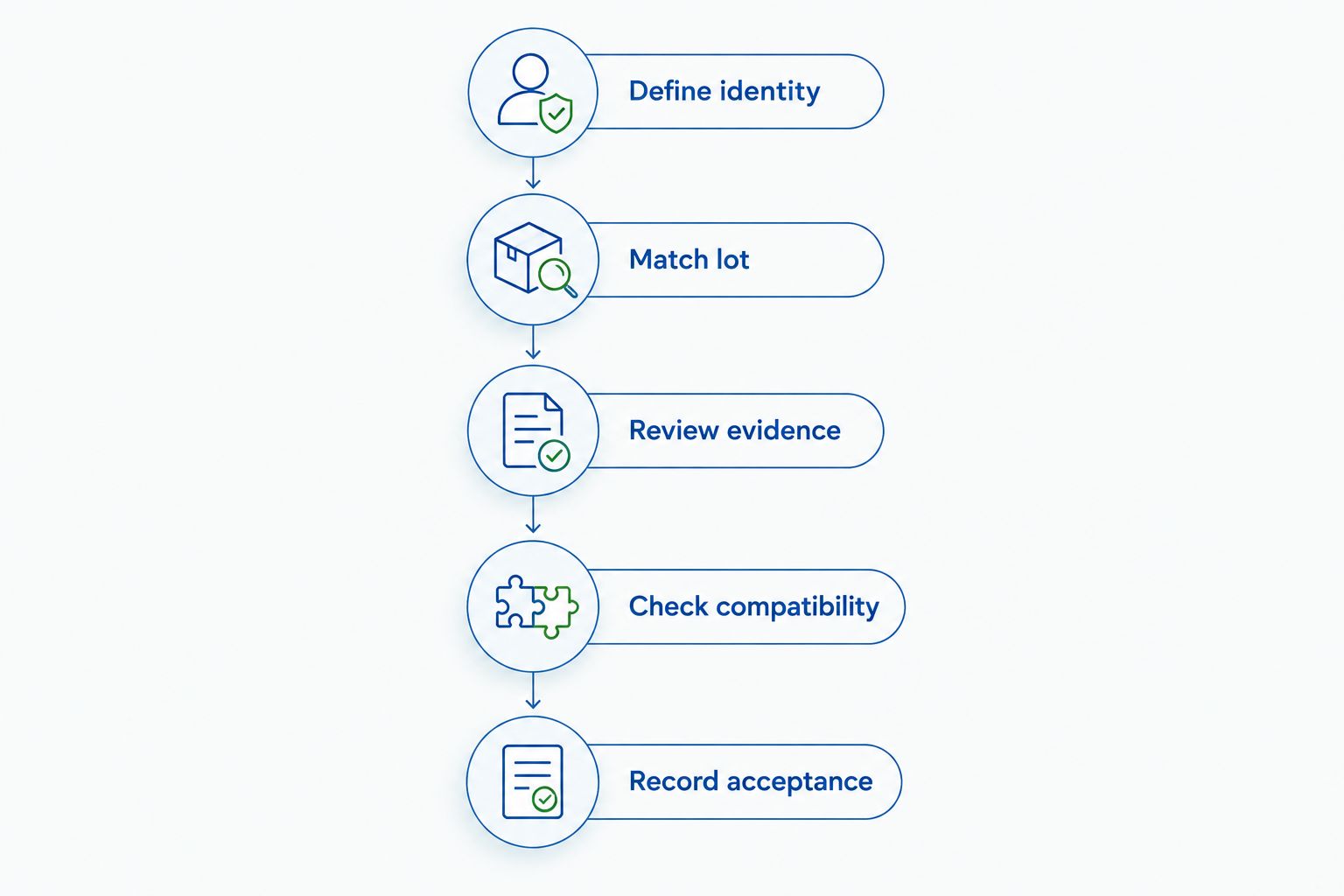
A vial's appearance cannot establish peptide identity or suitability. If the documentation and received material do not agree, hold the material outside experimental use until the discrepancy is resolved.
For biological systems sensitive to microbial contamination or endotoxin, define those requirements separately. Neither chemical purity nor the phrase research grade establishes sterility or an acceptable endotoxin level.
Melanotan I is a linear peptide containing 13 amino acid residues; Melanotan II is a cyclic peptide containing 7 amino acid residues. Their structural differences matter, so a similar name does not justify substituting one for the other in a pigmentation protocol.
| Compound | Structural distinction | Research-selection implication |
|---|---|---|
| Melanotan I | Linear, 13 amino acid residues | Select when the protocol specifies Melanotan I or NDP-α-MSH |
| Melanotan II | Cyclic, 7 amino acid residues | Treat as a separate compound requiring its own rationale and controls |
Best for a Melanotan I experiment: verified Melanotan I, not a related melanocortin peptide chosen by name similarity. Neither compound's identity establishes suitability for human use, and research material must not be presented as a clinical preparation.
Choose lot-verified Melanotan I for a routine pigmentation study. Choose characterized reference material when analytical comparison is the objective, and custom synthesis only when a defined molecular requirement demands it.
For a 2026 procurement file, the decisive document is the record showing why the specific received material meets the protocol. Celonyxlabs quality statements provide supplier context; your lot-level acceptance decision provides the experiment-specific justification.
What’s the best melanotan 1 peptide for pigmentation research?
Lot-verified Melanotan I is the default choice for routine pigmentation research. Select material with identity and purity evidence tied to the received lot, then confirm that its preparation meets your assay requirements.
Is Melanotan I the same compound as afamelanotide?
Melanotan I is also known as afamelanotide and NDP-α-MSH. A shared compound name does not make a research reagent equivalent to a regulated medicinal preparation.
Is Melanotan I better than Melanotan II for my experiment?
Use the compound specified by your experimental rationale, not a general better-or-worse ranking. Melanotan I and Melanotan II have different structures and are not interchangeable reagents.
Does 99% purity prove that a peptide is suitable for research?
No, a 99% purity statement alone does not establish experimental suitability. Review the analytical method, identity evidence, lot traceability, and assay-specific requirements separately.
Do I need a reference standard for every pigmentation assay?
No, every pigmentation assay does not automatically require a certified reference material. Reference requirements depend on the measurement objective, while biological assays still require appropriate controls and documented reagent acceptance.
What should I check on a Melanotan I certificate of analysis?
Check the compound identity, lot identifier, methods, and reported results against the received material. Resolve ambiguous quantity definitions, missing analytical context, or inconsistent identifiers before experimental use.
Can research-grade Melanotan I be used for tanning or self-administration?
No, research-grade Melanotan I is for laboratory research use only. Purity claims and third-party testing do not establish suitability for human or veterinary administration.
A stronger purity claim cannot correct the wrong molecular identity. Put sequence confirmation and lot matching ahead of percentage comparisons; those checks determine whether you are evaluating the intended reagent at all.
For research use only. Not for human or veterinary administration.
Choose the best GHK-Cu peptide format for laboratory skin and wound-healing research. Compare documentation, assay

Choose lot-verified melanotan 1 peptide for pigmentation research. Compare material specifications, purity evidence, and documentation

Native oxytocin peptide is the default for behavioral research. Compare reference standards, labeled materials, and
FOR RESEARCH USE ONLY. Products sold by Celonyx Labs are intended exclusively for laboratory and scientific research. They are not intended for human or veterinary use, consumption, diagnosis, treatment, cure, or prevention of any disease. By purchasing from this site, you acknowledge that you understand the intended research purpose of these materials and agree to comply with all applicable laws and regulations.