
Best Container Storage for Lab Samples: 7 Top Picks
Buying a colder freezer won't fix a leaking cap, an incompatible liner, or a label
Buying a colder freezer won't fix a leaking cap, an incompatible liner, or a label that detaches during retrieval. Choose the vial and closure first, then match them to boxes, racks, inventory records, and temperature control. Equipment cannot compensate for a container system that does not suit the sample.
Colder storage is not automatically safer. MirPeptide's storage and shipping guidance describes risks including freeze concentration, precipitation, aggregation, and container stress. Storage decisions should follow the requirements for the specific peptide rather than assume one freezer setting fits every compound.
The useful comparison is which supplier fits the storage job: cryogenic preservation, routine freezer aliquots, light-sensitive compounds, or barcode-tracked collections. The seven options differ in material, usable capacity, closure systems, and inventory support, including workflows for research peptides whose manufacturers publish specific storage instructions.
Best for standardizing tubes, boxes, and accessories across routine cold-storage workflows.
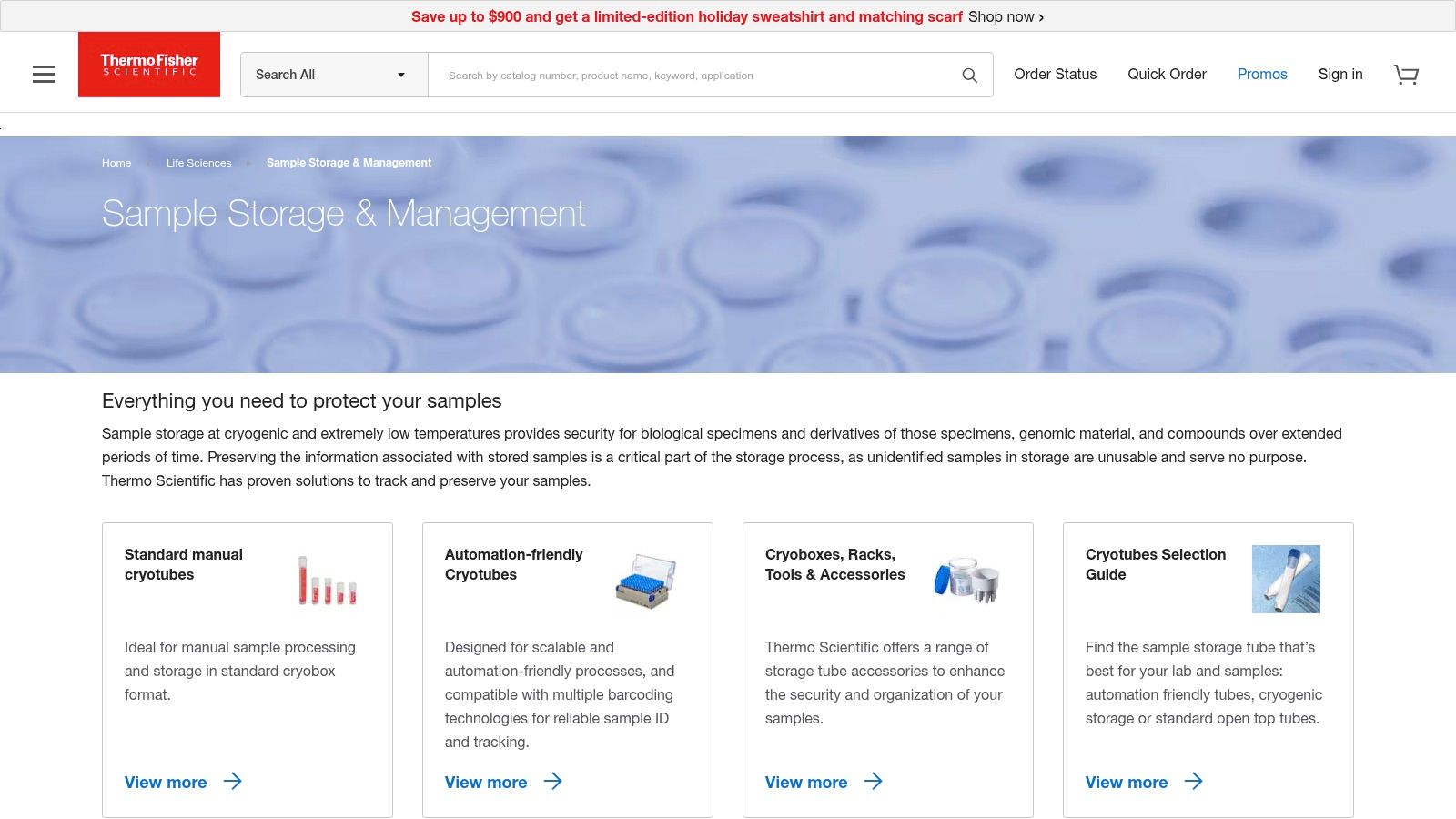
Thermo Fisher Scientific's sample-storage range includes Nalgene and Nunc products alongside cryoboxes, labels, and related accessories. Its main advantage is the ability to build a matched system instead of buying tubes first and discovering later that the caps catch on the rack above them.
Start with working volume, not nominal capacity. Leave the headspace required by the product instructions, then check the assembled tube's height, cap diameter, and fit inside the proposed box. A larger tube isn't useful if it wastes rack space or encourages staff to repeatedly thaw a shared stock.
The trade-off is purchasing complexity. Large case quantities can make a poorly chosen format expensive, while a broad catalog requires careful specification checks.
I'd shortlist Thermo Fisher when standardization is the priority, but approve the exact tube, closure, and box combination together. Don't assume that a cryogenic label applies equally to every storage environment or every product carrying the same brand.
A freezer can have spare volume and still be difficult to use because its boxes don't match its racks. Corning is a practical option when physical organization, rather than vial chemistry, is the main problem.
The Corning life-sciences catalog includes cryogenic vials, polycarbonate boxes, and storage accessories. A matched box-and-vial approach helps staff return samples to defined positions without improvising around incompatible footprints.
For capacity planning, count accessible sample positions, not just how many boxes fit inside the freezer. Check lid clearance, rack extraction, gloved handling, and whether staff can read the position map without removing neighboring boxes.
Safety boundary: Corning cautions against using its listed cryogenic vials and boxes in the liquid phase of liquid nitrogen. Follow the exact product instructions rather than treating all cryogenic storage as interchangeable.
Choose Corning for a controlled, manually mapped collection where consistent box geometry matters. Assign each box a durable identifier and record the freezer, rack, shelf, and position in the inventory.
Polycarbonate boxes are worth considering where repeated handling makes box durability important. However, a durable box doesn't establish the temperature suitability of the vial inside it.
The limitation is format dependence. A box that works well with one vial can be awkward with another cap or tube height, and purchasing may require an account or quote. Test a representative combination before replacing an entire freezer's storage system.
Glass or plastic? Clear or amber? Which liner? Fisher Scientific is useful when those questions remain open and you need to compare several manufacturers through a familiar purchasing channel.
Fisher Scientific's sample-vial catalog includes clear and amber glass options, with separate cold-storage categories available through its broader catalog. That makes it a useful retailer for comparing routine compound containers with purpose-built storage vials.
For a light-sensitive compound, amber borosilicate glass may be a sensible starting point. It isn't a complete specification: the cap, liner, solvent compatibility, and intended temperature must also fit the method.
A multi-brand catalog introduces a real trade-off. Similar-looking vials can differ in thread finish, cleanliness claims, packaging, and closure construction, so category filters alone aren't enough.
For purchasing, build a short comparison around the exact manufacturer part number, then record the approved cap alongside it. Don't let a substitute vial enter the workflow solely because its nominal capacity looks equivalent. Account-specific pricing and availability also mean that the lowest displayed price may not represent the final purchasing decision.
Best for glass-vial collections that need orderly, visible storage rather than a loose assortment of containers.
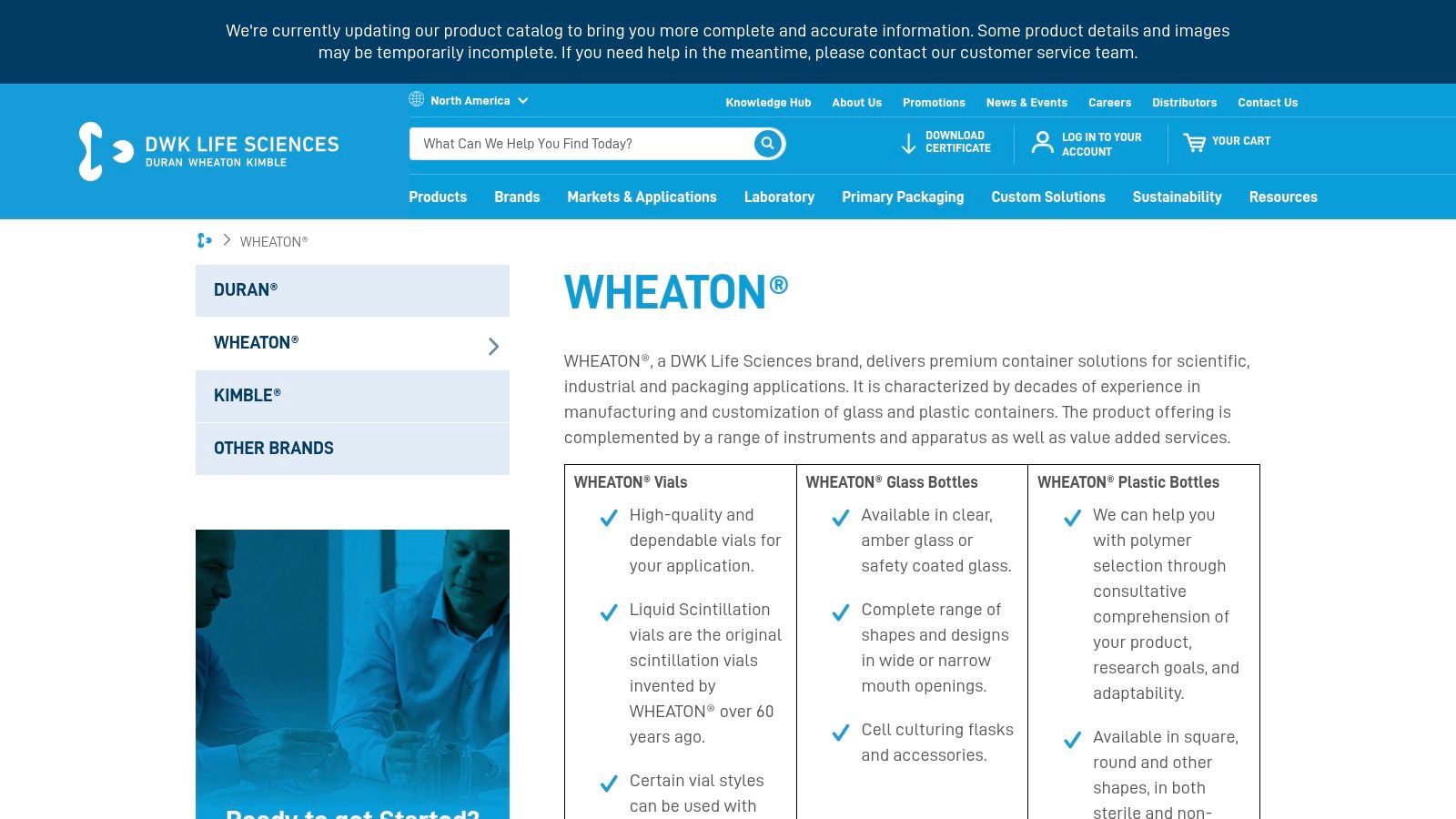
The WHEATON range from DWK Life Sciences includes clear and amber glass sample vials, partitioned trays, and vial-file formats. Those trays are useful for reference compounds and retained samples because they keep containers separated and give each vial a repeatable location.
Say a chemistry team maintains dry reference material alongside frequently accessed working solutions. Separate trays let staff distinguish reserve stock from working stock without relying on cap color or memory.
Check whether a listing is vial-only or a complete vial-and-cap assembly. Then match the liner to the contents and intended storage conditions, rather than choosing a cap only because it fits the thread.
For peptide work, the peptide vial storage guide is relevant to the practical relationship between the vial, secondary containment, and retrieval workflow. A tidy tray improves organization, but it doesn't prevent moisture entering an opened primary container.
ProSource Labs' peptide storage guidance emphasizes sealed, desiccated storage away from light and identifies moisture ingress and freezer temperature fluctuations as concerns.
WHEATON is less compelling when impact resistance or an explicitly cryogenic-rated plastic system is essential. Glass selection and freezer qualification are separate decisions, and neither should be inferred from the appearance of a laboratory vial.
A mixed-method laboratory may need conventional sample vials, chromatography containers, and cryogenic tubes in the same purchasing cycle. Thomas Scientific suits that procurement problem, particularly when the team wants to compare manufacturers without opening separate supplier accounts.
Thomas Scientific's vial catalog spans several vial types and includes cryogenic and specialized identification options. The benefit is breadth; the cost is the time required to distinguish comparable products.
Start by separating storage temperature, sample-contact material, and identification method. A barcode feature won't resolve a closure mismatch, and a suitable polymer won't establish that the assembled vial is approved for the intended cryogenic environment.
A supplier's category name is a starting point. The manufacturer's instructions for the exact vial determine where and how it belongs in storage.
For a mixed freezer inventory, use the catalog to create distinct purchasing specifications:
Thomas Scientific works well when purchasing staff need to consolidate orders while scientists retain control over technical approval. It works less well if the team expects the retailer's search results to replace that approval.
Record substitutions explicitly. A different cap geometry, barcode position, or tube height can disrupt an otherwise reliable storage process even when the replacement appears similar online.
Choose Qorpak for compound packaging, not as a shortcut to a cryogenic sample-management system.
Qorpak's compound-vial range includes glass containers for small quantities of powders and compounds, including amber options with screw caps. That makes it a relevant choice for dry materials and light-sensitive compounds when the complete container specification suits the contents.
A useful scenario is a laboratory separating retained dry compound from material issued for daily work. Dedicated containers reduce repeated opening of the reserve stock, while clearly differentiated secondary storage helps staff avoid confusing the two.
The liner and sealing surface deserve as much attention as the glass. Identify the liner material, check compatibility with the compound or solvent, and inspect whether powder on the vial rim could interfere with closure.
For peptide-specific selection, the guide to peptide storage containers for lab research provides a relevant starting point for evaluating containment and organization. Don't transfer material from its original vial merely to make the shelf look uniform; extra handling can introduce losses or contamination.
Qorpak's limitation is scope. It's oriented toward containers and packaging rather than integrated cryoboxes, freezer racks, scanners, and inventory software.
I'd consider it for a defined compound-storage task with a written container specification. I wouldn't buy a general-purpose glass vial for a freezer or dewar without explicit suitability for that use.
Manual maps become fragile when several people move samples between boxes. Nest Scientific USA is worth evaluating when the decision is whether to adopt barcode-based identification, rather than just replace conventional cryovials.
Nest Scientific USA's cryogenic range includes standard and two-dimensional barcode vial formats. These options are relevant to digitally tracked collections, but the vial is only one component of a reliable inventory workflow.
Before committing, test the actual vial with your scanner and inventory software. Confirm that staff can associate the identifier with a sample record, capture its location, and record removal or disposal without creating duplicate entries.
Operational test: Scan, retrieve, move, and return a representative set of vials under realistic handling conditions before ordering the full collection.
Barcode tracking isn't automatically the best container storage choice for every lab. A small, stable collection with one custodian may be adequately controlled through a disciplined position map.
Nest's strongest fit is a collection with frequent movement, multiple users, or plans for automation. Verify temperature limits, closures, rack compatibility, and identification performance for the selected product rather than assuming those details are shared across the range.
| Provider | Best For | Container Types | Key Feature |
|---|---|---|---|
| Thermo Fisher Scientific | Standardized cold-storage workflows | Cryogenic tubes, cryoboxes, labels, and accessories | Broad assortment with product documentation |
| Corning | Organized freezer storage | Polycarbonate cryoboxes and racks | Vial boxes sized for common formats |
| Fisher Scientific | Comparing sample-vial options | Clear and amber glass vials, cryogenic vials | Multi-brand catalog with product filters |
| DWK Life Sciences / WHEATON | Organized small-vial collections | Clear and amber glass vials, partitioned trays | Lab File formats combine vials and storage trays |
| Thomas Scientific | Labs with varied vial requirements | Cryogenic, barcode, chromatography, and sample vials | Multi-manufacturer selection with technical details |
| Qorpak | Small-quantity compound storage | Amber glass compound vials with screw caps | Packaging-focused catalog with case details |
| Nest Scientific USA | Tracked low-temperature sample storage | Standard and 2D-barcode cryogenic vials | Barcode options for inventory workflows |
The right purchase starts with the sample's storage requirements, not the supplier's broadest catalog. Match the complete container assembly to the intended conditions, including the vial, closure, liner, label, and secondary holder.
For cryogenic storage, confirm the permitted environment explicitly. For freezer storage, check chemical compatibility, working fill, and retrieval frequency; for shelf storage, establish that the material is suitable for ambient conditions before focusing on convenience.
There isn't a universal sample-count threshold that makes barcode tracking necessary. Workflow complexity matters more than a round inventory number, and a scanner won't correct incomplete records.
For a concrete peptide example, our GLP-1 and BPC-157 research peptides should be stored at −20°C for long-term stability. Keep those product-specific instructions distinct from assumptions about every peptide, and don't treat the same temperature as proof of an established hold time after reconstitution.
At Celonyx Labs, we supply research peptides with stated 99% purity and independent third-party testing. Those quality attributes support procurement decisions, but they don't replace appropriate storage or establish stability after an undocumented temperature excursion.
Before placing a bulk container order, approve a representative vial-and-box combination, document the intended workflow, and assign responsibility for inventory updates. That small qualification step is more useful than buying extra capacity that staff can't manage consistently.
Celonyx Labs offers research peptides, free shipping on every order, and phone and email support for product questions. Visit Celonyx Labs to review the catalog and product-specific storage guidance before matching your peptide order to an appropriate vial, closure, and freezer workflow.
Buying a colder freezer won't fix a leaking cap, an incompatible liner, or a label

The popular advice to treat BPC-157, TB-500, and GHK-Cu as a ready-made regenerative stack skips

How much does a vial of MOTS-C cost? Check the current listing, then compare peptide
FOR RESEARCH USE ONLY. Products sold by Celonyx Labs are intended exclusively for laboratory and scientific research. They are not intended for human or veterinary use, consumption, diagnosis, treatment, cure, or prevention of any disease. By purchasing from this site, you acknowledge that you understand the intended research purpose of these materials and agree to comply with all applicable laws and regulations.