

Best GHK-Cu peptides for skin and wound healing research 2026
Choose the best GHK-Cu peptide format for laboratory skin and wound-healing research. Compare documentation, assay
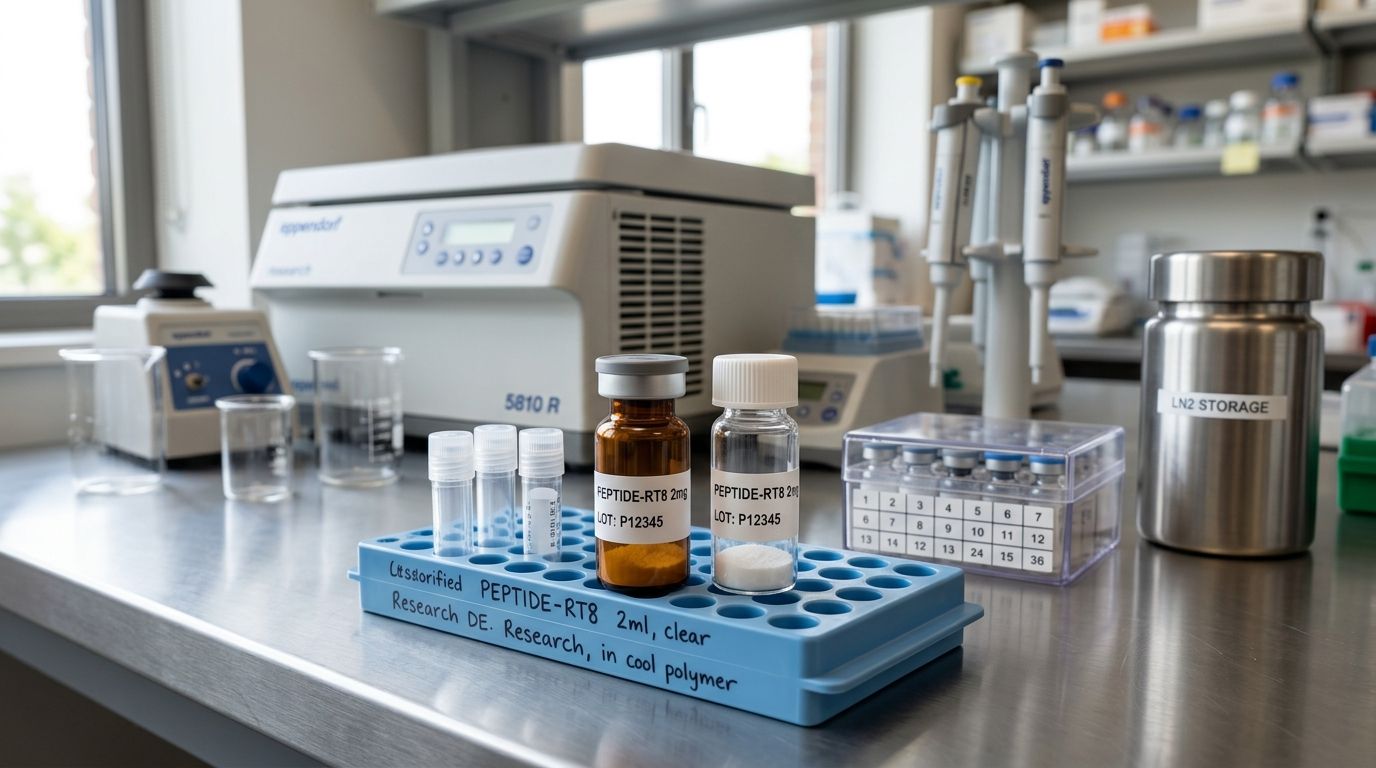
Peptide storage containers decide whether a lyophilized or reconstituted research compound holds its stated purity through the length of a study, or degrades before the first assay runs. This guide ranks the container types researchers actually rely on in 2026 – amber glass lyophilization vials, borosilicate reconstitution vials, cryovials, desiccant boxes, UV-blocking organizers, and cold-chain shippers – against the failure modes that actually damage peptides: light, moisture, temperature swings, and repeated freeze-thaw cycling.
A peptide's structural integrity depends on how it's held between reconstitution and use, not just on how it's synthesized. Researchers who follow a long-term peptide storage protocol still lose potency when the container itself is the weak point – clear plastic that lets UV through, a cap that doesn't seal against ambient humidity, or a vial rated for room temperature that cracks at -80°C.
The container is not an afterthought to the peptide. It's part of the experimental design, and choosing the wrong one introduces a variable you can't control for later. Celonyx Labs ships research peptides at 99% purity with third-party testing behind every batch, but that purity only holds as long as storage conditions after delivery match what the compound needs.
| Container type | Best for | Standout feature | Key limitation |
|---|---|---|---|
| Amber glass lyophilization vials | Long-term freeze-dried storage | Blocks UV/visible light, chemically inert | Fragile if dropped |
| Borosilicate reconstitution vials | Short-term bench storage after mixing | Clear glass for volume checks, autoclavable | Not built for long-term light-sensitive storage |
| Cryogenic vials | Ultra-low-temperature freezer storage | Screw-cap seal rated to -196°C | Needs a dedicated cryo freezer or LN2 dewar |
| Silica gel desiccant boxes | Humidity control | Reusable indicating silica beads | Doesn't address light or temperature |
| UV-blocking freezer organizers | Light-sensitive batches in shared freezers | Opaque compartments, keeps vials upright | Adds bulk to freezer shelf space |
| Insulated cold-chain shippers | Transport between labs | Maintains cold chain for hours in transit | Not a long-term storage solution |
Amber borosilicate vials are the default container for peptides that stay in freeze-dried form for weeks or months before use. The tint blocks UV and most visible light, and borosilicate glass doesn't react with the compound or leach plasticizers the way some polymer containers can over years of reuse.
Amber glass lyophilization vials pros:
Amber glass lyophilization vials cons:
Best for: researchers holding lyophilized peptide stock for more than a few weeks. Verdict: Buy.
Once a peptide is reconstituted with bacteriostatic water, it moves from long-term storage logic to short-term handling logic. Clear borosilicate vials let a researcher check solution volume and clarity at a glance, and they hold up through repeated autoclave cycles if the lab reuses containers.
Borosilicate reconstitution vials pros:
Borosilicate reconstitution vials cons:
Best for: peptides in active use during a study, right after mixing with bacteriostatic water for reconstitution. Verdict: Buy.
Cryovials are built with screw-cap seals rated to survive liquid nitrogen at -196°C without cracking, which standard glass vials cannot do reliably. Labs running long studies with infrequent sampling often move stock peptide into cryovials once reconstituted and split into single-use aliquots.
Cryogenic vials pros:
Cryogenic vials cons:
Best for: labs storing aliquoted peptide long-term at -80°C or below. Verdict: Buy if you have the freezer capacity; Skip if you don't.
Humidity does more damage to lyophilized peptide than most researchers expect, even inside a freezer, because condensation forms every time a container cycles between cold storage and room temperature. Desiccant boxes with indicating silica gel beads absorb that moisture and show color change when they need replacing.
Silica gel desiccant boxes pros:
Silica gel desiccant boxes cons:
Best for: any lab pulling vials in and out of the freezer repeatedly. Verdict: Buy.
Shared lab freezers rarely stay dark – the door opens dozens of times a day, and overhead lighting hits open racks directly. Opaque organizer boxes with UV-blocking walls keep individual vials protected even when the freezer itself isn't.
UV-blocking freezer organizer boxes pros:
UV-blocking freezer organizer boxes cons:
Best for: shared or multi-user freezers where light exposure is hard to control. Verdict: Buy.
When peptide stock moves between facilities, or arrives from a supplier, the container has to maintain cold chain for hours without a plug-in freezer. Insulated shippers with gel packs or dry ice compartments bridge that gap, but they're a transit solution, not a storage one.
Insulated cold-chain shipping containers pros:
Insulated cold-chain shipping containers cons:
Best for: receiving or transferring peptide shipments between sites. Verdict: Buy for shipping; Skip for daily storage.
Browse research peptides now
Third-party tested peptides paired with sound storage practice.
Each container type is scored against the six criteria above: material inertness, light protection, temperature stability, moisture control, size match, and labeling. No single container wins on every axis, which is why the ranking splits by use case instead of naming one universal winner – a cryovial that's ideal for -80°C storage is the wrong choice for a peptide in active use on the bench this week.
For most research peptide workflows in 2026, amber glass lyophilization vials paired with a silica gel desiccant box are the default for stock that isn't in active use. Once reconstituted, move the solution into a borosilicate vial for short-term handling, and only step up to cryovials if the study timeline stretches past the point where -20°C storage is enough. Shipping and receiving stay separate from storage decisions entirely – insulated cold-chain containers exist to protect the compound for hours, not months.
What’s the best container for storing lyophilized peptides long-term?
Amber glass lyophilization vials are the best peptide storage containers for long-term freeze-dried stock, since the tint blocks UV and visible light while the glass stays chemically inert. Pair the vial with a silica gel desiccant box if the freezer door opens frequently.
Do peptides need to be stored in the dark?
Yes, most research peptides degrade faster under UV and visible light exposure, which is why amber glass or opaque freezer organizers matter. Clear plastic tubes offer no light protection at all.
Can I store reconstituted peptides in plastic tubes?
Borosilicate glass is preferred over plastic for reconstituted peptide solutions because some polymers can leach into the solution over time. Plastic is acceptable for very short-term, single-use handling but not for repeated storage.
What temperature should peptide storage containers be kept at?
Lyophilized peptides are typically held near -20°C, while cryovials extend that range down to -80°C or liquid nitrogen at -196°C for longer-term stock. The container material has to be rated for whichever range applies.
How long can peptides sit in a cryovial before use?
A properly sealed cryovial at -80°C or below can hold aliquoted peptide for extended periods, but each freeze-thaw cycle still degrades the compound regardless of container quality. Aliquoting into single-use volumes before freezing avoids repeated cycling.
Is a desiccant box necessary if peptides are already lyophilized in sealed vials?
Yes, condensation forms every time a sealed vial moves between cold storage and room temperature, and a desiccant box absorbs that moisture before it reaches the powder. This matters most in labs that pull vials in and out of the freezer often.
What’s the difference between a cryovial and a standard freezer vial?
Cryovials use a screw-cap seal rated to survive liquid nitrogen temperatures near -196°C without cracking, while standard freezer vials are rated only for mechanical freezer ranges around -20°C. Using a standard vial in an LN2 dewar risks the seal failing.
How should peptides be packaged for shipping between labs?
Insulated cold-chain containers with gel packs or dry ice maintain temperature for the hours a shipment is in transit, but they aren’t a substitute for proper freezer storage on arrival. Move the peptide into its long-term container as soon as it’s received.
The container matters less than how often it gets opened. Repeated freeze-thaw cycling degrades research peptides faster than almost any single storage condition on this list, including light exposure – aliquoting stock into single-use volumes before the first freeze avoids the problem entirely, regardless of which vial type is holding it in 2026.
Choose the best GHK-Cu peptide format for laboratory skin and wound-healing research. Compare documentation, assay

Choose lot-verified melanotan 1 peptide for pigmentation research. Compare material specifications, purity evidence, and documentation

Native oxytocin peptide is the default for behavioral research. Compare reference standards, labeled materials, and
FOR RESEARCH USE ONLY. Products sold by Celonyx Labs are intended exclusively for laboratory and scientific research. They are not intended for human or veterinary use, consumption, diagnosis, treatment, cure, or prevention of any disease. By purchasing from this site, you acknowledge that you understand the intended research purpose of these materials and agree to comply with all applicable laws and regulations.