What Is KPV Peptide? Structure and Research Guide 2026
If KPV is one of the smallest peptide sequences ever reported to inhibit inflammation, why
Most online comparisons of hexarelin vs ipamorelin settle on a quick shortcut: hexarelin triggers a larger acute growth hormone (GH) spike, so it must be the stronger compound, while ipamorelin is framed as a milder alternative. That shortcut misleads laboratory teams. A higher single-dose hormone peak measures one narrow receptor event, not assay reproducibility, endocrine cleanliness, or downstream biological utility.
Evaluating these two synthetic growth hormone secretagogues properly means separating receptor-level pharmacology from the human evidence available. Cross-study potency rankings routinely collapse different species, dosing routes, and hormonal endpoints into a single score. Treating those rankings as settled fact leads to flawed experimental designs and confounded data.
Researchers search hexarelin vs ipamorelin because both compounds sit in the same functional class. Both are synthetic growth hormone secretagogues, both act as agonists at the GHSR-1a receptor, and both appear frequently in preclinical peptide literature and research catalogs. When two molecules share a primary receptor target, the natural assumption is that published data should tell a laboratory which one performs better.
Shared receptor binding doesn't settle the question, because no published controlled clinical study has administered both hexarelin and ipamorelin to the same human subjects. Every popular ranking comparing their potency or selectivity is an indirect inference stitched together from separate trials, distinct volunteer groups, and incompatible assay conditions.
Stronger GH release does not make one peptide the superior research tool, especially when no head-to-head human study exists to anchor a potency ratio.
Making a defensible compound selection requires evaluating both peptides through three distinct analytical lenses:
This analysis serves strictly as a research-context comparison for laboratory compound selection, not guidance on human use, and all research peptides discussed are labeled "For Research Use Only." By weighing the evidence across those three lenses, you can trace which claims rest on controlled data, identify which endocrine endpoints require assay controls, and select the right compound for a defined experimental question.
Looking at structural features, receptor profiles, and publication volume in one view clarifies why direct comparisons break down quickly. According to the Peptifact October 2026 comparison of hexarelin and ipamorelin, PubMed indexed 169 records tagged as human studies for hexarelin and 50 total records for ipamorelin as of October 9, 2026, with no study administering both peptides to the same participants.
| Attribute | Hexarelin | Ipamorelin |
|---|---|---|
| Peptide class | Hexapeptide GH secretagogue | Pentapeptide GH secretagogue |
| Receptor target | GHSR-1a, also described as interacting with CD36 | GHSR-1a, described as more selective |
| Endocrine selectivity | GH rise accompanied by prolactin and cortisol increases in a human study | GH-selective profile in pharmacological profiling |
| Human research record | Controlled human studies from the early 1990s | Short pharmacokinetic and clinical work |
| Head-to-head human data | None located | None located |
| Long-term data | One 16-week study of repeated exposure | No equivalent long-term human study located |
| Published record volume | 169 human-tagged PubMed records (October 2026) | 50 total records (October 2026) |
Each row in the table above describes a different category of evidence rather than points on a uniform grading scale. Counting rows where one peptide appears "stronger" or "cleaner" won't identify a winner, because historical human endocrinology trials, receptor-binding profiles, and database citation counts measure completely different properties.
Hexarelin is a six-amino-acid peptide (hexapeptide) whose binding profile extends beyond GHSR-1a to include interactions with CD36, a scavenger receptor studied in peripheral and vascular tissues. Ipamorelin is a five-amino-acid peptide (pentapeptide) engineered to narrow receptor activity toward GHSR-1a alone.
Those structural traits explain why investigators turn to each compound for different experimental setups. A deeper citation count for hexarelin reflects an earlier synthesis timeline and broader historical exploration across pituitary and non-pituitary tissues, not universal superiority over ipamorelin in modern assays.
Hexarelin carries the longer, more detailed human pharmacology record of the two compounds. Its early clinical characterization established clear acute dose-response curves across multiple delivery routes long before ipamorelin entered human pharmacokinetic testing.
A PubMed-indexed human route-comparison study evaluated four administration routes (intravenous, subcutaneous, intranasal, and oral) in 12 healthy young volunteers. At 1 microgram per kilogram administered intravenously, hexarelin generated a GH area under the curve of 3,175 ± 506 micrograms per minute per liter, compared with 1,544 ± 161 micrograms per minute per liter after 1 microgram per kilogram of growth hormone-releasing hormone (GHRH), a roughly twofold higher acute response that reached statistical significance at P < 0.001. Investigators in that same protocol tested 1 and 2 micrograms per kilogram intravenously, 1.5 and 3 micrograms per kilogram subcutaneously, 20 micrograms per kilogram intranasally, and 20 and 40 milligrams orally.
Read that dose spread carefully. Oral administration required milligram quantities to elicit a response that microgram intravenous doses produced, which means route selection alone can shift observed potency by orders of magnitude in this literature. Any cross-study comparison that ignores delivery route is comparing different experiments, not the same molecule.
These numbers confirm that hexarelin's early literature rests on controlled human pharmacology rather than purely in-vitro screening. Still, the study design sets firm boundaries on what you can extrapolate. All measurements came from small, specialized volunteer cohorts tracking acute hormone surges over hours, not long-term tissue or clinical outcomes. Teams modeling acute pulse kinetics versus longer experimental timelines can examine how long hexarelin takes to show effects in research models to keep short-window measurements separate from sustained signaling assumptions.
Ipamorelin's documented human evidence base is narrower and shorter in duration. As summarized in the Peptides.org review of hexarelin vs ipamorelin, human pharmacokinetic evaluation included a single-dose study of 40 healthy men receiving intravenous infusions, followed later by a brief seven-day perioperative clinical trial rather than extended multi-month administration.
That perioperative trial failed to demonstrate a statistically significant improvement in its primary recovery endpoint, reporting a median time to a tolerated meal of 25.3 hours compared with 32.6 hours for placebo. The same review notes that no direct human trials have compared the two compounds on cardiovascular, metabolic, endocrine, or immunologic outcomes.
The asymmetry here matters more than the raw counts. Hexarelin's human data answers questions about acute secretagogue potency; ipamorelin's answers questions about tolerability in a narrow clinical window. Neither dataset was built to answer the question laboratories ask: which compound performs better under matched experimental conditions? Hexarelin is the better-documented molecule historically in human acute endocrinology, yet historical volume doesn't prove it outperforms ipamorelin on a given laboratory endpoint.
Peak GH secretion tells only part of the endocrine story. When a secretagogue triggers secondary pituitary or adrenal hormones, downstream signaling in metabolic, immune, and tissue models shifts in ways that a GH-only assay will completely miss.
In a Journal of Clinical Endocrinology & Metabolism dose-response study of healthy adult men, intravenous hexarelin increased GH in a dose-dependent manner while simultaneously stimulating prolactin and cortisol. That finding confirms off-target endocrine activation beyond the somatotropic axis. By contrast, PubMed pharmacological profiling of ipamorelin reported that it stimulated GH release with selectivity resembling GHRH, separating its profile from broader secretagogues such as hexarelin.
Notice the evidentiary asymmetry between those two sources. The hexarelin off-target findings come from a controlled human dose-response trial, whereas ipamorelin's selectivity benchmark comes from pharmacological profiling. Neither study administered both compounds at matched molar doses to the same subjects, and neither establishes a direct head-to-head potency ratio.
The visual breakdown below summarizes how these distinct selectivity profiles shape your monitoring panel.
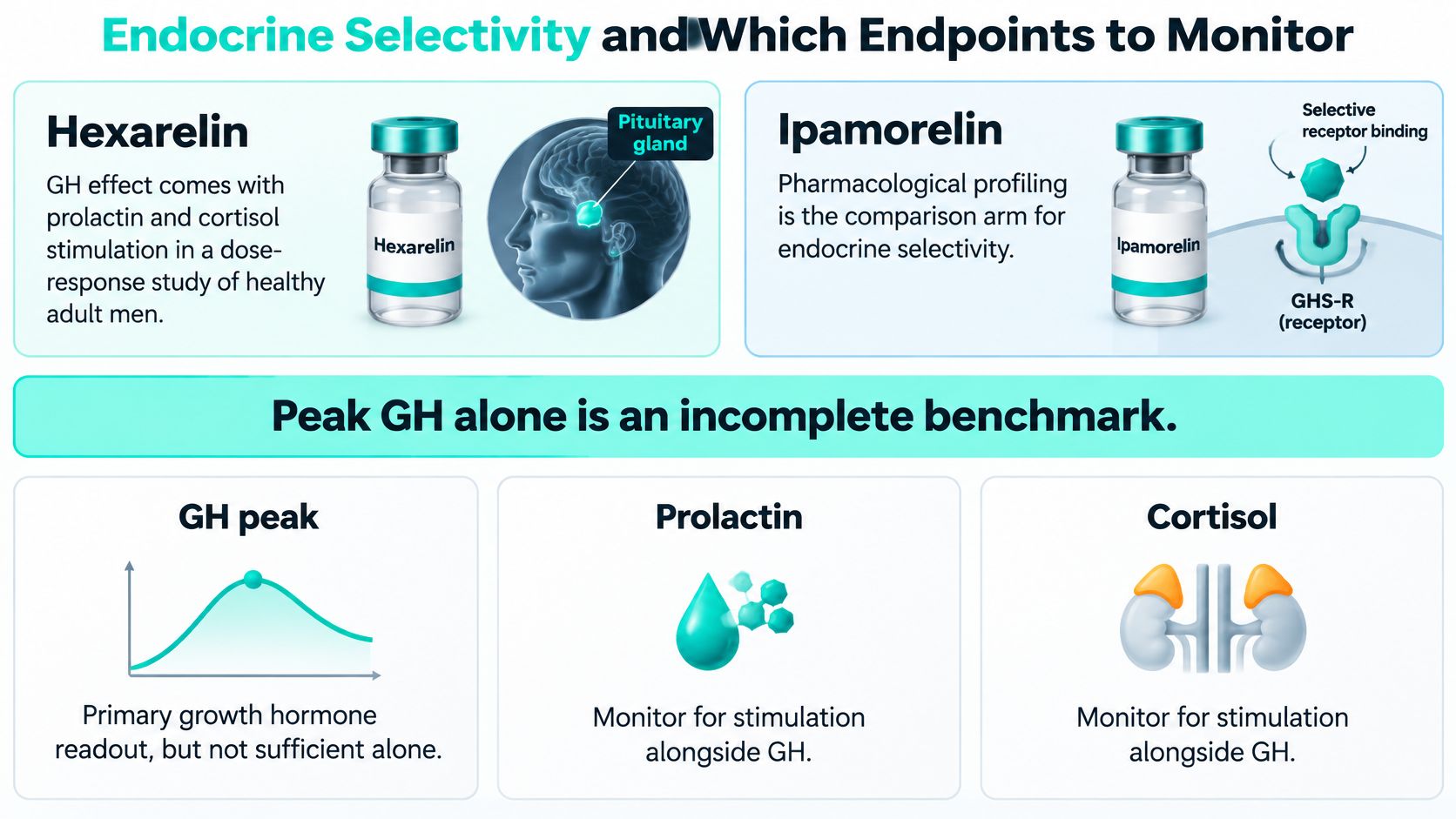
Building the right assay panel prevents unexpected hormonal crosstalk from skewing your interpretation. Rather than defaulting to peak GH alone, pair four markers with the specific questions they answer:
Ipamorelin's cleaner primary endpoint provides a practical advantage only if your laboratory confirms that selectivity under its own assay conditions. Species differences, buffer composition, sampling intervals, and batch purity can all shift endocrine profiles enough to invalidate assumptions borrowed from outside papers.
Single-dose potency figures collapse quickly once an experiment moves from acute injection to multi-week administration. Repeated agonist exposure at GHSR-1a alters receptor responsiveness over time, and human longitudinal data on hexarelin show exactly how steep that attenuation can be.
In a PubMed 16-week human study of twice-daily subcutaneous hexarelin administered at 1.5 micrograms per kilogram of body weight, investigators measured the mean GH area under the curve following a test dose across four checkpoints and a post-treatment washout period.
| Time point | Mean GH AUC (µg/L·h) | Note |
|---|---|---|
| Baseline | 19.1 ± 2.4 | Reference value |
| Week 1 | 13.1 ± 2.3 | Early reduction |
| Week 4 | 12.3 ± 2.4 | Continued reduction |
| Week 16 | 10.5 ± 1.8 | About 45% below baseline |
| Four weeks after stopping | 19.4 ± 3.7 | Essentially back to baseline |
Reading the trajectory row by row shows how fast attenuation sets in. The steepest loss occurs within the first week of twice-daily exposure, and the decline then slows rather than accelerating. The Aminoscope 2026 hexarelin vs ipamorelin analysis notes that this decline from 19.1 µg/L·h at baseline to 12.3 µg/L·h at week 4 and 10.5 µg/L·h at week 16 was statistically significant at P = 0.0003, while pointing out that no corresponding multi-week human figure exists for ipamorelin. That asymmetry matters more than the P value itself. Hexarelin's desensitization curve is quantified in humans; ipamorelin's is unknown at comparable exposure lengths, so any durability ranking rests on inference from animal or single-dose data rather than measured human outcomes.
The final row of the table carries the most important mechanistic insight for protocol design. Four weeks after stopping hexarelin, the mean GH area under the curve returned to 19.4 ± 3.7 µg/L·h, matching the starting baseline. Repeated exposure clearly blunted acute responsiveness, yet the somatotrope response recovered fully after an adequate washout window. That pattern points to reversible receptor desensitization rather than permanent pituitary exhaustion. For laboratory scheduling, the practical consequence is that washout length is a design variable with a measurable floor, not an arbitrary pause.
Downstream physiological markers from that same trial reinforce caution about equating acute GH pulses with long-term tissue outcomes. As reported in the PeptideDoctrine 2026 review of hexarelin vs ipamorelin, that 16-week adult hexarelin study found no change in lean mass, fat mass, or IGF-1, and confirmed that no direct human head-to-head study has tested hexarelin against ipamorelin.
Prior hormonal exposure also shifts secretagogue responsiveness. Human testing documented alongside the 16-week trial showed that pretreatment with recombinant human growth hormone blunted peak responses to both hexarelin and GHRH. The blunting was clearer for hexarelin, but the two compounds did not differ significantly from each other, so prior GH status acts as a confound across secretagogues rather than a hexarelin-specific liability.
Protocol rule: Build baseline measurements, mid-study checkpoints, and a defined washout assessment into any multi-week secretagogue protocol before drawing conclusions about sustained potency.
Because comparable multi-week human ipamorelin attenuation data haven't been published, ranking the two compounds on durability without running a matched schedule inside the same model remains guesswork. Exposure frequency, prior hormone status, washout length, and endpoint selection can shift results far more than a compound's acute single-dose peak.
Most misleading claims about hexarelin vs ipamorelin happen when writers treat receptor-level pharmacology as interchangeable with clinical evidence. A peptide's binding affinity in a cell line doesn't tell you how it behaves in intact animals, and rodent pharmacokinetics don't predict human endocrine outcomes.
A rigorous study-design framework keeps six experimental tiers strictly separate:
The PubMed human pharmacokinetic evaluation of ipamorelin illustrates why jumping across those tiers breaks down. Investigators evaluated ipamorelin in healthy male volunteers alongside other secretagogues rather than directly against hexarelin. Meanwhile, the frequently quoted 20% intranasal bioavailability figure came from male rats and can't be assumed to predict human exposure or subcutaneous delivery. A separate literature review cited alongside that pharmacokinetic work confirms that no dedicated head-to-head endocrine study has verified whether ipamorelin's selectivity advantage persists at clinically relevant human doses.
Laboratories reviewing legacy papers often stumble into four recurring methodological traps:
A second blind spot involves treating pharmacological selectivity as a guarantee of clinical safety. Ipamorelin may carry a cleaner mechanistic profile at GHSR-1a without possessing an established long-term safety advantage under repeated exposure, especially in physiological models involving diabetes risk, cardiovascular disease, altered GH/IGF-1 regulation, or concurrent medications.
Conversely, hexarelin's higher experimental potency can increase assay sensitivity in acute screening models while demanding stricter exposure controls and broader endocrine monitoring. Neither mechanistic plausibility nor publication volume proves safety or clinical benefit.
A defensible comparison requires a matched experimental endpoint, species, administration route, exposure-matching method, and assay control panel inside the same study design.
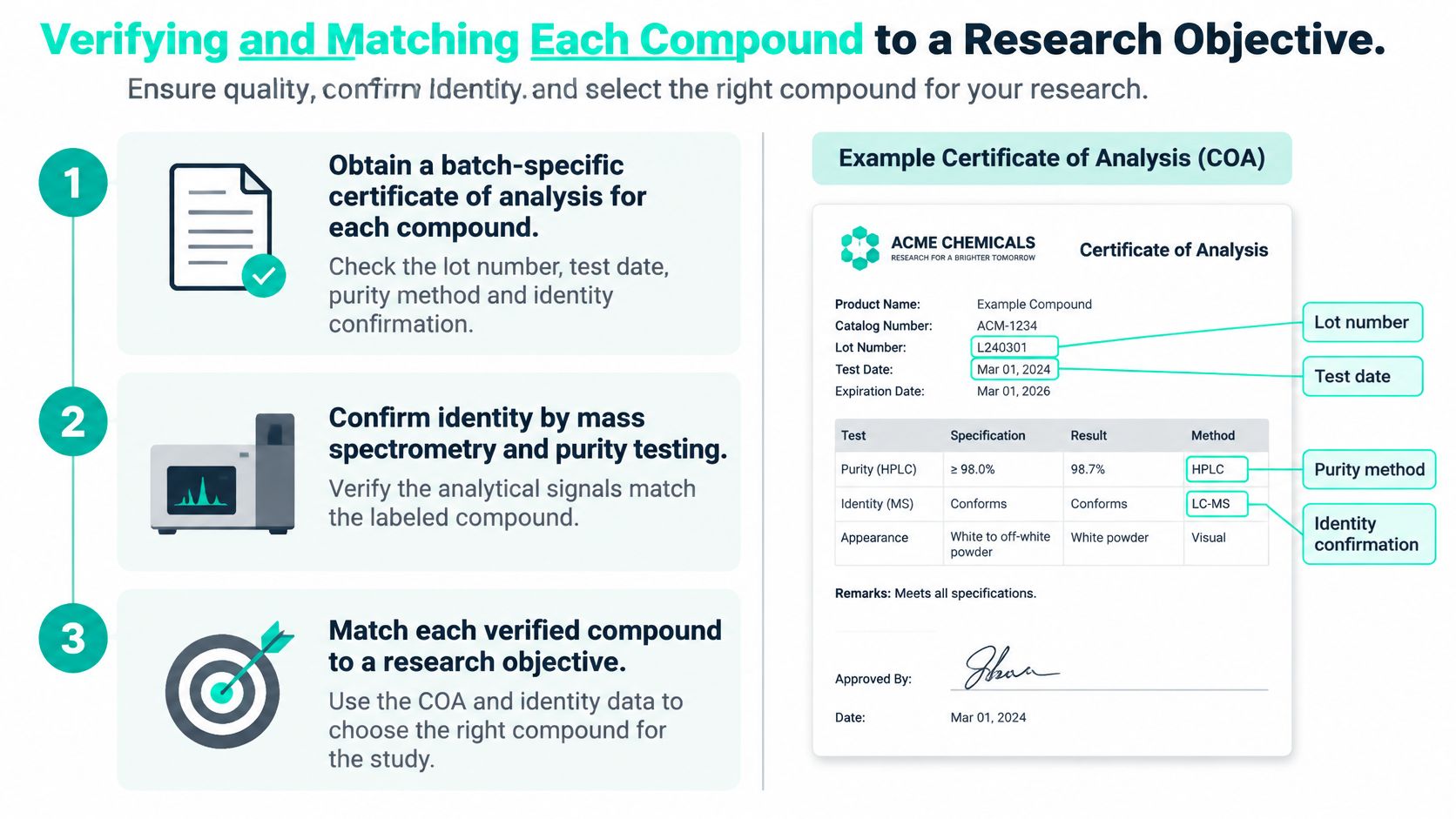
Analytical verification comes before any comparison of hexarelin and ipamorelin. Unverified peptide purity, residual synthesis solvents, or a mislabeled sequence introduce experimental noise that completely overshadows the subtle pharmacological differences between two GHSR-1a agonists.
The checklist below walks through the core Certificate of Analysis (COA) verification workflow that protects experimental validity before a vial ever enters an assay.
Follow five concrete verification steps every time you bring a secretagogue into your laboratory:
Once material identity and purity are confirmed, align the peptide's documented pharmacological profile with the exact biological question you need to answer.
| Research objective | Profile consideration | Controls to add |
|---|---|---|
| Maximal GH secretagogue response | Hexarelin's broader response may suit | Track prolactin and cortisol with GH |
| GH release with minimal endocrine change | Ipamorelin's selectivity profile fits better | Verify identity and purity before use |
| Multi-week repeated exposure | Hexarelin shows desensitization with recovery after washout | Baseline and washout measurements in the schedule |
| Assay validation across compounds | Substitution without re-mapping distorts dose-response | Concurrent dose-response in the same model |
Choosing between the two profiles becomes much clearer once you map the experimental confounders. If your protocol aims to provoke a maximal acute somatotropic stimulus or investigate peripheral CD36-linked pathways, hexarelin's broader activation profile fits the task as long as prolactin and cortisol sit alongside GH on your assay plate. The cost of that broader activation is a heavier control panel.
The opposite logic governs ipamorelin. If your study isolates GH-axis signaling in metabolic, stress-sensitive, or multi-peptide designs where glucocorticoid elevation would muddy the primary readout, ipamorelin's narrower profile reduces baseline endocrine noise. Teams investigating dual-receptor somatotropic stimulation also frequently examine CJC-1295 and ipamorelin research protocols to assess complementary GHRH-analog and GHSR-1a signaling without broadening adrenal activation.
A preclinical endocrinology group plans a four-week rodent assay measuring hepatic gene expression downstream of GH pulses. Starting with the question "which peptide is stronger?" invites trouble. Starting with the endpoint forces better decisions: if cortisol spikes would upregulate overlapping gluconeogenic genes in the liver, choosing hexarelin without adrenal controls compromises the dataset from day one. Conversely, if the team tests hexarelin across four weeks without baseline and post-washout test doses, they won't know whether declining gene expression reflects hepatic adaptation or pituitary receptor desensitization.
Neither peptide is universally superior in hexarelin vs ipamorelin laboratory evaluations. Choose the compound only after your primary endpoint, secondary endocrine controls, exposure schedule, and batch-specific lot documentation are settled.
For laboratories sourcing verified materials for endocrine and receptor-signaling assays, Celonyx Labs supplies third-party tested research peptides labeled "For Research Use Only," including Ipamorelin 5mg at $34.95 alongside BPC-157, Epithalon, GHK-Cu, GLP-1, GLP-2, GLP-3, MOTS-c, NAD+, Selank, Semax, and TB-500. Browse the current research catalog and analytical quality documentation at Celonyx Labs to align verified lots with your experimental protocol.
If KPV is one of the smallest peptide sequences ever reported to inhibit inflammation, why

Compare peptide supplier batch consistency by lot records, testing methods, and traceability. Choose documented evidence

Choose a growth hormone secretagogue peptide blend by research fit, not ingredient count. Compare four
FOR RESEARCH USE ONLY. Products sold by Celonyx Labs are intended exclusively for laboratory and scientific research. They are not intended for human or veterinary use, consumption, diagnosis, treatment, cure, or prevention of any disease. By purchasing from this site, you acknowledge that you understand the intended research purpose of these materials and agree to comply with all applicable laws and regulations.