

Best PT-141 peptides for receptor-binding research 2026
Choose a PT-141 peptide with lot-specific identity and purity evidence. Compare research material profiles, content
Why do researchers often treat CJC-1295 and ipamorelin as a single “stack” when the two peptides create very different hormone signals? For a laboratory, that difference isn't a minor detail. CJC-1295 with DAC extends exposure, while ipamorelin offers a more time-focused secretagogue response, so the pair is better understood as a methodological contrast than as a proven therapeutic combination.
Understanding that contrast means separating receptor mechanisms, hormone measurements, and clinical claims. The human evidence supports changes in endocrine biomarkers under specific study conditions, but it doesn't establish benefits for muscle gain, athletic performance, aging, or disease treatment. The central research question is therefore not which peptide is “better,” but how to design experiments that account for their different kinetics.
CJC-1295 is a synthetic analogue of growth-hormone-releasing hormone (GHRH), the signaling molecule that prompts the pituitary to release growth hormone. The DAC, or drug-affinity complex, is a modification designed to bind albumin in the bloodstream. That binding slows clearance and extends exposure compared with native GHRH, making DAC-modified CJC-1295 a long-acting research compound.
Ipamorelin acts through a different route. It's a synthetic agonist of the ghrelin receptor, GHSR-1a, and stimulates endogenous growth-hormone release through that receptor rather than through the GHRH receptor. The two are often discussed together because their mechanisms differ, not because they're interchangeable or because a combination has established clinical value.
That distinction provides a useful starting point for lab work. CJC-1295 with DAC is relevant when investigators want to examine prolonged exposure and downstream endocrine markers over time. Ipamorelin is relevant when the research question concerns an acute, more tightly timed secretagogue response. A study that treats both as equivalent “GH peptides” risks overlooking the very difference it should measure.
For readers looking for a separate overview of practical considerations, CJC-1295 and ipamorelin dosing insights offers another perspective. Dosing guidance found online shouldn't be treated as an experimental protocol or a clinical recommendation. Here, the focus is on pharmacology and research design.
Neither peptide should be confused with a validated therapy for performance, body composition, aging, or disease. A rise in a hormone measurement is a biological response, not proof that a meaningful health outcome follows. Keeping that distinction clear helps researchers ask narrower, answerable questions.
CJC-1295's basic signaling route starts at the GHRH receptor on cells in the anterior pituitary. When the receptor is activated, those cells release growth hormone. The resulting GH signal can then influence downstream endocrine activity, including insulin-like growth factor 1 (IGF-1), but the size and duration of any measured response depend on the compound's exposure and the experimental context.
A useful analogy is a thermostat that switches a heating system on and off. GHRH signaling encourages the pituitary to release GH in pulses rather than maintaining a perfectly flat signal. That matters because researchers need to distinguish a change in pulse activity from a sustained elevation in hormone exposure. A single measurement can miss that distinction.
The DAC modification changes how long CJC-1295 remains in circulation. By binding albumin, the compound's exposure lasts longer than that of native GHRH. This extended presence doesn't mean GH becomes a continuous, unvarying signal. Human pharmacology data describe continued pulsatile GH secretion even with prolonged CJC-1295 exposure, so sampling plans still need to account for biological fluctuation.
Ipamorelin provides a useful contrast, but its receptor target is different. It activates GHSR-1a, the ghrelin receptor, while CJC-1295 activates the GHRH receptor. To understand how peptide signals can produce different cellular responses, this overview of how peptides signal cells provides broader context.
The practical takeaway is to keep mechanism and outcome separate. Receptor activation can explain why a hormone marker changes; it can't, by itself, establish a clinical benefit. A laboratory can test endocrine responses under defined conditions, but claims about athletic performance, body composition, or aging require evidence that goes beyond the signaling pathway.
Ipamorelin activates the ghrelin receptor, GHSR-1a, to stimulate endogenous GH release. Receptor binding sets off a signaling cascade inside pituitary somatotrophs that produces a discrete secretory pulse rather than a prolonged elevation. For broader context on how peptides signal cells, this overview explains how receptor binding translates into cellular responses.
Early human pharmacology describes ipamorelin as relatively selective for GH secretion, with less activation of cortisol- or prolactin-related pathways than older secretagogues. In a phase I study, GH concentrations peaked approximately 40–60 minutes after administration, with no significant changes in other pituitary or adrenal hormones in that setting (human pharmacology findings on ipamorelin). That observation applies to the study setting and shouldn't be stretched into a general claim about safety or outcomes.
A simple comparison helps. Ipamorelin resembles a quick doorbell press: it suits questions about the timing of an acute response. DAC-modified CJC-1295 works more like a long-burning pilot light, holding exposure across a broader window. The analogy describes experimental timing; it makes no promise about the response in any given model.
| Research feature | Ipamorelin | CJC-1295 with DAC |
|---|---|---|
| Typical observation window | Minutes to a few hours post-administration (for example, 0–120 minutes around the expected peak) | Days to weeks |
| Washout consideration | Short, hours-scale gap between conditions | Multi-day carryover between conditions |
| Useful sampling focus | Dense sampling around the post-administration peak | Spaced sampling across an extended window |
| Research question | How does an acute secretagogue pulse unfold? | How does prolonged exposure shift endocrine markers? |
That contrast is why the pair functions methodologically rather than as a validated "stack." Ipamorelin sharpens the secretory pulse so a lab can resolve timing; CJC-1295 extends exposure so a lab can track carryover. A sampling schedule built for one will misread the other, and neither profile alone answers whether a treatment improves a clinical outcome.
The foundational human CJC-1295 study helps explain why researchers treat the DAC-modified compound as a long-exposure tool. Published in the Journal of Clinical Endocrinology & Metabolism in 2006, it included randomized, placebo-controlled, double-blind, ascending-dose trials lasting 28 and 49 days in healthy adults aged 21–61 years (foundational CJC-1295 human study). Participants received subcutaneous CJC-1295 as a single dose or through repeated weekly or biweekly dosing.
After one injection, mean GH concentrations rose in a dose-dependent way by approximately 2- to 10-fold for at least 6 days. Mean IGF-1 concentrations rose approximately 1.5- to 3-fold for 9–11 days, and the estimated plasma half-life was 5.8–8.1 days. With repeated administration, mean IGF-1 remained above baseline for as long as 28 days. These are endocrine measurements in healthy volunteers, not demonstrations of improved performance or body composition.
| Attribute | CJC-1295 with DAC | Ipamorelin |
|---|---|---|
| Primary receptor | GHRH receptor | Ghrelin receptor, GHSR-1a |
| Exposure pattern | Long-acting, albumin-binding design | Shorter, pulse-oriented response |
| Measured research focus | GH and IGF-1 over an extended window | Acute GH response and time to peak |
| Design implication | Plan around carryover and multi-day sampling | Standardize sampling close to administration |
| Evidence boundary | Hormonal activity established in small, short studies | Early pharmacology supports a selective GH response in its study setting |
No winner emerges from this comparison. The compounds address different research questions, so selection should follow the intended measurement rather than a broad claim that one is more effective. Investigators exploring other secretagogues can also review this comparison involving tesamorelin and ipamorelin, while keeping each compound's distinct evidence base in view.
The CJC-1295 trials reported no serious adverse reactions and described the compound as relatively well tolerated, particularly at 30 and 60 micrograms per kilogram. But those findings came from small, short-duration studies of healthy volunteers. They establish hormonal activity and exposure characteristics, not validated efficacy for athletic performance, body composition, aging, or disease.
A blood sample drawn on day 9 of a CJC-1295 trial can mean three different things. It might catch a growth hormone pulse, land in a trough between pulses, or reflect leftover compound from a dose given days earlier. Human pharmacology studies matter because they pin down timing like this: they show whether a compound changes hormone measurements under controlled conditions, and how long that change lasts.
For DAC-modified CJC-1295, the published work reports measurable drug concentrations for roughly 10–13 days after dosing and IGF-1 elevations persisting up to 28 days with repeated dosing (CJC-1295 pharmacokinetic summary). GH secretion stayed pulsatile rather than flattening into a continuous signal. Two design consequences follow. First, a single sample can land on a pulse or a trough, so timing relative to the last pulse matters as much as timing relative to the dose. Second, residual IGF-1 elevation, which outlasts measurable drug in these data, defines how long a washout period must run before a baseline measurement is clean.
Ipamorelin studies create the opposite timing problem. The reported response is acute and time-focused, so the informative data sit in a narrow window after administration. Sparse sampling would miss the peak or underestimate its height. The design question there is how densely to sample early. Read together, the two sets of findings behave like complementary instruments: CJC-1295 stretches the exposure window a laboratory must account for, while ipamorelin compresses the signal worth catching into a short interval.
A useful reporting standard follows: publish the sampling schedule alongside the hormone data, so readers can judge whether a reported baseline was collected during residual exposure. Many pharmacology papers omit that detail, and without it there is no way to separate a clean pre-dose measurement from a contaminated one.
Researchers may pair the compounds because they activate different receptor systems involved in endogenous GH release. CJC-1295 engages the GHRH receptor; ipamorelin engages GHSR-1a. That makes co-administration a mechanistically interesting way to study how distinct signals relate to GH secretion, but it doesn't establish that the combination produces a reliable additive effect in people.
The orchestra analogy is useful only up to a point. CJC-1295's extended exposure might be thought of as a sustained musical line, while ipamorelin's more time-focused response is an accent. That image can help explain why the pair attracts research interest, but it shouldn't be mistaken for evidence that the compounds work better together or create a desired clinical result.
A rigorous combination study needs to test its own hypothesis. Investigators should specify whether they're examining receptor-pathway interaction, hormone timing, or biomarker duration, then select measurements that can distinguish those possibilities. If a study only reports that a hormone marker changed after both compounds were administered, it may not reveal which compound contributed what.
Evidence for the specific combination remains limited, so researchers should be explicit about what their experiment can and cannot support. In particular, hormonal findings shouldn't be extended into recommendations about dosing, safety, or efficacy outside controlled research protocols.
Practical rule: Treat “complementary mechanisms” as a hypothesis to test, not a result to assume.
Quality control is part of that test. Researchers need to know whether the material's identity, purity, and batch documentation support the experimental question. If those basics are uncertain, the study may not be able to separate a biological response from material variability.
A peptide's stated purity is only useful when the documentation makes the claim verifiable. For research procurement, ask for batch-specific records rather than relying on a general product description. A certificate should identify the tested material and lot, and it should report the analytical methods used.
For identity, researchers can look for mass spectrometry documentation. For purity assessment, HPLC or UPLC results can provide an analytical profile, while independent third-party testing offers an external check on the supplier's own quality claims. These methods answer different questions, so a single purity figure shouldn't stand in for complete characterization.
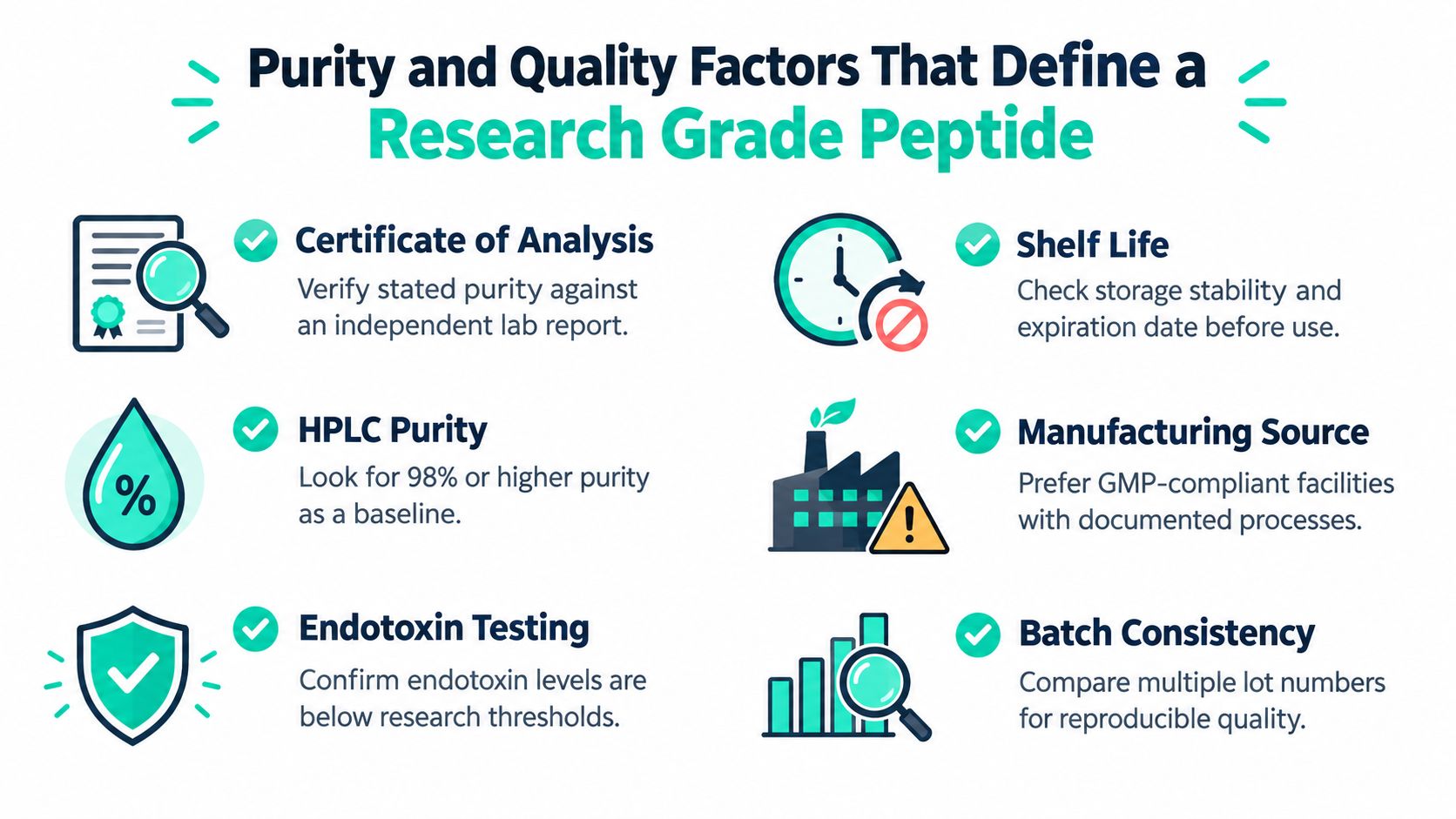
Useful records should also make it possible to trace a vial back to its batch and review storage and handling information. Researchers comparing suppliers can examine the third-party testing information for research peptides as one example of the type of quality assurance documentation to assess.
Before placing an order, check for:
These steps don't guarantee that a peptide is suitable for every experiment, but they make procurement decisions more defensible. Consistent documentation also helps investigators identify material-related variability when results differ across batches. Quality records can't replace good experimental design, but without them, it's harder to interpret the design's results.
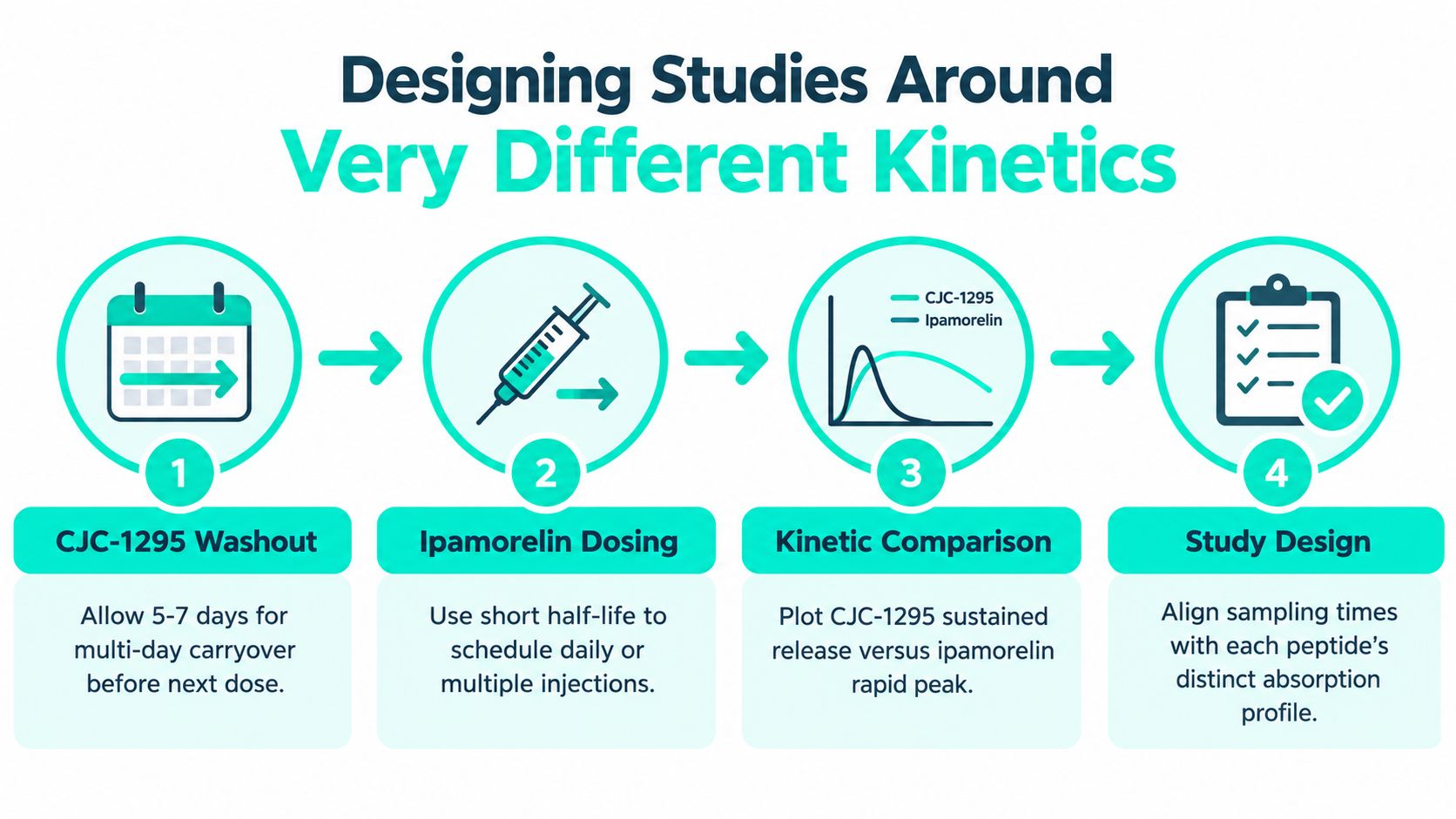
A strong study design follows the compounds' kinetics rather than forcing both into the same sampling schedule. CJC-1295 with DAC can produce multi-day carryover, while ipamorelin is studied for a more acute response. If researchers collect samples at identical intervals and assume those intervals mean the same thing for both compounds, they may compare unlike biological windows.
CJC-1295's prolonged exposure means researchers should plan for carryover when setting baseline measurements and treatment periods. The reported half-life and persistence after administration show why a short gap can leave residual compound exposure. Investigators should choose washout periods based on the protocol's scientific question and measured kinetics, not copy a generic schedule from an unrelated experiment.
A baseline sample taken before the system has returned to the study's intended comparison state may not be a true baseline. That can confound comparisons between treatment arms or between repeated measurements within the same participant. The protocol should make clear how it defines baseline and how it accounts for residual exposure.
Ipamorelin research calls for tight control of sampling time around administration, especially when the question concerns the acute GH response or time to peak. Record administration and collection times consistently. Even small differences in timing can make samples represent different points on the response curve.
The hormone itself is pulsatile, so researchers shouldn't interpret one isolated measurement as a complete picture. Repeated sampling or a clearly justified sampling window may better address the question, depending on the study design. The goal is to capture the response pattern, not just obtain a convenient blood draw.
Regardless of peptide, GH measurements can vary with context. Fasting status, sleep, stress, and assay platform should be standardized or recorded, then handled consistently across comparison groups. If conditions differ between visits, a measured change may reflect those differences rather than the peptide under investigation.
Researchers should also document the assay method and use it consistently where possible. A comparison across platforms can introduce interpretive uncertainty, especially when the study is looking for changes in a variable hormone signal. A well-controlled protocol specifies sample timing, participant conditions, and laboratory methods before data collection begins.
The central methodological point is simple: CJC-1295 and ipamorelin are not interchangeable inputs. One is relevant to prolonged exposure and multi-day monitoring; the other is relevant to an acute, time-sensitive response. A combined protocol should explain why both are included and how the analysis will separate their contributions rather than presume an additive effect.
Researchers considering CJC-1295 without DAC can review information about CJC-1295 without DAC and account for the specific formulation in their protocol. The difference in formulation matters because the study's exposure profile determines how sampling and washout should be planned.
The responsible conclusion is narrower than the popular “stack” narrative. CJC-1295 with DAC is a long-exposure GHRH analogue, and ipamorelin is a ghrelin-receptor agonist studied for an acute secretagogue response. Human research supports endocrine activity in defined settings, but it doesn't establish clinical benefits for performance, body composition, aging, or disease. Clear hypotheses, careful timing, consistent assays, and traceable material give investigators a stronger basis for interpreting whatever their measurements show.
Celonyx Labs supplies research peptides through an online catalog and provides product and customer support for laboratory procurement. If your work involves CJC-1295 or ipamorelin, review the available product and quality information at Celonyx Labs and assess it against your study's documentation requirements.
Choose a PT-141 peptide with lot-specific identity and purity evidence. Compare research material profiles, content

Choose a hexarelin peptide by lot-specific evidence, not purity alone. Compare research material, reference standards,

Choose the best semax peptide format for laboratory research. Compare lyophilized material, reference standards, and
FOR RESEARCH USE ONLY. Products sold by Celonyx Labs are intended exclusively for laboratory and scientific research. They are not intended for human or veterinary use, consumption, diagnosis, treatment, cure, or prevention of any disease. By purchasing from this site, you acknowledge that you understand the intended research purpose of these materials and agree to comply with all applicable laws and regulations.