Purity Ingredients Explained: How to Read a Peptide COA
The advice you'll see most often about peptide quality is to buy 99% purity and
The advice you'll see most often about peptide quality is to buy 99% purity and trust the certificate. Follow it and you'll still get caught out, because the percentage is the least informative line on the page.
A certificate of analysis is a stack of separate claims. One line says the material is the right molecule. Another says how much of the vial is peptide rather than water and salt. Another names what else showed up in the chromatogram. Another says who ran the tests. The 99% figure answers a narrow question about one of them, and it can be true of material that fails every other check.
Reading purity ingredients properly means working through the document in order, knowing what each item proves and what it leaves open, then carrying that evidence into how you store and reconstitute the vial.
Most certificates carry most of these items. The gaps are what matter, because each missing line removes a conclusion you're allowed to draw.
| Item | What It Confirms | Red Flag If Missing |
|---|---|---|
| Lot or batch number | The report belongs to the vial in your hand | Number absent or different from the vial label |
| Test date | How recent the analytical data is | No date given |
| Identity by mass spectrometry | Measured mass matches the expected sequence mass | No MS or LC-MS result |
| Purity by RP-HPLC | Share of the main peak in the chromatogram, with method named | Single percentage with no method or conditions |
| Individual impurities | Which related species are present and how much of each | One total impurity figure only |
| Water content | How much of the powder is water | Not reported |
| Counterion or salt form | Whether the peptide is supplied as TFA, acetate or another salt | Not stated |
| Net peptide content | Share of total mass that is peptide | Not reported |
| Testing laboratory and accreditation | Who ran the tests and under what quality system | Laboratory unnamed |
Start with the lot or batch number, because every other line describes one specific batch. If it doesn't match the vial label, the report describes some other material and can't vouch for yours. Identity by mass spectrometry comes next: a measured mass matching the expected mass of your sequence is the only line that addresses whether the synthesis built the molecule you ordered. Then the purity method, which should name RP-HPLC along with column, mobile phase and detection wavelength rather than offering a bare percentage.
Documenting identity, strength and purity is an old habit. The first United States Pharmacopeia, published in 1820, contained formulas for 217 established drugs, and after the Pure Food and Drug Act of 1906, products that failed applicable USP standards could be treated as adulterated. A modern certificate compresses the same idea: each line exists so a stranger can evaluate the material without trusting the seller.
The items readers skip most often are the ones that change calculations. Water content, salt form and net peptide content set how much peptide sits in the vial, and none of them shows up on a short-form certificate.
Verdict rule: a certificate that can't be matched to your lot, or that carries no identity result, isn't evidence of anything. Set it aside and request the batch report, whatever the percentage at the top says.
A purity percentage is a test score from an exam the supplier wrote, sat and graded alone. It tells you how the sample did on the questions asked. It says nothing about the questions nobody asked. The certificate is where those questions should be answered, one line at a time.
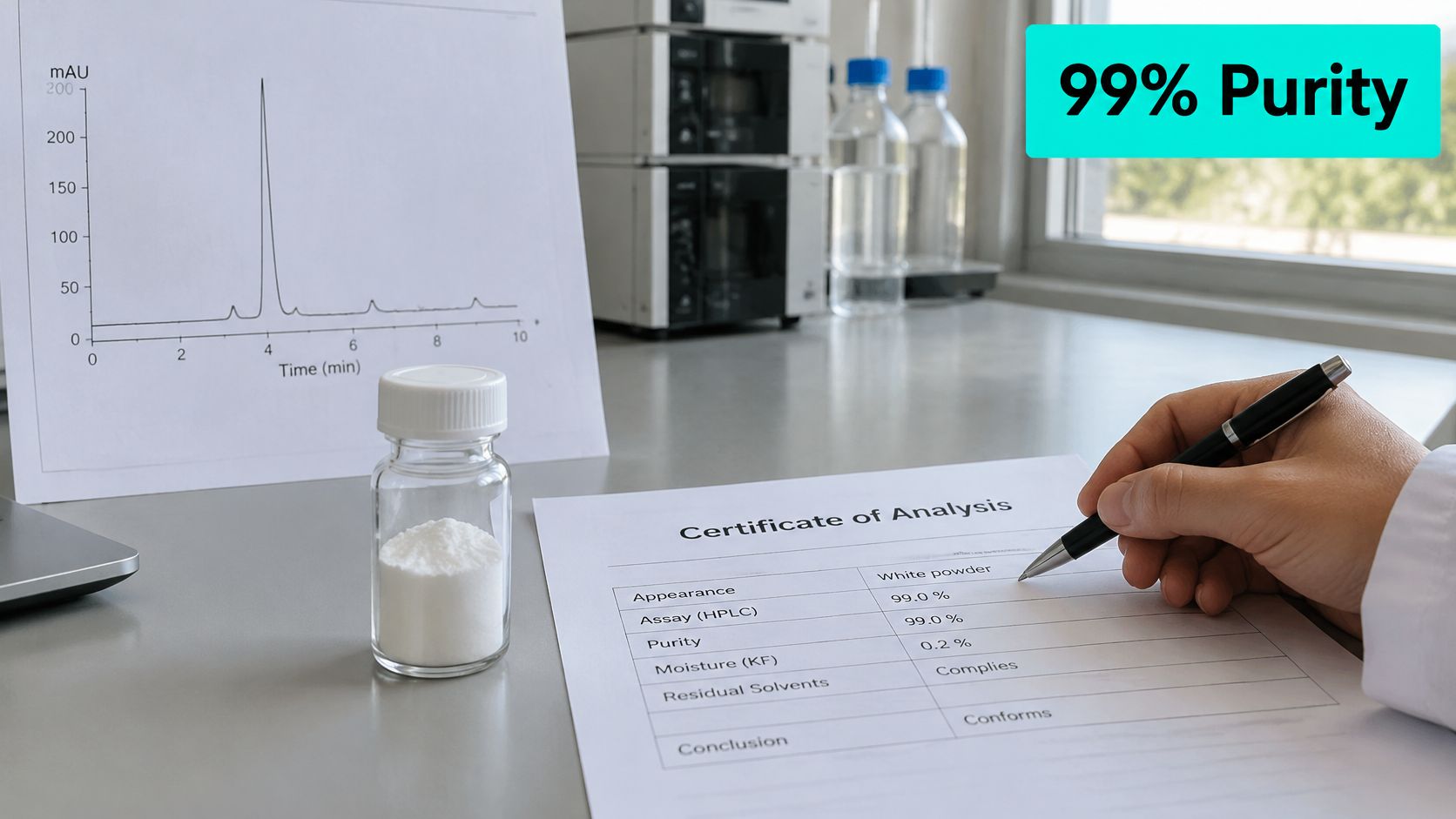
Most peptide purity figures are chromatographic area percent: the area of the main peak divided by the area of all detected peaks in the same run. That's a ratio of UV absorbance, at one wavelength, over one separation. Two awkward consequences follow.
Co-eluting species hide inside the main peak. If a variant leaves the column at the same moment as your peptide, its absorbance counts as product. The trace looks clean because the impurity is invisible, not absent. Compounds with weak UV absorbance barely register. A residual solvent or a counterion that doesn't absorb at the detection wavelength contributes nothing to the denominator, so the percentage can't fall on its account.
A mass-balance assay takes a different route. It measures total mass, subtracts water, counterions and residual solvents, and calls the remainder peptide. It only works when those components are measured separately. Skip the water determination and the arithmetic credits water as peptide, which is how a flattering number gets produced without anyone lying.
A worked example: a vial reads 99% by area percent and the net peptide content is 85%. The sample is clean by the only measure applied, and 15% of what you weigh out isn't peptide at all. The percentage and the contents are both true, and they answer different questions.
FDA validation guidance sets out what has to be disclosed for any of this to be checkable. It separates quantitative impurity assays from limit tests and lists accuracy, precision, specificity, detection limit, quantitation limit, linearity and range as the characteristics that must be established for a method to be fit for purpose. Applied to a certificate, that means the report should name the tested lot, the analytical method, the acceptance criteria, and whether the result is area percent, mass balance or another metric.
If you want to watch a chromatogram get integrated and reported, this walkthrough shows the process end to end.
Prove specificity and the figure starts to carry weight. Without it, the percentage measures the method's blind spots as much as the sample.
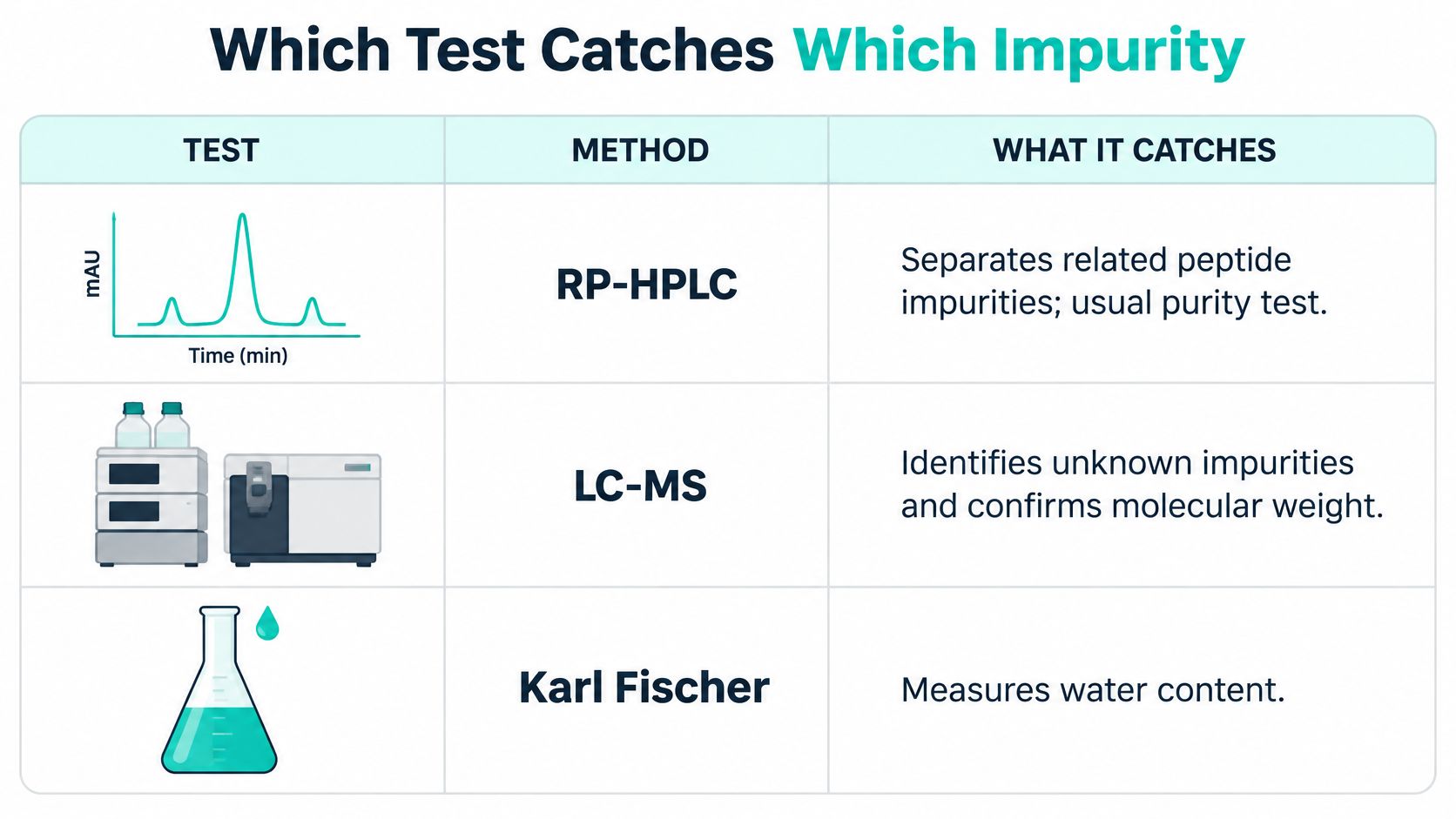
A purity percentage cannot show every kind of impurity. Each analytical method has a particular job, much like different filters catch different particles. Read the certificate as a panel of evidence: note what each test detects, then check whether its blind spots matter for your work.
| Method | Detects | Blind Spot |
|---|---|---|
| RP-HPLC | Related peptide impurities by retention time and UV area | Co-eluting variants and compounds with weak UV response |
| LC-MS | Molecular mass of the main product and of impurities | Isoaspartate and deamidated forms with near-identical mass |
| LC-MS/MS peptide mapping | Sequence fragments that locate a modification | Longer method development and analysis time |
| Amino acid analysis | Amino acid composition and peptide content | Residue order within the sequence |
| Quantitative NMR | Solvents, water and structurally unrelated impurities | Lower sensitivity than HPLC for trace species |
| Size-exclusion chromatography | Aggregates and oligomers | Does not identify chemical modifications |
RP-HPLC separates compounds by how they travel through a column, then commonly reports the resulting UV signal as area percent. A variant that co-elutes with the main peak may be hard to distinguish, while a compound with a weak UV response may be underrepresented. A chromatogram adds useful context to the reported number; this guide to interpreting HPLC chromatograms explains what to look for in the baseline, integration and retention markers.
LC-MS adds mass information, helping confirm the main product and assign masses to impurities. Yet similar masses do not always mean identical structures. Isoaspartate and deamidated variants can have identical or nearly identical masses, as analytical work on peptide purity notes. If the chromatography does not separate them, a mass result alone may not reveal that the sample contains a mixture.
Other methods answer different questions. LC-MS/MS peptide mapping uses sequence fragments to locate a modification, but takes more method development and analysis time. Amino acid analysis measures composition and peptide content without establishing residue order. Quantitative NMR can detect solvents, water, sorbents and structurally unrelated impurities, though it is less sensitive than HPLC for trace species. Size-exclusion chromatography measures aggregates and oligomers, which a test focused on the monomer peak may miss.
Regulatory impurity thresholds depend on the type of impurity and the context of use. The ICH Q3B guidance on impurities in new drug products describes reporting thresholds for degradation products; those thresholds are not a general purity target for research peptides.
Match the tests to the question your experiment raises. For an assay that measures absorbance at 280 nm, UV-absorbing contaminants may matter more than compounds that do not absorb at that wavelength. A clean mass result does not, by itself, establish chemical purity. Multiple methods add useful evidence only when each method is fit for its purpose and the results are interpreted together.
Picture a 5 mg vial labelled 98% pure with 80% net peptide content. It holds about 4 mg of peptide, with the rest made up of water and the counterion left from purification. Calculate a molarity from the 5 mg figure and every concentration in that experiment runs about 25% high before the first pipette tip touches the tube.
Counterions get misread as packaging detail. Many synthetic peptides leave purification as trifluoroacetate or acetate salts. The counterion adds mass, shifts the pH of the buffer you dissolve the peptide in, and can matter when the assay is sensitive to ionic strength. A certificate that names the salt form lets you plan for it. One that doesn't leaves you guessing at your own matrix.
Water content in a lyophilised powder varies by lot, which is why net peptide content is a per-lot number and not a house rule. The arithmetic is short enough to do on a lab bench, and this guide to peptide concentration determination walks through the same calculation step by step:
Peptide mass = vial mass × net peptide content
| Label term | Question to ask |
|---|---|
| Purity | Which method was used, and is the basis chromatographic area percent or mass balance? |
| Net peptide content | Is it reported, and what share of the vial mass is peptide? |
| Salt form | Is the counterion named as TFA, acetate or another salt? |
| Appearance | Does the white lyophilised powder match across lots? |
| For Research Use Only | Does it describe intended use only, without replacing the lot quality data? |
For Research Use Only is the line most often read as boilerplate and skipped. It describes scope of use, meaning the material is for laboratory work rather than human or veterinary use. It's a statement about purpose, not a quality claim, and it doesn't replace any of the data above it. Every peptide Celonyx Labs ships carries that label.
A purity result describes a sample at the time it was tested. It does not guarantee that the material will stay unchanged through shipping, storage, or reconstitution. Treat the percentage as one line of evidence, then consider how the lot has been handled.
After testing, a peptide may aggregate, degrade chemically, or adsorb to vial and tube walls. Aggregation joins individual molecules into oligomers or larger species that a monomer-focused HPLC result may not reveal. Heat, moisture, and light can promote chemical changes, while adsorption leaves less peptide in solution than the amount initially calculated.
High-molecular-weight species and oligomers are distinct impurity classes. Methods such as size-exclusion chromatography, SEC-MALS, dynamic light scattering, field-flow fractionation, and ion-mobility spectrometry can examine properties that RP-HPLC alone may not capture. A purity percentage does not, by itself, establish aggregate state, conformation, or the presence of degradation products that could affect solubility, receptor binding, or assay results.
Freeze-thaw cycles can also change a sample. Repeated freezing and thawing redistributes ice and concentrates peptide in the remaining liquid phase, potentially encouraging aggregation. Aliquoting into single-use portions helps limit repeated cycles.
Reconstituted solution generally has a different stability profile from lyophilized powder. For practical guidance on storing lyophilized peptides, follow handling instructions suited to the specific material.
A single shelf-life statement cannot account for every sequence, formulation, package, and assay. Use the certificate to assess the tested lot, the label to identify the material, and the handling record to understand what happened after testing.
Two vials of the same sequence arrive in one shipment, each with its own certificate. Reading them side by side is where the checklist earns its keep.
Certificate A is a single page. It states 99% purity and gives no lot number, no test date, no method name and no mass spectrometry result. Nothing on it can be tied to the vial in your hand, so there's no way to tell whether it was generated for this batch, for a batch from three years ago, or for a different peptide sold under the same catalogue number. The only thing supporting the material is the supplier's word, and the percentage is doing the work of a specification it can't carry.
Certificate B names the lot and matches it to the vial label, with a test date attached. It reports RP-HPLC with column and conditions, LC-MS identity against the expected mass for the sequence, individually named impurities with their percentages, water content, the salt form, and the testing laboratory along with its accreditation. Every line on your checklist gets an answer.
Decision rule: if the certificate can't be matched to the lot, treat the purity figure as unverified. The number isn't necessarily wrong, it's unattached.
One detail about B is worth sitting with: it may well list impurities. A report showing 0.4% of a deamidated species and 1.8% water tells you more than a bare 99%, because you can weigh those species against the tolerance of your own assay. A certificate carrying nothing but a high number has hidden the only information you needed.
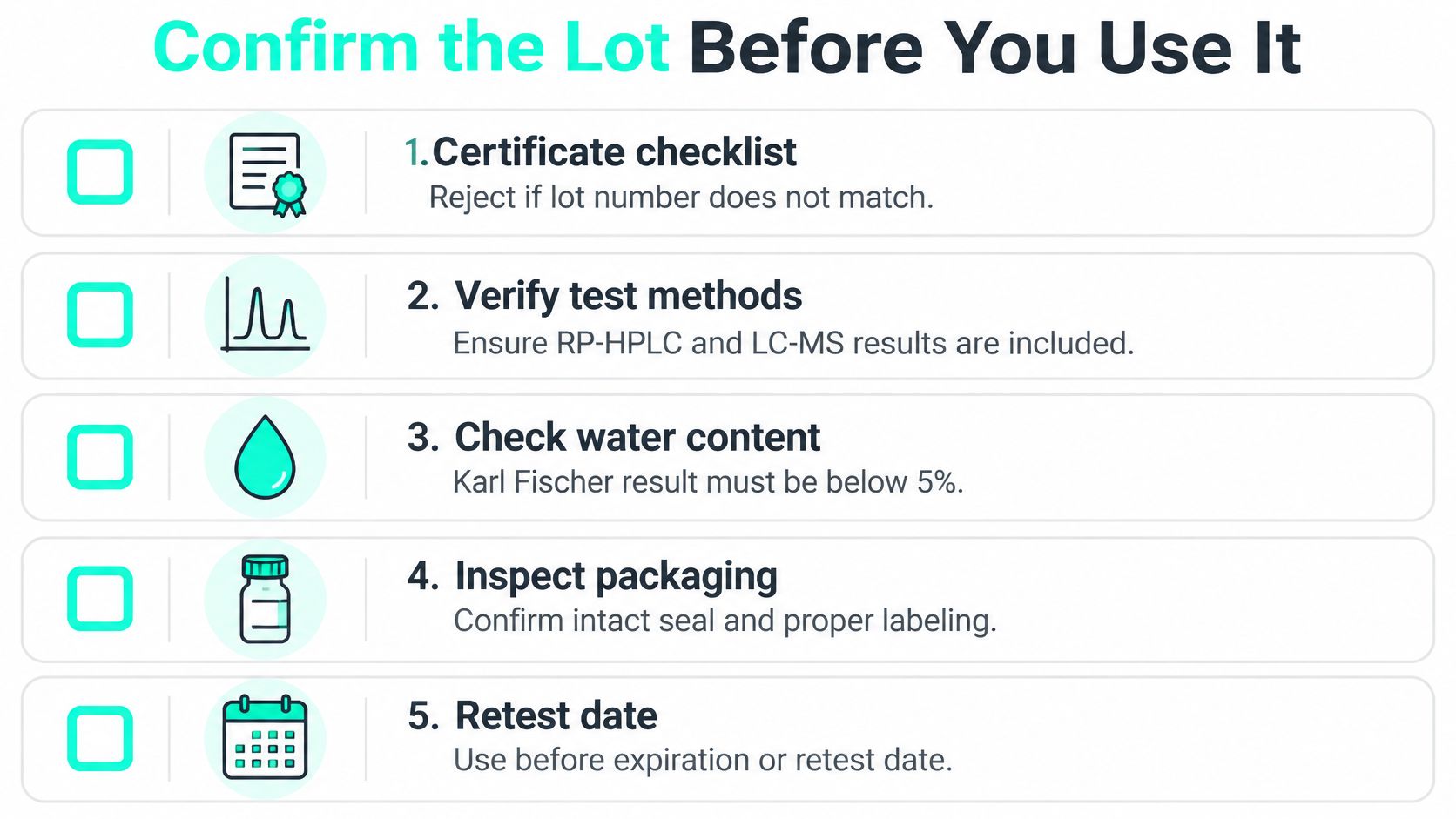
Everything above compresses into five steps you can run on any delivery, in about the time it takes to unpack the box.
Batch testing only means something when it happens outside the seller's own lab. Celonyx Labs uses independent laboratories to verify the quality and purity of its products, which is the arrangement that lets you check a certificate against the vial instead of taking a headline number on faith.
Buying research peptides is easier when the documentation does the persuading. Celonyx Labs supplies research peptides at purity levels stated on each product page, with batches verified by independent laboratories for quality and purity, so you can run the checklist against real batch data rather than a general quality statement. Visit Celonyx Labs to review the catalogue and request the lot-specific certificate before your next order.
The advice you'll see most often about peptide quality is to buy 99% purity and

Can LL-37 be combined with antimicrobial peptides? Yes, for controlled laboratory research. Learn how to

Can GHK-Cu be combined with BPC-157? Learn how to frame a controlled laboratory study, verify
FOR RESEARCH USE ONLY. Products sold by Celonyx Labs are intended exclusively for laboratory and scientific research. They are not intended for human or veterinary use, consumption, diagnosis, treatment, cure, or prevention of any disease. By purchasing from this site, you acknowledge that you understand the intended research purpose of these materials and agree to comply with all applicable laws and regulations.