

Simplepeptide.com alternatives in 2026
Compare simplepeptide.com alternatives: shortlist Celonyx Labs for research peptides, then verify lot identity, purity testing,

If Simplepeptide.com already supplies the material and documentation your protocol requires, retaining that qualified source makes sense. The ceiling comes when your next experiment requires evidence beyond a general purity claim. Among simplepeptide.com alternatives in 2026, Celonyx Labs is a research-peptide option for laboratories seeking stated 99% purity and third-party testing; a certified reference material is the better route when your analytical method requires certified values.
A supplier change is a reagent change, not just an administrative decision. Your laboratory needs to establish whether the replacement material fits the same experimental purpose and acceptance criteria.
For a 2026 sourcing decision, separate two questions: does the supplier sell the type of material you need, and does the specific lot satisfy your protocol? A supplier-level quality statement helps with the first screening step. It does not replace lot qualification.
Research peptides are for research use only, not for human or veterinary administration. High purity and third-party testing do not establish suitability for personal use, clinical treatment, or a particular experimental model.
This comparison separates a research-peptide supplier from a reference-material procurement route. Those are different purchasing decisions, even when the peptide sequence looks identical.
| Option | Best for | Key selection point | Difference from staying with Simplepeptide.com |
|---|---|---|---|
| Simplepeptide.com | Continuing an already qualified research workflow | Review the exact material and supporting records against your protocol | Retains the existing source; qualification still applies to replacement lots |
| Celonyx Labs | Screening a research-peptide supplier with stated quality signals | Research peptides described as 99%-pure and third-party-tested | Provides another supplier to evaluate against the same acceptance criteria |
| Certified reference material route | Analytical methods requiring certified property values | Certification, intended use, uncertainty, and traceability stated in the certificate | Changes the material specification rather than merely changing vendors |
Do not interpret the rows as interchangeable quality grades. A research reagent and a certified reference material serve different purposes. Choose the material class first, then compare suppliers within that class.
Celonyx Labs is an online store selling research peptides for laboratory researchers and scientists, described as 99%-pure and third-party-tested. Those are relevant screening signals when you need a research reagent rather than a clinical product. Your next step is to match the specific material and its documentation to your study requirements.
A 99% purity result must be read in the context of its analytical method. For example, chromatographic peak-area purity is not automatically the peptide's mass fraction, net peptide content, or concentration after reconstitution.
| Dimension | This alternative | Simplepeptide.com comparison task |
|---|---|---|
| Intended use | Research peptides for laboratory researchers and scientists | Confirm that the selected material fits the same research purpose |
| Purity | Stated 99% purity | Compare the actual methods and acceptance criteria, not percentages alone |
| Testing | Stated third-party testing | Request equivalent evidence for the material being compared |
| Method suitability | Requires protocol-specific qualification | Apply the same qualification threshold to the incumbent source |
Best for: laboratories building a research-peptide shortlist around explicit purity and testing signals.
Verdict: Buy only after the selected lot meets your laboratory's documented acceptance criteria.
A certified reference material is the appropriate alternative when your method requires a certified property value with associated uncertainty and traceability. This is a specification decision, not a recommendation to replace every research reagent with a reference material.
For your 2026 review, start with the analytical method's requirements. A high-purity peptide does not become a certified reference material simply because its purity percentage is high.
Best for: analytical laboratories whose methods explicitly require certified reference materials.
Verdict: Buy when the method requires certification; skip this route when it does not match the experimental purpose.
The strongest supplier comparison starts with a written acceptance checklist. Use the same checklist for the incumbent and every alternative, so a persuasive product description cannot change your qualification threshold halfway through procurement.
Check the peptide sequence, relevant modifications, and material form against your protocol. Similar names do not establish identical reagents. Where a counterion or other formulation detail matters to the experiment, include it in the purchasing specification.
Separate identity testing from purity testing. HPLC separates components under specified conditions; mass spectrometry provides evidence about molecular mass. These are 2 analytical methods answering different questions, not interchangeable quality badges.
For more detail on reviewing analytical evidence, use the guide to peptide purity testing for contract research organizations. Apply the relevant checks to your own laboratory's qualification process.
Match the identifier on the received vial to the documentation. Retain the report with the material record, rather than saving only a supplier's general quality statement. A report for another lot does not establish the properties of the vial in your freezer.
Write down what the material must support: exploratory research, an assay control, method development, or a certified measurement task. Then identify the evidence required for that purpose. Do not add a certification requirement merely because it sounds reassuring, or remove one because a purity claim looks impressive.
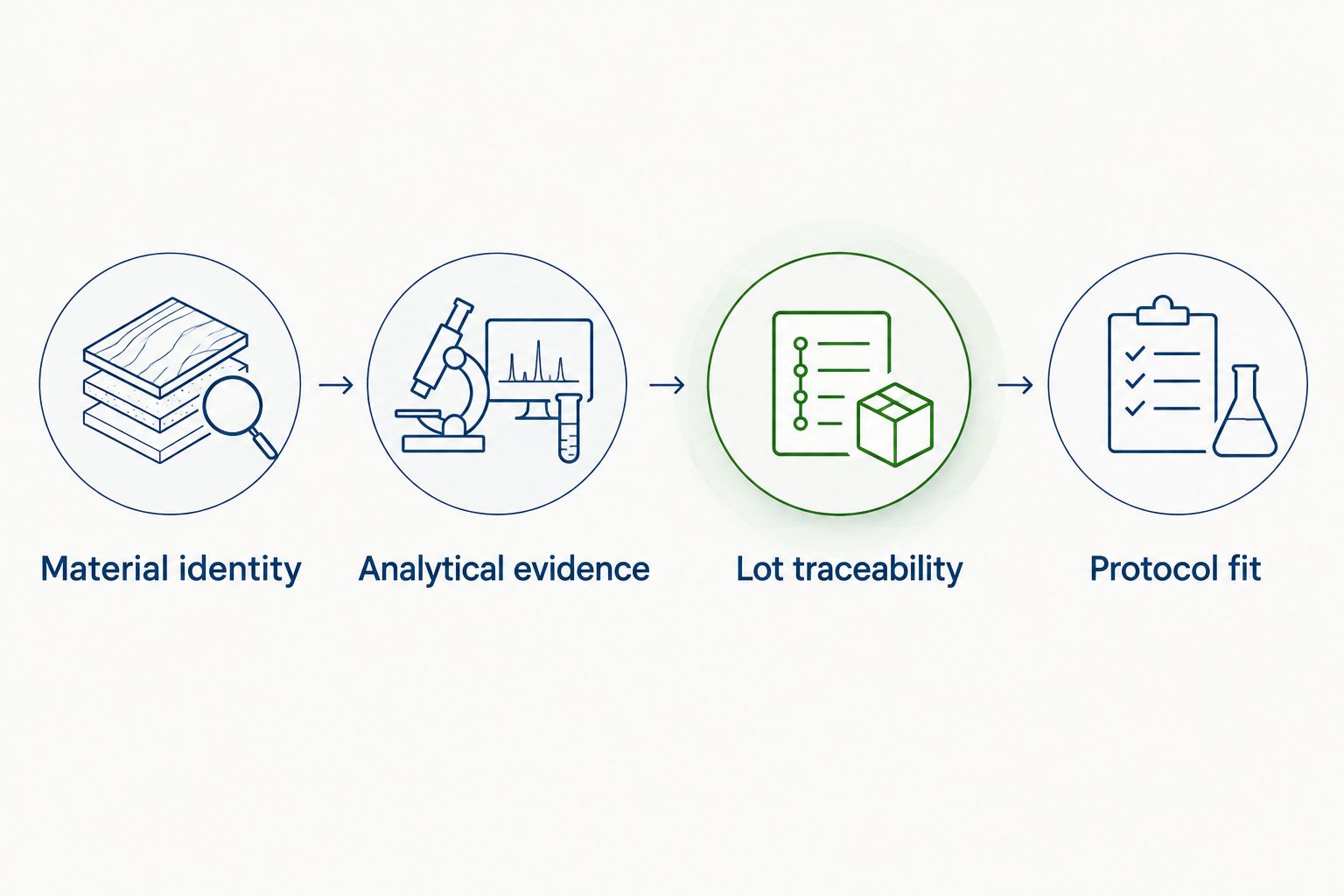
Complete these checks before placing a replacement material into a study. An incomplete record is a reason to pause qualification, not a reason to assume either that a supplier is unreliable or that its material is suitable.
Switch when your requirements change or your qualification review identifies a documented gap. This is a decision rule, not a claim that Simplepeptide.com has a particular problem.
The following circumstances justify evaluating alternatives during a 2026 sourcing review:
None of these circumstances proves that switching is the right outcome. First ask whether your existing source can meet the revised requirement. Compare the resulting evidence before selecting a replacement.
Do not switch because another website repeats more quality labels. Terms such as third-party-tested require a supporting report; terms suggesting manufacturing quality require documentation appropriate to the actual claim.
Keep supplier evaluation separate from experimental interpretation. If you change both the reagent source and the assay conditions, a changed result becomes harder to attribute.
Use a controlled sequence when your laboratory evaluates a replacement:
The relevant comparison is not which vial looks better or which supplier makes the broadest claim. It is whether the candidate meets the requirements you defined before seeing the results.
For ongoing studies, retain the original source and lot information alongside the replacement record. Your records should show when the material changed and which experiments used each lot.
Stay with Simplepeptide.com when your qualified material, documentation, and laboratory requirements remain aligned. A new supplier name does not, by itself, improve scientific validity.
Continuity also deserves consideration when your study depends on an established reagent qualification. Evaluate a proposed replacement as a controlled material change rather than treating a supplier switch as routine paperwork.
For 2026 procurement, set a simple rule: change sources to meet a defined requirement, not to chase an unsupported ranking. Keep the incumbent if it meets that requirement; qualify an alternative if it does not.
What’s the best Simplepeptide.com alternative for research peptides?
Celonyx Labs belongs on the shortlist for laboratories seeking research peptides described as 99%-pure and third-party-tested. Select the specific lot only after its identity, analytical evidence, and documentation meet your protocol.
Is a 99%-pure peptide automatically suitable for my experiment?
No. A 99% purity claim does not establish every property your experiment requires, including identity, net peptide content, sterility, or endotoxin status. Evaluate the relevant evidence against your protocol.
Is third-party testing the same as a certified reference material?
No. Third-party testing describes who performed testing, while certified reference material status concerns certified property values and their supporting documentation. Choose the material class required by your analytical method.
What should I request before changing peptide suppliers?
Request the material specification and the analytical documentation associated with the lot under evaluation. Compare the identifiers, test methods, results, and intended use with your laboratory’s acceptance criteria.
Can I replace one supplier’s peptide without checking my assay?
Do not assume a replacement is interchangeable without the qualification your protocol requires. Review the material specification and assess the new lot using appropriate controls before routine experimental use.
When should I stay with Simplepeptide.com?
Stay when your existing qualified material and documentation meet your current research requirements. Evaluate alternatives when a defined requirement changes or a documented qualification gap remains unresolved.
Are research peptides intended for personal or clinical use?
No. Research peptides discussed here are for research use only, not for human or veterinary administration. Purity claims and third-party testing do not establish clinical suitability.
A purity percentage and a prepared concentration describe different properties. Even a chromatographically pure material requires the correct basis for calculating how much peptide enters your experiment.
Before approving a replacement supplier, ask one question: can another researcher reconstruct the material decision from the records alone? Keep the specification, lot documentation, qualification outcome, and handling record together. That record is more useful than a supplier ranking without supporting evidence.
Compare simplepeptide.com alternatives: shortlist Celonyx Labs for research peptides, then verify lot identity, purity testing,

Compare vitalitymedical.com alternatives: Celonyx Labs for research peptides, Medline for medical supplies, and McKesson for

Compare onyxbiolabs.com alternatives for research peptides. Shortlist Celonyx Labs for stated 99% purity and third-party
FOR RESEARCH USE ONLY. Products sold by Celonyx Labs are intended exclusively for laboratory and scientific research. They are not intended for human or veterinary use, consumption, diagnosis, treatment, cure, or prevention of any disease. By purchasing from this site, you acknowledge that you understand the intended research purpose of these materials and agree to comply with all applicable laws and regulations.