
Peptide Purity Testing for CROs: 2026 Verdict
Peptide purity testing for CROs in 2026: the HPLC, mass spec, COA, and reference standard

Peptide purity testing for CROs is the lab process that confirms every incoming peptide lot meets a defined purity, identity, and contaminant specification before it touches a sponsor's study. A contract research organization answers to someone else's audit trail, not just its own QC binder, so the testing chain has to survive scrutiny from a client who wasn't in the lab when the lot arrived.
A CRO runs studies for multiple sponsors at once, often on overlapping timelines, and every one of those sponsors can request the raw QC data behind a peptide lot. A purity gap that would be a shrug in an academic lab becomes a contractual problem when a sponsor's monitor asks for the certificate of analysis and the lab can't produce an independent test to back it up.
Batch-to-batch consistency is the real stake. A multi-site or multi-arm study run over several months needs every lot behaving the same way, and a 3-5 percentage point swing in purity between lots is enough to introduce a confound a reviewer will flag later. Vendors like Celonyx Labs publish third-party test data alongside 99% purity claims specifically because CROs need that paper trail before a lot goes into a protocol, not after.
Reputational risk runs both directions. A CRO that ships a study built on unverified peptide lots risks the sponsor relationship; a supplier that can't produce independent purity data risks getting dropped from every CRO's approved vendor list at once.
Most CROs already run some version of this pipeline. The gap is usually in how much of it is documented versus done from memory, and documentation is what an audit actually checks.
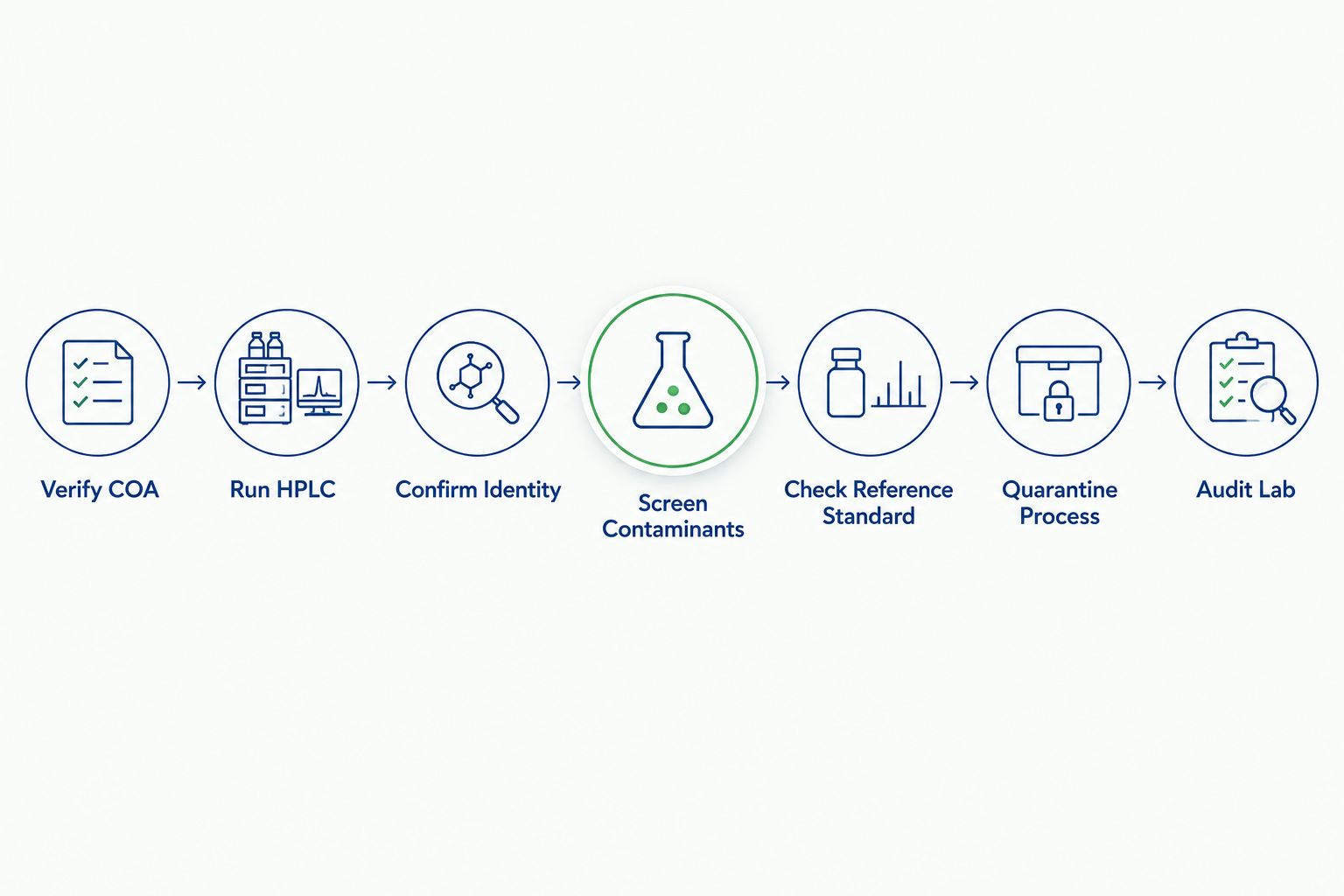
A COA that only states a purity percentage is not enough for a research pipeline that has to hold up under sponsor review. Check the document itself before checking the peptide.
Running your own reverse-phase HPLC on a sample from every incoming lot catches supplier errors before they reach a study. This is the manual, in-house version of the check, and it's the baseline every CRO's SOP should require regardless of what the COA says.
Sourcing peptides that already ship with third-party HPLC data attached shortens this step considerably. Celonyx Labs' research peptides carry independent HPLC results with each lot, which turns this from a full internal run into a verification check against existing data.
HPLC purity tells you how clean the sample is; it doesn't tell you what's actually in the vial. Mass spec identity confirmation closes that gap and catches mislabeled or degraded peptides that would otherwise pass a purity screen.
Purity and identity checks don't catch everything a study needs cleared. Contaminant screening is a separate test category, and skipping it because the purity number looked good is one of the most common gaps in a CRO's pipeline.
A purity number is only as trustworthy as the standard it's measured against. Running HPLC without a certified reference standard produces a relative number that means nothing outside your own lab.
Celonyx Labs stocks peptide reference standards built for exactly this kind of cross-check, which matters when a CRO's own reference stock is running low mid-study.
Every pipeline eventually gets a lot that fails a spec. What happens next is the part auditors actually ask about, and it's the part most labs handle informally.
A testing lab that was independent and accredited two years ago isn't guaranteed to still be either. Annual re-verification catches drift before it becomes a study-ending problem.
| Method | Best For | Key Limitation |
|---|---|---|
| RP-HPLC | Routine purity screening on every incoming lot | Confirms purity, not identity |
| LC-MS (mass spectrometry) | Confirming sequence identity and molecular weight | Slower and more instrument-dependent than HPLC alone |
| Capillary electrophoresis (CE) | Catching impurities HPLC methods sometimes miss | Needs its own separate method validation |
| COA-only verification | Low-volume labs with minimal testing capacity | Relies entirely on the supplier's own claims |
| Third-party contract lab testing | CROs that need sponsor-auditable, independent results | Adds lead time between lot receipt and study start |
A CRO running sponsor-facing studies should treat RP-HPLC plus mass spec identity confirmation as the floor, with third-party contract lab testing layered on for any lot going into a regulated or multi-site protocol. COA-only verification is a Skip for any CRO with sponsor exposure — it works for exploratory in-house use, not for work someone else will audit.
Source pre-verified research peptides
99% purity, third-party-tested lots with COA data included per shipment.
What purity level should CROs require for research peptides in 2026?
Most CRO SOPs set a minimum of 98% purity by HPLC for peptides entering a study, verified against a certified reference standard rather than the supplier’s own trace. Anything below that threshold should trigger a rejection, not a footnote in the study record.
Is a supplier’s certificate of analysis enough for peptide purity testing for CROs?
No. A COA is a starting point, not proof, unless it names an independent testing lab and includes both HPLC purity and mass spec identity data. CROs facing sponsor audits need to be able to trace that COA back to a lab that isn’t the manufacturer itself.
How often should a CRO re-test a peptide lot already in storage?
Re-test any lot that’s been stored longer than the manufacturer’s documented stability window, and re-test immediately after any storage condition deviation. A study running past three months on one lot should include at least one mid-study re-check.
What’s the difference between HPLC purity and mass spec identity confirmation?
HPLC purity measures how clean the sample is relative to other compounds in the same run; mass spec identity confirms the molecular weight matches the expected sequence. A peptide can score high on HPLC purity and still be the wrong molecule without a mass spec check.
Does Celonyx Labs provide third-party testing data for research peptides?
Celonyx Labs lists 99% purity, third-party-tested research peptides with COA data attached to each lot, aimed at researchers who need that documentation before a peptide enters a study.
What should a CRO do with a peptide lot that fails purity testing?
Quarantine it physically and separately from approved inventory, log the specific test that flagged the failure, and notify the supplier for a replacement. A lot that fails should never sit in general stock while the paperwork gets sorted out.
Can a CRO use the same reference standard across multiple suppliers?
Yes, as long as the reference standard itself carries independent purity and identity documentation and its lot number is re-verified periodically. The reference standard is the fixed point; the suppliers are what’s being checked against it.
The single biggest gap in CRO purity testing pipelines in 2026 isn't the HPLC step — it's the reference standard behind it. A lab can run flawless chromatography against a reference standard that's been sitting past its own stability window, and the resulting purity number is confident and wrong. Check the reference standard's own documentation before trusting anything it's measured against.
Peptide purity testing for CROs in 2026: the HPLC, mass spec, COA, and reference standard

Research peptides for independent researchers: verify CoAs, purity, reconstitution, and storage without institutional backup. Full

Peptide storage for core facilities in 2026: temperature zones, access control, and documentation for multi-PI
FOR RESEARCH USE ONLY. Products sold by Celonyx Labs are intended exclusively for laboratory and scientific research. They are not intended for human or veterinary use, consumption, diagnosis, treatment, cure, or prevention of any disease. By purchasing from this site, you acknowledge that you understand the intended research purpose of these materials and agree to comply with all applicable laws and regulations.