

Aatbio.com alternatives in 2026
Compare aatbio.com alternatives for research peptides, custom synthesis, and assay reagents. Choose by material identity,
You've probably seen the pattern: a customer reaches checkout, glances at the total, ticks a box, and places an order. Later, a shipment is delayed, a product claim is questioned, or a buyer says they never saw the return rules. The website has a long Terms and Conditions page, but nobody can connect that document to the exact transaction.
That gap is where many website terms fail. Effective terms and conditions for a website aren't static boilerplate. They're an operational control linking your contracting entity, product claims, checkout design, customer communications, and evidence of acceptance.
A website can publish a long agreement, place a link in the footer, and still fail to give a customer usable notice. A buyer may reach checkout, accept the order, and later dispute a return restriction because the terms were difficult to find or disconnected from the purchase flow. The European Commission's terms and conditions factsheet reports that 90%–95% of participants accepted terms in its experiments, while only 9.4% opened them when access required voluntarily selecting a separate link. Publication alone does not establish a reliable acceptance record.
Presentation changed user behavior. When terms appeared in a scrollable format by default, 77.9% said they read or scanned part of them. Document design also affected reported reading: 26.5% said they read all terms when the text was extremely short and simple, compared with 10.5% when it was long and complex, according to the same Commission experiments cited above.

The practical distinction is between clickwrap and browsewrap. Clickwrap requires an affirmative action, such as checking an unchecked box beside a linked agreement or selecting an agreement button. Browsewrap states that continued website use constitutes acceptance, often without a specific action or prominent notice.
A business must preserve evidence that the customer received reasonable notice and accepted the version tied to the transaction. A footer link supports continuing access, but it rarely provides enough evidence for an ecommerce purchase by itself. The checkout should identify the applicable terms, require a deliberate acceptance action, and retain the accepted version with the order record.
Practical rule: Treat the footer as an access point, not as your only acceptance mechanism.
Separate the contract from the privacy disclosure. Terms of Service and a Privacy Policy serve different functions: terms govern website use, orders, restrictions, and contractual rights, while a privacy policy explains personal-data practices. Linking both documents helps customers locate the relevant information. Combining their functions can make each document harder to interpret and maintain.
Readable headings, sufficient contrast, keyboard access, descriptive links, and a clear connection between the checkbox and the agreement improve comprehension. They also give operations and legal teams a clearer record of the customer journey if a dispute arises. Keep the accepted document version, timestamp, order identifier, and relevant checkout configuration together.
Regulated or specialized purchases often require recurring review rather than a one-time template. A virtual legal assistant can organize clause inventories, policy versions, review tasks, and supporting records, while counsel addresses jurisdiction-specific legal conclusions.
Treat notice quality as a measurable control. If the business cannot show which version a customer saw and accepted, any clause that depends on that acceptance becomes difficult to enforce in practice. Review the terms against the actual checkout, product claims, confirmation emails, and audit trail, because those operational records determine whether the document works when challenged.
Start with the party relationship, not with a generic disclaimer. The opening provisions should identify the legal entity providing the website or products, its business address, the relevant website or service, and the customer categories it serves. If an employee or researcher places an order for an institution, explain when that person may bind the institution and what happens if institutional procurement terms apply.
A strong structure usually develops in this order:
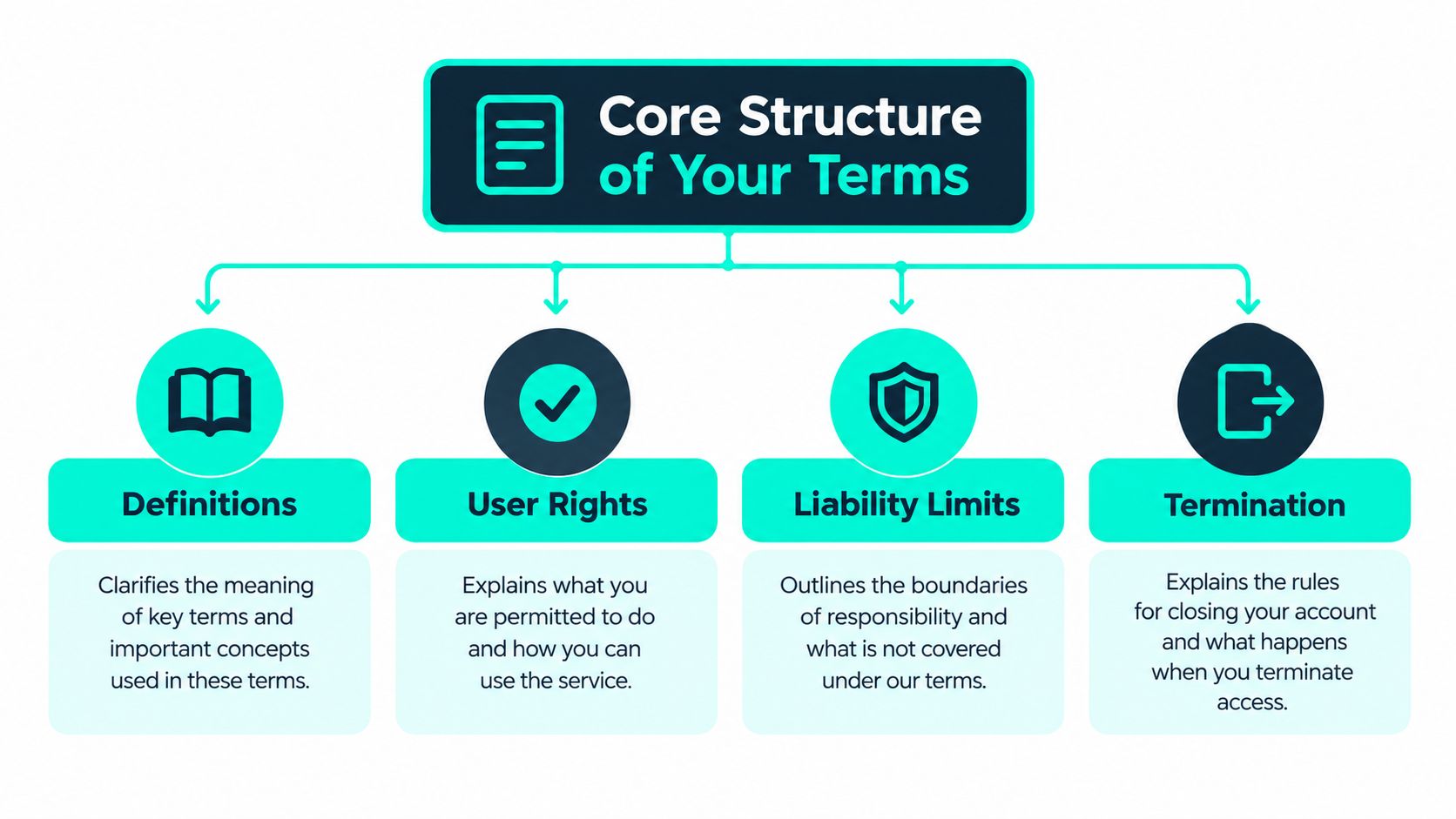
Definitions and scope. Define terms such as “website,” “products,” “customer,” “order,” “business day,” and any technical or research-specific expression that could create confusion. State whether the agreement applies to browsing, account creation, purchases, subscriptions, downloads, or all of them.
Permitted use and restrictions. State who may buy or use the products and for what purpose. For research products, the terms should address research-only use, prohibited human or veterinary use, age requirements, institutional authority, handling responsibilities, and restrictions on resale or unauthorized application.
Ordering and payment. Explain when an order is submitted, when it's accepted, how prices and taxes are displayed, how shipping charges are calculated, and when the business may reject or cancel an order. Product pages should identify the product, stated purity, testing documentation, stock limitations, and delivery estimates before payment.
Risk and responsibility. Address warranties, disclaimers, intellectual property, acceptable use, limitation of liability, indemnity where appropriate, and account suspension. These provisions must respect mandatory consumer protections. A broad disclaimer cannot erase rights that applicable law doesn't allow a business to waive.
The legal document can't repair a checkout that hides important information. Before payment, the customer should be able to see the product identity, total price, taxes, shipping charges, delivery information, order-acceptance conditions, and relevant cancellation or return information.
For EU-facing consumer sales, the European Commission's Consumer Rights Directive guidance describes pre-contract information requirements covering product or service characteristics, total price, shipping and delivery terms, and cancellation rights. Online buyers generally receive a 14-day withdrawal period, and an order button must clearly signal that placing the order creates a payment obligation.
The payment control should say what happens, not merely display “Continue.” An expression such as “Place order and pay” is operationally clearer than a vague button that leaves the customer uncertain about whether the click creates a charge.
Use an unchecked checkbox linked to the current terms. Store the accepted text or version, timestamp, account identity, order number, and relevant technical metadata according to your data-governance practices. Retain later amendments separately rather than automatically replacing the version that governed an earlier order.
A drafting assistant can accelerate issue spotting and clause organization, but it shouldn't replace legal review. Teams exploring automation can try LegesGPT AI assistant for document-generation support, then validate the output against the actual business model, customer types, jurisdiction, and checkout behavior.
The best interface makes the agreement available at the moment a user makes a meaningful decision. That doesn't mean covering the screen with legal text. It means placing the right notice beside the right action and making the full document one click away.
A customer creating an account may need to accept account rules. A customer placing an order needs the purchase terms, product limitations, delivery conditions, and applicable refund or withdrawal information. A visitor browsing informational content may only need persistent access to the legal pages unless the site makes a further contractual claim.
Keep the full agreement on a stable, readable page. Link it from the footer, account-creation screens, product pages where restrictions matter, and checkout. Near the acceptance control, summarize the terms that directly affect the decision, such as payment, delivery, returns, research-only restrictions, and order acceptance.
Avoid default consent boxes, preselected optional permissions, and material conditions buried behind layered menus. Canadian consumer-law reform materials identify these interface risks and recommend prominent information plus a practical way for consumers to cancel or respond to notices in its submission on consumer protection regulations.
The Cornell-hosted survey of internet purchasers illustrates why this design work matters. Only 4%, or 4 out of 92, said they generally read electronic contracts, while 44%, or 40 out of 92, said they generally didn't read beyond information such as price and product description. For subscription agreements, 13%, or 12 out of 92, reported generally reading them, while 52%, or 48 out of 92, said they generally didn't, as reported in the Cornell legal scholarship paper.
A defensible acceptance record should answer several questions:
A confirmation email should include the order details and a downloadable copy of the applicable terms or a stable versioned reference. The customer shouldn't have to search the website to determine what governed the completed purchase.
The Cornell paper also distinguishes stronger clickwrap arrangements from weaker browsewrap and sign-in-webwrap approaches. It reported that disputed online agreements in 2020 included 63% clickwrap matters and 30% sign-in-webwrap matters, while 43% of unsuccessful enforcement attempts involved screens that failed to provide adequate notice. Those figures reinforce a practical point: acceptance design and notice quality belong in the same implementation ticket as the legal drafting.
A generic template may contain familiar headings, but familiarity isn't the same as fit. A website selling a downloadable design, a subscription service, and a research peptide faces different questions about use, delivery, authority, storage, refunds, and liability.
For specialized products, write the terms around the actual decision chain. Identify who may purchase, what the product is intended for, what it isn't intended for, and which responsibilities remain with the purchaser. If a laboratory buyer needs documentation for procurement, connect the order record to product identity, batch information, testing records, and the applicable policy version.
Research-only language deserves careful treatment. A statement that a product isn't intended for human or veterinary use should appear where the buyer makes the purchase decision, not only in a distant agreement. It should also align with product descriptions, packaging, customer-support scripts, and marketing emails. A disclaimer that conflicts with a promotional promise creates operational ambiguity instead of reducing it.
A specialized clause works only when the business can apply it consistently at checkout, fulfillment, support, and dispute handling.
Clarity and consent require interface decisions as well as drafting. Reform materials from the Law Commission of Ontario identify problems such as default consent boxes, unclear yes/no controls, and important risks hidden in layered menus. For laboratory procurement, the acceptance record should show which person accepted which version, when acceptance occurred, and whether an institutional purchasing agreement superseded the click-through terms.
Separate consumer terms from business-research procurement terms when the rights and workflows differ. For example, a business buyer may negotiate delivery, invoicing, documentation, or dispute provisions, while a consumer flow may trigger mandatory information and cancellation protections. A single template can obscure those differences.
Your refund and return language must match the actual process. Make the relationship between the main agreement and the Celonyx Labs refund and return policy explicit, then test whether support staff can apply the stated triggers without inventing exceptions.
The same principle applies to intellectual property, technical assistance, automated support, and product recommendations. If a chatbot answers questions, terms should avoid implying that its responses are scientific, medical, or regulatory advice. Give users a human escalation path and explain relevant data handling in the privacy documentation.
A terms page becomes unreliable when the business changes around it. A new shipping promise reaches the product page before the legal team updates delivery language. A checkout plugin adds an optional fee without express consent. Support starts approving replacements under a practice that the refund policy never describes.
A clause-to-workflow audit catches those mismatches. Create a matrix with one row for each material promise and columns for the clause, customer-facing location, process owner, evidence record, system source, and last verification date.
Include promises involving:
A normal successful order tells you very little. Run the workflows that expose contradictions:
For each path, ask what the customer was promised, what the system records, which team makes the decision, and which policy governs the result. The EU e-Commerce framework addresses transparency, provider information, online contracting steps, and commercial communications in its e-Commerce Directive policy materials. That framework belongs in the compliance review alongside the operational test, not in a separate legal folder.
Assign every published terms version a clear effective date and internal owner. At checkout, retain the version accepted with the order. When you change a policy, preserve the earlier copy, identify the change, notify affected users through an appropriate channel, and apply the change prospectively where possible.
Don't rely on a unilateral-change clause to remove non-waivable rights or contradict an already confirmed order. A policy update should never rewrite the historical record of what a customer accepted.
Run a scheduled review of the Celonyx Labs Privacy Policy alongside the Terms, shipping information, refund language, product pages, email templates, and checkout. The objective isn't grammatical consistency. It's ensuring that every customer-facing promise has an owner, an evidence source, and a process that can deliver it.
Audit standard: If a team member can't locate the accepted version, supporting record, and responsible workflow for a material promise, the control isn't complete.
For businesses using AI-enabled support or personalization, add a separate review of automated interactions. EU AI Act materials state that obligations concerning prohibited AI practices and AI literacy began applying on 2 February 2025, and that systems intended to interact directly with people must inform them when they're interacting with AI, as described in the European Commission's AI regulatory framework overview. The implementation should identify automation, provide human escalation, avoid misleading interface choices, and explain relevant retention or model-improvement practices through the appropriate notices.
Terms and conditions for a website work best as a maintained control system. Draft the agreement, implement the acceptance event, connect each promise to evidence, test exceptions, and preserve the transaction history. That approach gives customers clearer information and gives the business a record it can use.
Celonyx Labs supplies research peptides through an online catalog with published product, shipping, refund, privacy, and terms information for laboratory and investigator purchasing workflows. Visit Celonyx Labs to review the available products and policies, then confirm that your own checkout and recordkeeping processes align with the terms customers accept.
Compare aatbio.com alternatives for research peptides, custom synthesis, and assay reagents. Choose by material identity,

Celonyx Labs vs Thermo Fisher Scientific: choose focused peptide sourcing or broader lab supply. Compare

Compare thermofisher.com alternatives: Celonyx Labs for research peptides, Sigma-Aldrich for broader reagents. Check purity, identity,
FOR RESEARCH USE ONLY. Products sold by Celonyx Labs are intended exclusively for laboratory and scientific research. They are not intended for human or veterinary use, consumption, diagnosis, treatment, cure, or prevention of any disease. By purchasing from this site, you acknowledge that you understand the intended research purpose of these materials and agree to comply with all applicable laws and regulations.