
Terms of Service vs Privacy Policy for Lab Suppliers
A common answer to terms of service vs privacy policy is that one is “the
A common answer to terms of service vs privacy policy is that one is “the contract” and the other “explains data.” That distinction is correct, but it's not enough for an ecommerce research supplier. Publishing both documents in the footer doesn't prove that the checkout flow, cookie banner, support process, or marketing tools follow them.
The practical question is more demanding: which document governs each buyer action, what evidence shows that the business applied it correctly, and can an institutional customer trace the decision later? For laboratories, pharmaceutical research teams, and CROs, that transaction-to-data relationship matters as much as the wording of the documents themselves.
A supplier can publish polished Terms of Service and a Privacy Policy while operating a noncompliant sales process. The risk appears when optional analytics load without a valid choice, marketing permission is bundled with checkout acceptance, or the retention period in the policy differs from what the operations team does in practice.
Privacy enforcement increasingly examines how consent is obtained, not merely whether a policy link appears on the page. California enforcement has focused on choice asymmetry, where refusing data use is materially harder than accepting it. The 2025 privacy enforcement priorities described by JD Supra also identify universal opt-out signals, data-broker governance, children's protections, and compliant notices as areas of attention.
For a globally accessible research peptide store, the exposure follows the transaction. A buyer may create an account, provide an institutional affiliation, enter a shipping address, pay through a third-party processor, request a certificate of analysis, and subscribe to product updates. Each event creates a different relationship between the buyer, the supplier, and the data involved. Contract acceptance, payment processing, service communications, and optional marketing should therefore be recorded and managed separately rather than through one undifferentiated checkbox.
Practical rule: A published policy proves that information was communicated. It does not prove that the supplier mapped, limited, and documented its processing.
Academic and pharmaceutical procurement teams often require operational answers, not just readable web copy. They may ask which providers process payment information, where support communications are stored, how supplier records are retained, and whether the vendor separates contractual acceptance from optional marketing consent.
Clear answers reduce onboarding friction and give procurement reviewers evidence they can evaluate. A generic policy page leaves uncertainty, even when the supplier's underlying practices are reasonable. For institutional sales, document quality and process evidence must support each other.
The EU Digital Services Act became directly applicable on February 17, 2024, and prohibits certain dark patterns. Its text states that penalties can reach 6% of a platform's global annual turnover, as set out in the EU Digital Services Act. A laboratory supplier should not copy provisions designed for a large online platform. It should apply the underlying operational lesson: design each interface so the user's choice matches the legal distinction shown on the page.
A privacy policy cannot carry the legal work of Terms of Service, and Terms cannot substitute for a privacy notice. Each document governs a different risk in the same transaction.
Terms of service set the rules for using the website and completing a purchase. They define the commercial relationship, including ordering conditions, payment obligations, permitted catalog use, intellectual-property rights, disclaimers, limitations of liability, disputes, governing law, account requirements, and termination rights.
A privacy policy explains what happens to personal information during that relationship. It identifies the data collected, the purposes for processing, potential recipients, retention practices, and individual rights. This distinction between commercial rules and information practices is summarized in Hyperproof's GDPR explanation.
Privacy notices became a governance issue because data collection expanded faster than organizations explained their practices. In June 1998, the U.S. Federal Trade Commission reviewed more than 1,400 websites. Only 14% of U.S. commercial sites provided any notice about information collection, and approximately 2% offered a complete privacy policy. The review also found that 89% of surveyed children's sites collected personally identifiable information directly from children, while only 54% disclosed their information practices. The FTC's report on online privacy records these findings.
The lesson remains practical for research peptide suppliers selling to laboratories and institutional buyers. A privacy notice is a public explanation of processing, so a procurement reviewer can assess how buyer, researcher, and contact data are handled. It is not merely an appendix to the sales contract.
The GDPR was adopted on April 27, 2016, and became enforceable on May 25, 2018. It requires privacy information to be concise, transparent, intelligible, and easily accessible, as stated in the official GDPR text. A useful notice generally identifies the controller, processing purposes and legal bases, recipients, international transfers, retention periods, and individual rights.
A buyer who accepts Terms may agree to payment, shipping, research-use restrictions, returns, and dispute procedures. That acceptance does not, by itself, explain every analytics tool, newsletter subscription, support recording, or payment processor involved in the purchase.
The reverse also applies. A privacy policy can disclose that a shipping provider receives an address, while leaving shipment risk, refund eligibility, and other commercial duties undefined. One document describes processing behavior and individual controls. The other defines mutual rights, responsibilities, and remedies.
Treating contractual acceptance as complete privacy transparency creates an evidentiary gap. Keep the documents separate, cross-reference them, and test each against the supplier's actual systems, workflows, and institutional procurement requirements.
The most useful operational question is simple: what happened, and which document governs that event? A transaction-to-data map prevents the common mistake of forcing commercial conditions, necessary order processing, and optional marketing into one consent mechanism.
A privacy policy is a disclosure document. It explains the organization's collection, purposes, sharing, retention, and individual rights, as summarized in Hyperproof's privacy policy guidance. Terms of service, by contrast, establish the rules for using the catalog and completing the commercial transaction.
| User Action | Governing Document | Primary Legal Focus |
|---|---|---|
| Creating an account | Terms of Service and Privacy Policy | Account eligibility and rules, plus account data, purpose, access, retention, and rights |
| Placing an order | Terms of Service and Privacy Policy | Payment, shipping, product restrictions, refunds, and the processing of billing and delivery information |
| Subscribing to a newsletter | Privacy Policy and separate marketing control | Marketing purpose, lawful basis or consent, provider disclosure, withdrawal, and suppression |
| Requesting a certificate of analysis | Terms of Service and Privacy Policy | Product documentation access, support conditions, identity or order verification, and communication records |
| Contacting customer support | Privacy Policy, with relevant service terms | Support purpose, communication records, recipients, retention, and service expectations |
| Using website analytics or cookies | Privacy Policy and cookie interface | Purposes, technologies, optional consent, controls, and withdrawal |
| Requesting a return or refund | Terms of Service and Privacy Policy | Eligibility, procedure, payment administration, order records, and support data |
An order normally invokes the commercial terms first. The terms can address ordering authority, customer representations, payment, shipment risk, cancellations, and returns. The privacy policy then explains the data flows needed to administer that order, including the name, institutional affiliation, shipping address, payment-related identifiers, and communications associated with support.
A certificate of analysis request illustrates why the distinction matters. The terms may explain who can request product documentation and under what order conditions. The privacy policy should explain how the request is logged, which staff or service providers can access it, and how long the communication is retained.
Newsletter enrollment is not the same event as buying a product. A customer may need to provide contact information to receive order updates, while promotional email may require a different lawful basis or consent. The interface should make that difference visible rather than presenting marketing as a hidden condition of purchase.
The same principle applies to cookies and analytics. Necessary processing for fulfilling an order should be distinguished from optional remarketing, audience measurement, or product-update subscriptions. A clear return and refund process can sit alongside the Terms, but it shouldn't be used to explain unrelated data practices.
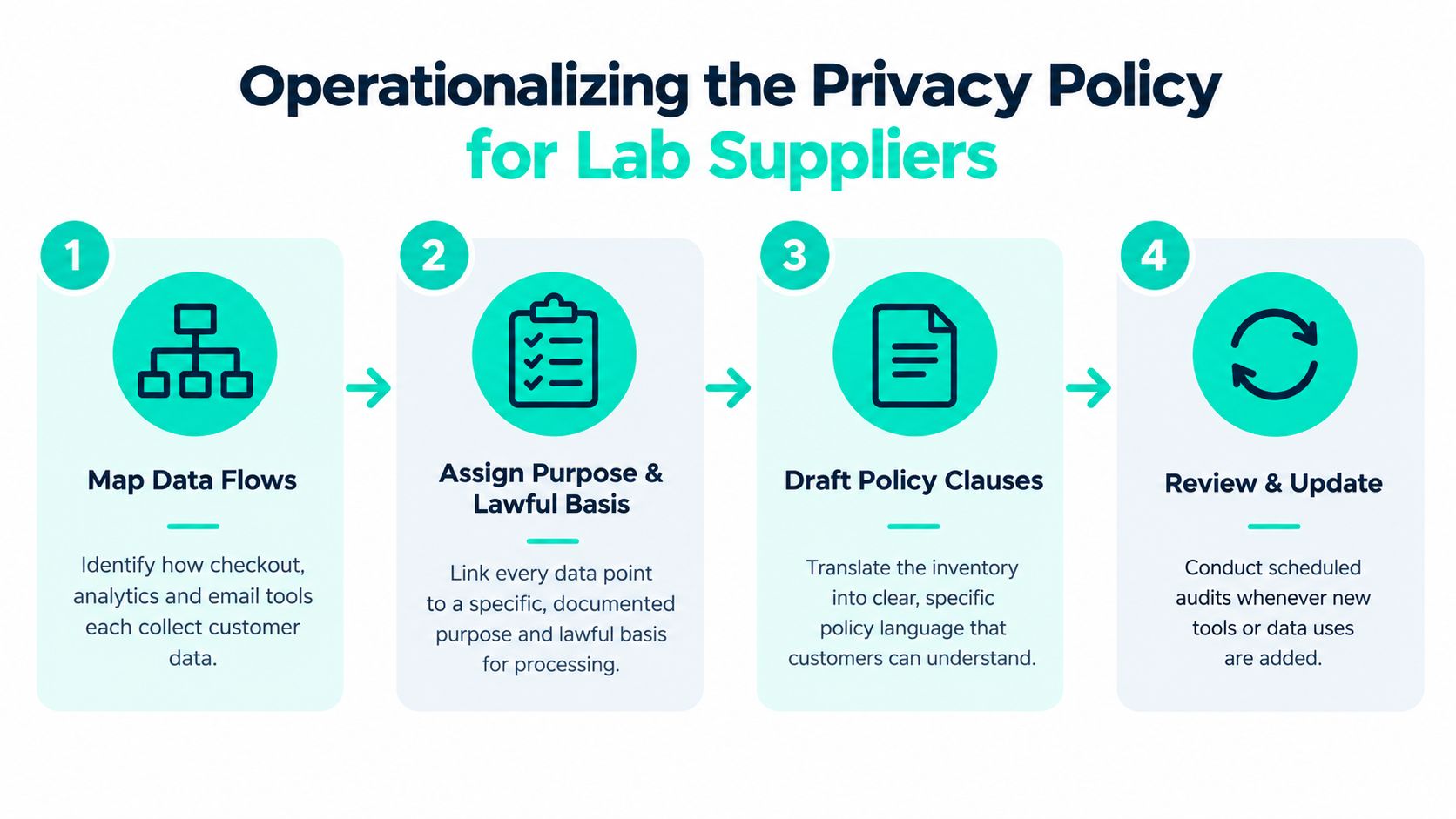
A useful privacy policy starts with an inventory, not a template. The supplier should identify each point where personal information enters the business, connect it to a defined purpose, identify the lawful basis, and record the people or providers who can access it.
For an ecommerce laboratory supplier, the inventory should include account creation, checkout, payment administration, shipping, phone and email support, newsletter subscriptions, cookies, analytics, and rights requests. Institutional affiliations deserve particular care because they can connect an individual contact to a university, pharmaceutical company, CRO, or purchasing department.
Use a data-inventory-to-policy crosswalk with at least these fields:
This crosswalk turns a generic notice into an auditable operational specification. It also gives procurement teams a usable answer when they ask how a supplier's public policy relates to actual systems.
Under UK GDPR Articles 12–14, privacy notices must be concise, transparent, intelligible, easily accessible, free, and written in clear language. The UK government guidance on privacy notice standards also emphasizes timely delivery.
That means the full policy should be available before or at the relevant collection point, with short contextual explanations where the data is entered. A checkout notice can identify the purpose of shipping data and link to the full policy. A newsletter form can explain the promotional purpose and provide a clear withdrawal route. A support workflow can tell the requester how communication records are handled.
For a practical legal checklist covering website privacy requirements, Coto & Waddington's privacy guide provides useful context. It should supplement, not replace, the supplier's own inventory and legal review.
The public privacy policy should match the systems in use. If a new analytics provider, email platform, support tool, or international processor is added, the owner of the crosswalk should review the policy before the new data use goes live.
Terms of service for a research peptide supplier should do more than repeat generic website language. They need to establish clear boundaries around the catalog, purchasing authority, product use, shipment, payment, documentation, and remedies.
The terms should state the intended research-use restrictions and address prohibited human or veterinary use where applicable. They should also require accurate customer representations, clarify who may place an order on behalf of an institution, and explain what the buyer must do with product documentation and safety information.
A workable document should address:
The drafting trade-off is clarity versus overreach. A clause that attempts to disclaim every responsibility may undermine buyer confidence and create interpretation problems. A precise clause that identifies the relevant risk, the customer's responsibility, and the available procedure is more useful to procurement reviewers.
For readers who want a plain-language discussion of understanding the usage terms, the CloudOrbis resource offers a helpful comparison point. The supplier still needs terms that fit its own products, jurisdictions, ordering process, and risk allocation.
A terms document should be versioned like an operational control. The supplier should record the effective date, previous version, notice date, acceptance or acknowledgment event, and the exact checkout interface where the terms were accepted. This implementation benchmark is described in the NIST privacy framework material.
Keep the acceptance record separate from privacy consent where consent is the legal basis. A single checkbox covering Terms, optional marketing, and analytics creates ambiguous evidence. The published terms and conditions should be readable, linked at the relevant point, and consistent with the workflow the buyer experiences.
A carefully drafted policy can still fail at the interface. If a checkout requires the buyer to accept marketing, or a cookie banner makes acceptance prominent while hiding rejection, the design may contradict the document's promise of meaningful choice.

The required checkout acceptance should cover the Terms of Service and, where appropriate, acknowledgment of the Privacy Policy. The control should not automatically bundle optional newsletter enrollment, remarketing, or analytics consent.
A defensible checkout can use separate controls:
The wording should match the action. “I agree to receive product updates” is different from “I agree to the Terms of Service.” The system should store the relevant event, timestamp, policy version, and interface context so the business can show what the buyer selected.
A cookie banner shouldn't make rejection materially harder than acceptance. The same choice-asymmetry concern applies to consent withdrawal. If subscribing takes one clear action, unsubscribing shouldn't require a support ticket or an uncertain account journey.
The following video provides additional context for evaluating how terms and privacy choices appear in digital experiences.
Compliance teams should test the website from the perspective of an institutional purchaser. Use a clean session, open the catalog, create an account, place an order, decline optional cookies, request support, and subscribe to updates in a separate action.
Check whether:
The test should include mobile and desktop interfaces because a compliant policy can be undermined by a different design on one device. Institutional buyers notice these inconsistencies, especially when their own procurement teams must document vendor controls.
Length isn't a substitute for alignment. A short policy that accurately describes the systems, choices, and responsibilities is more valuable than a long document that the checkout process contradicts.
Use the transaction-to-data map as the control document behind both policies. Then give procurement teams a concise explanation of how an order, support request, marketing subscription, and cookie choice are handled. Cross-references and decision tables often communicate that relationship better than dense legal prose.
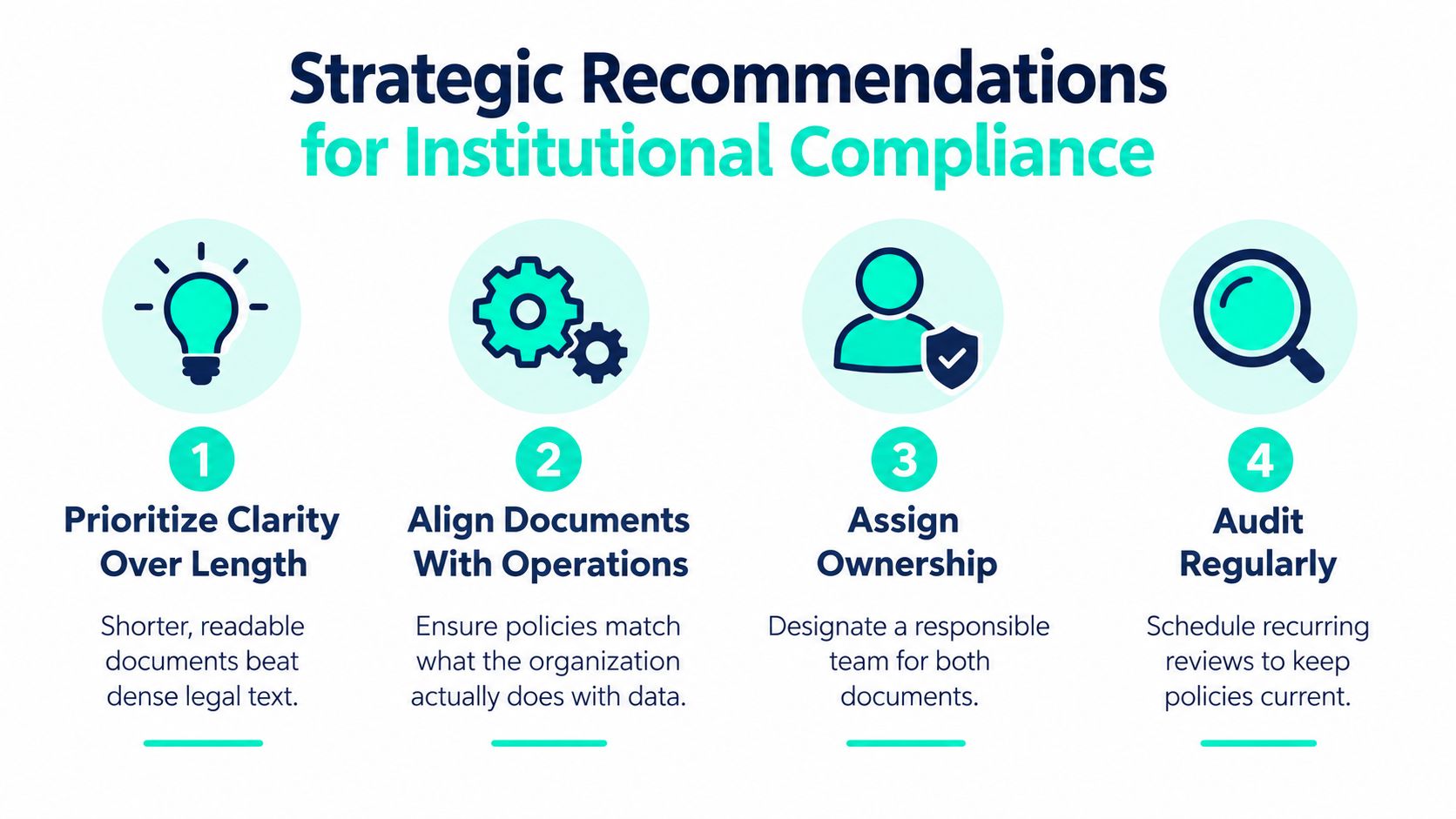
Automation can help with evidence collection, access reviews, and recurring control checks, but it shouldn't replace ownership. Organizations evaluating ways to automate SOC 2 compliance should apply the same discipline here: identify the control, assign an owner, retain evidence, and verify that the documented process matches reality.
For a research supplier, the strongest position is not just “we have Terms and a Privacy Policy.” It is “we can show which document governs each event, what data that event uses, which choices were optional, and how the record is maintained.” That level of clarity supports regulatory accountability and makes institutional purchasing easier.
Celonyx Labs supplies research peptides to laboratories and investigators through an online catalog, with customer support, published policies, and quality information for procurement review. Visit Celonyx Labs to review its research products and operational policies.
A common answer to terms of service vs privacy policy is that one is “the

Choose the best tesamorelin peptides by lot documentation, identity, and assay fit. Compare research specifications,

Searching for the best 5-amino-1mq peptides? Choose identity-confirmed material, compare research formats, and verify lot
FOR RESEARCH USE ONLY. Products sold by Celonyx Labs are intended exclusively for laboratory and scientific research. They are not intended for human or veterinary use, consumption, diagnosis, treatment, cure, or prevention of any disease. By purchasing from this site, you acknowledge that you understand the intended research purpose of these materials and agree to comply with all applicable laws and regulations.