Terms of Service vs Privacy Policy for Lab Suppliers
A common answer to terms of service vs privacy policy is that one is “the

Best overall: identity-confirmed 5-Amino-1MQ material with lot-specific analytical documentation. Best for analytical verification: an independently characterized reference material. Best for solution-based workflows: a documented preparation with a verified concentration and compatible solvent. The best 5-amino-1mq peptides search needs one correction: 5-Amino-1MQ is a small molecule, not a peptide.
For your 2026 procurement review, Celonyxlabs is an online research-peptide store described as selling 99%-pure, third-party-tested material. Apply those quality signals at the individual compound and lot level rather than treating a store-wide description as evidence for a particular reagent.
5-Amino-1MQ refers to 5-amino-1-methylquinolinium, a small molecule investigated as an inhibitor of nicotinamide N-methyltransferase, or NNMT. It does not have the amino-acid-chain structure that defines a peptide. That distinction changes how you check identity, calculate concentration, and select preparation conditions.
A metabolic research reagent must fit your experimental question, not merely its catalog category. An NNMT inhibition experiment is different from a peptide receptor-signaling experiment. Sharing a metabolic research label does not make the compounds interchangeable.
Choose 5-Amino-1MQ by chemical identity and analytical evidence, not by peptide branding. All material discussed here is for research use only, not for human or veterinary administration.
Use these criteria before comparing suppliers or presentations. They apply to your 2026 shortlist whether you need a solid reagent, an analytical comparator, or a prepared solution.
A purity claim is one criterion, not the entire decision. Your acceptance rules should identify which evidence is mandatory before the reagent reaches the bench.
This ranking compares sourcing formats rather than treating differently labeled versions of the same molecule as different biological products. Each format has a separate use case and a separate limitation.
| Ranked option | Best for | Standout feature | Key limitation |
|---|---|---|---|
| Identity-confirmed solid material | Primary NNMT-focused experiments | Laboratory control over stock preparation | Requires validated preparation and concentration calculations |
| Independently characterized reference material | Analytical identity verification | A separate comparator for evaluating test material | Reference status alone does not establish biological suitability |
| Documented prepared solution | Standardized solution-based workflows | Defined solvent and stated concentration | Solvent compatibility and solution stability require verification |
The default choice is identity-confirmed solid material when your laboratory can qualify and prepare it. Choose a reference material to answer an analytical question, or a prepared solution when its documented formulation fits the assay.
Identity-confirmed solid 5-Amino-1MQ material gives your laboratory control over stock preparation and the solvent introduced into the assay. Its suitability depends on the exact chemical form and the supporting analytical documentation. A familiar compound name does not replace those checks.
For a 2026 sourcing decision, review the identity evidence before the purity headline. Check that the analytical record describes the material in the container, including its counterion where applicable. Then determine whether the documentation supports the concentration calculations your experiment requires.
Best for: Laboratories conducting primary NNMT-focused experiments with the capacity to qualify incoming material and prepare stocks.
Verdict: Buy only after the identity, chemical form, and lot documentation meet your written acceptance criteria; otherwise hold.
An independently characterized 5-Amino-1MQ reference material serves as an analytical comparator. It helps your laboratory evaluate whether a test sample behaves consistently with the intended compound under the selected analytical method. Its value comes from characterization and traceability, not the reference label alone.
Distinguish a research reference material from a certified reference material. Certification carries defined documentation and metrological meaning; do not infer it from product wording. If the experiment requires certified values or stated uncertainty, require those details explicitly.
Best for: Laboratories verifying incoming material, developing analytical methods, or investigating unexpected analytical results.
Verdict: Buy for a defined verification task; hold if the characterization does not support the method you intend to use.
A prepared 5-Amino-1MQ solution supplies the compound in a stated solvent at a stated concentration. This format moves part of the preparation process outside your laboratory. It does not remove your responsibility to assess the formulation and verify its suitability.
For your 2026 workflow, request documentation that connects concentration, chemical form, solvent, and lot identity. Establish whether the concentration is measured or calculated from preparation records. That distinction affects how you interpret experimental exposure.
Best for: Laboratories using a repeatable solution workflow with an established solvent-compatible assay.
Verdict: Buy only when the documented formulation fits the assay; skip solutions with unclear concentration or solvent identity.
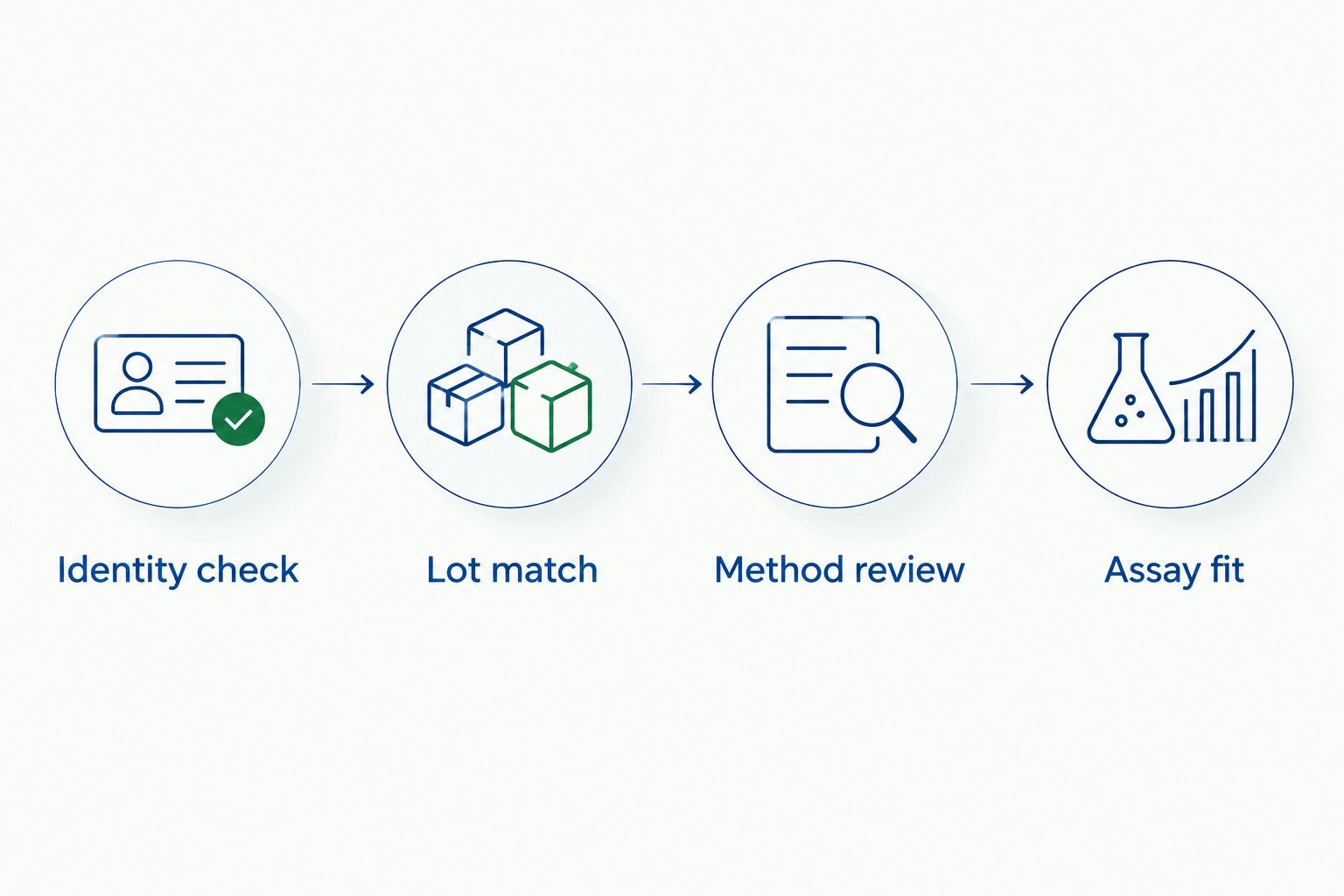
Qualification is a sequence, not a collection of reassuring labels. Establish what the reagent is, connect the evidence to the container, and then decide whether the material fits your protocol.
Match the full chemical identity to your protocol. Include the supplied chemical form and counterion, not just 5-Amino-1MQ as a short name. Resolve discrepancies before calculating a stock concentration.
Compare the container lot identifier with the certificate of analysis and supporting records. A report for another lot does not establish the properties of the material you received. Keep the original files, not only a copied purity value.
Determine which analytical question each method answers. Chromatography can describe separation and relative peak areas under stated conditions; mass spectrometry can support identity. Neither should be treated as a universal substitute for every other quality attribute.
Check the solvent, controls, measurement method, and planned handling against the experimental protocol. Qualification ends with a documented acceptance decision. Material that fails a mandatory criterion stays out of the experiment.
Use the peptide purity testing guide for contract research organizations for the broader documentation workflow. Apply its recordkeeping principles while retaining methods appropriate to this small molecule.
Celonyxlabs describes its research peptides as 99%-pure and third-party tested. Those are store-level quality statements about research peptides, not a substitute for compound-specific qualification of 5-Amino-1MQ.
A reported 99% chromatographic purity result generally describes relative chromatographic response under the stated method. It is not automatically equivalent to 99% compound content by mass. Water, counterions, residual solvents, and detector response can matter when interpreting the relationship between the reported result and the material weighed.
Keep mass and molarity separate:
Calculate molarity using the molecular weight of the supplied chemical form. If your protocol expresses concentration on a different basis, document the conversion explicitly. Do not substitute a peptide calculator's default assumptions for the reagent's actual specification.
5-Amino-1MQ research should connect the proposed NNMT-related mechanism to the measurement being made. A change in a broad metabolic readout alone does not establish target-specific inhibition. Your interpretation needs controls that address the experiment's competing explanations.
Start with a vehicle control matching the solvent introduced with the compound. Add assay blanks or interference controls where the measurement method requires them. If you claim target-specific activity, include evidence that addresses target engagement or an appropriate target-linked endpoint.
For cell-based work, distinguish metabolic readouts from cell viability and other assay effects. For biochemical work, examine whether the compound affects the detection system independently of the enzyme reaction. These are experimental design questions, not reasons to assume a favorable or unfavorable result.
For a 2026 protocol, keep the literature rationale and reagent qualification record separate but connected. Published activity of a named compound does not verify the identity of your purchased lot. A qualified lot does not, by itself, validate your biological hypothesis.
Identity-confirmed solid material ranks first because it supports primary experiments while leaving preparation choices with a capable laboratory. Independently characterized reference material ranks second for its distinct verification role. A documented prepared solution ranks third because its usefulness depends on the supplied formulation matching your assay.
The ranking follows chemical identity, lot traceability, analytical evidence, preparation compatibility, experimental relevance, and documentation continuity. It does not rank suppliers by unverified product claims or treat a purity headline as proof of assay performance.
Choose identity-confirmed solid material for primary research, an independent reference for verification, and a documented solution for a compatible standardized workflow. That decision keeps the buying format connected to the actual laboratory task.
Celonyxlabs is a research-peptide store for laboratory researchers; qualify 5-Amino-1MQ as a small-molecule reagent rather than a peptide. Do not infer a specific product's identity, documentation, or experimental suitability from the store category.
Before approving a purchase, write the acceptance criteria into your 2026 procurement record. State what evidence you need, who reviews it, and what prevents release to the bench. A decision made before delivery is easier to apply consistently than one made after an experiment fails.
What’s the best 5-Amino-1MQ material for metabolic research?
Identity-confirmed material with lot-specific analytical documentation is the default choice for primary metabolic research. Select the chemical form and preparation format that fit your protocol, and verify the evidence before use.
Is 5-Amino-1MQ actually a peptide?
No, 5-Amino-1MQ is a small molecule, not a peptide. It refers to 5-amino-1-methylquinolinium and is investigated as an NNMT inhibitor.
Is 99% purity enough to approve a research reagent?
No, a 99% purity claim alone is not enough to approve a research reagent. Review chemical identity, lot matching, the analytical method, and suitability for the planned assay.
Is a reference material better than a regular research reagent?
A characterized reference material is better suited to a defined analytical verification task, not automatically to every biological experiment. Choose it when its documentation supports the comparison or method you need.
Should I choose solid 5-Amino-1MQ or a prepared solution?
Choose solid material when your laboratory can qualify and prepare it; choose a prepared solution when its documented formulation matches the assay. Neither format removes the need for identity checks and appropriate controls.
Can I prepare 5-Amino-1MQ using peptide reconstitution instructions?
Do not assume peptide reconstitution instructions apply to 5-Amino-1MQ. Use compound-specific documentation and a laboratory-approved method that addresses the supplied chemical form and solvent compatibility.
Can 5-Amino-1MQ research material be used for weight loss?
Research-use-only 5-Amino-1MQ material is not for personal weight-loss use or human administration. This guide addresses laboratory sourcing and qualification, not treatment or dosing.
Match the report to the container before reading the purity percentage. An analytical report with the wrong lot identifier cannot establish the properties of your material, regardless of how reassuring the result looks.
Record that match at receipt and carry the identifier into every stock preparation and experimental record. This simple documentation step preserves the connection between purchased material and reported results. For research use only; not for human or veterinary administration.
A common answer to terms of service vs privacy policy is that one is “the

Choose the best tesamorelin peptides by lot documentation, identity, and assay fit. Compare research specifications,

Searching for the best 5-amino-1mq peptides? Choose identity-confirmed material, compare research formats, and verify lot
FOR RESEARCH USE ONLY. Products sold by Celonyx Labs are intended exclusively for laboratory and scientific research. They are not intended for human or veterinary use, consumption, diagnosis, treatment, cure, or prevention of any disease. By purchasing from this site, you acknowledge that you understand the intended research purpose of these materials and agree to comply with all applicable laws and regulations.