
5 Amino Acid Peptides: A Practical Lab Guide
A five-residue sequence can look simple on paper, but what exactly does “5 amino acid”
A five-residue sequence can look simple on paper, but what exactly does “5 amino acid” mean in your experiment? It might describe a true pentapeptide, a short motif cut from a larger protein, or a small molecule whose name has nothing to do with peptide bonds. Those materials need different synthesis plans, analytical methods, controls, and biological interpretations.
A useful lab habit is to stop before ordering material and define the object structurally. Count residues, identify the termini, check whether the sequence came from a larger protein, and confirm that the compound name describes a peptide at all. Short length reduces some problems, but it also makes identity, purity, solubility, and sequence context harder to interpret.
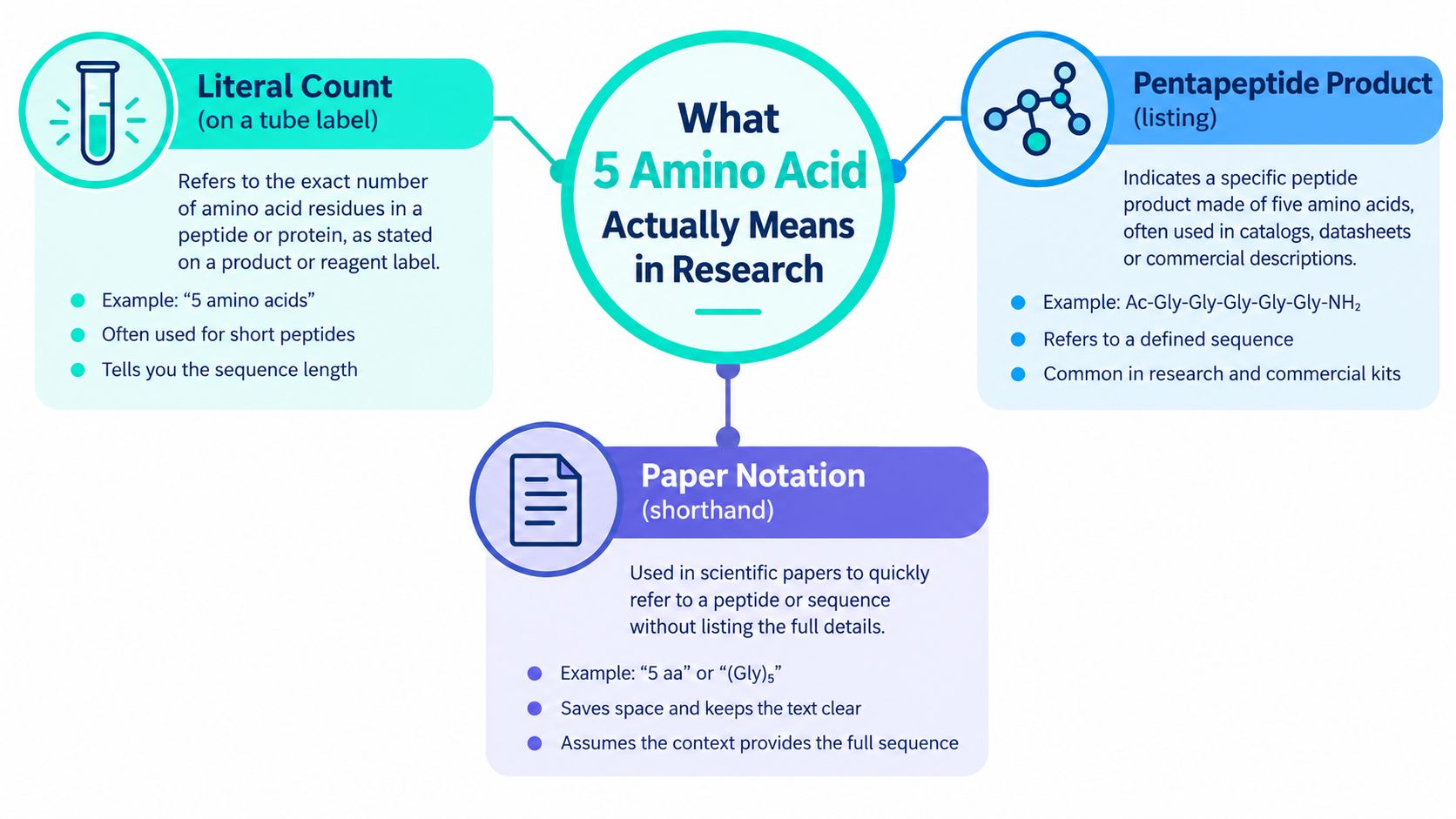
The phrase 5 amino acid has at least three practical meanings in research. Treating them as interchangeable can send a lab toward the wrong synthesis route or the wrong assay.
A pentapeptide is a literal chain of five amino acid residues joined by peptide bonds. It has an N-terminus, a C-terminus, and a defined order, such as Thr-Lys-Pro-Arg-Lys. The order matters because changing even one residue can alter charge, solubility, conformation, proteolytic stability, or target binding.
A five-residue motif is different. It may be a short window taken from a much longer protein to test whether a binding or signalling function survives outside its original sequence. The fragment might be biologically meaningful, or it might be no more than a convenient truncation chosen for an initial experiment. Its behaviour can depend on residues immediately outside the selected window, on a folded protein surface, or on a post-translational modification that the isolated fragment no longer carries.
The third meaning is a misnamed small molecule, such as 5-Amino-1MQ. In that name, “5-amino” refers to the position of an amino substituent on a chemical scaffold. It doesn't indicate five amino acids, five residues, or a peptide chain. A small molecule therefore needs a compound-identity workflow, not a peptide-sequence workflow.
Practical rule: Before reading a product page or planning an assay, ask whether you have a chain of five residues, a fragment of a larger chain, or a nonpeptide compound.
These distinctions affect everything from ordering specifications to analytical readouts. A pentapeptide is usually described by sequence, terminal chemistry, salt form, and purity method. A motif fragment also requires its source protein and biological rationale. A small molecule needs its chemical structure, molecular formula, counter-ion, and compound-specific identity testing.
The first question for your notebook should therefore be direct: which of these three objects are you working with? If the answer isn't clear, don't infer it from a product name. Request the structure, sequence, and analytical documentation.
Short-peptide work depends on a long chain of discoveries. Researchers first had to isolate amino acids, then distinguish one residue from another, then understand how residues join, and finally develop methods to build and verify defined sequences.
The timeline was gradual rather than instantaneous. Asparagine was isolated in 1806, glycine and leucine had been identified by 1820, and threonine, the last of the 20 standard proteinogenic amino acids, was discovered in 1935. This history is summarized in the historical account of the one-letter amino acid code, which also illustrates how the chemical alphabet of proteins emerged through isolation, hydrolysis, and analytical chemistry.
The decisive conceptual step came in 1902, when Emil Fischer and Franz Hofmeister independently proposed that proteins are linear chains of amino acids joined by peptide bonds. That model gave chemists a structural language for describing a short sequence rather than treating it as an undefined biological extract.
By 1950, researchers had reported and characterized about 200 natural amino acids, showing that the canonical 20 represent only a portion of the broader natural family. For a laboratory working with a five-residue sequence, this matters because “amino acid” doesn't automatically identify one of the standard residues. Modified, noncanonical, or naturally unusual building blocks can change synthesis, purification, and interpretation.
The history also explains why identity, purity, and sequence control became central quality variables. A pentapeptide isn't validated merely because a reaction produced material with the expected general appearance. The lab must establish which residues are present, whether they appear in the intended order, and whether byproducts remain.
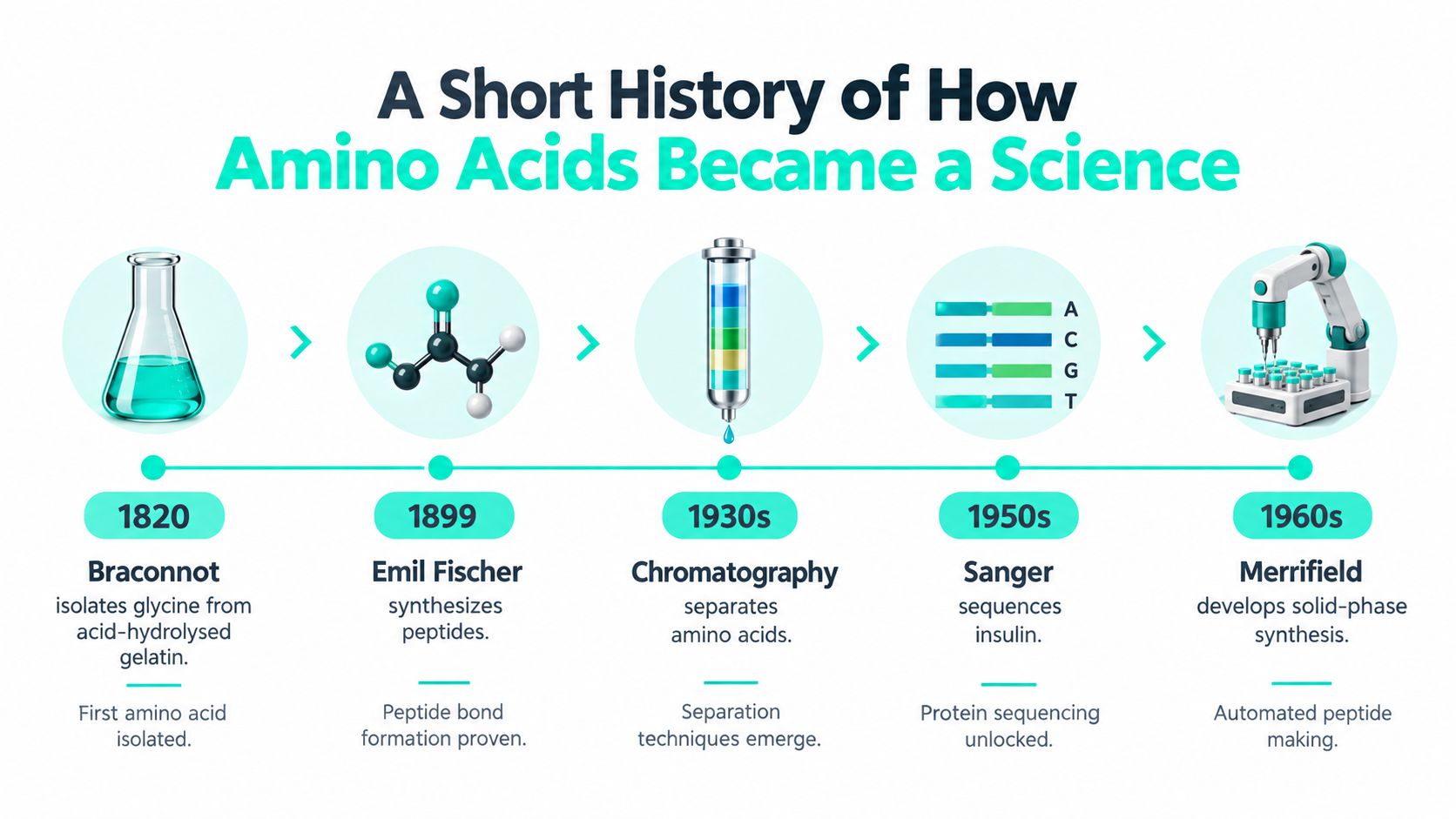
The modern workflow is an accumulation of these milestones. Chemical isolation made residue identity possible. Peptide-bond theory made sequence design intelligible. Analytical chemistry made mixtures separable. Together, they created the foundation for synthesizing and testing short peptides as defined molecular entities.
Take Thr-Lys-Pro-Arg-Lys as a working example. It contains five residues in a specified order, but the chain isn't just a list of abbreviations. Each residue contributes to a repeating peptide backbone and carries a side chain that changes the molecule's chemical behaviour.
The N-terminus is the amino end of the chain, while the C-terminus is the carboxyl end. Unless the specification says otherwise, you should confirm whether each terminus is free, blocked, acetylated, amidated, or otherwise modified. Terminal chemistry can change charge, solubility, enzymatic stability, and receptor recognition.
The backbone repeats the basic amino acid pattern through the chain. The side chains then distinguish threonine, lysine, proline, and arginine from one another:
At a chosen pH, the termini and ionizable side chains exist in particular protonation states. That means a five-residue peptide can behave very differently in water, buffered assay medium, organic solvent, or a formulation containing a counter-ion. Never describe the sequence as only “positive” or “negative” without naming the pH and terminal form.
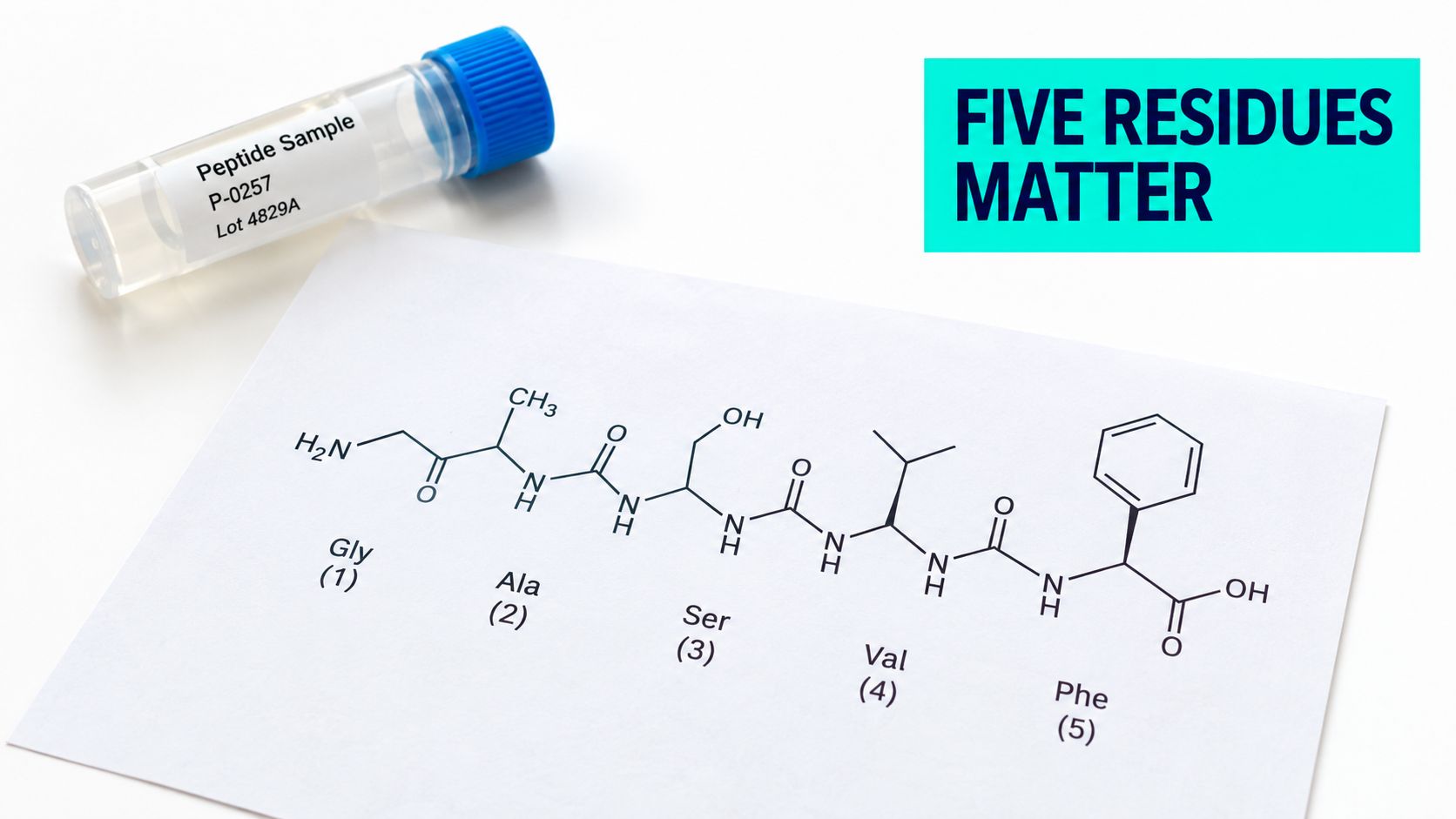
Five residues are enough to create a defined chemical object with several side-chain interactions, but not enough to assume that a larger protein's fold or binding surface has been preserved. A missing residue, incorrect terminal modification, or side-reaction product can therefore change the assay result rather than merely lowering nominal purity.
Write the full structure specification before synthesis:
This specification becomes the reference point for synthesis, mass confirmation, chromatographic analysis, and biological controls.
A short sequence can retain biological activity, but length alone doesn't explain why. Function may survive because the selected residues form a minimal active motif, preserve a contact surface, or maintain a side-chain arrangement required for recognition. In other cases, a five-residue fragment is only a convenient piece of a larger structure and loses activity when removed from its native context.
A useful example comes from a prosaposin-derived pentapeptide. The verified research summary describes a five-residue fragment that reduced metastasis in mouse models. That finding makes the sequence interesting, but it doesn't prove that every five-residue fragment is active on its own, nor does it establish that the same result will appear in a different model or assay.
Ask what the fragment is supposed to preserve. If the activity depends on a compact set of side-chain contacts, five residues might be sufficient. If the parent protein supplies a broader folded surface, a single short window may not recreate the active geometry. A fragment can also lose function if the original biology depends on a modification, a neighbouring residue, or a particular terminal arrangement.
A practical test is to compare related constructs:
If deleting one residue eliminates activity, the system may have a strict length or geometry requirement. If substitutions at non-contact positions are tolerated, the motif may be more resilient than its first sequence suggests.
5-Amino-1MQ belongs in a different category. Its name describes an amino substituent position on a small-molecule scaffold, not a chain containing five amino acids. It doesn't contain peptide bonds, so a peptide synthesis plan, peptide sequence notation, or pentapeptide analogue isn't the correct way to define it.
The distinction matters experimentally. A prosaposin-derived fragment is evaluated through sequence, termini, peptide purity, and biological motif context. 5-Amino-1MQ must instead be handled as a small molecule with its own identity, formulation, and mechanism. Similar wording in search results doesn't create structural similarity.
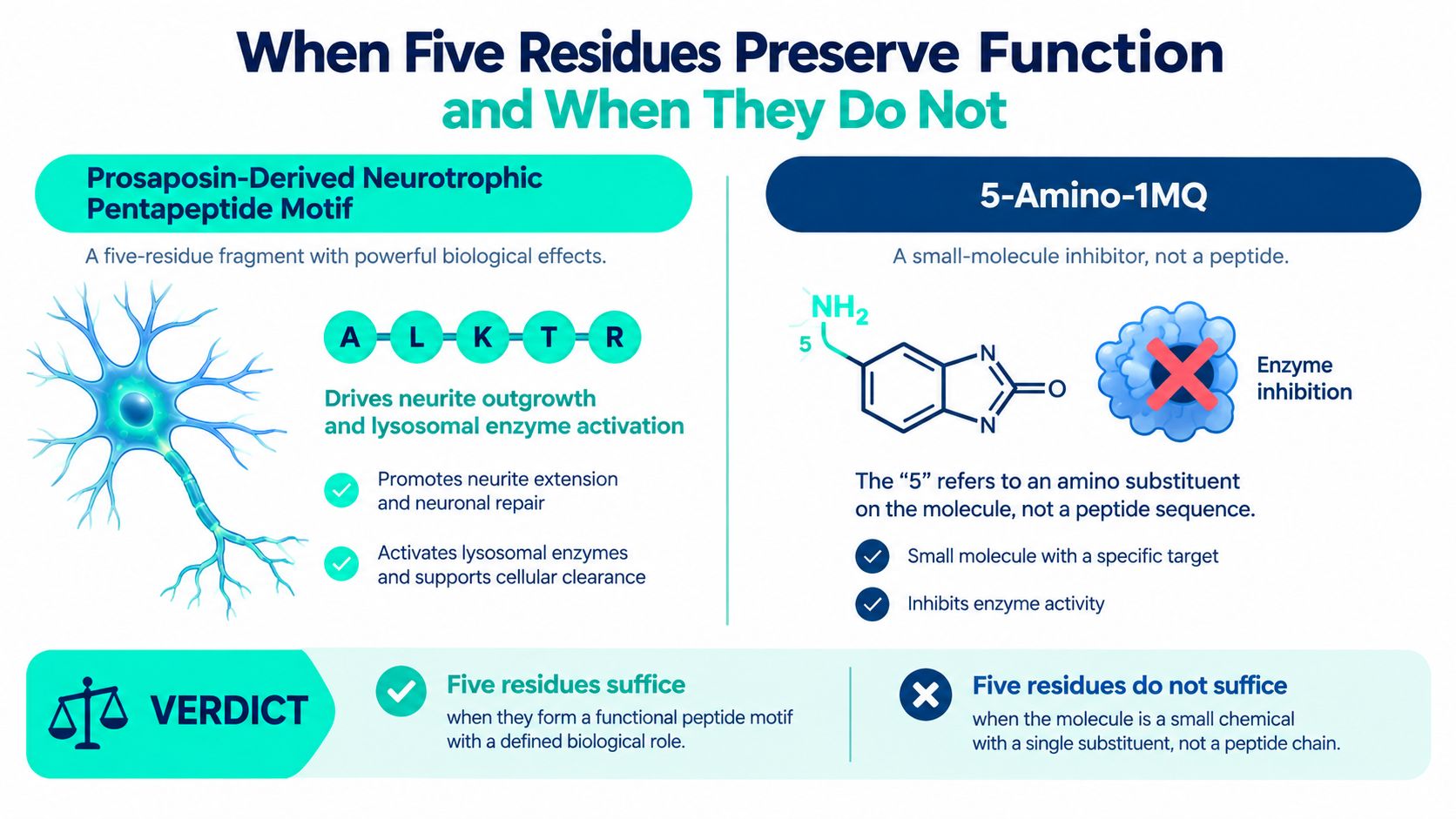
A short peptide deserves biological confidence only after the experiment shows sequence-dependent activity, appropriate controls, and a plausible connection to the proposed mechanism.
Short sequences aren't automatically easy to synthesize. Their small size can make crude mixtures look deceptively clean while a minor deletion, terminal error, or protecting-group remnant remains relevant to the assay.
In solid-phase peptide synthesis, incomplete coupling can generate deletion sequences. A chain that misses one residue may remain chemically similar enough to co-elute with the desired product or to produce a confusing mass spectrum. Premature deprotection can create truncations, while side reactions near a difficult residue can produce variants that aren't obvious from the intended sequence alone.
Short peptides also contain a high proportion of chemically important end groups relative to their total structure. Residual protecting groups, incomplete cleavage, or an incorrect terminal form can therefore have a pronounced effect on charge and solubility. A product can look acceptable by one measurement and still behave inconsistently in solution.
The synthesis record should allow you to identify where a problem might have entered:
For broader sample-behaviour questions, researchers may also consult this guide to peptide aggregation analysis. Aggregation can complicate both handling and biological interpretation, but it shouldn't be used as a catch-all explanation for an identity or synthesis failure.
Bench rule: If a short peptide fails quality control, don't ask only whether the main peak is present. Ask which deletion products, terminal variants, and residual reagents could still be present.
Request the complete sequence specification, crude analytical trace, purified HPLC trace, observed mass, calculated mass, and the stated salt or counter-ion. If the material was custom-made, ask whether the vendor can provide the purification method and explain any unidentified peaks rather than reporting only a headline purity value.
A five-residue peptide should be evaluated with orthogonal analytics, because no single readout answers every quality question. Reverse-phase HPLC separates components by chromatographic behaviour, while mass spectrometry tests whether an ion with the expected mass is present.
The two methods answer different questions. HPLC can show that the sample contains multiple eluting components, but it doesn't by itself prove the identity of the main peak. Mass spectrometry can support the expected molecular weight, but a correct parent ion can appear even when other impurities remain in the vial.
| Detection Capability | Reverse-Phase HPLC | ESI-MS |
|---|---|---|
| Separation from many byproducts | Yes, if the method resolves them | No, ions are detected together rather than chromatographically separated |
| Relative chromatographic purity | Yes, based on integrated peaks | No, ion response isn't a direct purity percentage |
| Expected molecular mass | No, not directly | Yes, by comparing observed and calculated mass |
| Some terminal or protecting-group variants | Often, if retention differs | Often, if the mass difference is detectable |
| Isobaric impurities | May separate them | May not distinguish compounds with the same mass |
| Enantiomeric substitutions | Not reliably without a suitable specialized method | Usually not distinguished by mass alone |
| Sample adducts and counter-ions | Can influence retention | Can appear as additional or shifted ions |
A single sharp HPLC peak is encouraging, but it doesn't establish complete identity. Conversely, an MS signal matching the expected parent mass doesn't establish that the sample is free of deletion sequences or co-eluting contaminants. The guide to interpreting HPLC chromatograms can help a new analyst read peak shape, retention behaviour, baseline stability, and integration choices.
Check the column chemistry, gradient, mobile phases, detection wavelength, sample solvent, and integration method. Then compare the observed mass with the calculated mass while confirming the expected charge state and any adducts. Don't treat a mass match as proof of sequence order, because different structures can share a nominal mass.
For a novel motif, unusual modification, or unexplained biological effect, request additional characterization. Amino acid analysis may support composition, while multidimensional NMR can provide deeper structural information when the sequence and conformational behaviour justify it.
Procurement begins with the specification, not the vendor catalogue. A short peptide order should state the exact sequence, terminal chemistry, modifications, salt form, intended scale, purity method, and required analytical package.
| COA Field | Why It Matters | Minimum Standard |
|---|---|---|
| Sequence and terminal form | Confirms what material was ordered | Exact sequence with both termini stated |
| Chromatographic purity | Shows how much material separates as the reported product | Reported percentage with method and column |
| Observed and calculated mass | Supports molecular identity | Both values shown with charge-state interpretation |
| Counter-ion or salt form | Affects mass, charge, solubility, and assay composition | Explicitly identified |
| Residual solvents or reagents | May affect cells, enzymes, or binding assays | Reported when relevant to the application |
| Net peptide content | Distinguishes peptide from total weighed salt material | Stated separately from gross vial weight |
| Batch and test date | Connects results to the supplied material | Batch-specific documentation |
High chromatographic purity doesn't necessarily equal high net peptide content. A salt form, water, counter-ion, or residual solvent can contribute to the weighed material without appearing as the desired peptide sequence. A trifluoroacetate counter-ion may also matter in a sensitive biological assay, especially where buffer composition or ionic strength affects the readout.
Before placing a custom order, ask for a sample COA and confirm that the report belongs to the same batch format you expect to receive. Find out whether raw chromatograms and mass spectra are available, whether the synthesis route is appropriate for the sequence, and how the supplier handles an out-of-specification result.
Researchers managing recurring laboratory purchases may also find operational guidance on subscribe and save for supplements, although recurring commerce tools don't replace batch-level peptide documentation.
For additional procurement considerations, see this guide to how to buy peptides. The central principle is simple: buy documented material that matches the experiment, not merely a product name that resembles it.
The most useful question isn't “what is a 5 amino acid peptide?” It's when does a five-residue fragment actually carry the mechanism you want to test?
Start with the biological source. Identify the parent protein, the proposed binding or signalling site, and the evidence that the selected residues participate in activity. Then decide whether the fragment needs the same termini as the parent context. A free amine, a free acid, an amidated C-terminus, or a cyclized structure can produce different molecular behaviour.
A strong design distinguishes sequence-specific activity from general effects such as aggregation, charge-driven adhesion, solvent toxicity, or nonspecific membrane disruption.
| Experimental Element | Question It Answers |
|---|---|
| Parent five-residue sequence | Does the candidate produce the expected signal? |
| Scrambled sequence | Is order important, or is composition enough? |
| Single-residue substitutions | Which positions contribute to activity? |
| Shortened fragment | Does the mechanism require the full selected length? |
| Vehicle blank | Does the solvent or formulation affect the assay? |
| Positive control | Can the assay detect a known response? |
Solubility deserves attention before the first dose-response run. A short hydrophobic sequence may precipitate, adsorb to plastic, or form aggregates as concentration rises. Prepare and inspect the peptide under the actual assay conditions, and record solvent composition, mixing time, appearance, and any filtration or centrifugation step.
A receptor-binding experiment may require competition with an established ligand. A cell-based assay needs controls for viability, vehicle exposure, and nonspecific membrane effects. A competition study needs a clear relationship between competitor concentration and displacement, not just one high test concentration.
Write the acceptance criteria before synthesis. Define what would count as sequence-dependent activity, what result would suggest a solubility artefact, and which observation would justify making a longer fragment. That discipline prevents a positive-looking signal from carrying more mechanistic meaning than the design can support.
Final bench check: Verify the structure, termini, purity evidence, solubility, negative controls, and assay-specific readout before you interpret a five-residue peptide as a mechanism.
Celonyx Labs supplies research peptides through an online catalogue for laboratories and investigators, with product documentation and third-party testing information presented for research procurement. If you need material for a defined short-peptide workflow, visit Celonyx Labs to review the catalogue and contact options before placing an order.
A five-residue sequence can look simple on paper, but what exactly does “5 amino acid”

Can bacteriostatic water be used more than once? Yes, if labeled multidose. Learn the 28-day

How long can peptides sit in a syringe before use? No universal time applies. Learn
FOR RESEARCH USE ONLY. Products sold by Celonyx Labs are intended exclusively for laboratory and scientific research. They are not intended for human or veterinary use, consumption, diagnosis, treatment, cure, or prevention of any disease. By purchasing from this site, you acknowledge that you understand the intended research purpose of these materials and agree to comply with all applicable laws and regulations.