1500 Mg Glutathione: What That Strength Really Means
You're comparing two bottles on a supplement shelf. One says 500 mg glutathione. The other
You've got a vial that won't clear, a protocol that needs repeating, and a solvent choice that should've been simple but isn't. That's usually where the work starts, because acetic acid vs bacteriostatic water isn't just a pH debate. It's a decision about solubility, stability, contamination control, and whether your peptide is going to survive the workflow you've built around it.
| Property | Acetic Acid Water | Bacteriostatic Water |
|---|---|---|
| Main role | Acidic solvent for difficult reconstitution | Preservative medium for multidose use |
| Typical composition | Sterile water with dilute acetic acid | Sterile water with 0.9% benzyl alcohol |
| pH behavior | Acidic, around 3.0 | Near-neutral, about 5.7 |
| Best fit | Hydrophobic or basic peptides that resist neutral solvents | Peptides that dissolve readily and need repeated access |
| Storage posture | Usually treated as fresh-use | Commonly used for refrigerated multidose handling |
| Antimicrobial function | Chemically active with documented antimicrobial activity | Preservative-only, not an antimicrobial treatment itself |
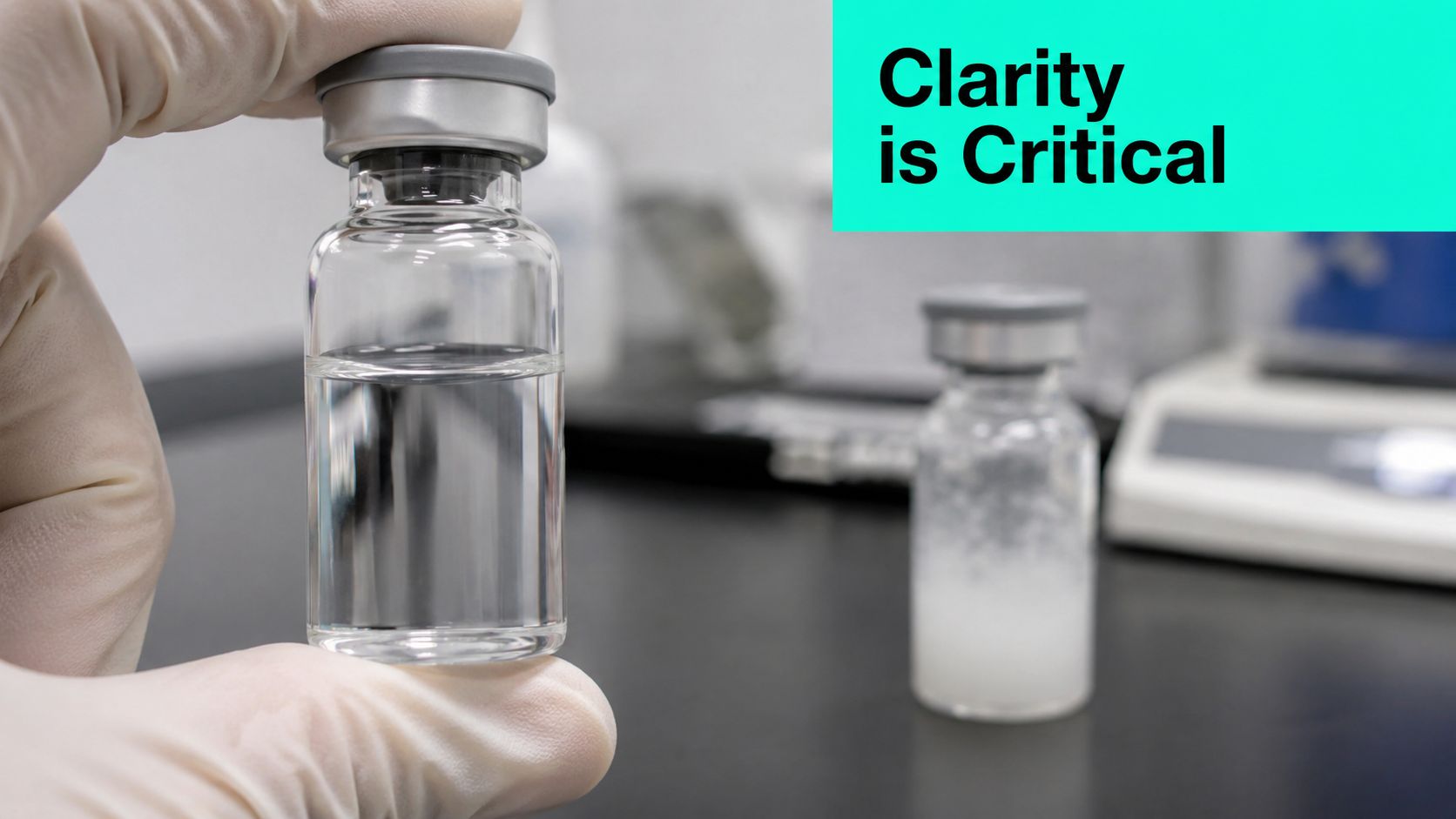
The failure usually shows up fast. A colleague pulls a vial after reconstitution, expects a clear solution, and sees haze, floating particles, or a stubborn pellet on the bottom. That's not a cosmetic problem. It's the kind of moment that tells you the peptide either never fully solubilized or didn't stay stable long enough to matter.
Peptide handling looks routine until the solvent doesn't match the molecule. A peptide that behaves well in a neutral diluent can still fail later if the workflow needs repeated vial access or long refrigerated holding. A peptide that seems incompatible with bacteriostatic water may clear quickly in acidic solution, then become useless if the acidic environment isn't handled correctly downstream.
Practical rule: if the vial stays cloudy after gentle mixing, assume a solubility problem first, not a contamination problem.
That matters because the two solvents aren't interchangeable conveniences. Acetic acid is a chemically active acidic solvent with a documented antimicrobial profile, while bacteriostatic water is a preservative medium built around benzyl alcohol. Their jobs overlap only at the level of “used in peptide work.” Their actual function in the lab is different.
If the peptide is hydrophobic, basic, or prone to aggregation, the wrong solvent choice often shows up as incomplete dissolution, then inconsistent downstream dosing or assay variability. If the peptide dissolves cleanly but you need to access the vial multiple times, the trade-off shifts toward preservation and handling convenience. That's why this comparison is less about theory and more about protecting the sample you already paid for.
You can see that practical mindset reflected in the way peptide vendors and lab references frame reconstitution choices, including Celonyx Labs' own note on bacteriostatic water use in peptide workflows. The key question isn't which solvent sounds more advanced. It's which one gives your specific peptide the best chance of staying usable long enough to finish the experiment.
Bacteriostatic water is sterile water containing 0.9% benzyl alcohol. Its role is to inhibit bacterial growth during repeated access, not to act as a treatment solvent with strong killing power. The practical result is a medium that suits multidose handling, especially when you need to re-enter the vial more than once.
Its pH is commonly described as around 5.7, which helps explain why it's broadly compatible with peptides that don't mind a near-neutral environment. In normal lab use, that neutrality is the point. You want a solvent that gets out of the way unless the peptide needs something more specialized.
Acetic acid water is usually described as 0.6% glacial acetic acid in sterile water, with an acidic pH around 3.0. That lower pH matters because it can help dissolve hydrophobic or basic peptides that resist neutral diluents. The solvent is doing active chemical work here, not just standing by as a carrier.
That same acidity is why it's generally treated as a fresh-use solution. It doesn't bring the same preservative protection that bacteriostatic water does, so the operational model changes. Use it when you need dissolution more than storage convenience.
The choice between them is really a choice between solubilization and preservation. Bacteriostatic water is the default when the peptide already behaves and you need repeated access. Acetic acid water is the fallback when the peptide refuses to behave in a neutral medium.
Lab shorthand: bacteriostatic water protects the workflow, acetic acid protects the dissolve.
If you need a broader handling overview, Celonyx Labs' peptide reconstitution guidance lines up with the same basic principle. Neutral, preservative-backed handling works for many peptides. Acidic handling becomes relevant when the sequence itself pushes back against neutral conditions.
Acetic acid has a real antimicrobial effect, and that is broader than the preservative role people usually associate with bacteriostatic water. A 2013 study on multiple bacteria reported that acetic acid inhibited several clinically important strains at low concentrations, with minimum inhibitory concentrations reported for Pseudomonas aeruginosa, methicillin-sensitive Staphylococcus aureus, Acinetobacter baumannii, and MRSA. Another study found that 10% acetic acid produced at least a 6-log10 reduction in viable bacteria after 30 minutes against Mycobacterium massiliense. That is antimicrobial activity, not just a storage aid. ScienceDirect study on acetic acid antimicrobial activity
Bacteriostatic water is not used as an antimicrobial treatment. It is sterile water with 0.9% benzyl alcohol, and the preservative's role is to slow bacterial growth during multidose use. That difference matters when someone assumes both solvents protect a peptide in the same way.
The practical split is straightforward. If the protocol needs direct acidic chemistry, acetic acid is the active choice. If the workflow needs preservative support and repeated vial access, bacteriostatic water fits that job.
Antimicrobial behavior does not automatically mean peptide compatibility. A solvent can suppress microbes and still be a poor fit if the peptide precipitates, aggregates, or degrades in that environment. The reverse also happens, a solvent can dissolve a difficult peptide well and still be a poor choice if the assay or storage plan cannot tolerate acidity.
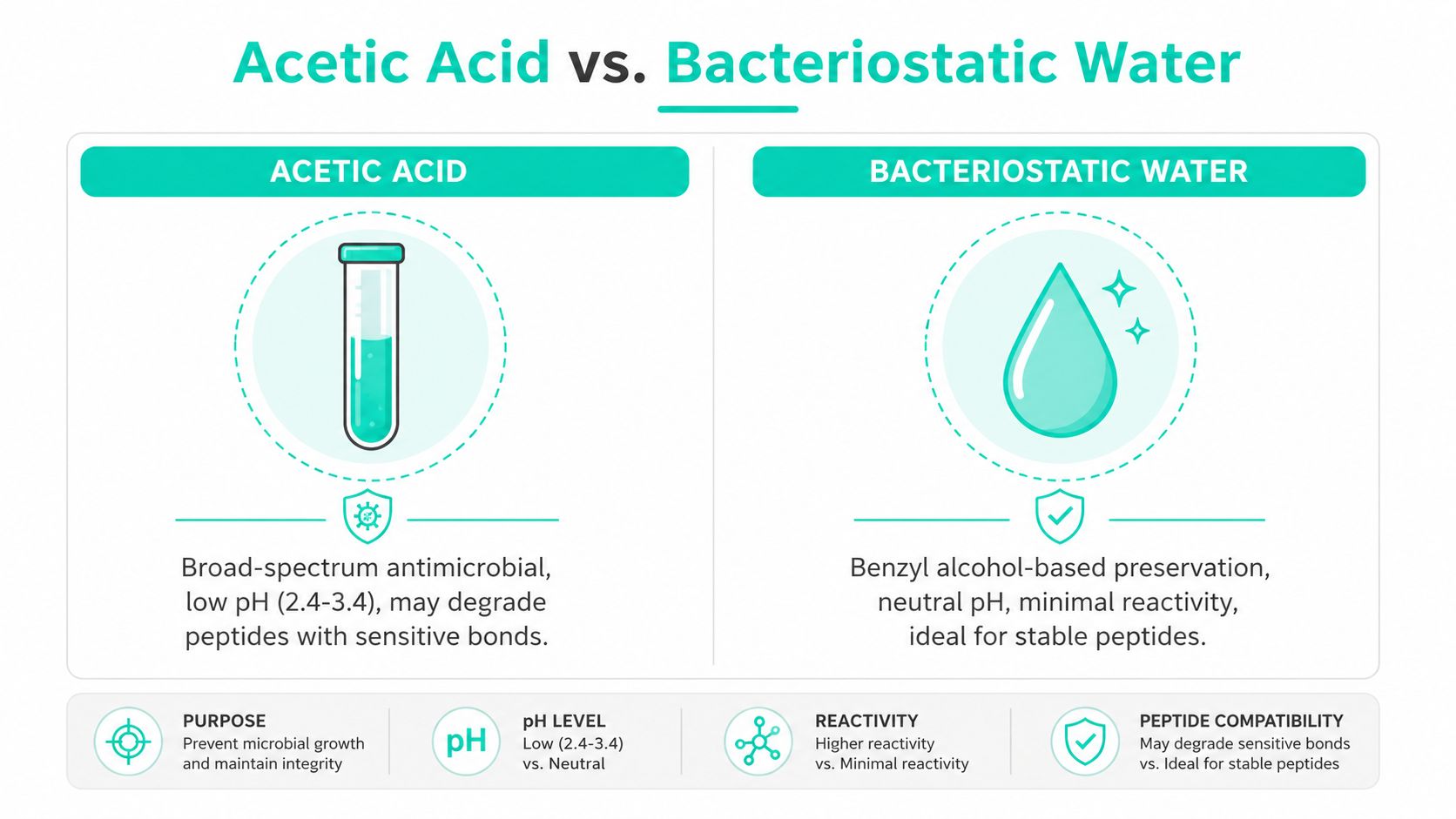
| Property | Acetic Acid Water | Bacteriostatic Water |
|---|---|---|
| Main action | Acidifies and can disrupt microbes | Inhibits bacterial growth through benzyl alcohol |
| Antimicrobial profile | Strong, chemically active | Preservative-only |
| Typical use pattern | Fresh reconstitution for difficult peptides | Multidose handling and routine reconstitution |
| Chemical environment | Acidic | Near-neutral |
| Best-fit risk profile | Helps with insoluble peptides, but may be too harsh for some | Gentler for many peptides, but less useful when solubility fails |
For a product-focused reference, Celonyx Labs offers a 10mL bacteriostatic water product for reconstitution and dilution of lyophilized compounds. That kind of product fits a preservation-first workflow, while acidic reconstitution belongs in the more specialized solubility-first lane.
The most useful rule I've seen in practice is blunt. If the peptide dissolves cleanly in bacteriostatic water, don't complicate the protocol. If it doesn't, the next question is whether acidity will help without creating a new problem. The solvent should follow the molecule, not the other way around.
Bacteriostatic water stays popular because it balances convenience with microbial control. Vendor guidance commonly cites up to 28 days refrigerated after opening for multidose handling, which makes it practical when the vial will be accessed repeatedly. That convenience disappears if the peptide won't dissolve.
Acetic acid water earns its place when the peptide is hydrophobic or basic enough that neutral diluents leave you with cloudiness or residue. In those cases, the goal is a clear, fully dissolved stock before any downstream dilution or buffering. The acidic medium can get you there when bacteriostatic water can't.
A two-step approach sometimes helps with difficult material. Some labs use a small pre-mix of acetic acid with bacteriostatic water to give the peptide an acidic start while keeping part of the preservative advantage. That's a useful workaround, but it should stay a compound-specific exception, not a habit applied to every vial.
If you need repeated withdrawal, routine access, and less fuss, bacteriostatic water usually wins. If you need the highest chance of first-pass dissolution for a stubborn peptide, acetic acid water is the more logical choice. That trade-off is the axis of the decision, more than any simple pH chart.
Use the mildest solvent that fully solves the peptide problem. If the peptide stays cloudy, “mild” isn't helping you.
Acetic acid water should be prepared only in the amount you plan to use in the current session or day. It lacks preservative protection, so there's no reason to treat it like a stock solution that can sit around. Labeling matters here, especially when multiple peptides are in play and vial mix-ups can happen fast.
A clean label should include the date, concentration, and peptide identity. That sounds basic until a bench full of similar vials turns into a guessing game. The fewer unknowns you leave in the fridge, the fewer bad assumptions you make later.
For bacteriostatic water reconstituted solutions, refrigerated storage at 2 to 8 degrees Celsius is the normal handling approach, and vendor guidance commonly cites 28 days for multi-use storage. That timeframe is about preserving practical usability, not promising that every peptide behaves identically. Some peptides are less forgiving and still need tighter handling even when the solvent is right.
Celonyx Labs' storage guidance for reconstituted peptides is useful if you're building your own bench SOP around access, refrigeration, and vial turnover. The storage rule itself is simple. The skill is matching the storage window to the peptide's chemistry.
If bacteriostatic water leaves a peptide cloudy, assume hydrophobicity before you assume contamination. Switching to acetic acid water can solve the problem, and a two-step pre-mix may help when the peptide sits in the middle. If the peptide still won't clear, the issue may be deeper than solvent choice.
If a peptide precipitates after acetic acid reconstitution, that's a warning sign too. The acidic environment may have triggered instability, or the peptide may need a different handling path before storage or assay use.
Your own notes become the fastest decision tool in the room. After a few runs, the pattern is usually obvious, and the next reconstitution stops being a guess.
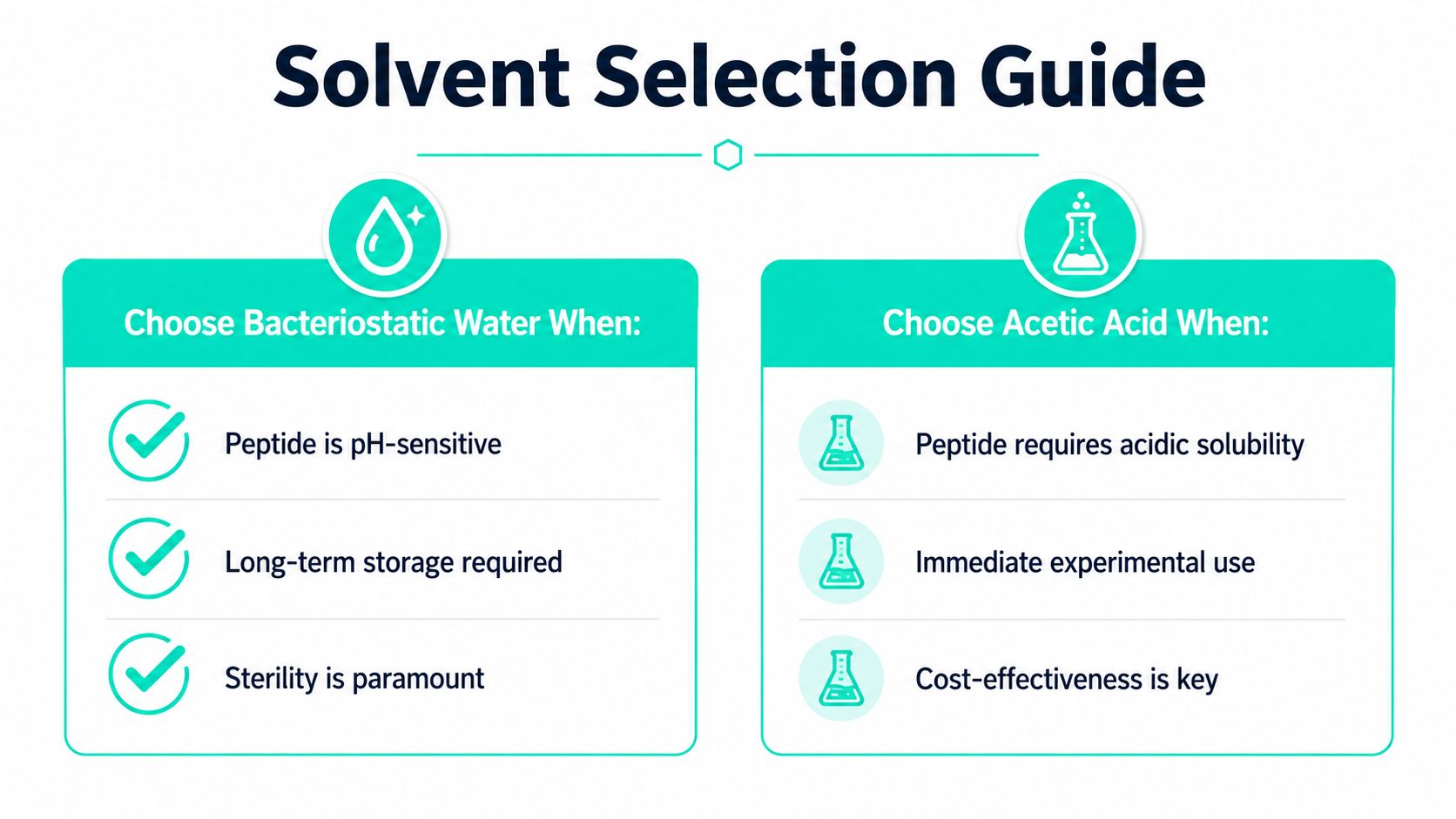
Choose bacteriostatic water when the peptide dissolves readily in a near-neutral medium and you need multidose convenience. That's the clean fit for peptides that aren't fussy about solvent environment and for workflows that depend on repeated vial access. It's the option that stays close to standard handling.
Choose acetic acid water when the peptide is hydrophobic, basic, or aggregation-prone, and you need a better chance of complete solubilization before downstream dilution. That's the specialized fit, and it's the one that earns its place when neutral handling leaves residue behind.
If the protocol is assay-sensitive to acidity, bacteriostatic water is usually the safer starting point. If the priority is getting a stubborn peptide fully into solution, acetic acid water is often the more practical route. Those two goals don't always line up, and that's where the judgment lives.
A simple decision frame helps:
The more useful question isn't “What solvent do we usually use?” It's “What does this sequence need?” Recent guidance has moved in that direction by treating acetic acid as a compound-specific exception rather than a universal substitute. That's the right mindset, because peptide behavior comes from chemistry, not tradition.
Yes, some researchers dilute acetic acid water with bacteriostatic water to create a more moderate environment, especially when they want a compromise between acidic solubility and handling comfort. The trade-off is straightforward. As the solution becomes less acidic, you lose some of the solubilization advantage that made acetic acid useful in the first place.
That makes documentation essential. If you deviate from a standard acidic reconstitution, record the final solvent blend and the peptide's appearance after mixing. Without that, you're left with a result you can't reliably reproduce.
No. Acid-sensitive assays, especially enzymatic or receptor-binding workflows, may not tolerate the acidic environment well. In those cases, you may need to neutralize after reconstitution or use bacteriostatic water from the start if the peptide cooperates.
The important distinction is between reconstitution compatibility and assay compatibility. A solvent can help you dissolve the peptide and still be wrong for the experiment that follows.
Treat it as a fresh-use solution unless your local protocol says otherwise. There's no preservative to support long holding, so a long fridge interval is a bad habit unless you've validated it for that specific peptide. Some labs keep fresh acidic solutions refrigerated for a short period with monitoring, but that should never become a casual default.
If you're choosing acetic acid, plan the downstream work before you reconstitute. The solvent is solving a solubility problem, not buying you storage convenience.
It makes sense when a peptide remains partially dissolved after standard neutral reconstitution and still resists a straightforward acidic approach. That usually points to a hydrophobic sequence or one with an awkward aggregation tendency. In that situation, a small pre-mix can be a reasonable troubleshooting step, provided you keep the process tight and document every move.
The most reliable decision is still the simplest one. Start with the peptide's chemistry, choose the solvent that matches it, and don't force a universal rule onto a compound that clearly doesn't want one.
Celonyx Labs supplies research peptides and a 10mL bacteriostatic water product for reconstitution and dilution of lyophilized compounds, so it's a relevant place to source materials when your workflow depends on clean handling and clear documentation. If you're building or revising a peptide reconstitution protocol, visit Celonyx Labs and compare the available options against the chemistry of the peptide you're working with.
You're comparing two bottles on a supplement shelf. One says 500 mg glutathione. The other
Is bacteriostatic water the same as sterile water? No. Compare preservatives, vial handling and peptide
How do you know if a peptide vial has gone bad? Quarantine changes, check storage
FOR RESEARCH USE ONLY. Products sold by Celonyx Labs are intended exclusively for laboratory and scientific research. They are not intended for human or veterinary use, consumption, diagnosis, treatment, cure, or prevention of any disease. By purchasing from this site, you acknowledge that you understand the intended research purpose of these materials and agree to comply with all applicable laws and regulations.