

Sermorelin vs Tesamorelin: A 2026 Research Comparison
Tesamorelin and sermorelin are compared for the same reason that weak evidence gets mistaken for

You're probably holding a vial, a spreadsheet, or a protocol draft, and the label says TB-500. The next question is the one that matters in the lab: what's in the tube, what evidence exists for that material, and what can you claim once you start running assays.
That's where most confusion starts. Thymosin beta 4 and TB-500 get blurred together online, but they're not the same thing, and they don't carry the same evidence base. If you're onboarding a new project, the safe move is to separate the parent peptide from the research-market fragment, then verify the exact construct before you compare results or build a story around them.
A new vial lands in the receiving area. The label says TB-500, the packing slip says peptide, and the postdoc at the bench asks the only question that matters before anyone touches the aliquot rack, what exactly are we testing?
That question is more than paperwork. If the material is being treated as a stand-in for thymosin beta 4, the team has to know whether the sequence, length, and N-terminal state match the assumptions in the protocol. If the vial is a shorter fragment, then the assay is being run on a different molecule, even if the product name looks familiar.
Practical rule: never let a product name do the work of identity confirmation.
The simplest way to stay out of trouble is to treat TB-500 as a research-market label, not as a universally standardized peptide. That label often travels with expectations about repair biology, but expectations don't equal equivalence. The same name can hide differences in sequence length, acetylation, and mass that affect how the material behaves in solution and in a cell-based readout.
This guide follows the questions a lab manager would ask on day one. What is the parent peptide? What does the fragment preserve? Why do published human data on the full-length molecule not transfer cleanly to the fragment? And what should you verify on the COA before anyone starts an assay? If you've ever had to explain to a trainee why a vendor page is not a methods section, you're in the right place.
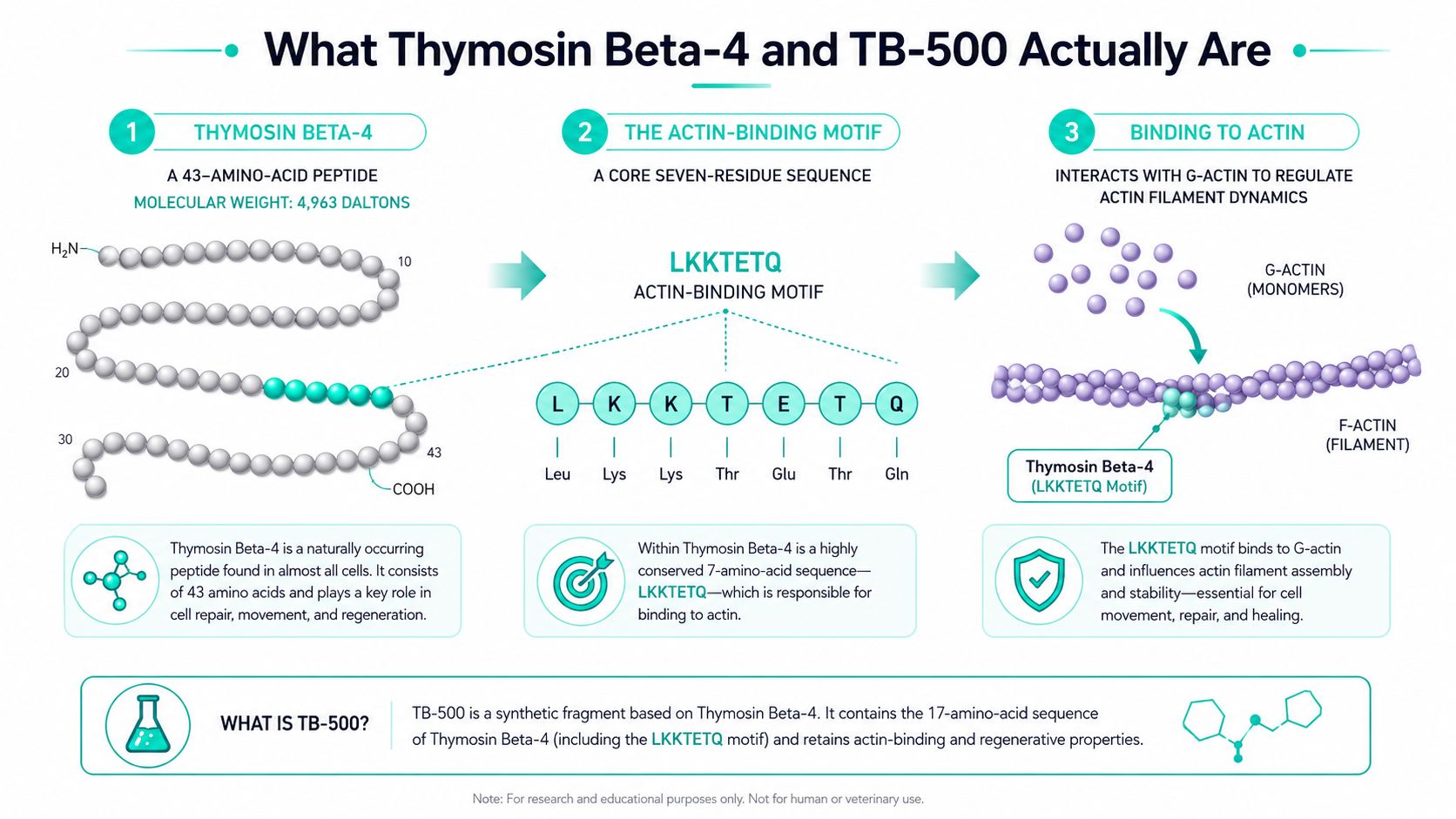
The cleanest way to understand thymosin beta 4 TB 500 is to start with the parent molecule. Thymosin beta-4 (Tβ4) is a naturally occurring 43-amino-acid peptide with an estimated molecular mass of about 4,963 daltons. In human research, the TB-500 fragment is described as the 7-amino-acid Ac-LKKTETQ sequence spanning residues 17 to 23, weighing roughly 889 daltons. That size gap matters because a short fragment can keep the core actin-binding motif while losing parts of the full-length context that shape behavior in assays. Source material on Tβ4 and the TB-500 fragment
The phrase G-actin-sequestering sounds dense, but the idea is straightforward. G-actin is the monomeric form of actin, the building block cells use to assemble their internal scaffold. When thymosin beta-4 binds that pool of monomeric actin, it helps control how much actin is available for filament formation, which affects cell shape, movement, and repair-related behavior.
That's why the LKKTETQ motif keeps appearing in product descriptions. It's the part most closely tied to actin binding, so fragment vendors often preserve it in a shortened or re-labeled construct. The problem is that preserving a motif is not the same as preserving the whole biological context. A fragment can keep a key interaction and still diverge in solubility, signaling behavior, and assay performance.
Working assumption: if the sequence is shorter, the biology may be narrower, even when the marketing copy sounds broad.
The practical takeaway is simple. Thymosin beta-4 is the parent peptide. TB-500 is the research-market label usually attached to a fragment or analog built around the actin-binding region. If someone uses the names interchangeably without checking the sequence, the experimental comparison is already shaky. If you want a more detailed side-by-side framing, the comparison at TB-4 vs TB-500 is useful as a reference point, but the key lab habit is still the same, verify the molecule, not the nickname.
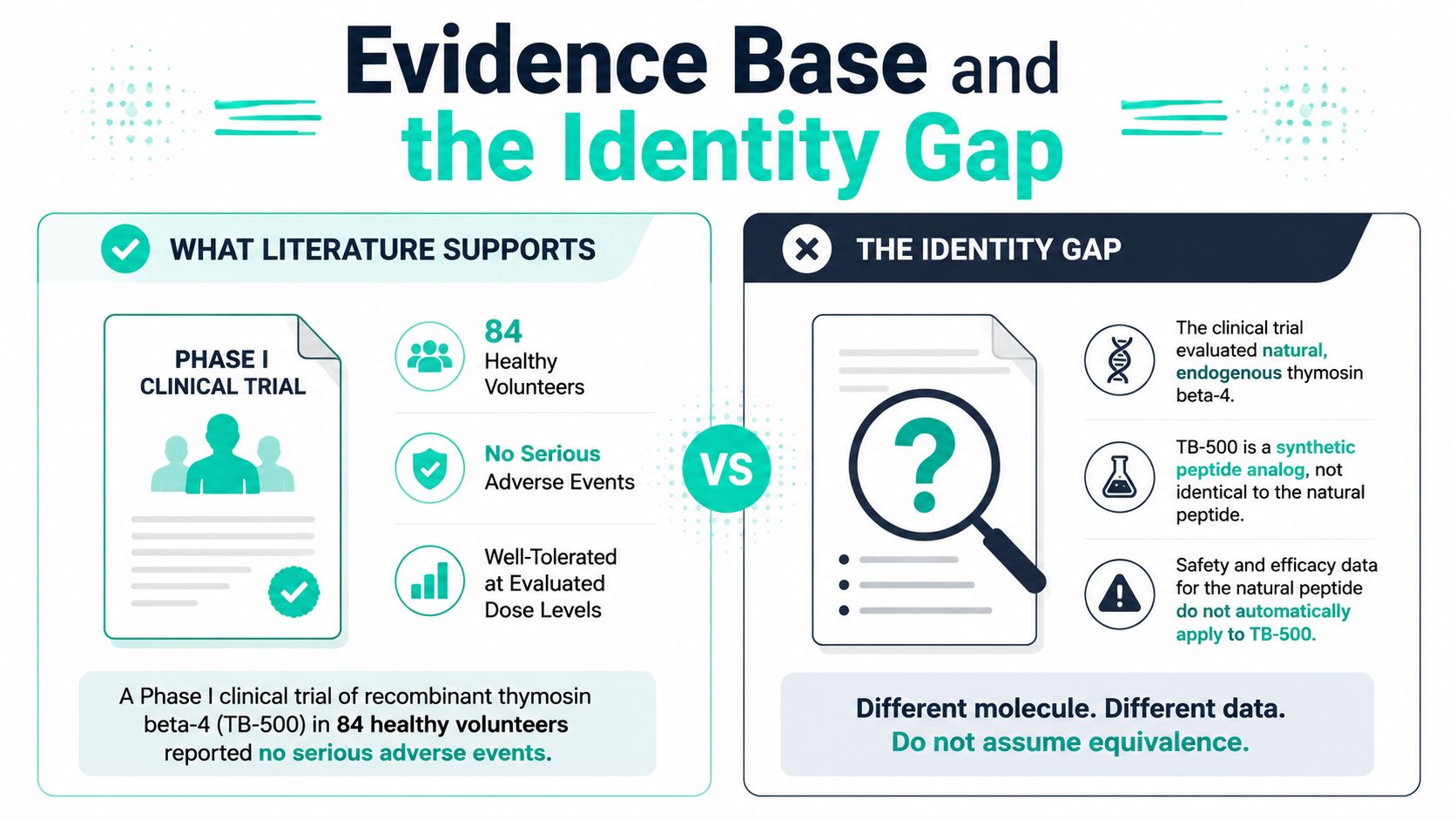
A new vial can look straightforward until the label and the sequence stop agreeing with each other. That problem shows up fast with thymosin beta-4 and TB-500, because the strongest human evidence sits on the full-length peptide, while the research-market label often points to a shorter construct that is not the same material.
The clearest human safety data come from a Phase I trial of recombinant Tβ4 in 84 healthy volunteers. The study used single doses up to 25 μg/kg and multiple doses up to 5 μg/kg daily for 10 days, and it reported no serious adverse events or dose-limiting toxicity. Human safety data for thymosin beta-4
That trial is useful, but only inside its own lane. It tells you something about the parent peptide in a controlled human setting. It does not establish that a shorter TB-500 construct behaves the same way in circulation, reaches the same tissues, or carries the same risk profile.
That is the identity gap. Product pages often blur the line, but the published human clinical literature still centers on the 43-amino-acid parent peptide, while TB-500 is sold as a short synthetic fragment. Bioequivalence between them has never been measured, so any claim that human results transfer from thymosin beta-4 to TB-500 is an inference, not a demonstrated fact.
The practical consequence is simple. A lab can use thymosin beta-4 literature to frame a hypothesis, but it cannot treat fragment-specific human efficacy as established. Current review summaries still describe TB-500 as having no published controlled human efficacy trial, no validated human dosing protocol, and no FDA-approved indication, while the strongest human evidence for thymosin beta-4 remains narrow and formulation-specific, especially in ophthalmic settings. Current review summary
For experimental design, this means one thing: use the parent-molecule evidence as background, then verify that the material on the COA matches the construct your assay actually needs.
A second way to frame it is comparability. Two materials can share a motif and still behave differently enough to break a cross-study claim. That is why this topic confuses new researchers, the label looks familiar, but the evidence chain does not line up cleanly.
Researchers usually reach for TB-500 when they want a peptide tool that sits close to tissue repair biology. In practice, that means the assay question comes first, and the peptide is the variable under study, not a promise of outcome.
In wound healing and dermal work, the relevant question is often whether a construct changes cell migration, closure rate, or matrix behavior in a controlled model. In muscle and soft tissue studies, the focus may be on regeneration markers, local repair signaling, or histology after injury. In cardiac and vascular settings, researchers tend to ask whether actin-related signaling or progenitor-linked responses shift after damage.
Ophthalmic research sits in a different category because the human literature is strongest there for the parent molecule, not the fragment. That makes it a useful biological comparator, but not a shortcut for fragment claims. If a protocol is borrowing ideas from eye research, the team should state that explicitly and keep the molecule distinction intact.
A clean preclinical plan usually follows a simple sequence.
That order matters because it stops the team from picking endpoints that flatter the peptide instead of testing the hypothesis.
A peptide is not a conclusion. It's one variable inside a model, and the model has to earn the claim.
If the lab is using TB-500 as a tool, the most defensible posture is to describe it as a fragment used to probe repair-related pathways. If the lab is using thymosin beta-4 literature as background, keep the parent molecule separate in the discussion section and don't let the two blur together in the results narrative.
A COA should do more than reassure someone that a vial shipped on time. It should let you answer, with confidence, whether the material matches the construct you think you ordered.
The first thing to check is the exact sequence. Published technical specifications for thymosin beta-4 list the 43-amino-acid sequence Ac-SDKPDMAEIEKFDKSKLKKTETQEKNPLPSKETIEQEKQAGES, molecular formula C212H350N56O78S, and molecular weight around 4,963 Da, with the LKKTETQ actin-binding motif preserved in common TB-500 product descriptions. Published thymosin beta-4 specifications
That means a generic “high purity” line item is not enough. You need the sequence, the stated mass, and the modification state. If the vendor says “acetylated fragment” but the COA doesn't say where the truncation begins or ends, you don't have a clear identity record. If the mass doesn't match the construct, the vial is not ready for comparison work.
| COA Fields Every Lab Should Verify Before Use | What to look for | Why it matters |
|---|---|---|
| Lot number | A unique batch identifier tied to the vial | You need traceability if results need review later |
| Sequence statement | Exact amino acid sequence and truncation points | Confirms you're testing the intended construct |
| N-terminal status | Acetylated, free, or otherwise modified | Modification state can change behavior and comparability |
| Molecular mass | Stated mass that fits the declared sequence | Helps catch mislabeling or swapped constructs |
| Analytical method | Identity confirmation method, ideally mass spectrometry | Shows how the vendor verified what's in the tube |
| Purity profile | Main peak plus impurity or minor peak information | Lets you judge whether contaminants could affect the assay |
| Test date | Recent enough to be meaningful for the batch | Older paperwork can be a weak proxy for current material |
| Storage guidance | Conditions for keeping the peptide stable | Protects the vial before and after opening |
The useful COA details are often the least glamorous ones. If the document doesn't connect the lot number to the analytical result, the identity claim is weaker. If the sequence is implied rather than written, the document is doing marketing work, not audit work. If you need a model for tighter supplier documentation, the checklist at third-party tested peptides is a helpful benchmark for what a serious paperwork trail should look like.
A peptide can be analytically correct and still fail you if the receiving and handling steps are sloppy. The first job is to protect the material before anyone starts mixing solvents or opening a chain of custody gap.
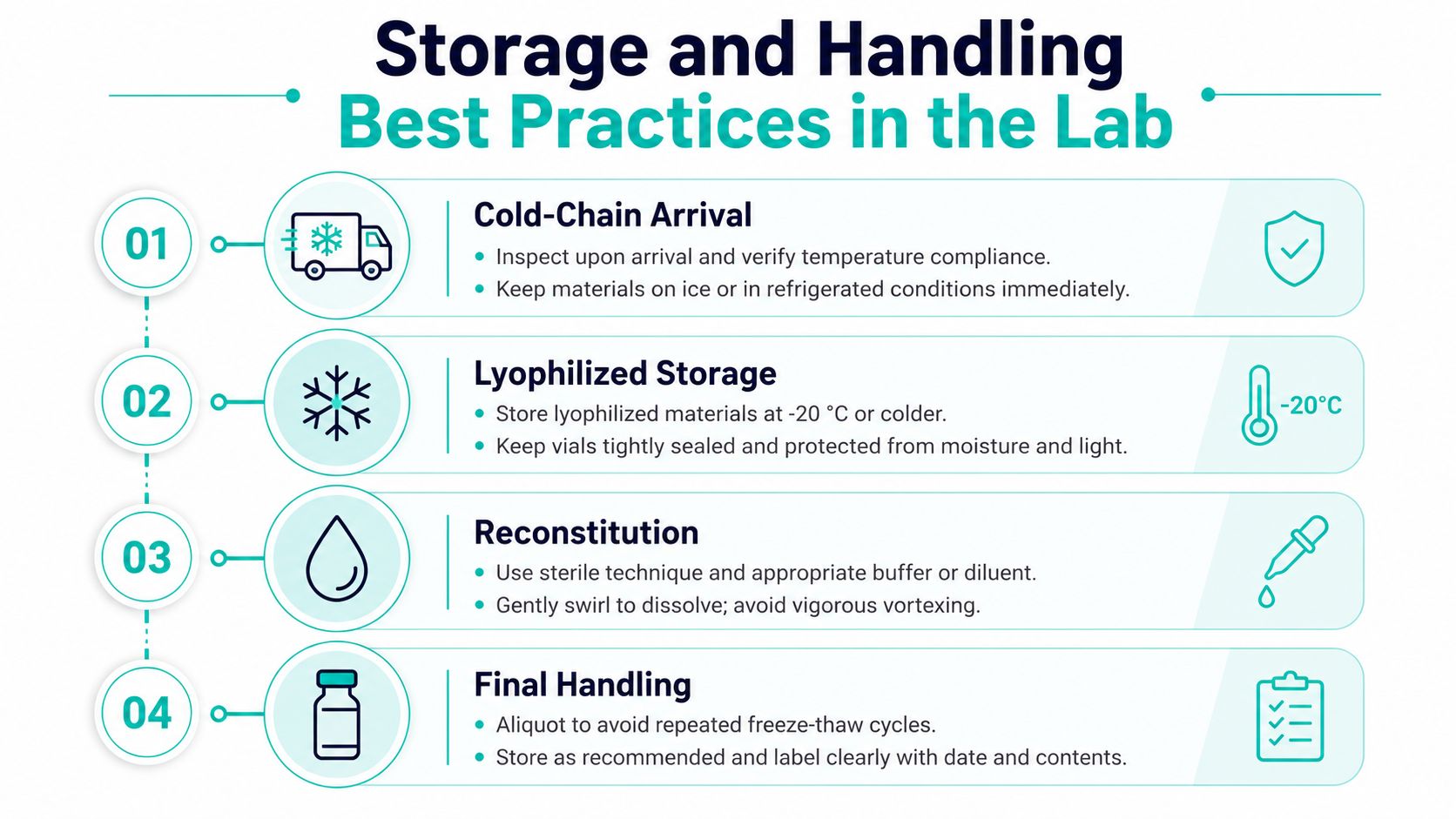
When the shipment arrives, confirm the cold-chain condition and log the receiver, date, and lot number immediately. Lyophilized peptide is usually kept cold until use, and once the vial is opened, the lab should treat the clock as started. Reconstitution should be done with the solvent your protocol specifies, then the material should be aliquoted so repeated freeze-thaw cycles don't become part of the experiment.
If you're tracking multiple studies at once, label each aliquot with the lot, date, and intended use. That sounds basic until someone finds a half-used tube with no date and no initials. At that point, the assay problem becomes a records problem.
The handling log should answer four questions without anyone needing to guess.
If a vial isn't traceable after the fact, it wasn't handled well enough for research use.
Working solutions should be treated as temporary materials unless the protocol or vendor documentation says otherwise. That's especially important for experiments that depend on consistent concentration across multiple runs, because a small handling error can look like a biological effect if the recordkeeping is weak. A good bench habit is to assume the audit trail will matter later, because it usually does.
Procurement is where the science meets the paperwork. TB-500 is sold for research purposes only, so the sourcing team should evaluate it the same way they'd review any other lab reagent that needs traceability, documentation, and a defensible chain of custody.
A serious supplier should give you more than a checkout button. You want clear product categories, accessible policies for shipping and returns, contact information that a real person can answer, and documentation that connects the batch to third-party testing. If a vendor won't show you how they handle a problem before the order goes out, they're not helping you after the order lands either.
For a practical example of how a supplier can organize its sourcing language, this GMP-adjacent research peptide guide shows the kind of information buyers usually want to see in one place.
The bigger point is compliance, not branding. A lab that documents supplier review, lot acceptance, and storage conditions is in a much stronger position than a lab that treats peptide buying like a casual online purchase. That's true whether the final use is a cell assay, an animal study, or a method-development project that has to survive internal review.
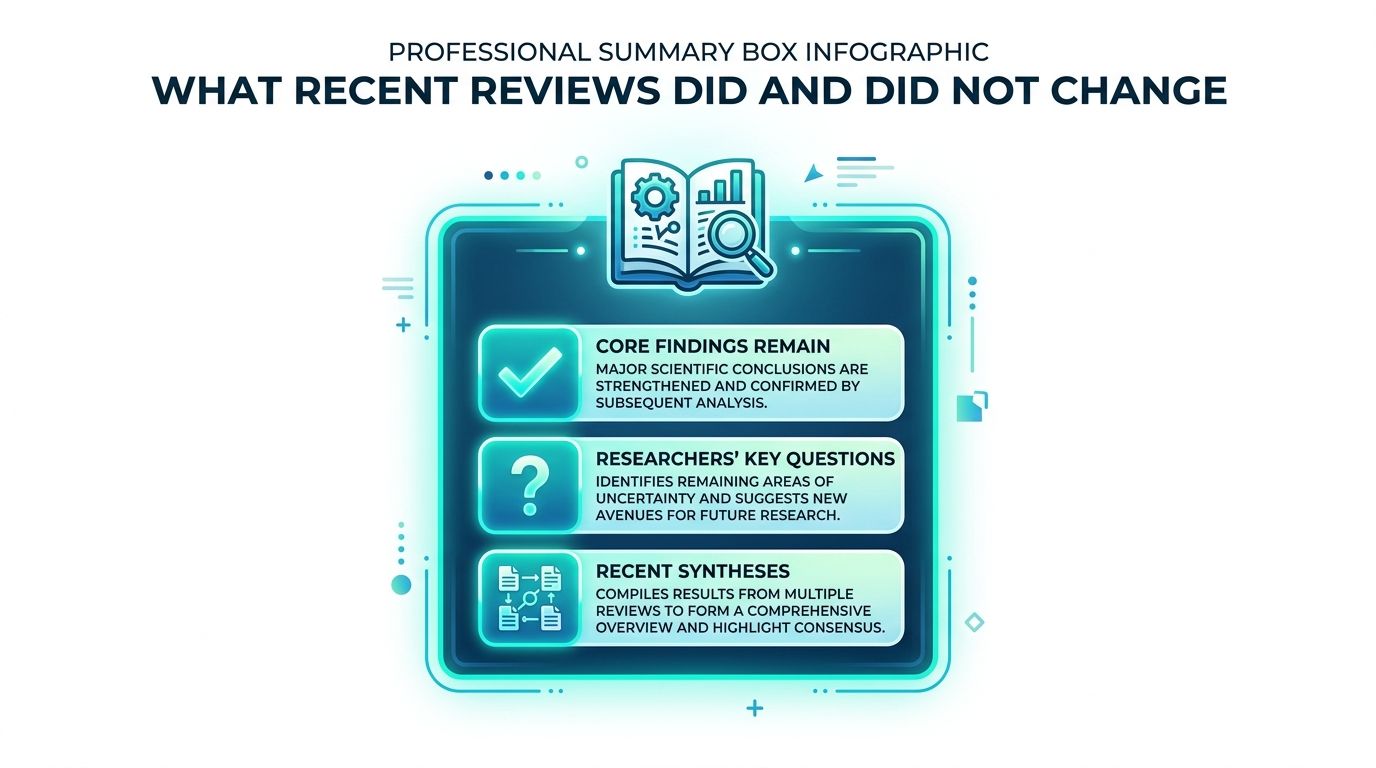
A recent review sweep did not erase the identity gap between thymosin beta-4 and TB-500. It mostly made that gap harder to ignore. For a lab that has to decide what is in a vial, the message is unchanged, the fragment still has no published controlled human efficacy trial, no validated human dosing protocol, and no FDA-approved indication, while the clearest human signal remains tied to thymosin beta-4 in ophthalmic contexts rather than broad systemic recovery claims. Recent synthesis summary
The practical question is whether a newer review changes how you should write or run a protocol. For TB-500 work, it does not. If your study uses the fragment label, the safest read is still that you are handling a research tool, not a clinically validated stand-in for the full-length protein.
Another common question is whether thymosin beta-4 trial data can be used to support TB-500 claims. That background can help with biology, but it does not transfer cleanly to the fragment. The identity gap is still the sticking point, and that is where people get into trouble when they treat the two names as if they mean the same thing.
Bottom line: if you are writing, presenting, or planning around TB-500, keep the claims narrow, keep the molecule name precise, and keep the evidence chain visible.
The short FAQ stays short. Is it a standardized clinical peptide? No. Does the literature support fragment-specific human efficacy? Not yet. Should a lab treat the parent molecule and the fragment as interchangeable? No.
If your team needs a source for research-grade peptide procurement, documentation, and product selection, Celonyx Labs offers an online catalog, third-party testing references, and published ordering policies that fit the kind of traceability a lab needs. If you are building a TB-500 workflow, start there, then bring the vial, the COA, and the protocol back to the bench with the identity question already answered.
Tesamorelin and sermorelin are compared for the same reason that weak evidence gets mistaken for

The shortest insulin syringe needle now used in mainstream practice is 6 mm, and a

Popular advice treats tesamorelin like a universal fat-loss or anti-aging peptide. That framing is too
FOR RESEARCH USE ONLY. Products sold by Celonyx Labs are intended exclusively for laboratory and scientific research. They are not intended for human or veterinary use, consumption, diagnosis, treatment, cure, or prevention of any disease. By purchasing from this site, you acknowledge that you understand the intended research purpose of these materials and agree to comply with all applicable laws and regulations.