
Best GHK-Cu peptides for skin and wound healing research 2026
Choose the best GHK-Cu peptide format for laboratory skin and wound-healing research. Compare documentation, assay
You open the freezer, pull out a vial that looked perfect on paper, and still the assay won't behave. Replicates drift, controls wobble, and the batch that should have been routine starts looking like the problem. In a lot of labs, that's the moment people realize a supplier's purity claim is not the same thing as independent verification.
That gap is exactly why third party tested peptides matter. A strong test report acts like an outside referee, checking purity, identity, and whether the exact batch in your hand matches the document you were sent. For researchers, that difference protects reproducibility, saves time, and keeps procurement decisions tied to evidence instead of marketing language.
A lab can lose days to a problem that started with one vial. The peptide looked fine, the supplier's page looked polished, and the COA looked official enough to file away. Then the experiment came back inconsistent, and only after the fact did anyone ask whether the report was tied to the actual batch that was opened.
That is why third party tested peptides have become a serious procurement topic in research settings. Independent testing gives buyers a separate check on purity, identity, and batch-specific consistency, instead of asking a vendor to validate its own material. A strong COA should identify the testing lab, match the lot number on the vial, and include HPLC purity and mass spectrometry confirmation. For a broader primer on the materials being procured, Learn more about what research peptides are and how they are used, so the label on the vial is considered alongside the documentation that supports it (source guidance).
Treat every peptide purchase like a traceability exercise, not a checkout step. The useful question is not just whether a test exists, but whether the document proves that the vial in hand was tested, by whom, and for which batch. A supplier can hand over a polished PDF, yet that file is only useful if it follows the exact material that entered the lab.
A careful buyer reads a COA the way a good technician reads a chromatogram, with skepticism, attention to detail, and an eye for mismatch. That habit matters because reproducibility starts long before the assay plate is loaded. It starts at receiving.
Supplier testing and third-party testing serve different purposes. Supplier testing is an internal claim, while third-party testing is an outside verification of the material you are about to buy. In peptide procurement, that independence matters because the report is only useful if the lab, the lot, and the product line up exactly.
A practical batch-specific COA should identify the testing laboratory, match the lot number on the vial, and show the analytical results for that exact batch. A good procurement file should also make clear whether the lab is independent, because a report generated by the seller carries a different weight than one produced by a separate lab. If you want a closer look at how impurity data is organized on these reports, see this guide to peptide impurity profiling methods. One established benchmark says ≥95% purity is generally acceptable for most research use, while ≥99% purity is preferred when the work is sensitive or quantitative (quality-control guidance). Another operational benchmark is ISO 17025 accreditation, which is widely treated as the standard for analytical competence in third-party labs.
Practical rule: if the report does not name the lab and tie the data to the exact lot, it is not a strong procurement document.
That distinction gets missed because “third party tested” is often used as a broad marketing phrase. In practice, the phrase can cover very different setups depending on the vendor's process, the lab's independence, and how much of the sample was examined. Some reports are little more than purity snapshots, while stronger frameworks also include confirmatory identity work and other checks that help show the vial in hand matches the document.
Those are separate questions, and they should stay separate in your mind. A material can look clean by one measure and still fail another. That is why researchers should read the words on the COA as carefully as the numbers on it.
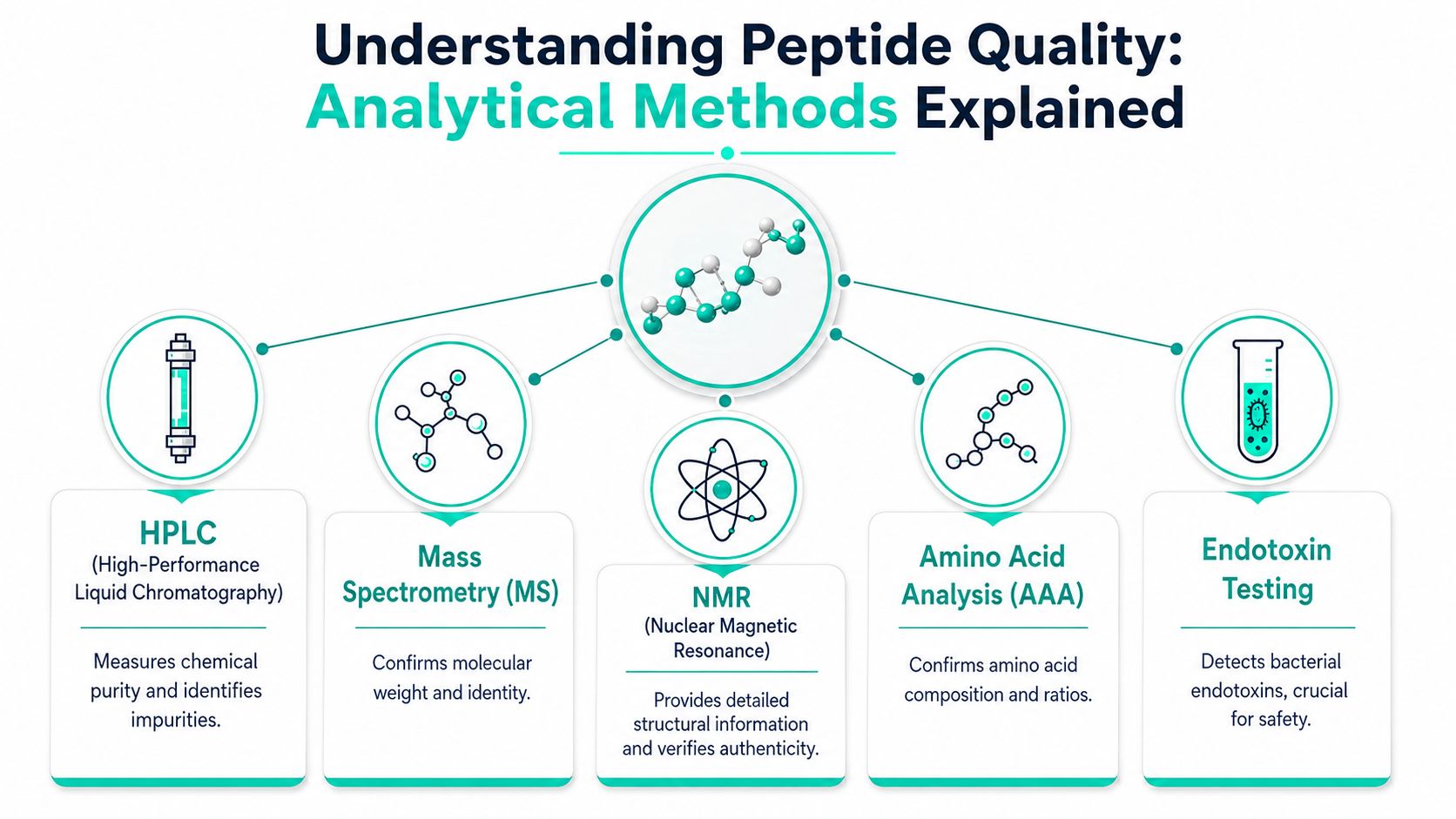
A peptide COA is strongest when the methods line up like a set of lab checkpoints. HPLC asks whether the sample is chemically clean. Mass spectrometry checks whether the molecule in front of you is the one you expected. NMR, AAA, and endotoxin testing add more context, which matters when a vendor claims independence but the report only shows a narrow slice of the sample.
That is why method choice matters as much as the headline purity number. A chromatogram can look tidy while leaving the identity question open, and a mass spectrum can support identity without fully describing impurity burden. Researchers who buy third party tested peptides should read the method list as a workflow, not a menu.
| Method | What It Measures | Key Indicator |
|---|---|---|
| HPLC | Chemical purity and impurity profile | Main peak area, impurity peaks |
| Mass Spectrometry | Molecular weight and identity | Expected mass match |
| NMR | Structural information and authenticity | Pattern consistent with the expected structure |
| Amino Acid Analysis | Amino acid composition and ratios | Composition matches the sequence |
| Endotoxin Testing | Bacterial endotoxin presence | Safety-related contamination check |
Each method answers a different procurement question. HPLC is the first pass, like checking whether a vial looks clear before you begin an assay. Mass spectrometry follows the chain of custody from report to molecule. NMR and amino acid analysis are more like cross-checks, useful when a buyer wants another layer of confirmation that the sample matches the claimed structure and sequence. Endotoxin testing sits in a different category, because it addresses contamination that can affect downstream work even when purity appears high.
For teams that want a cleaner picture of impurity work, See a detailed impurity-profiling overview is a useful companion to the main analytical methods. It helps explain why a single pass through one instrument does not settle every question a buyer should ask.
A defensible COA should also be batch-specific, with the sample tied to the exact lot you received and the report signed by a lab that can stand apart from the seller. In practice, that means looking for HPLC purity, mass-spectrometry identity, residual-solvent/TFA quantification, endotoxin testing, and an independent signature, rather than relying on a polished summary page alone. A useful reference point is the buyer-reference framework, which places method transparency and lot traceability at the center of procurement review.
A report that skips identity testing can still look polished. Smart buyers read the method list, not just the headline purity number.
A COA should read like a chain-of-custody record, not a polished attachment meant to calm a buyer at a glance. Start with the batch number. It is the link between the vial on your bench and the results on the page, like the label on a freezer box that lets you trace one tube back to one sample. If the number does not match, stop there, because the rest of the report may belong to a different lot entirely.
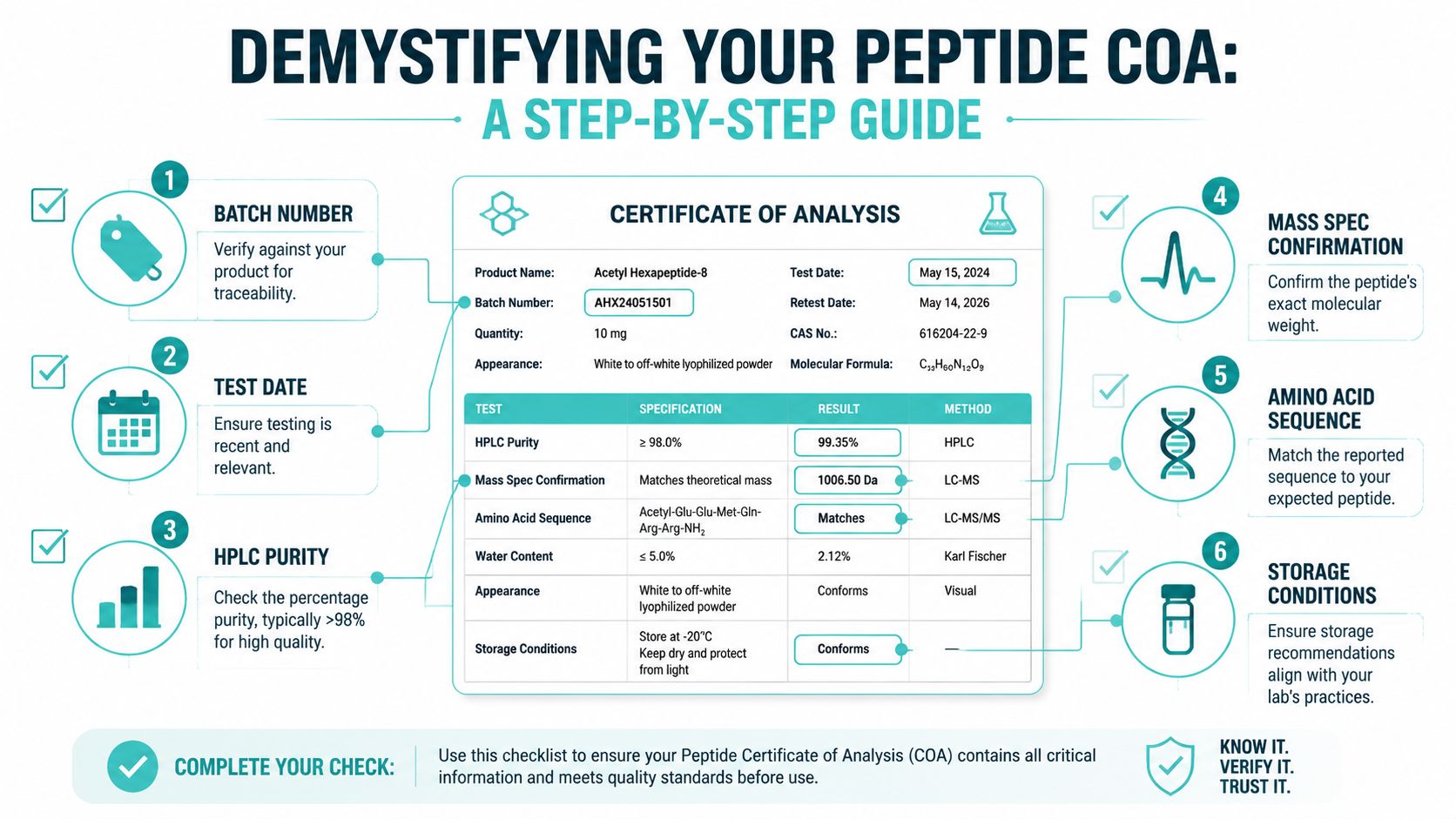
A defensible COA for research peptides should be tied to the exact lot and show HPLC purity, mass-spectrometry identity, residual-solvent/TFA quantification, endotoxin testing, and an independent signature. A COA framework helps buyers check whether the document contains enough method detail to support the claim on the summary page. If the report only gives a percentage and leaves out the supporting data, treat it as incomplete rather than reassuring.
A common mistake is confusing purity with peptide content. Many synthetic peptides are supplied as TFA salts and may contain only 70–90% peptide by weight, with the rest coming from counter-ions and residual moisture, as explained in content-versus-purity guidance. That matters for concentration calculations, especially in quantitative work. A vial can look highly pure on paper and still contain less peptide mass than a buyer expects if the report is read too casually.
The other mistake is accepting a generic report. A COA that is not lot-specific cannot show whether the vial on the bench is the same batch that was analyzed. If the testing date is far earlier than the product you received, or the lab name is missing, ask for the missing fields before you treat the document as usable. If you are comparing supplier paperwork during procurement, a structured buying guide for research peptides can help you line up the report with the rest of the order record.
Vendor verification is where procurement moves from theory to practice. A supplier can say the right things and still leave gaps in the paperwork, so the buyer needs a repeatable checklist. Start with the lab behind the report, not the marketing copy around it.
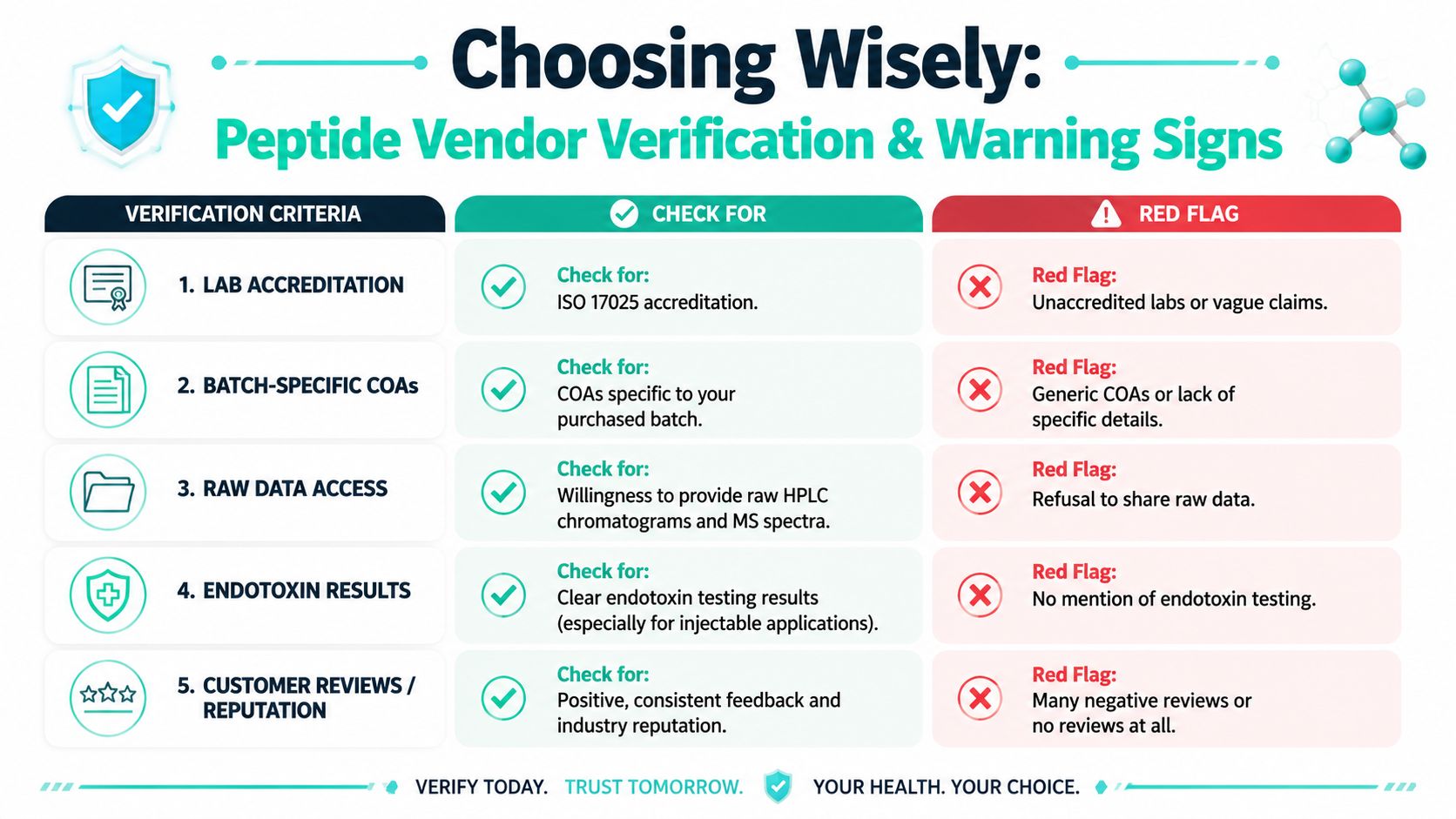
The first question is whether third party tested means a lab that is independent, tied to the right batch, and current enough to matter. If a vendor uses the phrase loosely, the label can sound reassuring while the paperwork stays thin. For a practical buying workflow, see our guide on how to buy peptides online and compare each step with the documents a supplier provides.
If a vendor can't name the testing lab without hesitation, that's a warning sign.
A useful test is to ask whether the report could stand on its own if the product label disappeared. A generic purity statement, missing lab credentials, or an old test date does not tell you whether the vial on your bench matches the sample that was analyzed. If the supplier will not share raw data when your SOP or internal review calls for it, the report is acting more like a brochure than a verification document.
The weight issue matters too. For reproducibility, you need to know whether the vial's labeled mass reflects actual peptide or salt burden. Many synthetic peptides contain only 70–90% peptide by weight because of counter-ions and residual moisture, as discussed in weight-versus-content guidance. That does not automatically make the material unusable, but it does mean the number on the bottle can overstate what your assay receives.
A sound procurement workflow turns quality checks into a routine part of ordering, not a late-stage scramble. Start by asking for the batch-specific COA before purchase, while the vendor is still tied to the exact lot. If they cannot provide the document for that lot up front, pause the order and verify why the paperwork is missing.
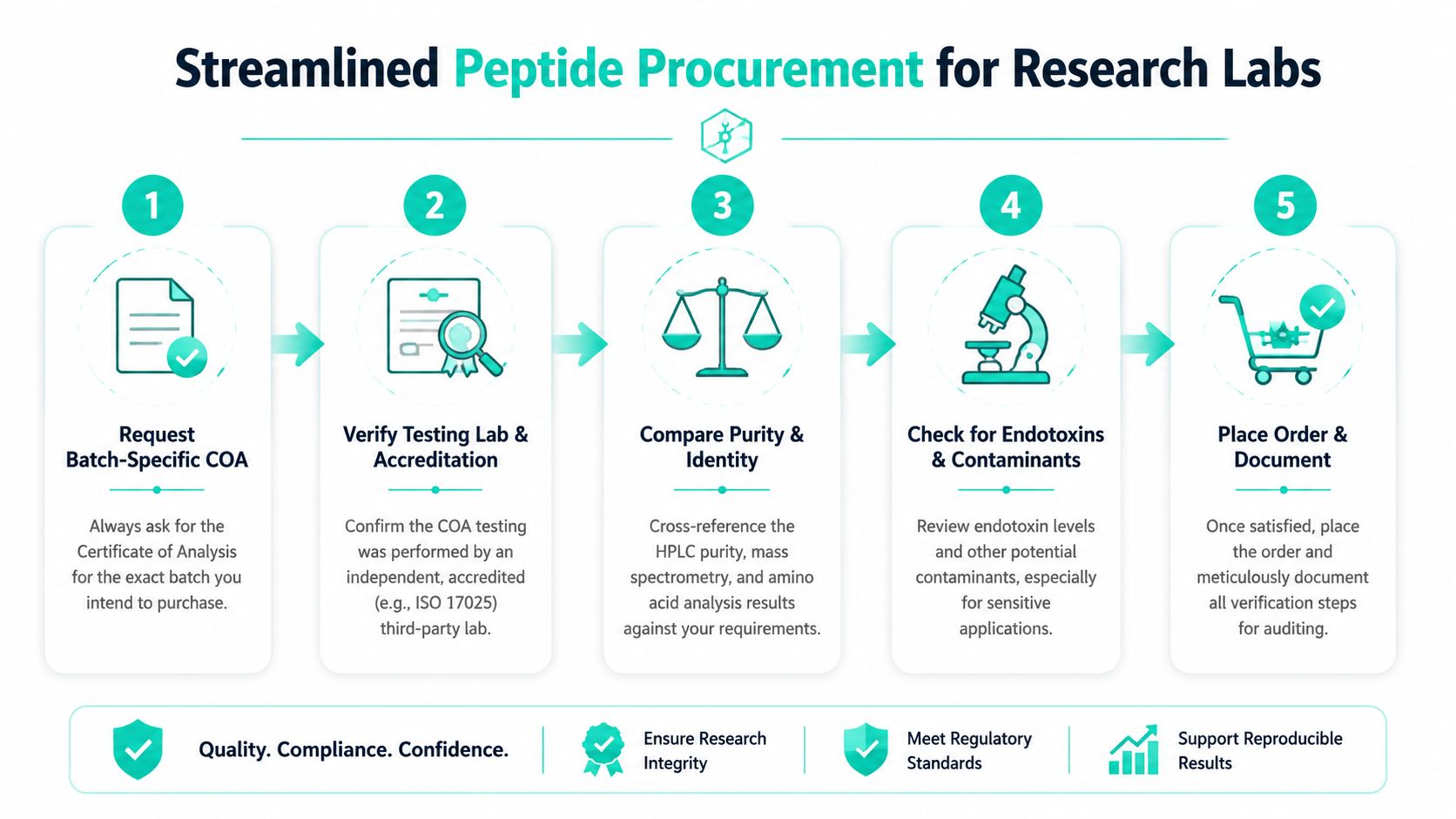
After that, verify the testing lab itself and confirm its accreditation, then compare the report's purity and identity fields with your internal acceptance criteria. A polished summary is only the cover sheet. The useful part is whether the lab can be identified, whether the data are tied to the right batch, and whether the report can stand up to internal review on its own.
That archive becomes the paper trail your team can use later. If a batch needs to be compared against a future lot, or if an audit asks how the material was qualified, the records should show the answer without guesswork. Side-by-side comparison is much easier when the original file set is complete, because memory is a poor substitute for documentation.
Some labs ask for extra confirmation for sensitive work, such as more detailed structural testing or added contaminant checks. That request is not about collecting paperwork for its own sake. It is about making procurement defensible, so the next data set rests on a clearer chain of custody than the one before it.
The best peptide procurement decisions are boring in the right way. The lab name is present, the lot number matches, the methods are visible, and the report is current enough to trust. That's what third party tested peptides should mean in practice, independent verification that supports reproducible research instead of just reassuring language.
Use the COA as a traceability tool, not a sales flyer. Check purity, check identity, and check whether the report matches the vial in front of you. If any of those pieces are missing, ask for them before the sample reaches the bench.
If your lab wants a cleaner procurement standard, start with batch-specific documentation and insist on independent verification at the point of purchase. A CTA for Celonyx Labs.
Choose the best GHK-Cu peptide format for laboratory skin and wound-healing research. Compare documentation, assay

Choose lot-verified melanotan 1 peptide for pigmentation research. Compare material specifications, purity evidence, and documentation

Native oxytocin peptide is the default for behavioral research. Compare reference standards, labeled materials, and
FOR RESEARCH USE ONLY. Products sold by Celonyx Labs are intended exclusively for laboratory and scientific research. They are not intended for human or veterinary use, consumption, diagnosis, treatment, cure, or prevention of any disease. By purchasing from this site, you acknowledge that you understand the intended research purpose of these materials and agree to comply with all applicable laws and regulations.