

Is bacteriostatic water the same as sterile water? No 2026
Is bacteriostatic water the same as sterile water? No. Compare preservatives, vial handling and peptide

Popular advice treats tesamorelin like a universal fat-loss or anti-aging peptide. That framing is too broad to be useful and too loose to be scientifically honest. The evidence supports something narrower, more interesting, and more constrained, tesamorelin peptide science is best understood as targeted visceral adiposity biology with a measurable IGF-1 signal, not as a generic body-composition shortcut.
That distinction matters because the compound's best-supported clinical signal came from the clinic, not the wellness aisle. Tesamorelin became the only FDA-approved growth hormone secretagogue on the market, and its key Phase 3 trials showed a 15–18% reduction in visceral adipose tissue (VAT) versus placebo over 26 weeks (tesamorelin clinical overview). If you're trying to judge what the molecule does, that endpoint should anchor the discussion.
The first error in tesamorelin discussions is treating a growth hormone secretagogue as if it were a general slimming agent. That framing misses the one endpoint the compound consistently supports, visceral fat reduction, and it also collapses the distinction between visceral adipose tissue and total body weight. The clinical record is narrower than the marketing language around it, and that narrowness is the point.
Tesamorelin was developed as a 44-amino-acid synthetic analog of human GHRH and was approved for a focused indication, reducing excess visceral abdominal fat in adults with HIV-associated lipodystrophy (clinical summary). That context matters because it gave investigators a defined metabolic phenotype to study, a population with abnormal central fat accumulation rather than a vague promise of body recomposition. The compound's value emerged from a pathological setting, not from generalized physique enhancement.
Practical rule: If a claim about tesamorelin does not mention visceral adiposity, GH-axis activation, or IGF-1, it is drifting away from the evidence.
The same narrowness also explains why popular summaries can mislead readers. Tesamorelin can reduce visceral fat and improve related metabolic markers, but available reviews describe it as typically weight-neutral rather than a scale-weight loss agent (tesamorelin evidence gap review). That distinction is easy to miss if someone only tracks the bathroom scale. Body weight is a blunt outcome, while visceral adipose tissue is the biologically meaningful one in this dataset.
Researchers should treat tesamorelin as a targeted metabolic intervention, not a broad anti-aging peptide. The evidence-backed reading is that it shifts where fat is stored and mobilized, with the strongest signal concentrated in intra-abdominal fat. That makes it more relevant to adipose biology and cardiometabolic risk discussions than to cosmetic fat-loss narratives.
The misconception is not just semantic. It changes study design, endpoint selection, and how results are interpreted. If a project expects large body-weight drops, tesamorelin will look underwhelming. If the project measures VAT and metabolic markers, the same compound looks far more coherent.
Tesamorelin's pharmacology starts with its structure, and that structure is doing specific mechanistic work. It is a 44-amino-acid synthetic analog of human GHRH with a hexenoyl (C6) moiety on the N-terminal Tyr, a modification documented in the FDA clinical pharmacology review (FDA clinical pharmacology review). The point of that change is straightforward. It preserves receptor affinity while increasing resistance to enzymatic degradation in human serum, which is why tesamorelin behaves differently from native GHRH.
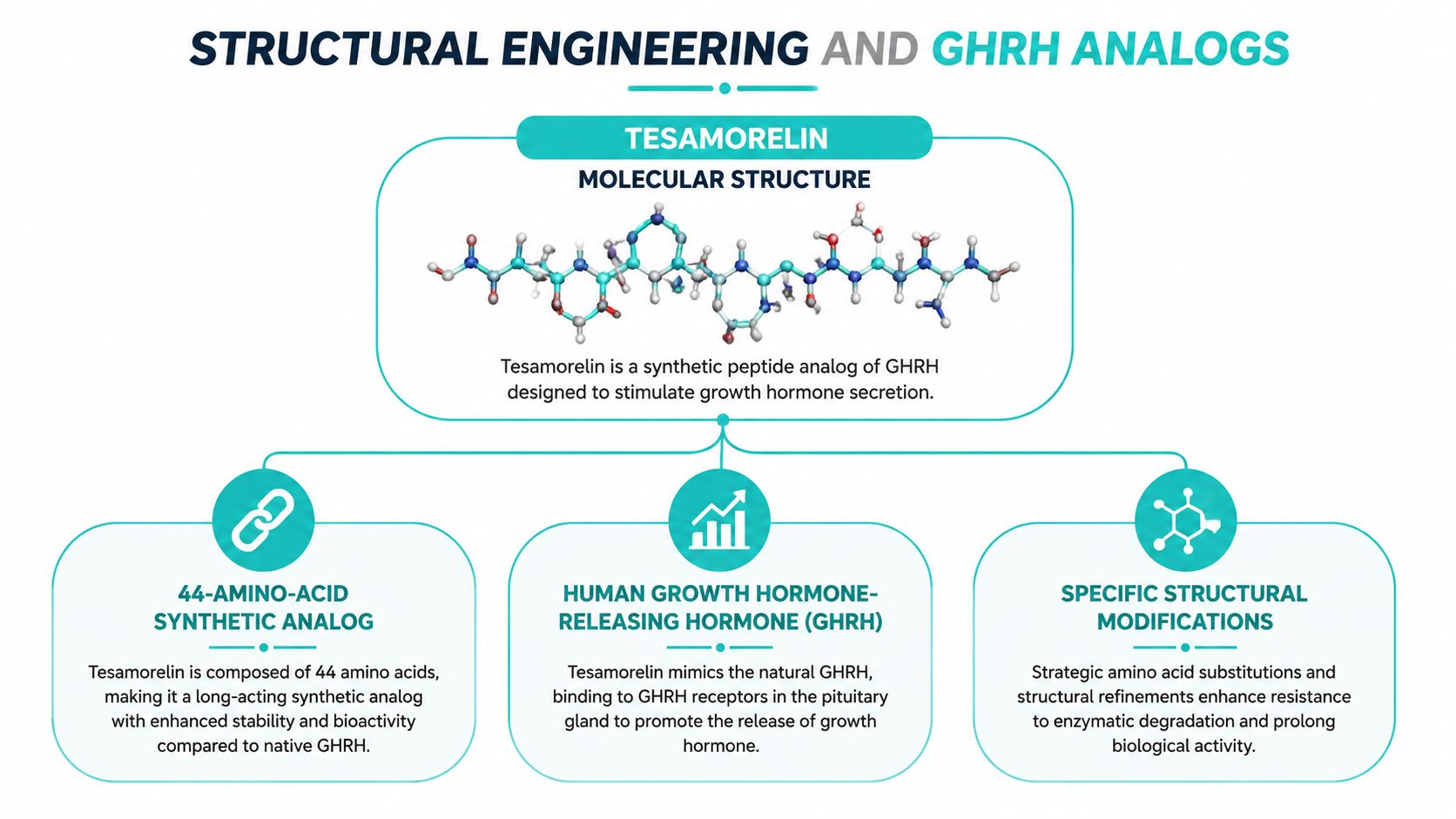
Native GHRH is short-lived in circulation. Tesamorelin was engineered to preserve the receptor logic of the endogenous axis while lasting long enough to matter pharmacologically. The FDA review states that the C6 modification increases resistance to degradation in human serum while preserving affinity at the target receptor (FDA clinical pharmacology review). In practice, that gives the peptide a more durable biologic signal without changing the basic endocrine pathway it engages.
That distinction matters because the structure does not make tesamorelin a substitute for growth hormone. It still signals upstream through the pituitary, so the body's own regulatory architecture remains active. For researchers, the compound is best described as an axis activator, not as a replacement hormone.
The relevant difference is not just stability. It is stability combined with endocrine intent. By resisting serum degradation, tesamorelin can sustain receptor engagement long enough to produce a measurable in vivo effect. By preserving the endogenous pathway, it keeps the signal within physiologic feedback logic rather than flattening it into a constant replacement profile.
For those comparing GHRH-family tools, the contrast with CJC-1295 without DAC is useful because both compounds are discussed as upstream secretagogue strategies, yet their structural choices are aimed at different duration and signaling profiles.
The molecular design is why tesamorelin can produce a more durable signal than native GHRH without abandoning pulsatile biology.
For assay planning, that structural information is useful before a sample is ever run. The expected profile is a peptide that is more durable than native GHRH, yet still governed by pituitary timing, receptor biology, and downstream endocrine feedback. That is why tesamorelin belongs in a different category from simple growth hormone replacement, and why its evidence should be read through narrow metabolic endpoints rather than broad physique claims.
Tesamorelin acts at the start of the growth hormone axis, at the pituitary somatotroph. It stimulates endogenous GH synthesis and release through the native secretory pathway, so the peptide drives the body's own signal rather than supplying GH directly. That upstream action preserves feedback control and keeps secretion tied to the pulsatile logic of the endocrine system.
The distinction matters because the biological readout is different. Exogenous GH replacement introduces a direct input, while tesamorelin asks the pituitary to generate the signal itself. If GH rises after exposure, that rise should be interpreted as an axis-activation readout, not as evidence that the compound is substituting for missing hormone.
The downstream sequence follows that same logic. LiverTox notes that GH released after GHRH-receptor activation stimulates hepatocytes to produce IGF-1, and that IGF-1 sits downstream of effects that include lipolysis and glucose handling (LiverTox and DrugBank summary). DrugBank also reports that tesamorelin increases IGF-1 and IGFBP-3, while warning that GH-axis stimulation can predispose to glucose intolerance and may raise type 2 diabetes risk (LiverTox and DrugBank summary).
That cascade is the reason the compound's most defensible metabolic endpoint is visceral fat reduction. The pituitary signal raises GH, the liver responds with IGF-1 production, and adipose tissue becomes more responsive to mobilization. The result is visceral lipolysis, a specific endocrine-linked effect, not a general claim of body fat loss.
Researchers should avoid collapsing that sequence into a simple before-and-after body-composition story. The strongest biology sits at the intersection of endocrine signaling and adipose mobilization. Ignore the GH axis, and the mechanism is missed. Ignore visceral fat, and the supported endpoint is missed.
Tesamorelin's research value comes from its time course and its readouts, not from any broad claim about what it “does” to the body. Its design supports a sustained pituitary signal relative to native GHRH, but interpretation still depends on the body's own pulsatile endocrine output. Assay timing therefore matters, because a single sample can miss a shifting hormone target.
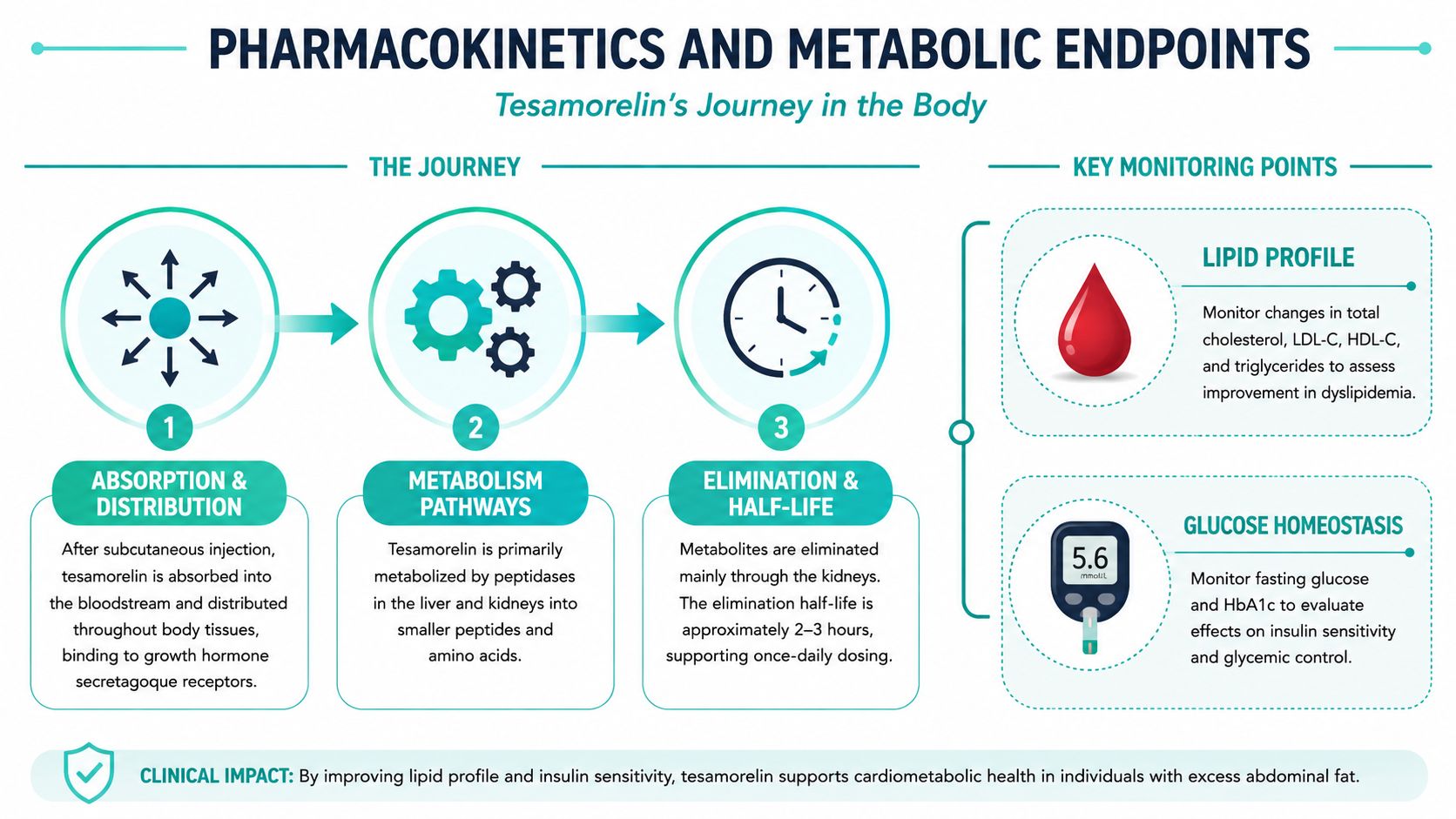
The most defensible pharmacodynamic signal is not GH in isolation. It is the hepatic IGF-1 induction that follows pituitary activation, together with the downstream lipolytic effect on visceral tissue. IGF-1 is the more stable biomarker because it integrates an upstream endocrine pulse into a measurable liver-derived output. That makes it easier to interpret than a single GH snapshot, which can be misleading if treated as a standalone endpoint.
Researchers also track IGF-1, fasting glucose, and related glycemic markers alongside body-composition endpoints, because GH-axis stimulation can worsen glucose handling in susceptible subjects. That pairing is not optional if the goal is a clean readout. The intended lipolytic effect and the unwanted metabolic stress can appear in the same study, so both have to be measured.
Monitoring rule: If IGF-1 is rising but glycemic control is also drifting, the study needs interpretation, not just enthusiasm.
GH is pulsatile, so sample timing can change the apparent magnitude of the response. A mistimed draw can understate activation or make normal variability look like noise. That is a sampling problem, not a mechanism problem.
Tesamorelin studies are better planned as endocrine experiments than as static chemistry measurements. A sensible endpoint hierarchy starts with IGF-1, then adds fasting glucose and related glycemic markers, then body-composition assessment. That order follows the biology. The liver signal is easier to capture than the GH pulse, and the adipose outcome is the distal effect that matters most for this compound's narrow metabolic profile.
Tesamorelin research rises or falls on material identity. If the peptide source is inconsistent, every downstream readout becomes harder to trust, especially when the biological effect depends on a narrow endocrine signal. Batch-specific Certificates of Analysis matter, along with identity confirmation by mass spectrometry and purity confirmation by HPLC. A useful lab workflow also includes review of the actual analytical method, and the standards for HPLC and mass spectrometry analysis help frame what a defensible package should contain.
A serious analytical package should answer three basic questions. The material has to be the right peptide. It has to be pure enough for the intended assay. It also has to be traceable enough to support later replication. Without those checks, a change in signal could come from the material itself rather than from tesamorelin biology.
For labs that buy or qualify research material, the relevant question is not marketing language, it is whether the documentation can support the experiment. Third-party testing is useful because it provides an external check on stated quality attributes, which reduces the risk that impurities become hidden confounders. The same logic applies when handling and storing the peptide, because poor reconstitution or unstable storage can distort apparent activity before the experiment even starts.
A peptide with the wrong mass spectrum or a weak chromatographic profile should be treated as suspect before it ever reaches a model system. QC is not bureaucratic compliance, it is experimental validity. If identity and purity are not established, changes in IGF-1, lipolysis, or glucose markers cannot be attributed confidently to tesamorelin itself.
The sourcing problem is especially important for compounds with real endocrine effects, because even minor contamination can blur interpretation. A batch that looks acceptable on paper but behaves inconsistently in the assay can waste weeks of work. Researchers who want a tighter analytical workflow often review dedicated HPLC and mass spectrometry analysis standards before they commit to a batch.
Lab standard: Verify identity first, then purity, then stability. Reversing that order saves nothing.
In practical terms, QC is not a separate administrative task. It is part of the mechanism story, because an unverified peptide breaks the chain between receptor binding, endocrine activation, and the metabolic endpoint being measured.
Tesamorelin's clinical history gives preclinical researchers a useful anchor, but it also defines the limit of what can be inferred. The Phase 3 trials showed a 15–18% reduction in visceral adipose tissue (VAT) versus placebo over 26 weeks. That finding matters because it identifies the endpoint tesamorelin can move with evidence behind it. It does not support broad weight-loss claims, anti-aging extrapolation, or casual extension into unrelated use cases.
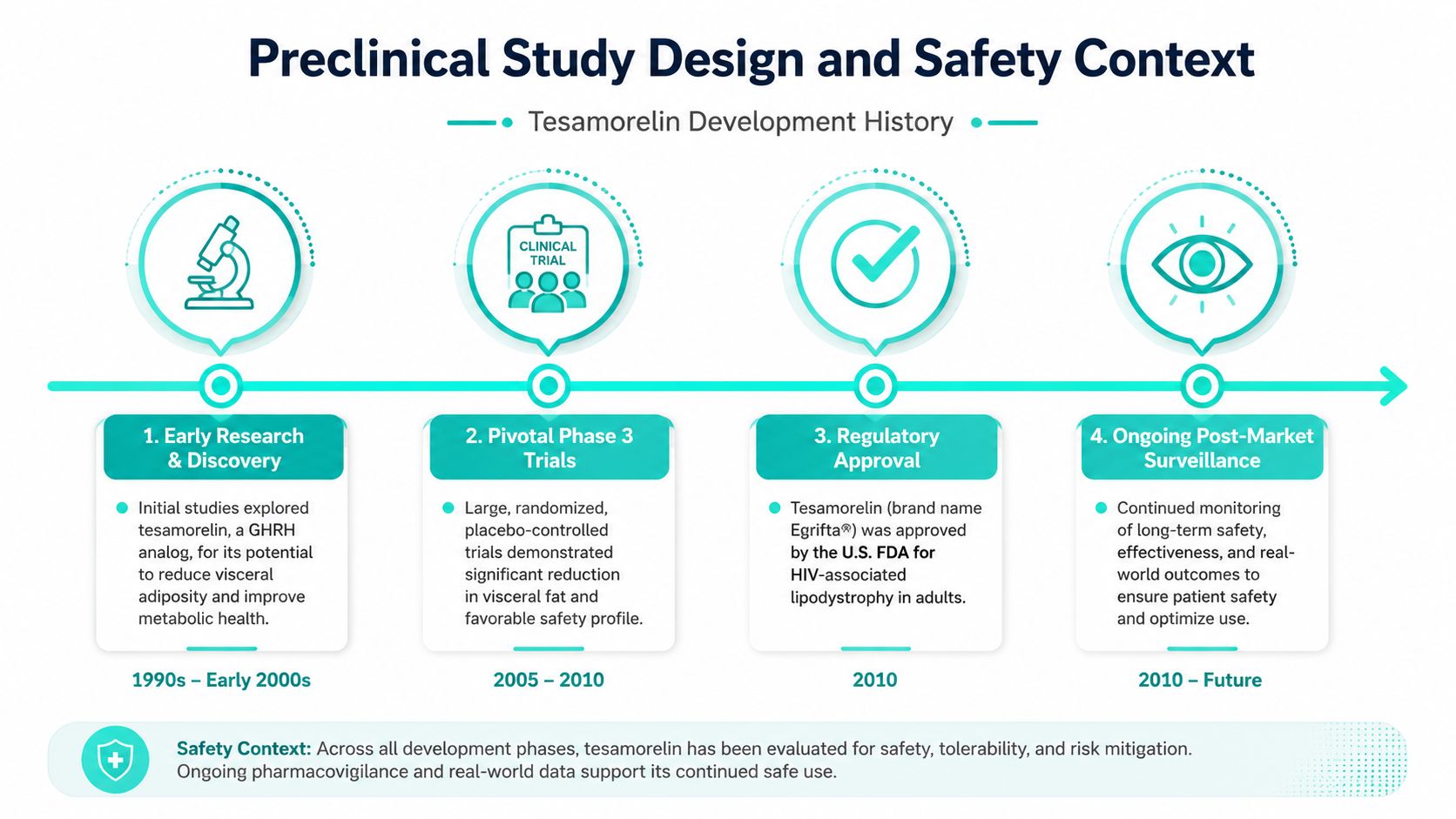
A preclinical system should track the biology tesamorelin influences, namely visceral lipolysis and IGF-1 induction. If a model cannot separate depot-specific fat mobilization from generalized weight change, it is answering the wrong question. The clinical signal came from a visceral-fat phenotype, so the endpoint should stay close to that phenotype.
The more common mistake is to treat tesamorelin as a generic fat-reduction tool. The better approach is to ask whether a model can capture GH-axis activation and downstream adipose behavior without collapsing those readouts into a vague body-weight number. That distinction becomes even more important outside the HIV-associated lipodystrophy context, where qualifying randomized evidence is limited, as noted earlier in the evidence gap review.
The safety context is straightforward. GH-axis stimulation can affect glucose handling, so investigators should monitor glycemic markers as part of the core readout, not as an afterthought. Baseline characterization and post-dose tracking matter if the study is meant to distinguish intended lipolysis from metabolic stress.
Regulatory boundaries matter too. The strongest evidence supports tesamorelin in its approved metabolic context, not as a general wellness compound. If a study moves beyond that boundary, the protocol should state that clearly and justify the endpoint choices with the same caution applied to any endocrine-modulating peptide.
Tesamorelin sits in a small but useful corner of peptide science. Its value is not that it does everything, but that it does a few things with enough evidence to matter. The compound's distinguishing features are its GHRH-analog structure, its pituitary-first mechanism, and its clinically observed effect on visceral adiposity rather than broad weight loss.
That profile makes tesamorelin a stronger candidate for studies centered on VAT, IGF-1 dynamics, and metabolic marker shifts than for projects built around cosmetic slimming or non-specific anti-aging claims. The evidence-backed use case is narrow, and that narrowness is a strength because it gives researchers a cleaner hypothesis to test. A peptide that is biologically specific is often easier to interpret than one that promises everything.
For comparative work, it helps to separate tesamorelin from other growth-hormone-axis peptides by mechanism and evidence depth. Tesamorelin's clinical footprint is anchored in human trials and FDA review, not in speculative extrapolation. That makes it a better reference compound when the endpoint is visceral fat biology and a weaker fit when the objective is generalized longevity positioning.
A useful planning check is simple:
Researchers comparing peptide combinations often look at tesamorelin blend strategies to understand how study design shifts when multiple GH-axis signals are layered together, but the baseline logic stays the same, the endpoint has to fit the biology.
The right question is not whether tesamorelin is a powerful peptide. The right question is whether your research endpoint is narrow enough to capture what it actually does.
For a deeper literature review, the most useful starting points are the FDA clinical pharmacology review, the visceral-fat trial summaries, and the mechanistic discussion of GH, IGF-1, and glucose handling in the LiverTox and DrugBank material cited above. Those sources give you a compact dossier, structure, mechanism, efficacy, and safety, without the noise of overextended claims.
If your team is evaluating tesamorelin research material, Celonyx Labs provides research peptides, quality-focused sourcing, and supporting documentation that fits laboratory workflows. Visit Celonyx Labs to review current availability, quality information, and ordering details for your next tesamorelin-focused study.
Is bacteriostatic water the same as sterile water? No. Compare preservatives, vial handling and peptide

How do you know if a peptide vial has gone bad? Quarantine changes, check storage

Can too much bacteriostatic water ruin a peptide vial? Yes, if it overfills the vial
FOR RESEARCH USE ONLY. Products sold by Celonyx Labs are intended exclusively for laboratory and scientific research. They are not intended for human or veterinary use, consumption, diagnosis, treatment, cure, or prevention of any disease. By purchasing from this site, you acknowledge that you understand the intended research purpose of these materials and agree to comply with all applicable laws and regulations.