

How to Buy Peptides: A Lab Buyer’s Guide
It's Tuesday morning, and you need five custom peptides on the bench by Friday. Three

A peptide shipment can be “overnight” on the label and still arrive too late for the experiment that depends on it. The failure may happen at the pickup cutoff, during a hub transfer, over a weekend, or after a delivery attempt sends a temperature-sensitive package back into an uncontrolled environment. By the time the box reaches the lab, the tracking page may show movement while the research team is left questioning whether the material is still suitable for use.
That's why laboratory procurement teams shouldn't choose fast shipping companies by advertised transit time alone. They need to evaluate the specific service, cutoff, route, packaging method, tracking detail, documentation, and recovery process behind the promise. For research peptides, reliable execution matters more than a fast-looking network average.
A researcher schedules an assay around a peptide expected before the next run. Equipment is reserved, personnel are coordinated, buffers are prepared, and the experimental window is narrow. The carrier accepts the parcel, then a missed connection shifts delivery to the following day. The result is operational disruption: the experiment may need rescheduling, reagents may need to be remade, and the laboratory may have to document why the planned work did not proceed.

I've seen procurement teams compare quoted delivery days while overlooking the conditions that make those promises workable. An express service still creates exposure when the lab misses the pickup cutoff, the destination station cannot support the promised time, or the parcel remains in transit through a nonworking day. The service level on the contract must match the way the laboratory packs, tenders, receives, and records shipments.
Global parcel infrastructure gives laboratories many carrier and service choices. Pitney Bowes recorded 159 billion parcels shipped across 13 major markets in 2021 and 161 billion in 2022, with the tracked markets showing a 21% year-over-year rise from 2020 to 2021 and a 150% increase over seven years from 2016 to 2022 in the same dataset (Pitney Bowes Shipping Index). Those figures describe market scale, not the outcome of a particular research service. Procurement still has to examine the exact product, route, cutoff, handoffs, and exception process being purchased.
Consumer parcel delivery usually prioritizes convenience, visibility, and an arrival date. A research peptide shipment may also require controlled temperature, secure handling, batch traceability, signed receipt, and records that satisfy institutional purchasing procedures. A parcel that arrives quickly can still raise a quality question if the lab cannot establish how it was handled.
The risk increases for materials with a limited stability window. Procurement should determine whether the shipment requires expedited service, validated cold-chain packaging, a scheduled delivery, or receiving instructions that prevent unattended exposure. These decisions depend on the product's handling requirements and the lab's procedures. A carrier's overall reputation cannot establish that a specific service protected a specific batch.
Practical rule: Treat the delivery promise as one control in the workflow, not as proof that the material remained fit for research.
Fast shipping companies support research programs that depend on predictable material movement. The procurement review must also cover packaging validation, cutoff rules, exception handling, temperature evidence, and recipient availability. For temperature-sensitive peptides, a carrier's network average can conceal failures at a particular service level or destination station. The right choice protects batch integrity across the full shipment process, from tender through receipt and release for use.
Before requesting carrier proposals, write down what the shipment must accomplish. “Fast delivery” is too broad to compare. A laboratory requirements matrix should connect the peptide's stability window to the service level, packaging method, documentation, receiving process, and acceptable recovery action.
Start with the material itself. Record the storage condition, any supplier handling instruction, the maximum expected transit exposure, and whether the shipment needs temperature evidence. Separate products that tolerate ordinary parcel handling from those that require insulated packaging, coolant, monitoring, or an expedited route. Don't assume that a small vial is a low-risk shipment. The value may be concentrated in the material, the experiment, and the time already invested in preparing the work.
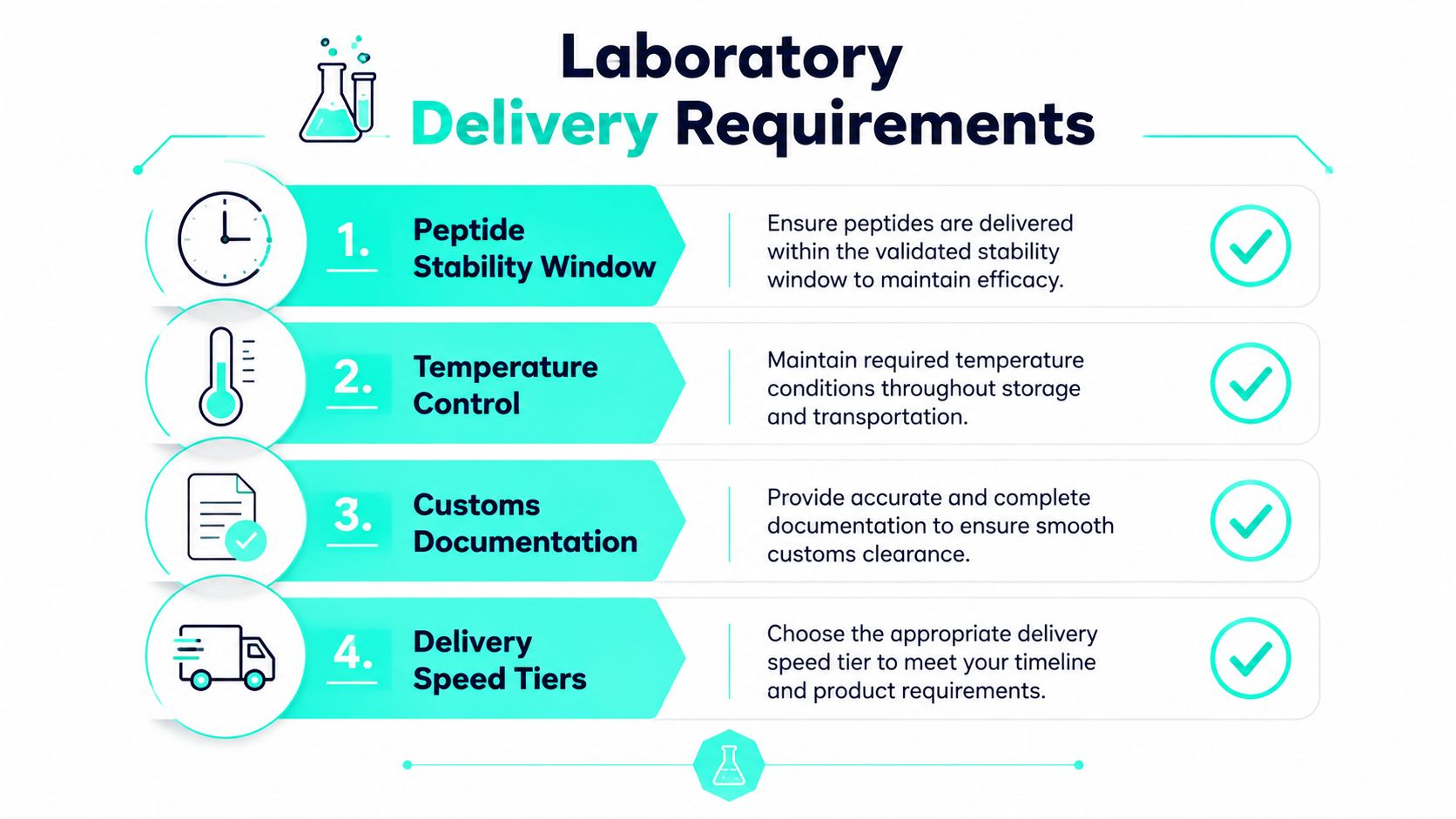
Use a row for each shipment category rather than creating one universal rule. A practical matrix can include:
A clear matrix also helps distinguish urgency from convenience. A peptide needed for a scheduled instrument run may justify an expedited service. A replenishment shipment with a broad stability window may not. Routing every parcel through the fastest tier increases cost and can complicate receiving without improving the outcome.
For institutional workflows, document the decision in the purchase record. Link the selected service to the material's handling requirement and the receiving plan. If the supplier provides published shipping policies, quality information, or support contacts, retain those records with the order. Teams can also review their broader vendor qualification process before approving a recurring source.
This short video can help teams think through the practical controls around laboratory shipping:
The matrix should be usable by procurement, laboratory staff, receiving personnel, and finance. If only one person understands why a service was selected, the control will weaken when that person is unavailable.
Carrier selection should begin with the service, not the logo. Request performance data for the product, lane, delivery window, and shipment class your laboratory will use. A carrier's overall reputation provides context, but it cannot show whether a specific ground, priority, overnight, or international service meets the laboratory's committed arrival time.
On-time performance, or OTP, measures whether a carrier meets its promised delivery commitment. ShipMatrix's peak-2024 data reported OTP of 96.5% for UPS, 91.8% for FedEx, and 90.4% for USPS, while USPS Ground Advantage and Priority Mail fell to 84.7% when Parcel Select was excluded (ShipMatrix parcel performance data). These figures do not rank every carrier for every laboratory lane. They demonstrate how a network average can conceal a service-specific failure that leaves a temperature-sensitive peptide outside its usable handling window.
| Carrier | Overall OTP | Service-specific notes |
|---|---|---|
| UPS | 96.5% | The overall figure cannot replace lane-level and service-level review. Confirm performance for the selected commitment and destination route. |
| FedEx | 91.8% | Request data for the exact express or ground product, particularly when the shipment depends on a narrow arrival window. |
| USPS | 90.4% | The reported USPS Ground Advantage and Priority Mail figure was 84.7% when Parcel Select was excluded, showing the risk of broad averages. |
Ask each carrier or logistics provider for the written SLA, its definition of late delivery, remedies for a miss, and exclusions that limit those remedies. Confirm how the commitment changes for weekends, remote destinations, weather events, holidays, residential delivery, and incomplete addresses. A service that appears fast at origin can lose that advantage if the laboratory misses the tender cutoff by minutes.
Tracking needs a separate review. For a high-value peptide, one “in transit” scan provides little operational control. Require pickup confirmation, hub movement, destination arrival, out-for-delivery status, proof of delivery, exception alerts, and access to temperature records when monitoring is used. Define who receives an alert when movement stops and how quickly the carrier escalates the event.
Temperature control requires evidence, not a label. Review pack-out instructions, validated packaging documentation, allowable ambient conditions, coolant replacement procedures, and the process for investigating an excursion. Ask how the carrier defines control and which records it can provide.
Teams purchasing research materials can review available peptide ordering options alongside the supplier's stated shipping methods. Match the order type to carrier requirements, rather than choosing the quickest option by default.
A fast shipment still needs an audit trail. If a package arrives late, damaged, warm, or with missing paperwork, the laboratory must be able to reconstruct what happened. That record starts before tender, with the purchase order, product identity, batch information, packing instructions, selected service, and named recipient.
The strongest carrier arrangement gives procurement documented answers. The weakest relies on an account representative's informal assurance. Compare the two approaches before signing a contract.
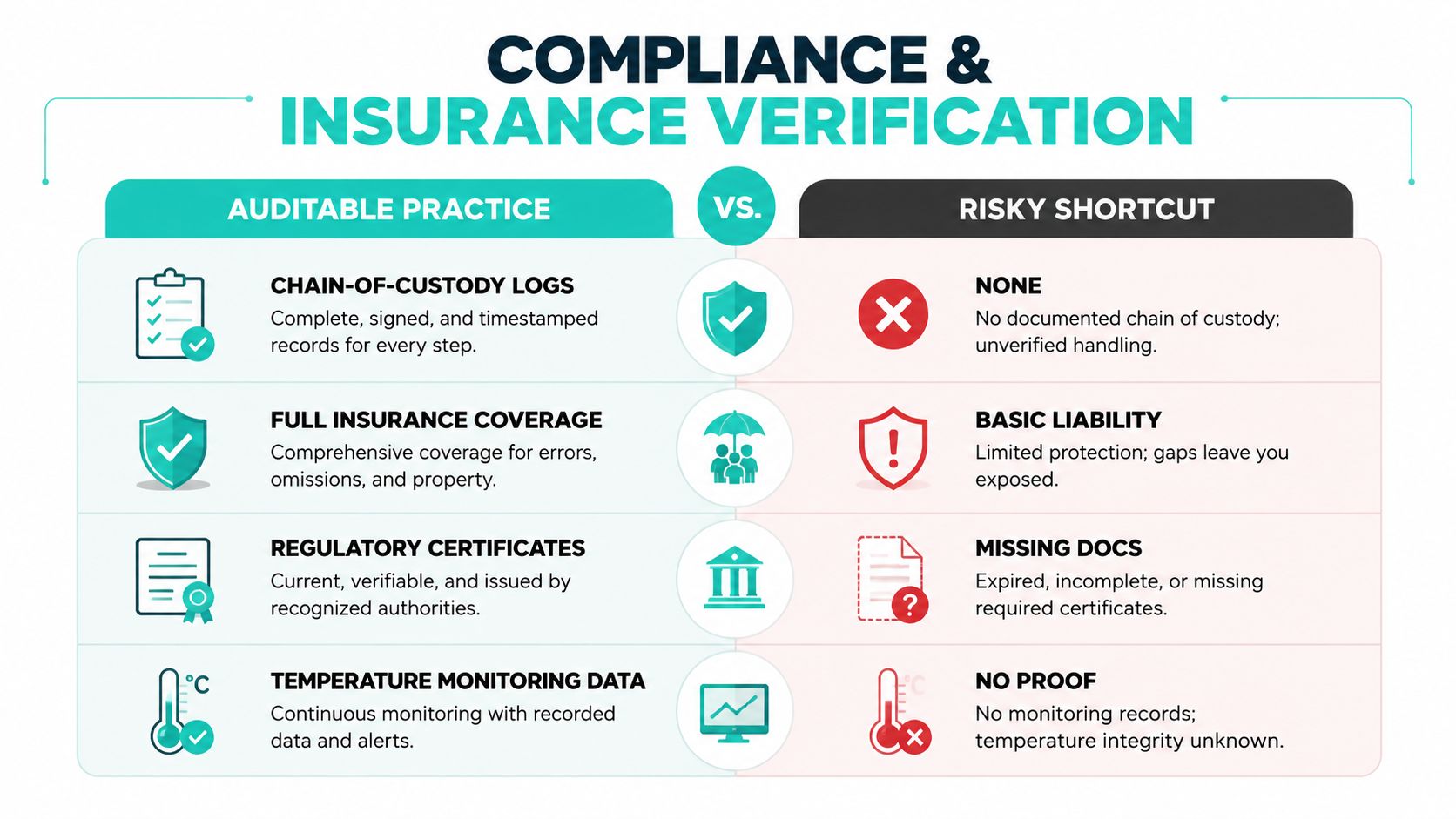
| Auditable practice | Risky shortcut |
|---|---|
| Chain-of-custody logs connect packing, pickup, transit events, receipt, and storage handoff. | Staff rely on a tracking page with no internal receiving record. |
| Insurance terms identify covered loss, damage, delay, temperature excursion, exclusions, and claim deadlines. | The team assumes declared value equals full protection for the research material and related costs. |
| Regulatory certificates and quality documents are current, accessible, and tied to the service used. | Missing documents are treated as an administrative issue that can be fixed later. |
| Temperature monitoring data can be retrieved and associated with the parcel. | The package arrives with no proof of its conditions during transit. |
Insurance review should go beyond the amount printed on a shipping label. Ask whether the policy covers the peptide itself, packaging, coolant, temperature monitors, duties, reshipping, and losses caused by delay. Confirm whether the carrier excludes consequential research costs, fragile materials, or temperature excursions. Finance and the principal investigator should agree on what level of loss requires a claim, replacement, quarantine, or investigation.
Request the carrier's quality-management documentation, incident-response procedure, escalation contacts, audit access, and retention period for tracking and monitoring records. Ask how it handles a missed delivery, an address error, a damaged container, a failed temperature indicator, or a package delivered to an unauthorized location.
Third-party documentation can support the review, but it shouldn't replace direct verification. Check the issuing organization, expiration date, scope, and whether the certification applies to the relevant operation rather than to a separate business unit. Supplier quality materials, including information about third-party-tested peptides, should sit alongside the carrier record so the lab can evaluate product quality and shipping integrity together.
The goal isn't to create paperwork for its own sake. It's to make a defensible decision when an experiment depends on a shipment that didn't behave as expected.
Don't move every critical peptide shipment to a new carrier after one successful delivery. Run a controlled pilot that exposes the service to the conditions your lab faces, including ordinary packing, real cutoff times, receiving availability, and the lanes that create the most concern.
Define the test before the first parcel leaves the facility:
The pilot should use representative research material or an approved substitute that behaves similarly in packaging. Don't place irreplaceable material into an untested workflow merely to generate performance data.
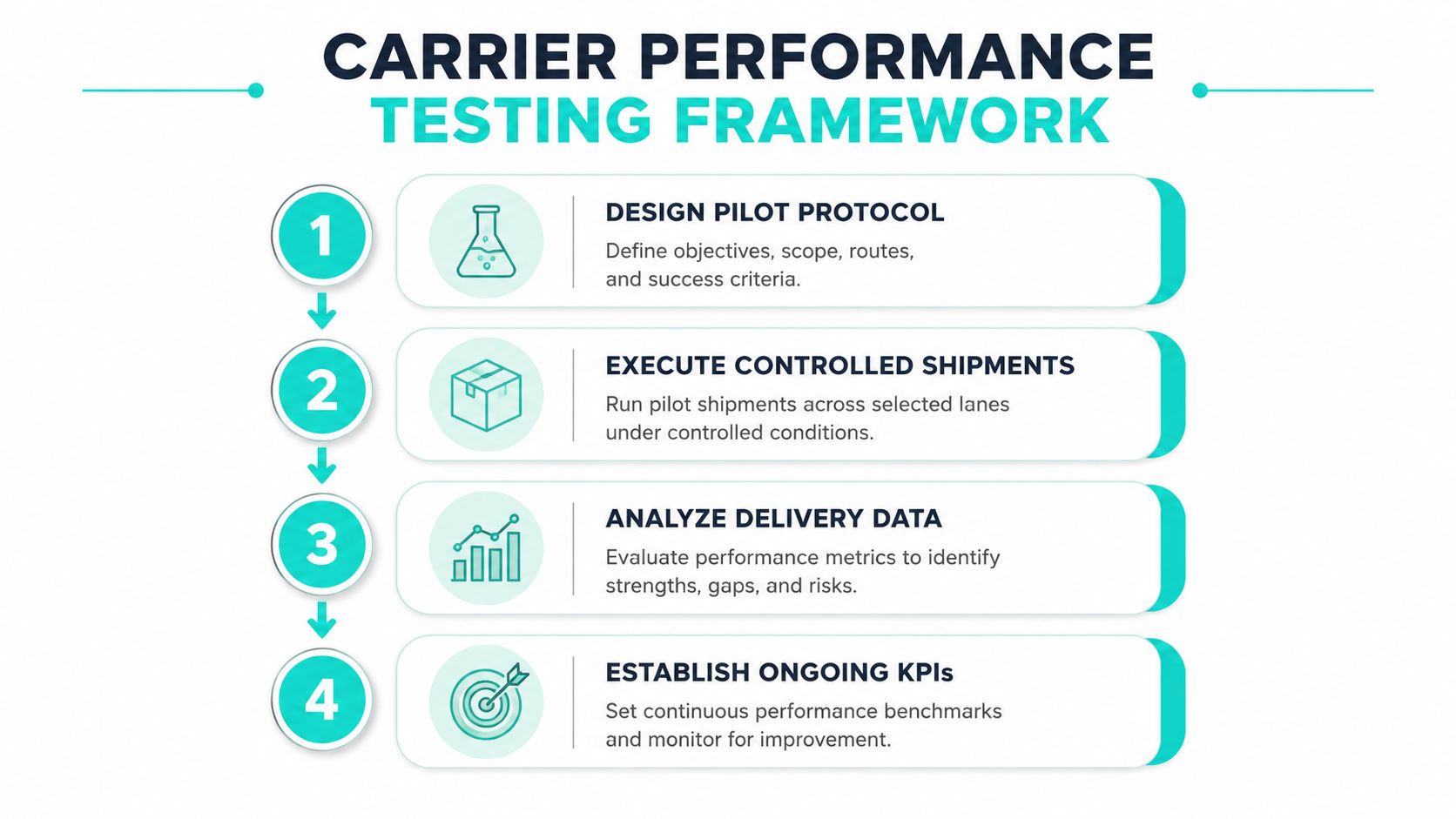
A useful scorecard separates carrier failure from laboratory failure. Track the planned tender time, actual pickup, promised arrival, actual arrival, delivery condition, documentation completeness, exception response, and invoice accuracy. Add a field for the service selected and another for the reason it was selected. That distinction reveals whether the problem came from the carrier, the packaging design, the cutoff decision, or the receiving process.
Review the scorecard at a defined cadence with procurement, laboratory operations, quality, and finance. Escalate repeated misses instead of treating each one as an isolated incident. Require a corrective-action response that identifies the failure point, the owner, the remedy, and the date for verification.
Measure the shipment your lab receives, not the service the sales presentation describes.
A carrier can remain approved while a specific service is suspended for sensitive material. That's often more practical than abandoning an entire network after one failure, provided the carrier responds transparently and the corrective action works.
The cheapest shipping strategy is rarely the one with the lowest label price. A missed experimental window can consume staff time, instrument availability, preparation materials, and procurement effort. A contingency plan protects continuity while also preventing the lab from paying for emergency service on every order.
Start by assigning shipment categories. Critical materials can use a tested expedited service with a defined backup. Routine replenishment can use a lower-cost tier when the stability window and receiving schedule allow it. The routing rule should be visible to anyone creating a shipment, not buried in one buyer's memory.
A backup carrier is only useful if the lab has already verified its lane, packaging compatibility, pickup process, account access, and escalation contacts. Maintain current credentials, approved shipping supplies, service codes, and a short decision tree for switching providers. If a primary carrier reports a network disruption, staff should know whether to reroute immediately, hold the package, or contact the supplier before tender.
Use dual sourcing selectively. Splitting every shipment across carriers can make billing, tracking, and quality review harder. Concentrating all risk with one provider creates a different problem. A controlled allocation based on route, urgency, and service performance gives the lab practical resilience without losing operational visibility.
Carrier negotiations should include more than the base transportation rate. Ask about fuel adjustments, residential or remote-area charges, pickup fees, weekend handling, declared value, temperature-monitoring requirements, packaging costs, and claim support. Compare the complete landed cost for representative lanes and service tiers.
Volume commitments can help, but don't trade away flexibility for a discount that forces unsuitable service selection. Put review provisions into the agreement so the lab can revisit rates, performance, surcharges, and coverage when its shipping profile changes. A procurement team that can show lane history and service-specific failures has stronger negotiating evidence than one that only asks for a general discount.
The cost-control principle is straightforward: reserve premium speed for shipments where delay has a defined research consequence. Use standard service where it meets the documented requirement, and keep expedited capacity available for the cases that need it.
A carrier can post a strong network average and still mishandle the service your peptide shipment uses. A missed pickup, weekend hold, temperature excursion, or late handoff can threaten batch integrity before tracking shows a serious exception. Fast shipping companies have raised delivery expectations, but laboratory procurement should judge the specific lane, service, and recovery process.
McKinsey found that average parcel delivery speed improved about 40%, from 6.6 days in Q1 2020 to 4.2 days in Q2 2023, while 90% of customers were willing to wait two to three days (McKinsey ecommerce delivery research). Those consumer benchmarks explain why sub-three-day promises influence purchasing decisions, but they do not define a peptide's acceptable transit window.
Cost still matters. Survey data reported that 90% of consumers would wait two to three days to avoid shipping charges, and 95% preferred free standard shipping to paying for expedited delivery (Retail Insider shipping survey coverage). For a laboratory, expedited service earns its cost only when it protects a documented stability limit, experiment schedule, or replacement constraint.
Cross-border orders require separate scrutiny. 94% of organizations handling cross-border operations reported delays related to incorrect classification and documentation, according to the Avalara report (Avalara cross-border ecommerce report). Customs classification, duties, recipient details, and paperwork can erase a domestic speed advantage.
Choose the service that protects the experiment, then publish a delivery window the carrier can support. Reliability, traceability, and recovery options usually create more value than an aggressive promise, especially when a delayed peptide shipment can force retesting or replacement.
Celonyx Labs supplies research peptides through an online catalog and offers standard and expedited shipping options, with tracking information supplied after shipment. Review Celonyx Labs for product documentation and shipping policies, then confirm the delivery requirements with the team.
It's Tuesday morning, and you need five custom peptides on the bench by Friday. Three

Comparing Ibisci.com alternatives in 2026? Celonyx Labs delivers 99% pure, third-party tested research peptides with

Compare nationwidepeptides.com alternatives for 2026, including Celonyx Labs, Core Peptides, and Peptide Sciences, with honest
FOR RESEARCH USE ONLY. Products sold by Celonyx Labs are intended exclusively for laboratory and scientific research. They are not intended for human or veterinary use, consumption, diagnosis, treatment, cure, or prevention of any disease. By purchasing from this site, you acknowledge that you understand the intended research purpose of these materials and agree to comply with all applicable laws and regulations.