What Is Solid Phase Peptide Synthesis? a Clear Guide
Solid phase peptide synthesis is a method that builds a peptide one amino acid at
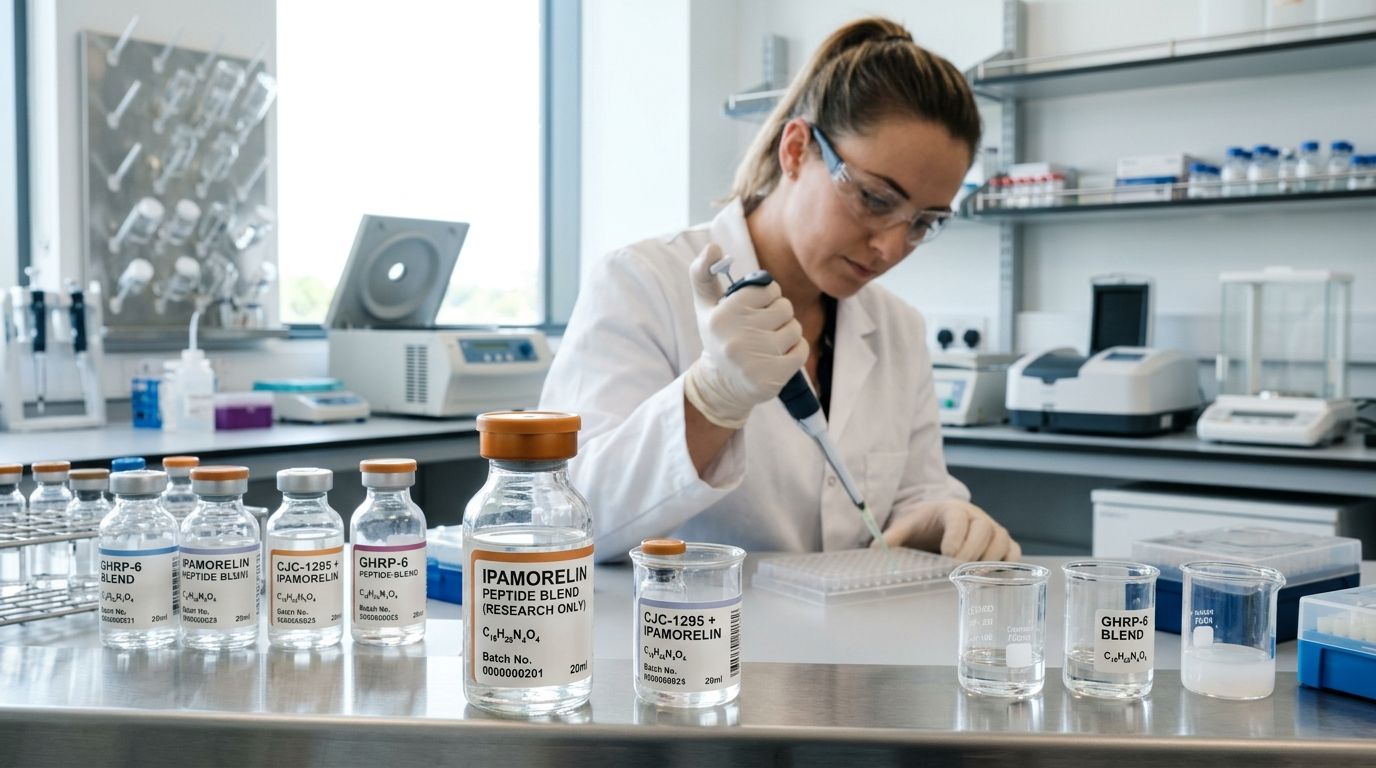
Five ipamorelin blend configurations dominate 2026 GH-axis research catalogs, and the right pick depends on what receptor pathway you're isolating, not brand loyalty.
Ipamorelin is a pentapeptide GHS-R agonist, and researchers pair it with GHRH analogs or other GHRP-class compounds to build a full GH secretagogue axis in vitro or in animal models. The blend you choose changes what you're actually measuring: pulsatility, amplitude, receptor selectivity, or downstream cortisol and prolactin markers.
Catalogs across the industry now list five to seven common ipamorelin combinations, and not all of them serve the same experimental design. Picking the wrong pairing wastes a research cycle and muddies your data with uncontrolled variables. The peptides sourced through Celonyx Labs ship at 99% purity with third-party COA documentation, which is the baseline every blend on this list should meet before it enters a protocol.
| Blend | Best for | Standout feature | Key limitation |
|---|---|---|---|
| Ipamorelin + CJC-1295 (no DAC) | Pulsatile GH-axis research | Mimics natural pulsatile release pattern | Requires more frequent reconstitution cycles |
| Ipamorelin monotherapy | Control-arm / baseline research | Isolates GHS-R agonism without a second mechanism | Doesn't model combined-axis behavior |
| Ipamorelin + Tesamorelin | Lipolysis-focused secretagogue research | Adds GHRH-receptor engagement distinct from GHRP pathway | Two-compound reconstitution adds handling steps |
| Ipamorelin + Sermorelin | GHRH receptor comparative studies | Shorter-acting GHRH analog pairing for contrast studies | Shorter stability window post-reconstitution |
| Ipamorelin + GHRP-6 | Appetite-signaling comparative research | Contrasts selective vs non-selective GHRP activity | GHRP-6 introduces ghrelin-pathway crosstalk to control for |
This pairing combines a selective GHS-R agonist with a GHRH analog that lacks the Drug Affinity Complex extension, meaning it clears faster and preserves a pulsatile secretion pattern rather than a flat, sustained one. It's the closest analog researchers have for studying natural GH pulsatility dynamics under controlled conditions in 2026 protocols.
Ipamorelin + CJC-1295 (no DAC) pros:
Ipamorelin + CJC-1295 (no DAC) cons:
Best for: research designs specifically measuring pulsatile GH-axis behavior. Verdict: Buy for research use.
A single-compound vial gives you the cleanest isolation of GHS-R agonism without a second mechanism confounding the data. It's the default control arm in most comparative GH secretagogue studies published since ipamorelin's selectivity profile was first characterized.
Ipamorelin monotherapy pros:
Ipamorelin monotherapy cons:
Best for: control-arm designs and baseline pharmacology studies. Verdict: Buy for research use.
Tesamorelin is a GHRH analog studied for its metabolic and lipolytic signaling properties, and pairing it with ipamorelin lets researchers separate GHRH-receptor effects from GHS-R effects within the same protocol. This combination shows up most often in comparative metabolic research rather than pure pulsatility studies.
Ipamorelin + Tesamorelin pros:
Ipamorelin + Tesamorelin cons:
Best for: metabolic and lipolysis-signaling research designs. Verdict: Buy for research use.
Sermorelin is a shorter GHRH-analog fragment, and pairing it with ipamorelin gives researchers a contrast point against the longer-acting CJC-1295 pairing above. This blend is smaller in scope — it's built for side-by-side GHRH receptor comparison work, not standalone axis modeling.
Ipamorelin + Sermorelin pros:
Ipamorelin + Sermorelin cons:
Best for: side-by-side GHRH receptor contrast studies. Verdict: Hold — situational use only.
GHRP-6 is a non-selective ghrelin-receptor agonist, and pairing it with ipamorelin — a selective one — creates a natural comparative design for isolating selectivity effects on appetite-signaling pathways. Researchers use this pairing specifically to contrast selective versus non-selective GHS-R activity, not as a general-purpose blend.
Ipamorelin + GHRP-6 pros:
Ipamorelin + GHRP-6 cons:
Best for: appetite-signaling and receptor-selectivity comparative research. Verdict: Hold — narrow use case.
“Ipamorelin’s selectivity for the ghrelin receptor over cortisol and prolactin pathways is what separates it from older GHRP compounds in published secretagogue research.”
Each blend was weighed against the six criteria above: COA verification, receptor-pairing logic, reconstitution stability, shelf-life documentation, batch traceability, and cold-chain handling. Blends that isolate a single, well-documented mechanism ranked higher for control-arm use; blends with published comparative literature ranked higher for axis-modeling use. None of this list substitutes for reviewing the batch-specific third-party peptide testing labs report attached to your own order.
For most GH-axis pulsatility research in 2026, ipamorentin + CJC-1295 (no DAC) is the default pick — it has the deepest comparative literature and the cleanest pulsatile modeling. If your protocol needs a control arm, run ipamorelin monotherapy alongside it rather than substituting one for the other. Reserve the Tesamorelin, Sermorelin, and GHRP-6 pairings for the specific comparative designs they were built for, not as general-purpose substitutes.
Any blend you select should ship with a documented third-party peptide testing labs certificate and clear guidance on bacteriostatic water for peptide reconstitution. Skipping either step is the fastest way to invalidate a research cycle.
Verify sourcing before you order
Check batch COA practices across research peptide vendors before committing to a blend.
All compounds referenced here are sold for research use only — none are intended for human or animal consumption, and none of the language above should be read as a clinical or health claim.
What is the best ipamorelin peptide blend for growth hormone research in 2026?
Ipamorelin + CJC-1295 (no DAC) is the best ipamorelin peptide blend for 2026 pulsatile GH-axis research because it models natural pulsatile release rather than sustained secretion. Ipamorelin monotherapy remains the better choice for control-arm designs.
Is ipamorelin combined with CJC-1295 better than ipamorelin alone for research?
It depends on the study design, not a universal ranking. The combination models combined-axis pulsatility, while monotherapy isolates GHS-R agonism alone as a control.
How should ipamorelin blends be reconstituted for lab use?
Ipamorelin blends are reconstituted with bacteriostatic water following documented concentration guidance specific to each compound pairing. Two-compound blends require separate handling steps to avoid cross-contamination.
What purity level should research peptides have?
99% purity verified by third-party COA testing is the standard baseline for reproducible peptide research in 2026. Anything shipped without batch-specific documentation shouldn’t enter a controlled protocol.
How is ipamorelin different from GHRP-6?
Ipamorelin is a selective GHS-R agonist, while GHRP-6 is non-selective and engages broader ghrelin-pathway activity. That selectivity difference is why the two are often paired in comparative research designs.
What’s the shelf life of lyophilized ipamorelin blends?
Lyophilized peptide blends generally hold stability far longer than reconstituted solutions, which is why most labs store unused vials in lyophilized form until immediately before use. Reconstituted solutions have a much shorter usable window.
Should researchers verify peptide purity independently?
Yes — relying solely on a vendor’s published COA without cross-checking batch numbers against third-party lab records is a common source of irreproducible data in peptide research.
Are ipamorelin blends available for purchase in 2026?
Yes, ipamorelin and its common blend pairings are widely available through research peptide suppliers in 2026, sold strictly for laboratory and research use.
Ipamorelin's defining research value isn't its potency — it's its selectivity. Unlike older GHRP-class compounds, it doesn't meaningfully engage cortisol or prolactin pathways, which is exactly why it shows up as the control arm in nearly every comparative GH secretagogue study rather than as the experimental variable itself. If a blend you're evaluating claims broad-spectrum activity across multiple hormone pathways, check whether ipamorelin is even the right base compound for that design.
Solid phase peptide synthesis is a method that builds a peptide one amino acid at
500 mcg equals 0.5 mg, a labeled research quantity, and no published human study establishes

Choose the best GHK-Cu peptide format for laboratory skin and wound-healing research. Compare documentation, assay
FOR RESEARCH USE ONLY. Products sold by Celonyx Labs are intended exclusively for laboratory and scientific research. They are not intended for human or veterinary use, consumption, diagnosis, treatment, cure, or prevention of any disease. By purchasing from this site, you acknowledge that you understand the intended research purpose of these materials and agree to comply with all applicable laws and regulations.