What Is Solid Phase Peptide Synthesis? a Clear Guide
Solid phase peptide synthesis is a method that builds a peptide one amino acid at
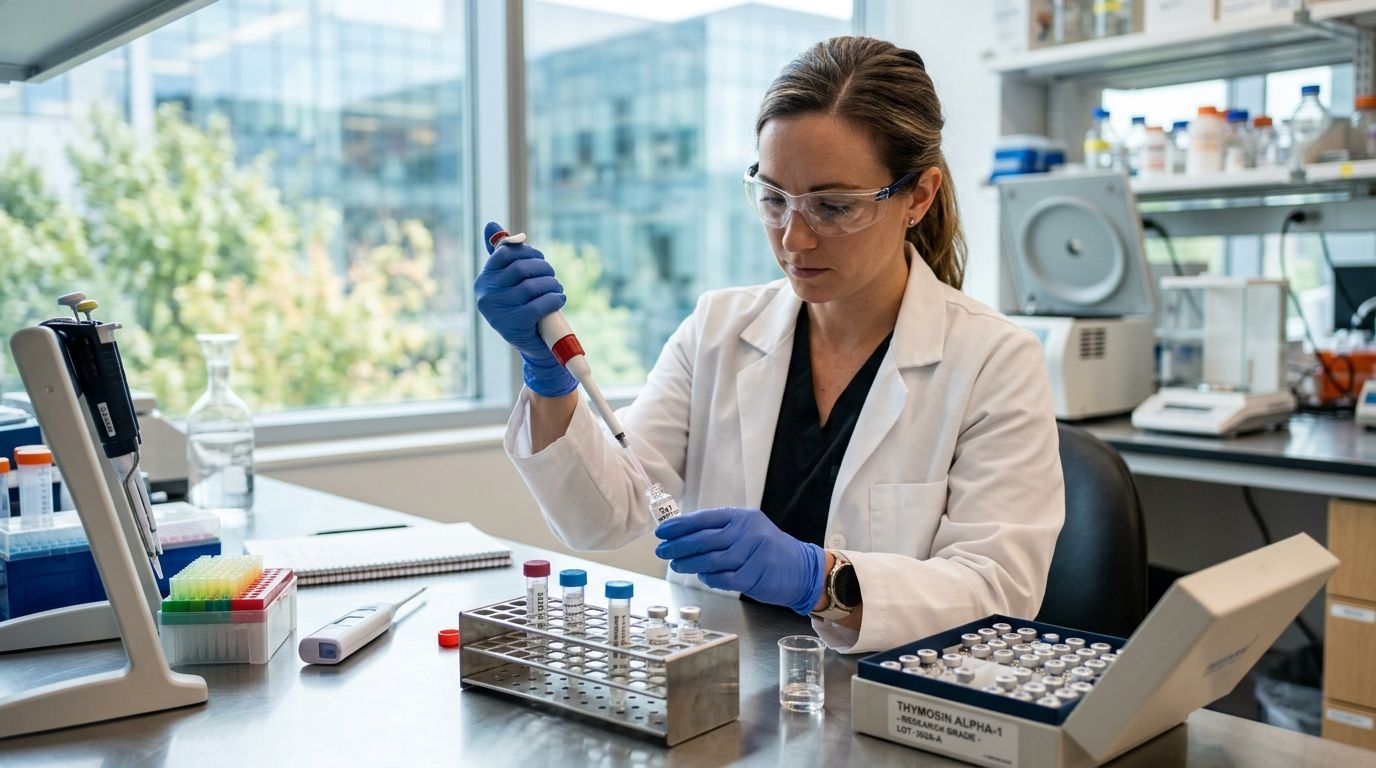
Thymosin alpha-1 is one of the most requested immune-modulation peptides in research peptide catalogs for 2026, and the sourcing format you pick changes what your data looks like three months into a study, not just what shows up on the invoice.
Thymosin alpha-1 shows up in immune pathway studies precisely because small differences in purity or reconstitution technique produce measurable shifts in assay results. A peptide that reads 97% purity on one certificate of analysis and 99% on another is not interchangeable for a study that depends on dose consistency across vials.
Celonyx Labs sources research peptides, thymosin alpha-1 included, with 99% purity and third-party testing on file, and every product on this list is sold strictly for laboratory and scientific research use, not for human or animal application.
Best overall: COA-verified, third-party tested thymosin alpha-1. Best for long-term storage protocols: lyophilized thymosin alpha-1 powder. Best for high-throughput panels: bulk multi-vial thymosin alpha-1 kits.
| Format | Best for | Standout feature | Key limitation |
|---|---|---|---|
| COA-verified, third-party tested | Regulatory-grade documentation | Independent purity verification against a reference standard | COA turnaround varies by supplier |
| Lyophilized powder | Long-term stability studies | Freeze-dried form resists degradation pre-reconstitution | Requires precise reconstitution technique |
| Bulk multi-vial kits | High-throughput immune panels | Batch-matched vials reduce inter-sample variance | Larger upfront quantity commitment |
| Blend / co-formulation | Combination pathway research | Paired with complementary immune-modulating peptides | Harder to isolate single-compound effects |
| Custom synthesis, small batch | Sequence-specific verification | Synthesized to exact spec with a dedicated COA | Longest lead time of the five |
This is the standard most research protocols should default to in 2026. The certificate of analysis names a reference standard lot, the purity figure comes from an outside lab rather than the manufacturer's own equipment, and the paperwork holds up if a reviewer asks where the number came from.
COA-verified thymosin alpha-1 pros:
COA-verified thymosin alpha-1 cons:
Best for: labs that need defensible documentation on file. Verdict: Buy.
Freeze-dried thymosin alpha-1 sits stable far longer than a pre-reconstituted solution, which matters for any study that spans more than a few weeks. The format shifts the stability risk to the reconstitution step instead of the shelf.
Lyophilized thymosin alpha-1 pros:
Lyophilized thymosin alpha-1 cons:
Best for: studies running longer than four to six weeks between orders. Verdict: Buy.
When a protocol runs dozens of samples, vial-to-vial variance becomes the confound you least want. Multi-vial kits pulled from a single synthesis batch reduce that variance compared to ordering single vials over time.
Bulk thymosin alpha-1 pros:
Bulk thymosin alpha-1 cons:
Best for: panel studies with 10+ samples run in parallel. Verdict: Hold — confirm your storage capacity before committing to a full batch.
Some protocols study thymosin alpha-1 alongside other immune-modulating peptides in a single formulation. That's useful when the research question is about combined pathway effects, and it's the wrong choice when it isn't.
Blend thymosin alpha-1 pros:
Blend thymosin alpha-1 cons:
Best for: protocols explicitly designed around combination pathway effects, not single-compound baselines. Verdict: Hold — situational, not a default.
When a study needs exact sequence confirmation beyond a standard COA, custom synthesis is the format that delivers it, at the cost of lead time.
Custom synthesis thymosin alpha-1 pros:
Custom synthesis thymosin alpha-1 cons:
Best for: research requiring sequence verification beyond standard stock. Verdict: Wait — order only when the timeline allows for it.
Compare thymosin alpha-1 sourcing options
Review purity documentation before you start a 2026 protocol.
Each format is scored against the six criteria above: COA documentation, independent testing, storage-appropriate form, batch consistency, research-use labeling, and reconstitution guidance. No format wins on every criterion, which is why the ranking splits by use case instead of naming one universal winner.
“If the certificate of analysis doesn’t list a reference standard lot number, treat the purity claim as unverified.”
For most labs starting a new protocol in 2026, COA-verified, third-party tested thymosin alpha-1 is the default pick — the documentation holds up regardless of what the study is measuring. Move to lyophilized powder if the protocol spans months rather than weeks, and reserve bulk kits for panels large enough that batch consistency actually moves the needle. Custom synthesis stays a specialist choice, not a starting point.
What is the best thymosin alpha-1 peptide for immune research in 2026?
COA-verified, third-party tested thymosin alpha-1 is the strongest default for 2026 protocols because the purity claim is independently checkable. Lyophilized powder is the better pick specifically for studies running longer than a few weeks.
Is lyophilized thymosin alpha-1 better than pre-reconstituted stock?
Lyophilized thymosin alpha-1 holds stability longer than pre-reconstituted liquid stock, which matters for multi-week or multi-month studies. The tradeoff is that reconstitution technique becomes a variable you have to control at the bench.
How do I verify thymosin alpha-1 purity before starting a study?
Check that the certificate of analysis lists a reference standard lot number and that the purity figure came from an independent third-party lab, not the manufacturer’s own testing. Without both, the purity claim is not verifiable.
What is a certificate of analysis and why does it matter for thymosin alpha-1?
A certificate of analysis (COA) documents the purity and identity testing results for a specific batch of peptide. For thymosin alpha-1, it matters because purity differences of even a few percentage points can shift assay outcomes.
How long does lyophilized thymosin alpha-1 stay stable in storage?
Lyophilized thymosin alpha-1 stays stable considerably longer than reconstituted solution because freeze-drying halts most degradation pathways. Exact stability windows depend on storage temperature and packaging, so follow the supplier’s documentation rather than assuming a fixed timeline.
Can thymosin alpha-1 be combined with other research peptides?
Yes, co-formulated blends exist for protocols studying combined immune pathway effects. They’re the wrong choice for any study that needs to isolate thymosin alpha-1’s individual contribution to results.
What’s the difference between bulk and single-vial thymosin alpha-1 orders?
Bulk multi-vial kits are pulled from a single synthesis batch, which reduces vial-to-vial variance across a large study. Single-vial orders are simpler to manage but introduce more batch-to-batch variability if a study runs over several reorders.
Does Celonyx Labs test thymosin alpha-1 for purity?
Celonyx Labs sources research peptides, including thymosin alpha-1, at 99% purity with third-party testing on file, sold strictly for laboratory and scientific research use.
Most purity disputes in peer discussions trace back to a missing reference standard lot number on the COA, not to a flaw in the synthesis itself — check that field before you check the percentage.
Solid phase peptide synthesis is a method that builds a peptide one amino acid at
500 mcg equals 0.5 mg, a labeled research quantity, and no published human study establishes

Choose the best GHK-Cu peptide format for laboratory skin and wound-healing research. Compare documentation, assay
FOR RESEARCH USE ONLY. Products sold by Celonyx Labs are intended exclusively for laboratory and scientific research. They are not intended for human or veterinary use, consumption, diagnosis, treatment, cure, or prevention of any disease. By purchasing from this site, you acknowledge that you understand the intended research purpose of these materials and agree to comply with all applicable laws and regulations.