Research Peptides Reviews How to Read Them Like a Scientist
You've found a peptide vendor with polished product pages, reassuring testimonials, and fast-shipping promises. The

You've found a peptide vendor with polished product pages, reassuring testimonials, and fast-shipping promises. The reviews sound convincing, but when you look for the Certificate of Analysis, the page offers only a purity statement with no chromatogram, mass spectrometry result, or lot number. That gap is where many procurement decisions go wrong.
Research peptides reviews can help you identify patterns in communication, fulfillment, packaging, and customer support. They can't, by themselves, prove that a vial contains the stated sequence, concentration, or purity. A useful review is a starting signal, not a verdict.
This distinction matters whether you're ordering for an academic laboratory, a CRO, a biotech research group, or an independent investigation. Resources such as what research peptides are can establish the basic research-use context, while PepFlow peptide dosing insights can help clarify why concentration and experimental context matter. Neither type of resource replaces lot-specific analytical documentation.
The practical habit is simple: triangulate the review, the quality documents, and the physical lot identity. Read testimonials for operational clues. Then test those clues against HPLC, mass spectrometry, quantity information, and traceability records. By the end of this guide, you'll have a repeatable way to turn online impressions into an auditable vendor decision.
A new researcher often starts with the same routine. They search a peptide name, add “reviews,” compare several vendor pages, and look for evidence that other buyers received their orders without trouble. A cluster of positive comments can create confidence quickly, especially when reviewers mention responsive support or a package arriving on schedule.
Then the procurement questions begin. Is the stated purity tied to the exact lot? Does the Certificate of Analysis show the chromatogram, or does it only display a number? Does the mass spectrometry result confirm the expected molecular identity? If the review praises “consistency,” what method did the reviewer use to assess it?
Those questions don't make reviews useless. They define their proper role.
Testimonials can reveal recurring experiences with:
These are meaningful signals because a laboratory depends on more than the material itself. A missing lot number, unclear invoice, or delayed response can create documentation problems even before an assay begins.
A reviewer may report that a product arrived promptly and looked professionally packaged. That doesn't establish peptide identity or analytical purity. Reversed-phase HPLC estimates purity by comparing the main peak area with the total chromatographic area, while mass spectrometry helps confirm identity (peptide quality control guidance).
The strongest buying decision combines both evidence streams. Reviews tell you what the vendor experience may feel like. QC records tell you what the supplier tested, which lot was tested, and whether the result can be interpreted.
Practical rule: Treat every positive review as a prompt to ask a better verification question.
A restaurant review and a lab notebook can both be honest, but they serve different purposes. A diner can describe service speed, cleanliness, and satisfaction. A lab notebook records conditions, measurements, controls, and observations that another researcher can examine. Research peptides reviews are closer to restaurant reviews than lab notebooks, even when the reviewer has scientific training.
That doesn't mean a testimonial has no value. It means you should match the claim to the evidence it can reasonably support.
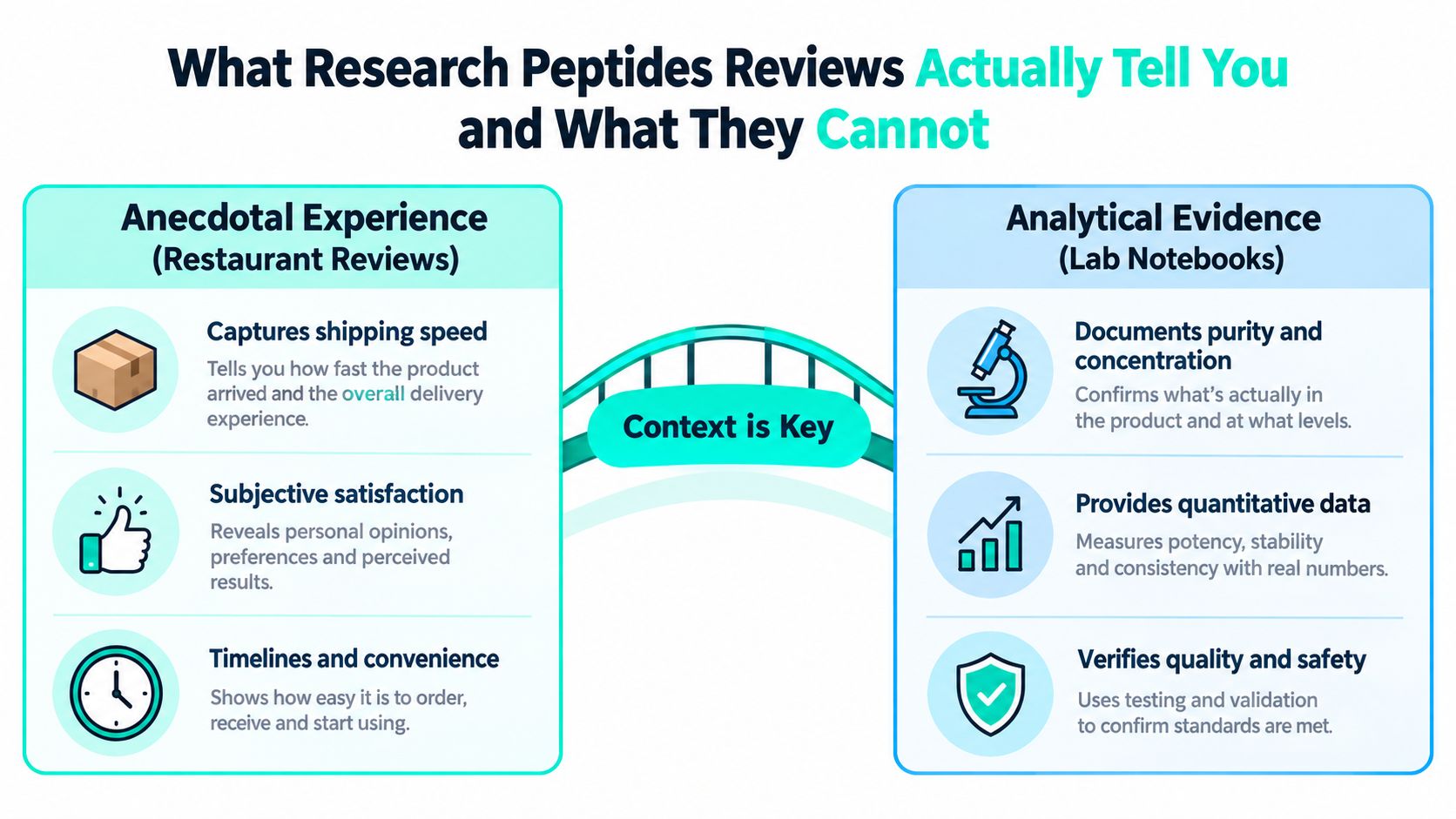
Look for concrete descriptions rather than broad approval. A reviewer who explains that support answered a documentation question, the shipment arrived with intact labeling, or the vendor provided a lot-specific document gives you an operational clue. Several detailed reviews pointing to the same service pattern may justify further investigation.
Reviews may also reveal friction. Customers sometimes mention unclear policies, inconsistent packaging, slow replies, or difficulty obtaining records. Those observations don't prove a chemical defect, but they can identify procurement risks worth resolving before an order.
A useful review can answer questions such as:
A testimonial can't independently establish the peptide's sequence, purity, quantity, sterility, endotoxin status, or absence of specific by-products. Even a technically detailed reviewer may not have access to the analytical method, integration rules, raw data, or an independent laboratory report.
Generic phrases such as “high quality” or “exactly as described” are especially weak because they lack a test condition. They don't explain what the buyer measured, which lot was involved, or whether the material was compared with an appropriate reference.
“Good reviews reduce uncertainty about the vendor experience. They don't eliminate uncertainty about the vial.”
Verified-purchase labels can add context, but they still don't convert an anecdote into analytical evidence. Read the review for its specific observation, record the question it raises, and then look for a document or direct vendor response that addresses that question.
Review pages are evidence about communication and customer experience, but they're also curated environments. The visible comments may represent only the customers who chose to post, the reviews a platform approved, or the feedback a vendor decided to display. A disciplined reader looks for observable signals instead of relying on the overall mood of the page.
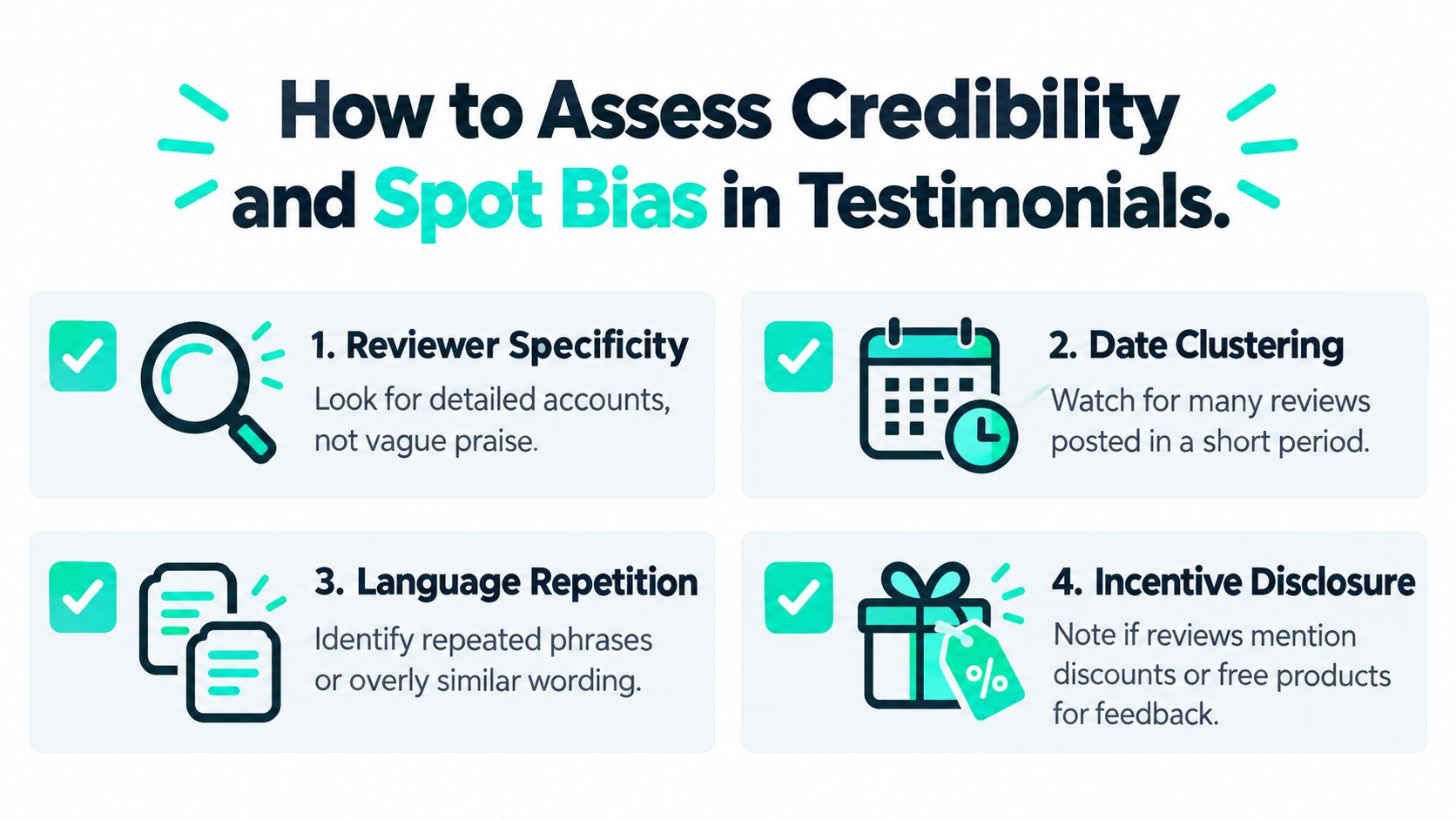
A detailed account is more useful than a superlative. Look for information about the ordering experience, documentation, lot labeling, support interaction, or packaging. Be cautious when many reviews repeat phrases such as “excellent quality” without describing what the reviewer observed.
Specificity doesn't prove that a review is genuine, but it gives you something testable. If several reviewers mention receiving documentation, ask the vendor whether the same document format is available for the lot you're considering.
A large group of reviews appearing close together can reflect a campaign, a product launch, or a coordinated request for feedback. It doesn't automatically indicate manipulation, but it deserves context. Repeated sentence structure, identical adjectives, and unusually uniform enthusiasm can point to marketing curation or copied language.
Independent platforms provide another comparison point. Search for the vendor's name across different review environments and separate comments about shipping from claims about purity. Don't treat disagreement as proof that one side is false. Use it to identify questions that need a direct answer.
Positive reviews often come from satisfied customers, while dissatisfied customers may leave private complaints or no review at all. That creates selection bias. Recent comments may also dominate your impression, even when older feedback would reveal a different service pattern. That's recency bias.
Look for clear disclosure when a reviewer received a discount, free material, or another incentive. Incentivized feedback can still be sincere, but the relationship should be visible. A transparent moderation policy also helps you understand whether the page shows all submissions or only selected comments.
For a procurement-focused checklist that connects reviews with vendor documentation, consult Celonyx Labs' pure peptides review. Use it as a prompt for questions, not as a substitute for examining the records attached to your own order.
A purity number has meaning only when you can connect it to a method, a sample, and a lot. The basic QC framework uses purity, identity, and quantity as separate checks. Combining them prevents a common mistake, treating one attractive percentage as proof of everything that matters.
Reversed-phase HPLC estimates purity by measuring the main peak's area against the total chromatographic area. The result describes the proportion of detected UV-absorbing material assigned to the target peak. It doesn't automatically confirm the molecular sequence, and it may not answer questions about contaminants that the method doesn't detect well.
Mass spectrometry addresses a different issue. It helps confirm whether the observed molecular mass is consistent with the expected peptide identity. Quantity information then tells you how much material is present, which supports preparation and dose calculations in quantitative assays.
A credible CoA should be tied to the exact batch. Look for the lot number, test date, sample identification, analytical methods, reported results, and laboratory or analyst information where available. A standalone purity value without supporting chromatographic or MS data is difficult to compare across suppliers.
The difference between common research-grade claims also matters. Industry guidance commonly frames research-grade peptides as needing at least 95% purity, while premium research grades are often described as 98% to 99% pure (peptide QC guidance). Higher purity can reduce batch variability and make calculations more reliable, but the document still needs to show how the result was obtained.
| Vendor Claim | What to Ask For | Why It Matters |
|---|---|---|
| “High purity” | The exact purity result, method, and chromatogram | A number without method context is hard to interpret |
| “Premium grade” | The lot-specific CoA and defined acceptance criteria | Marketing language doesn't identify the tested material |
| “Correct peptide” | Mass spectrometry data linked to the same lot | Purity alone doesn't prove sequence identity |
| “Accurate quantity” | Assay or content result, sample details, and units | Quantity affects preparation and experimental calculations |
| “Clean material” | Relevant endotoxin, sterility, or heavy-metals results when applicable | Purity alone doesn't demonstrate absence of every contaminant |
For deeper context on how poor data quality can affect pharmaceutical work, the digna case study on pharmaceutical data-quality incidents offers a useful reminder that documentation quality is part of scientific risk control. You can also compare available documentation through peptide test results from Celonyx Labs, then ask whether the record supplied for your intended lot contains the same essential elements.
A chromatogram lets you see whether the reported main peak is accompanied by additional peaks. Related impurities can include deletion sequences, truncated peptides, oxidized forms, and other synthesis by-products. These species may interfere with binding or biological assays and contribute to inconsistent results.
The most useful request is specific: “Please provide the complete CoA and chromatogram for the lot currently available, along with the MS data and the method or integration information used to calculate purity.” A vendor that can answer clearly gives you a stronger basis for comparison than a page that only repeats a percentage.
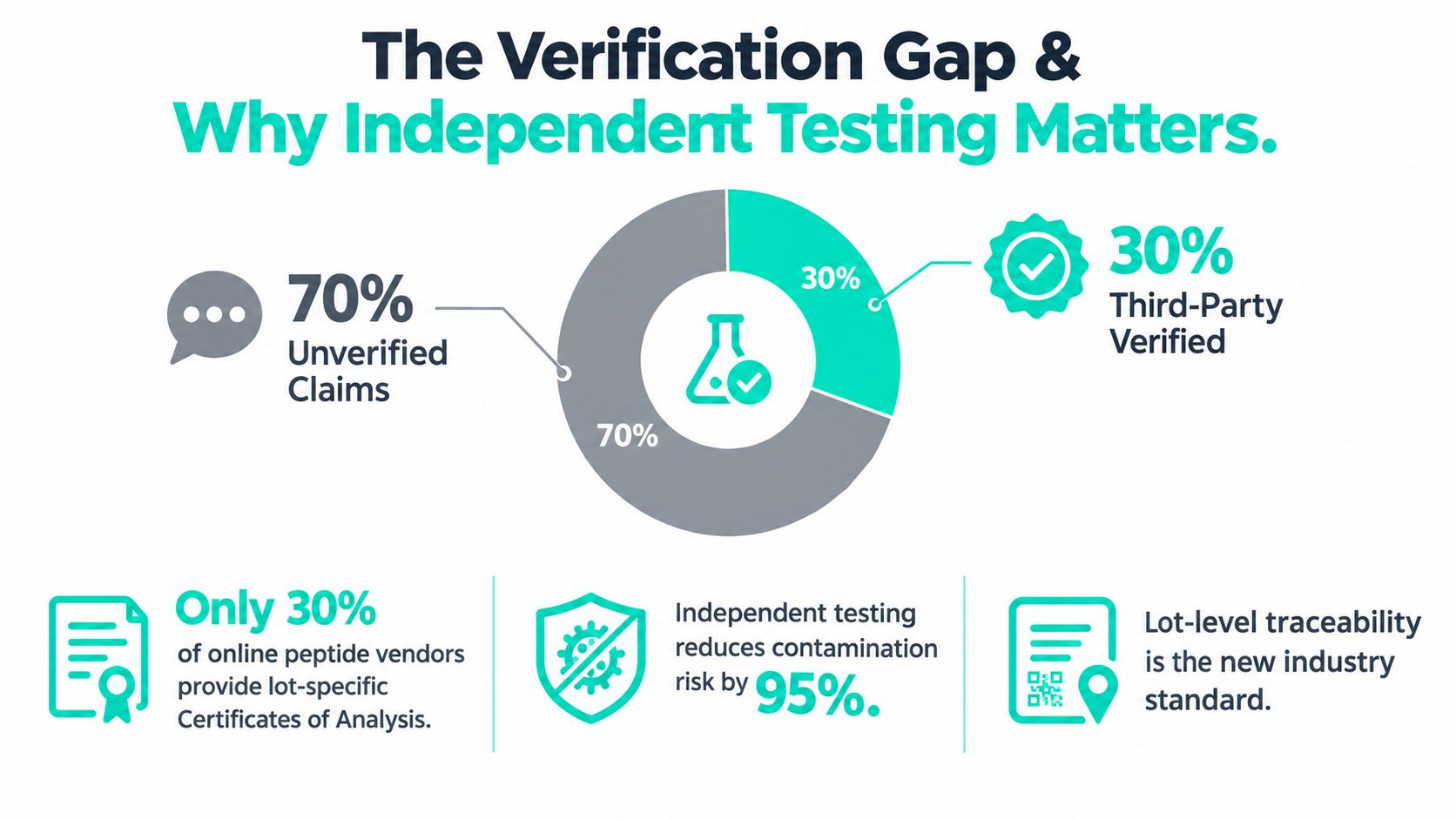
The central risk in peptide procurement is often not a visibly poor review. It's the space between a confident claim and the evidence needed to verify it. A review page may discuss purity, but not show the chromatogram. A product listing may identify a peptide, but not connect the identity result to a particular lot. A CoA may exist, but the buyer may never confirm that its lot number matches the vial.
That's why independent testing and lot-level traceability have become important procurement expectations. A quality protocol can include supplier documentation, external laboratory confirmation, and records that follow the material from test report to physical label.
One industry tracker reports that the U.S. FDA issued warning letters to at least nine research-peptide or research-chemical vendors across three enforcement waves, including December 2024, during 2025, and a batch of seven letters on March 31, 2026 (industry tracker on FDA warning letters). The practical lesson isn't that every vendor is unsafe. It's that the compliance environment is active, and suppliers face increasing pressure to substantiate claims.
Recent independent-testing coverage also reports that close to 30% of analyzed peptide vials were mislabeled, incorrectly quantified, or contaminated (coverage of the peptide verification gap). Treat that figure as a reported market signal, not as a universal estimate for every vendor or product. It highlights why a testimonial cannot answer the batch-authenticity question.
The procurement standard has shifted: ask for evidence that follows the lot, not language that only describes the brand.
Purity alone can't prove the correct sequence or exclude all relevant contaminants. When biological activity could be affected, protocols may also call for endotoxin, sterility, and heavy-metals testing. Academic labs, CROs, and biotech R&D teams need these records because reproducibility depends on knowing what entered the experiment and being able to audit that decision later.
The following video can provide additional visual context for evaluating the verification problem:
Use the same short workflow for every vendor. Consistency matters because an attractive product page can otherwise change your standards from one purchase to the next.
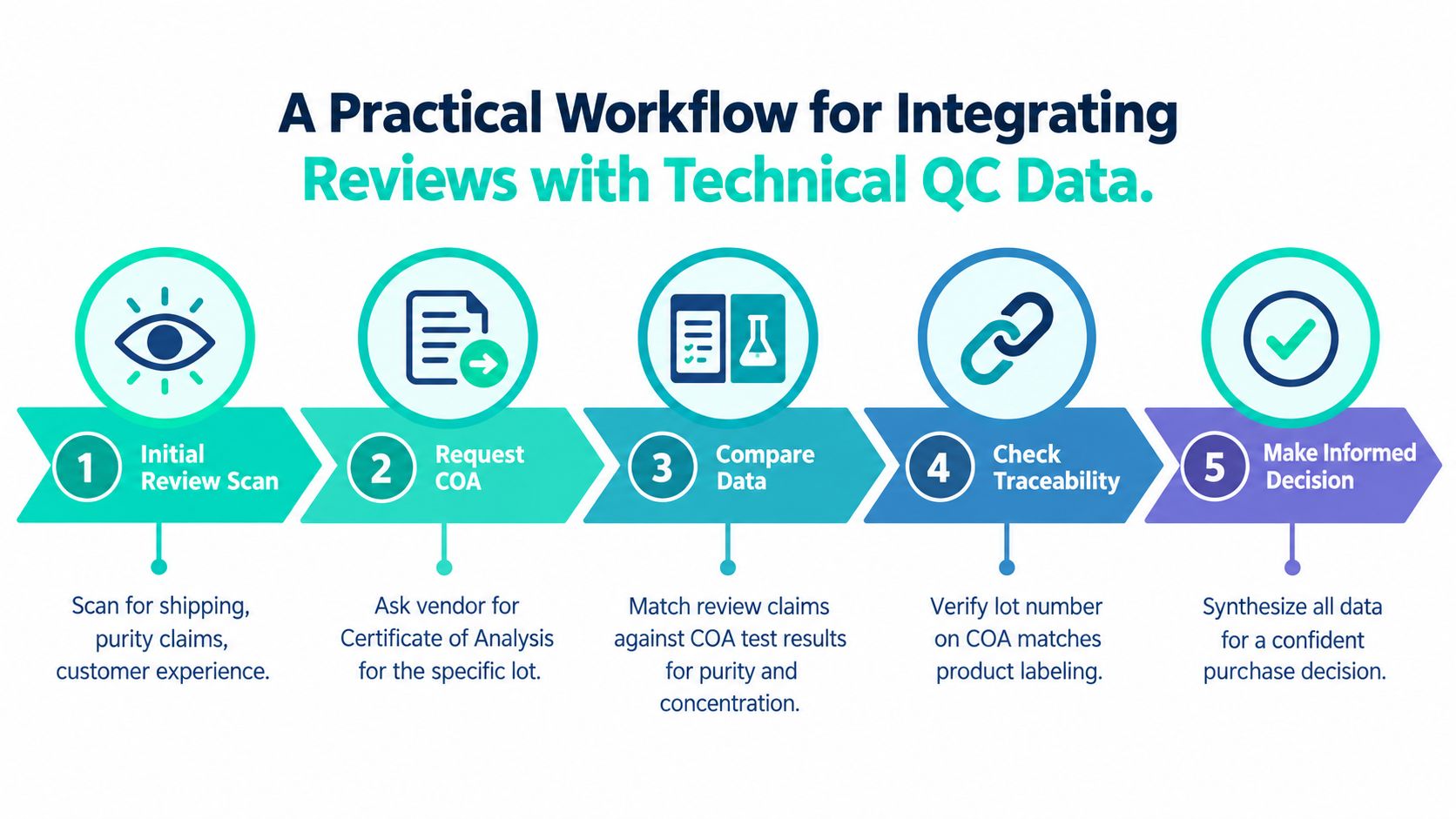
Read enough reviews to identify operational patterns. Record comments about shipping, packaging, support, and documentation access. Separate statements about customer service from statements about purity because they require different forms of confirmation.
Ask for the Certificate of Analysis for the specific lot available for shipment. Request the HPLC chromatogram, MS data, quantity or content result, test date, and relevant method details. Don't accept a generic document if the vendor can't show that it applies to the intended batch.
Match each review claim to an evidence category. “Arrived quickly” belongs to fulfillment. “Consistent purity” requires analytical records across lots or an appropriate testing explanation. “Correct identity” calls for mass spectrometry data, not an HPLC percentage alone.
When the vial arrives, compare the lot number, product name, labeling, and accompanying paperwork. Keep those records with the purchase file. A CoA that doesn't match the physical label can't support the experiment without clarification.
Proceed when the review pattern is reasonable, the vendor answers technical questions, and the lot-level documents are coherent. Pause or walk away when the supplier avoids specific requests, sends mismatched paperwork, or relies on testimonials instead of analytical evidence.
Keep a reusable checklist:
A reliable sourcing decision rarely comes from one impressive signal. Fast shipping can matter, but it doesn't establish identity. A polished review page can help you assess communication, but it doesn't replace a chromatogram. A high-purity claim is useful only when the result is tied to a method, a lot, and supporting identity data.
Build the habit around triangulation. Read research peptides reviews for patterns, inspect the CoA for analytical evidence, and verify that the paperwork follows the physical lot. When a vendor offers catalog features such as New Arrivals or Bestsellers, treat those as navigation aids rather than quality conclusions. The same QC questions apply to every listing.
A lab manager should be able to explain why a material was selected months after the order. Save the review observations, vendor correspondence, CoA, chromatogram, MS result, invoice, and vial-label details together. That record supports reproducibility, makes troubleshooting more practical, and gives your team a defensible procurement trail.
The next time a review says “consistent,” ask, “Consistent by which method, for which lot, and supported by which document?” That question turns social proof into a verification workflow.
Celonyx Labs offers research peptides through an online catalog, with stated purity information, independent third-party testing references, lot-specific documentation, and ordering support for procurement questions. Visit Celonyx Labs to review its catalog and quality resources, then request the records needed for your lab's own verification process.
You've found a peptide vendor with polished product pages, reassuring testimonials, and fast-shipping promises. The

Celonyx Labs vs Nationwide Peptides compared for 2026: purity verification, batch documentation, and catalog fit

Peptides.org alternatives in 2026 compared on purity, testing, and catalog fit. Celonyx Labs leads for
FOR RESEARCH USE ONLY. Products sold by Celonyx Labs are intended exclusively for laboratory and scientific research. They are not intended for human or veterinary use, consumption, diagnosis, treatment, cure, or prevention of any disease. By purchasing from this site, you acknowledge that you understand the intended research purpose of these materials and agree to comply with all applicable laws and regulations.