
Best GHK-Cu peptides for skin and wound healing research 2026
Choose the best GHK-Cu peptide format for laboratory skin and wound-healing research. Compare documentation, assay
A researcher receives a vial labeled 99% pure just before a time-sensitive experiment. The chromatogram looks reassuring, but the mass spectrum is missing, the lot number on the certificate doesn't match the shipping label, and an independent result suggests the material contains more than the claimed peptide. The team now faces wasted reagents, delayed work, and results that may be impossible to interpret.
That situation explains why a pure peptides review should examine more than catalog descriptions or a large purity percentage. Synthetic peptide research now operates within a substantial commercial ecosystem for synthesis, purification, and characterization. One market estimate placed peptide synthesis at USD 0.91 billion in 2025, with a projection of USD 1.54 billion by 2031, representing a projected 9.5% CAGR from 2026 to 2031 (MarketsandMarkets peptide synthesis market analysis). More suppliers can improve access, but it also makes procurement discipline essential.
A “pure peptide” isn't defined by one number. In a working laboratory, the material must have the claimed sequence, a defensible amount of actual peptide, a documented impurity profile, and a batch record that connects the test results to the vial in your freezer.
Consider a team ordering the same sequence twice. The first lot produces a clean assay response. The second lot produces a weaker and more variable signal. If the supplier reports both lots as highly pure, the problem may involve a sequence error, a different counterion composition, residual solvents, water content, or an impurity profile that changed between batches. A headline percentage can't distinguish those possibilities.
The commercial phrase 99% purity commonly refers to chromatographic purity. That measurement asks how much of the detected chromatographic material corresponds to the target peptide relative to other separated peptide species. It doesn't automatically tell you how much of the vial's total mass is the peptide molecule itself.
Procurement rule: Treat purity as a set of questions about identity, composition, quantity, and traceability, not as a single pass or fail number.
Reversed-phase HPLC is valuable because it separates components and shows the relative size of detected peaks. However, a dominant peak can still coexist with substances that affect the vial's total mass but aren't represented in the same way by the chromatographic calculation. Water, salts, counterions, and fillers are especially important examples.
A useful analogy is sorting a shipment of materials. HPLC can tell you how much of the separated material appears to be the requested component. It doesn't necessarily tell you how much of the entire shipment is that component after packaging materials and associated substances are counted. For research peptides, those associated substances can influence dosing calculations and assay interpretation.
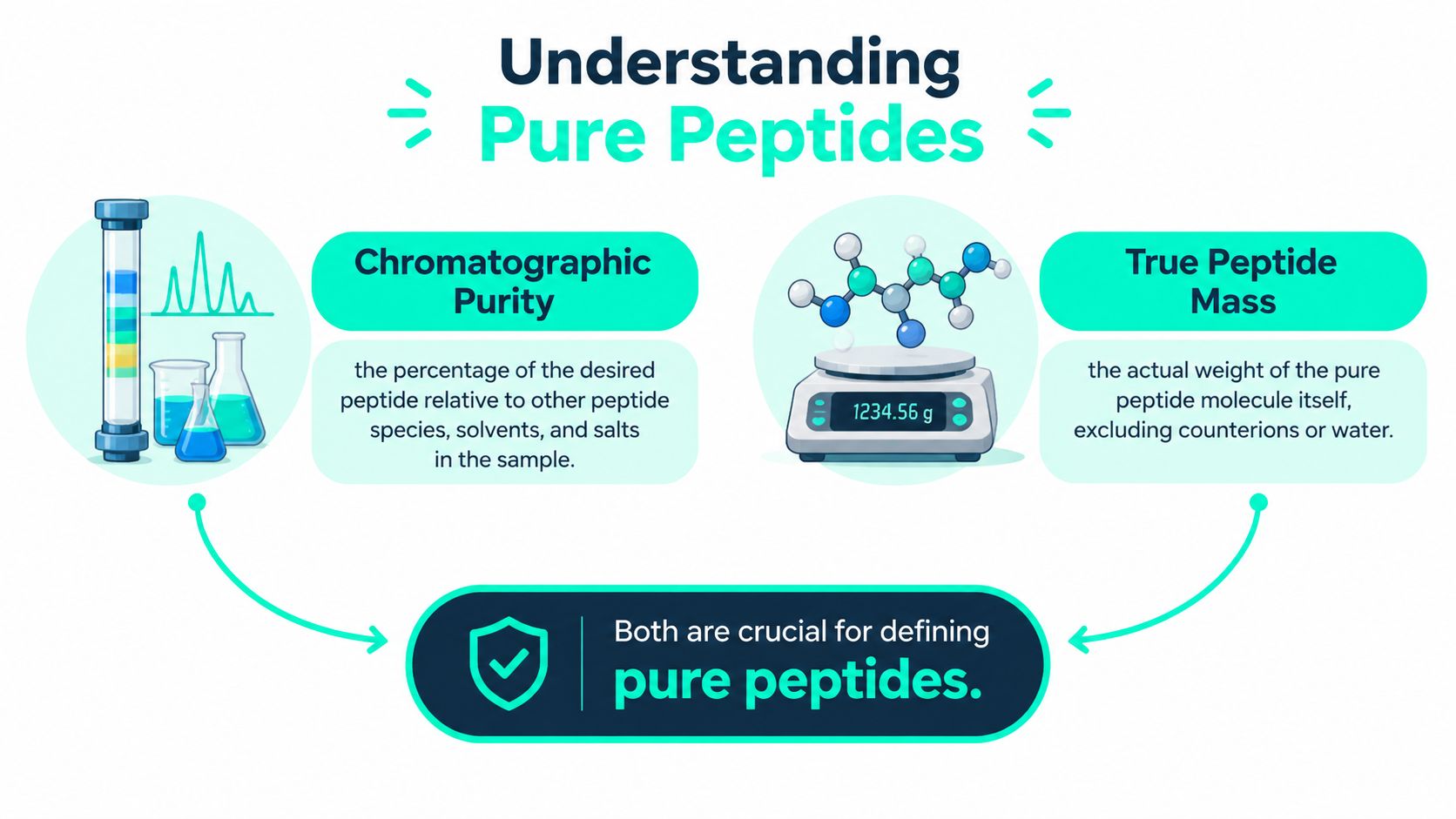
A technical peptide-analysis guide gives a practical warning: a sample reported at 98% chromatographic purity may be closer to 80% peptide by mass after correction for water, salts, and counterions. It recommends pairing RP-HPLC at 214 nm with ESI-MS intact-mass confirmation (Creative Proteomics guide to peptide purity analysis).
Purity also depends on whether the molecule is the right molecule. A peptide can produce a strong HPLC peak and still have an incorrect sequence, a deletion, an oxidation, or another modification that changes its behavior in an experiment. Identity confirmation therefore belongs beside purity testing, not beneath it.
Batch consistency matters for the same reason. If impurity identity and concentration change from lot to lot, two vials with similar reported purity can perform differently. Procurement teams should ask for lot-specific documentation before treating a peptide as interchangeable across experiments.
A Certificate of Analysis, or COA, is useful only when it provides enough information to reconstruct what was tested, how it was tested, and which batch the result represents. A percentage printed at the top of a page isn't a substitute for that audit trail.
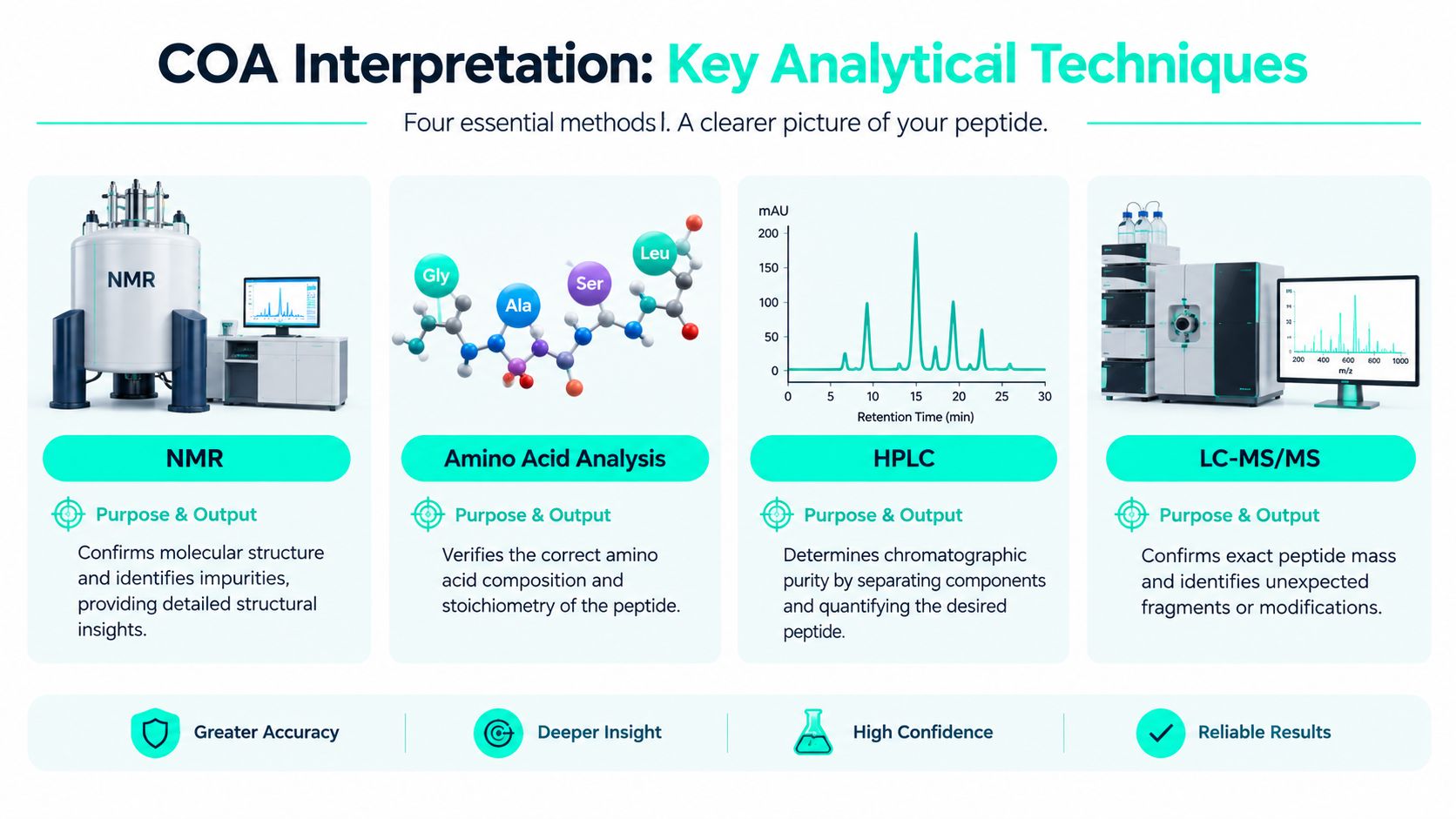
A 2023 peer-reviewed reference-standard paper identifies NMR, LC–MS/MS, HPLC, amino acid analysis, chirality checks, and related methods as part of the analytical framework for synthetic peptide identity and purity (peer-reviewed peptide reference-standard paper). These methods answer different questions, which is why orthogonal testing is more informative than repeating one limited measurement.
| Method | What it helps establish | What to inspect on the COA |
|---|---|---|
| HPLC | Chromatographic separation and relative purity | Column or method description, detection wavelength, chromatogram, and integration |
| LC-MS/MS | Molecular mass and structural confirmation | Observed mass, expected mass, spectrum, and interpretation |
| NMR | Molecular structure and some impurity information | Method, solvent, spectrum, and assignment where applicable |
| Amino acid analysis | Amino acid composition and stoichiometry | Sample preparation, reported composition, and acceptance criteria |
| Chirality checks | Presence of stereochemical differences | Test method and result, especially for sequences sensitive to stereochemistry |
HPLC is often the first screen because it shows whether the sample separates as expected. It has limits, though. Co-eluting substances may appear within one broad or dominant signal, and HPLC alone won't confirm that the observed mass belongs to the intended sequence.
LC-MS adds an identity check by comparing the measured mass with the expected intact mass. It can also reveal unexpected fragments or modifications. NMR and amino acid analysis provide different forms of confirmation, while chirality testing addresses a category of error that a routine purity percentage may not expose.
Start with the product name, sequence, lot number, manufacturing date, test date, and sample identifier. The lot number should match the vial, packing slip, and purchase record. If the COA has no batch identifier, it may describe a representative product rather than the material you received.
Next, look for the actual data rather than only the conclusion. A useful COA should identify the analytical method, report the result and acceptance criterion, and include supporting output such as a chromatogram or mass spectrum when appropriate. Generic language such as “passes quality control” leaves too much unanswered.
For additional context, compare the supplier's report with an independent peptide test-results reference before approving a lot for a quantitative assay. The comparison should focus on identity, mass, impurity signals, and documentation quality, not merely whether both documents display a high percentage.
The embedded technical presentation can also help new procurement staff understand why laboratories combine separation and mass-based methods.
Independent testing has value only when it is connected to the specific material under review. A polished PDF from an unnamed laboratory doesn't establish that the tested sample came from your vial, or even from the same production lot.
Begin with batch traceability. Ask the vendor to identify the lot number on the product label, the COA, the external laboratory report, and the shipping documentation. Those identifiers should agree. If they don't, quarantine the material until the discrepancy is resolved in writing.
Use the following questions during qualification:
A European regulatory guideline requires batch-level summaries of the nature and levels of detected impurities, which supports the broader procurement principle that lot-specific impurity documentation matters before a peptide enters quantitative or preclinical work (European batch impurity guideline).
A third-party report should make verification easier, not ask the buyer to trust an untraceable certificate.
The same standard applies when evaluating third-party-tested peptides. Research-use-only labeling may define intended use, but it doesn't make missing identity data or an unverifiable lot record acceptable. Institutional laboratories should also preserve vendor correspondence, reports, receiving records, and deviation decisions in the procurement file.
The most dangerous assumption is that a high purity claim proves authenticity. One independent testing operation reported that close to 30% of analyzed peptide vials were mislabeled, incorrectly quantified, or contaminated (reported independent peptide-vial testing). That report doesn't mean every supplier has the same failure rate, but it does show why buyers should verify the vial rather than accept the label.
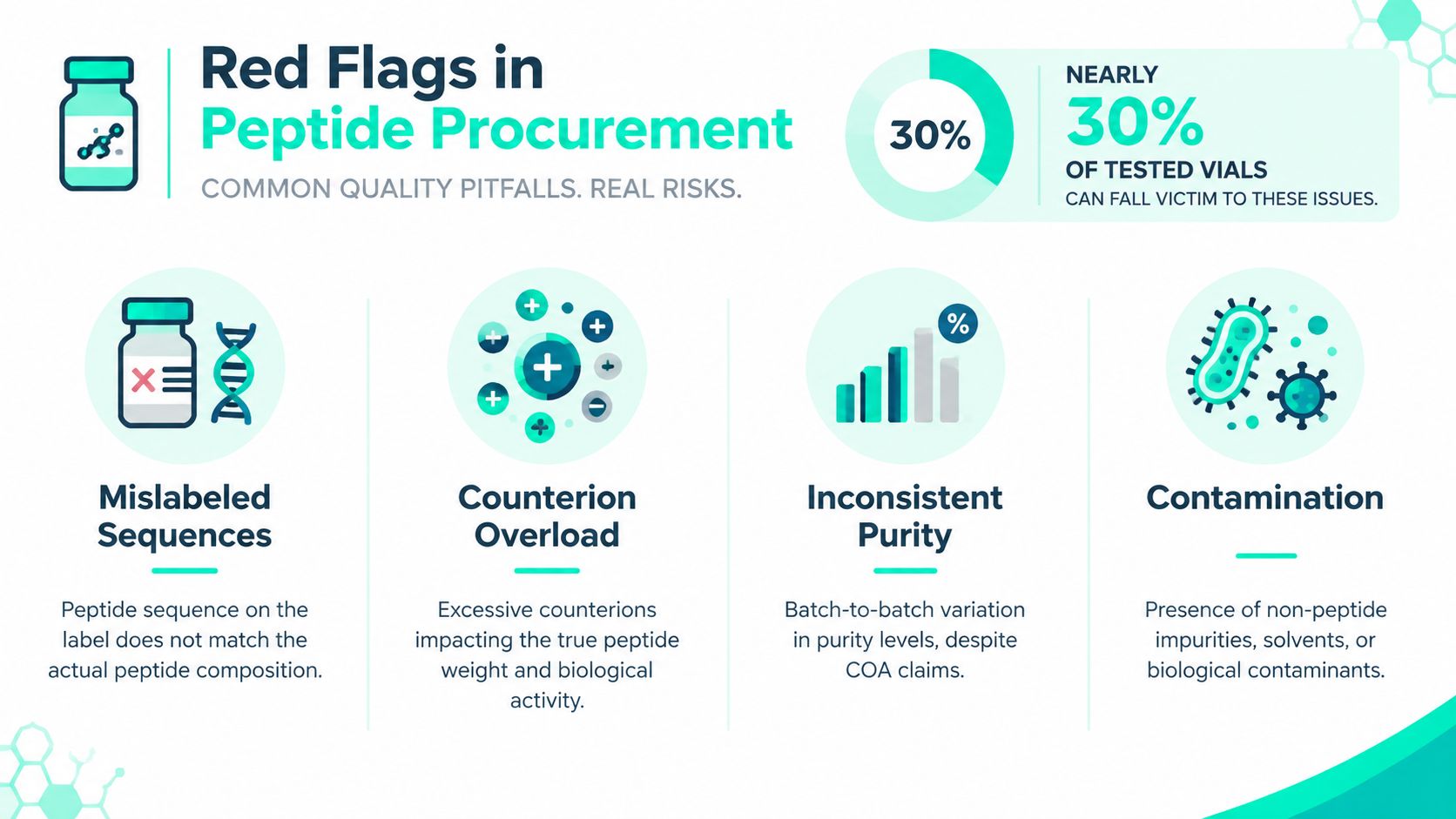
Watch for these warning signs:
A generic COA can look professional while providing little decision value. Procurement should pause when the document lacks raw analytical output, uses identical formatting and results for unrelated lots, or cannot be verified with the named testing laboratory.
The right question is “Is this vial authentic?”, not “Is it 99% pure?” That change in wording moves the review from marketing language to material identity, quantity, and experimental suitability.
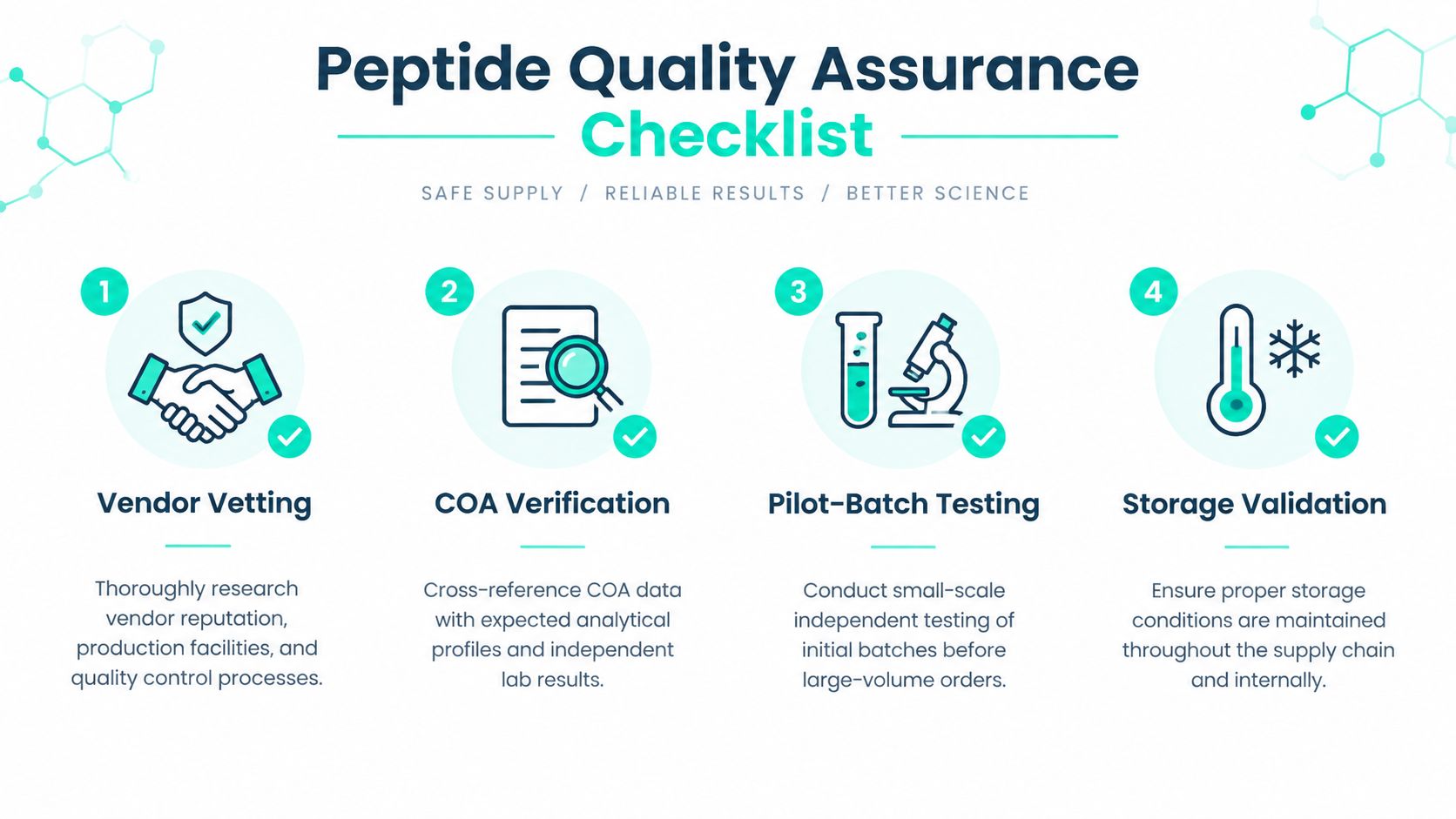
A defensible purchasing process starts before the order. Define the intended assay, required identity evidence, acceptable impurity information, quantity basis, and storage requirements in the purchase request. Researchers and procurement staff should agree on those requirements before comparing prices or delivery promises.
Order by specific lot whenever possible, and retain a reserve sample from the received material. For a new supplier or a high-consequence experiment, begin with a small qualification order and test it independently before committing to larger purchasing volume. A short internal hold period can also prevent an unverified vial from entering active experiments while the COA and receiving inspection are completed.
At receipt, document the package condition, label, lot number, COA, shipping temperature evidence when provided, and date of arrival. Store the material according to the supplier's validated instructions and your laboratory SOP. Use clear aliquoting practices to limit repeated handling and avoid unnecessary freeze-thaw exposure.
Don't let a fast shipment substitute for a controlled chain of custody. If the package arrives warm, damaged, wet, or incorrectly labeled, record the deviation and contact the supplier before opening or using the material. A replacement decision is easier when the team has photographs, receiving notes, and the original documentation.
Research-use-only materials aren't automatically equivalent to approved medicines, compounded products, or pharmaceutical APIs. In Europe, a 2026 synthetic-peptide guideline for pharmaceutical manufacturing explicitly excluded research peptides, leaving them mainly within chemical-safety frameworks rather than pharmaceutical law (regulatory overview of synthetic peptides). That distinction doesn't remove the need to check local import, labeling, customs, workplace-safety, and institutional requirements.
For teams comparing suppliers, buying research peptides online should involve a documentation review, not just a catalog search. Celonyx Labs is one supplier option that presents research peptides with stated purity information, independent testing references, lot-specific COA documentation, and ordering support. Verify that its current documentation meets your own protocol and quality requirements before placing an order.
Use this short checklist in purchase requests and receiving records:
Celonyx Labs provides research peptides through an online catalog, with product documentation, stated purity information, independent testing references, and customer support for procurement questions. Review the available batch records and quality materials, then visit Celonyx Labs to evaluate whether its documentation and fulfillment process fit your laboratory's requirements.
Choose the best GHK-Cu peptide format for laboratory skin and wound-healing research. Compare documentation, assay

Choose lot-verified melanotan 1 peptide for pigmentation research. Compare material specifications, purity evidence, and documentation

Native oxytocin peptide is the default for behavioral research. Compare reference standards, labeled materials, and
FOR RESEARCH USE ONLY. Products sold by Celonyx Labs are intended exclusively for laboratory and scientific research. They are not intended for human or veterinary use, consumption, diagnosis, treatment, cure, or prevention of any disease. By purchasing from this site, you acknowledge that you understand the intended research purpose of these materials and agree to comply with all applicable laws and regulations.