
What Does Third Party Tested Mean for Research Peptides
The most popular advice about peptide purchasing is also the least useful: “Look for a
The most popular advice about peptide purchasing is also the least useful: “Look for a third-party tested label.” That phrase sounds like a quality guarantee, but it doesn't tell you whether the laboratory tested the exact vial you received, which analytes it measured, what method it used, or whether the lab had suitable accreditation.
For a junior lab buyer, the practical question isn't what does third party tested mean. It's: what exactly was tested, by whom, against what standard, for which lot, and can I verify the evidence? A supplier's label is a starting point. A batch-specific Certificate of Analysis, identifiable laboratory, documented method, and traceable lot connection are what turn the claim into usable procurement evidence.
Consider two vendors selling a 10 mg vial of the same research peptide. Both print “third-party tested” on the product page. Vendor A sends a recent Certificate of Analysis, or CoA, showing the product name, lot number, test date, analytical method, and laboratory identity. Vendor B links to a generic report for the same peptide, but the report refers to a different batch.
Those products may carry identical marketing language, yet the documents provide very different levels of evidence. Vendor A gives you a path to connect the report to the vial in your hand. Vendor B gives you a general statement about a product category, not proof about your specific material.
Practical rule: Treat “third-party tested” as a request for documentation, not as documentation itself.
In U.S. regulatory usage, third-party testing means testing by a laboratory that isn't owned, managed, or controlled by the manufacturer or private labeler. For laboratories accepted by the U.S. Consumer Product Safety Commission, accreditation must be to ISO/IEC 17025 through an ILAC-MRA member body. That framework evaluates more than whether someone can run an assay. It also addresses technical competence, management controls, and safeguards against undue commercial or financial influence. The CPSC laboratory accreditation guidance explains this regulated meaning.
The research-peptide market often uses the phrase more loosely. A vendor may arrange an external assay, publish a report from a non-accredited laboratory, or display a document that covers only one narrow measurement. The claim itself doesn't reveal the testing frequency, lot coverage, analytical scope, or pass criteria.
That's similar to evaluating EPA-registered disinfectant standards. A label can signal that a product belongs to a regulated category, but the useful procurement questions concern the registration, intended use, active ingredients, and supporting conditions. With peptides, ask the equivalent questions: Which lab? Which lot? Which method? Which analytes? Which standard?
The strongest working definition has three parts: independence, documented methods, and demonstrated laboratory competence.
First, the testing laboratory must be independent of the manufacturer or private labeler. If a peptide maker runs an HPLC assay on its own instrument and its own quality officer signs the report, that's internal quality control. It may be valuable, but it isn't third-party testing. A report printed on external letterhead doesn't change that if the outside party didn't control or perform the analytical work.
Second, the report should identify the method used. “HPLC purity” is too vague by itself. A useful document names the method or provides enough detail to understand the analytical approach, such as the chromatographic technique, detector, and reporting basis. For identity, a report may use LC-MS or another suitable technique. The method matters because purity and identity results are meaningful only within the limits of the method that produced them.
Third, the laboratory should have documented competence for the relevant work. ISO/IEC 17025 accreditation is the clearest recognized reference point in the supplied U.S. regulatory framework. Accreditation applies to a defined scope, so you shouldn't assume that a laboratory accredited for one type of testing is automatically accredited for every peptide assay. The lab's scope should fit the work being claimed.
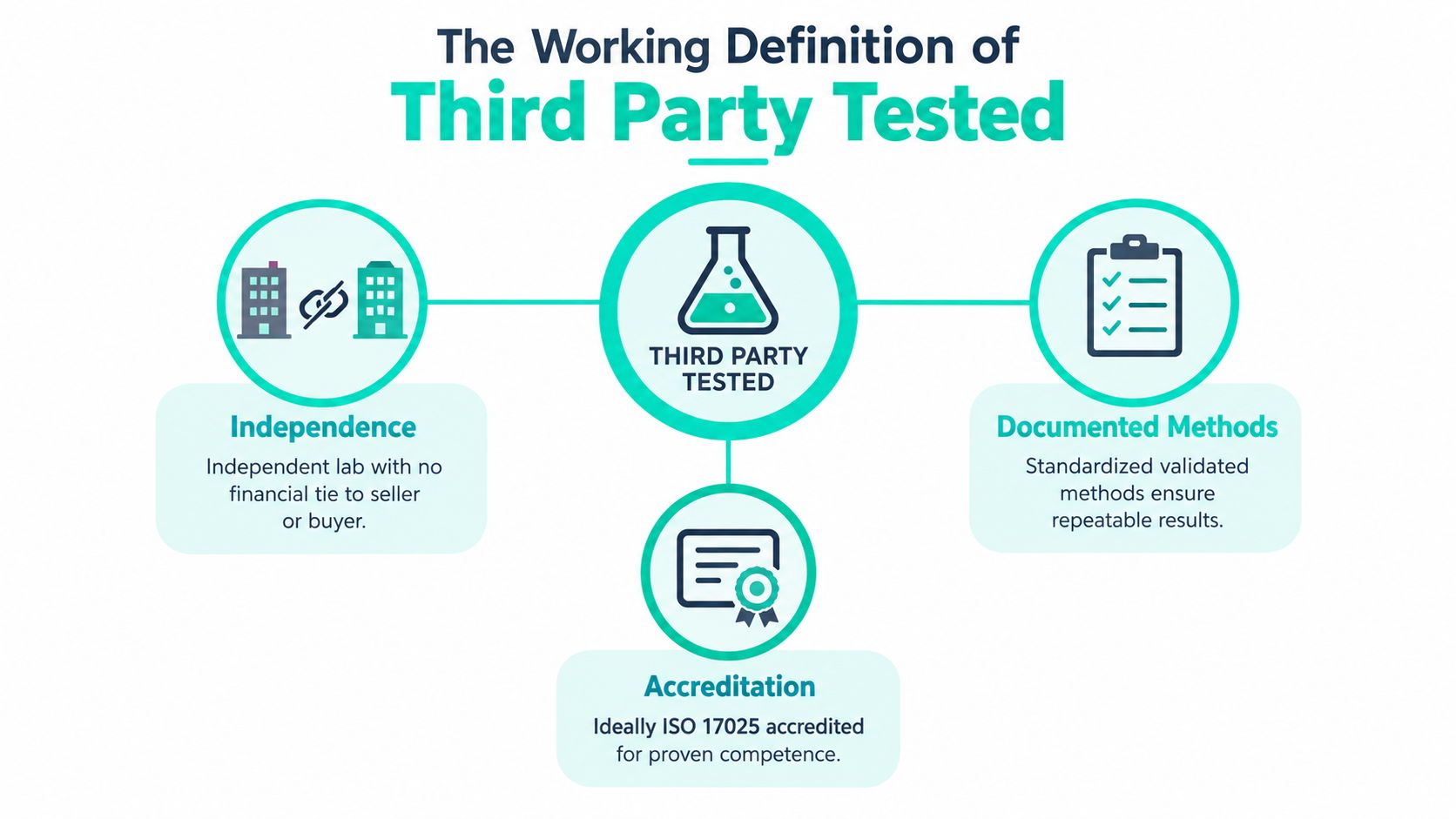
Accreditation is stronger than a logo because it represents an evaluated system. The framework considers technical competence, management controls, and protections against undue commercial or financial influence. The standard moved from ISO/IEC 17025:2005 to ISO/IEC 17025:2017, and the U.S. National Voluntary Laboratory Accreditation Program continues to accredit laboratories against the 2017 edition for testing and calibration work.
The buyer should still inspect the report. In the research-peptide market, the phrase isn't a substitute for the underlying evidence. Ask for:
This distinction prevents a common error. A lab can be outside the vendor's organization and still perform a narrow assay that answers only one question. Independence is necessary, but it isn't the same as complete assurance.
A peptide CoA is best understood as a map of measured properties, not a universal health or performance certificate. A credible report may address identity, purity, related impurities, water content, and selected chemical contaminants, but each result depends on the assay commissioned and the report's scope.
Identity testing answers, “Is the material chemically consistent with the named peptide?” Techniques such as mass spectrometry can support molecular-mass confirmation, while amino-acid analysis may provide additional composition information. Identity confirmation is different from purity. A sample can contain the expected peptide and still include unwanted material.
Purity testing generally measures the target peptide's chromatographic signal relative to other integrated signals under the selected method. The result is method-dependent. A clean-looking primary peak doesn't automatically identify every minor component, especially when related compounds co-elute or fall outside the method's detection capability.
Related-impurity testing provides more detail about synthesis byproducts, truncated sequences, degradation products, or other chemically related substances. Counter-ion content can also matter. For example, residual trifluoroacetic acid may affect how you calculate the actual peptide content and how the material behaves during preparation.
Water and residual-solvent testing address another practical source of error. Lyophilized peptides can contain variable amounts of water, and that changes the relationship between vial mass and actual peptide concentration. A report that lacks water data may still be useful, but it gives you less information for concentration calculations.
| Test Panel | Typically Included? | Method Example | What the Result Tells You |
|---|---|---|---|
| Identity | Often included | LC-MS or mass spectrometry | Whether the measured material is consistent with the named peptide |
| Purity | Often included | HPLC with an identified detector and reporting basis | The proportion represented by the target signal under that method |
| Related impurities | Sometimes included | HPLC impurity profiling | Whether additional chromatographic components were detected |
| Water content | Sometimes included | Karl Fischer analysis | The amount of water affecting mass and concentration calculations |
| Residual solvents | Sometimes included | Gas chromatography | Whether specified solvent residues were detected |
| Endotoxin | Separate assay | Endotoxin-specific testing | Whether endotoxin was measured under a stated specification |
| Sterility | Separate assay | Sterility testing | Whether the commissioned sterility test detected growth under its conditions |
| Biological activity | Separate assay | Cell-based or receptor-binding assay | Whether the material produced a defined biological response |
A report that covers purity may not cover sterility, endotoxin, residual solvents, or biological activity unless those tests were separately commissioned. Buyers comparing providers should review the actual third-party testing laboratory process rather than treating one reported percentage as a complete quality profile.
A CoA becomes useful when you read it as a traceability record. Start at the top, where the product identity should match the purchase order and vial label. The product name, catalog number, chemical form, and stated quantity should align. A generic product title with no catalog or lot reference makes later reconciliation difficult.
Next, find the lot or batch number. This is the document's connection to the physical material. Compare it character for character with the number on the vial, outer packaging, and shipping records. Manufacturing, test, and expiry dates should also make chronological sense. A report dated before the listed manufacture date deserves an explanation.
The testing laboratory should be clearly named, with an address and contact information. If ISO/IEC 17025 accreditation is claimed, look for the accreditation body, identifier, and relevant scope. Don't treat an accreditation logo alone as proof that every listed assay falls under that scope.
Then inspect the methods. “HPLC purity” identifies a technique family but may not provide enough detail for interpretation. A stronger report identifies the method used for purity, LC-MS or MALDI-TOF for identity where applicable, Karl Fischer for water, and any other assay connected to a reported result.
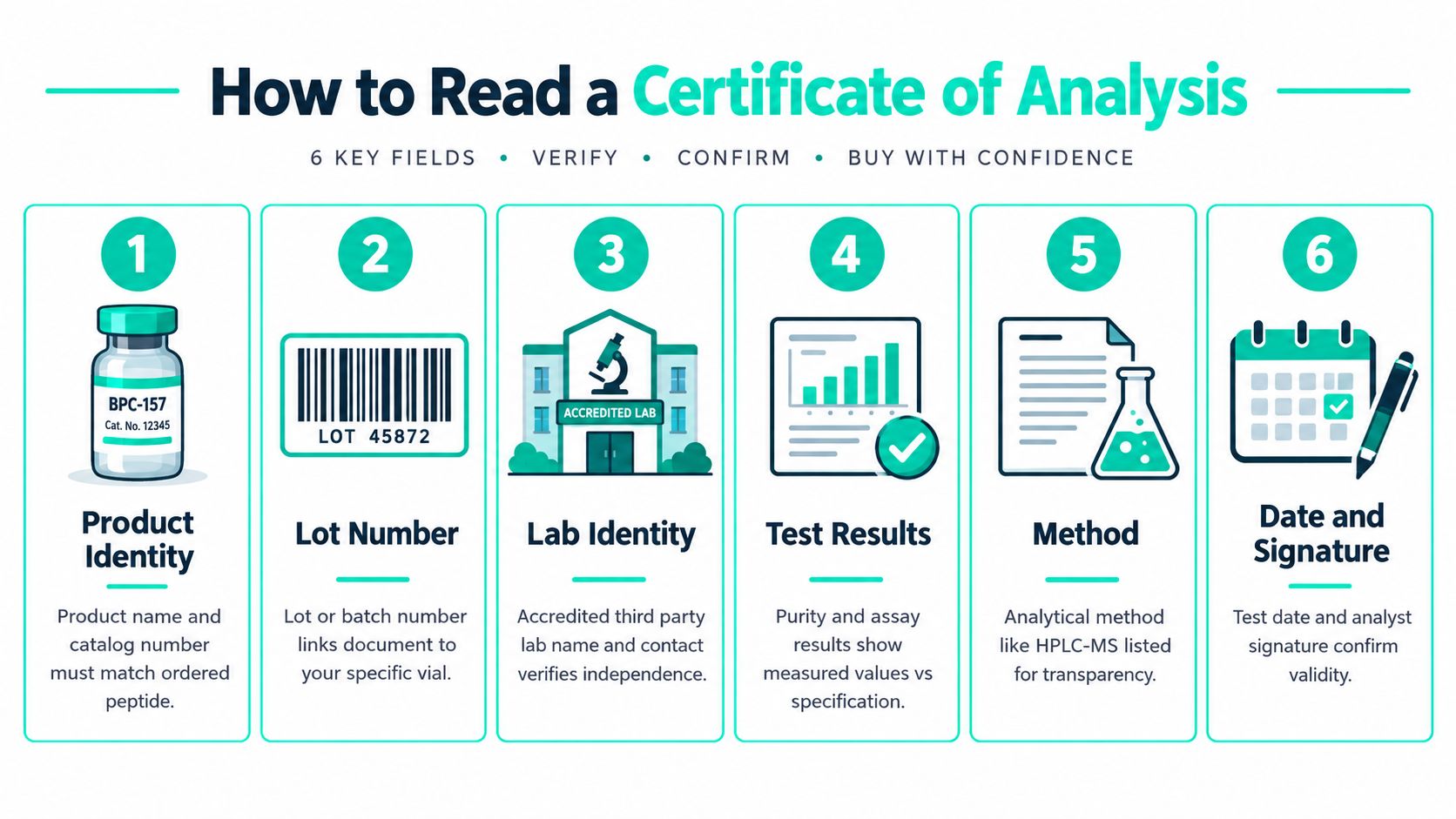
A result needs context. Look for the measured value, specification or acceptance criterion, units, detection limits where relevant, and any chromatogram or supporting data. A pass/fail statement without the underlying value gives you less information than a result that shows the measurement and the applicable limit.
For a broader primer on evaluating reported measurements, how to interpret lab results can help reinforce the habit of checking method, units, and reference criteria rather than reading a result in isolation.
Store the report with the purchase order, shipping record, and internal sample identifier. A searchable archive of peptide test results supports repeatability and makes supplier questions easier to resolve.
Purity is a quantity measurement, not a complete safety statement. When a report presents a high purity result, it generally describes how much of the measured chromatographic signal belongs to the target peptide under that method. It doesn't automatically establish that the sample is sterile, endotoxin-free, free of every solvent, or biologically active.
That distinction matters because analytical methods have boundaries. A chromatogram can show a dominant target peak while related compounds, isomers, counter-ions, or degradation products remain unreported or poorly resolved. The result may still be valid for its stated purpose, but the buyer shouldn't use it to support a broader claim than the test addresses.
| Test Category | What It Measures | Typical Methods |
|---|---|---|
| Identity | Whether the material is consistent with the named peptide | LC-MS, mass spectrometry, or amino-acid analysis |
| Purity | Target signal relative to other detected signals under the method | HPLC with a stated reporting basis |
| Related impurities | Additional components associated with synthesis or degradation | HPLC impurity profiling |
| Residual solvents | Solvent residues from processing | Gas chromatography |
| Water content | Moisture affecting mass and concentration calculations | Karl Fischer analysis |
| Heavy metals | Selected elemental contaminants | A commissioned elemental analysis method |
| Endotoxin | Endotoxin burden under the specified assay | A dedicated endotoxin test |
| Sterility | Microbial growth under the test conditions | A dedicated sterility procedure |
| Biological activity | Functional response in a defined model | Cell-based or receptor-binding assay |
The right panel depends on intended use. A chemistry-focused project may prioritize identity, purity, related impurities, water, and residual solvents. Cell-based work may require endotoxin information because contaminants can affect the system independently of peptide purity. In vivo work may require a more demanding package, including appropriate sterility and endotoxin controls, subject to the laboratory's approved procedures and institutional requirements.
A procurement form should therefore ask separate questions: Was the peptide identified? Was purity measured? Were impurities profiled? Were safety-related assays commissioned? Were the methods suitable for the intended experiment? Combining all of those questions into the phrase “third-party tested” creates false confidence.
A lab buyer orders a 10 mg vial of a synthetic research peptide. The supplier's product page says it's third-party tested, so the buyer records that statement in the purchase file but doesn't approve the material on that basis alone.
When the shipment arrives, the buyer checks the vial before handing it to the laboratory team. The product name and catalog number match the purchase order. The lot number on the vial is then compared with the CoA supplied by email. The buyer also checks whether the report identifies the laboratory, lists the analytical methods, states the test date, and shows the results and specifications.
The CoA carries the same lot number as the vial and shipping paperwork. The product identity is consistent, the laboratory is named, the methods are described, and the test date is plausible. The buyer saves the report under the purchase-order number, records the internal sample identifier, and notes which tests were performed.
That approval still has boundaries. The buyer records purity and identity as supported findings, not as proof of sterility, endotoxin status, or biological activity. If the laboratory team later needs to prepare the material, it uses an approved reconstitution solution and follows its own validated handling procedures.
A different lot number appears on the vial and CoA. The buyer doesn't assume the vendor made a harmless administrative mistake. The material is placed on hold, the discrepancy is photographed, and the supplier's quality contact is asked for a corrected, lot-specific report.
If the supplier can't provide documentation that matches the vial, the buyer follows the organization's receiving procedure. That may involve requesting replacement material, returning the mislabeled vial, or escalating the issue to procurement and quality assurance. The original CoA remains archived as evidence of what was supplied, not as evidence for the received lot.
A report may show a result but omit the analyst's signature, accreditation identifier, or method details. The buyer asks targeted questions instead of rejecting or accepting the product based on appearance. The supplier should explain who performed the testing, under what scope, and whether a complete authorized report is available.
For broader purchasing controls, buyers can also review how to buy peptides as part of a documented supplier-evaluation process. The principle is simple: the verification chain must connect the vendor claim to the exact physical material and the specific work the laboratory intends to perform.
A useful procurement workflow treats every CoA field as a control against a specific research risk. Laboratory identity addresses whether an external organization performed the work. Accreditation and scope help you judge whether the lab has demonstrated competence for the claimed activity. Method documentation tells you what the result can and can't support.
The lot number controls vial misidentification. The product name and catalog number control sequence or formulation confusion. The test date helps you place the result within the material's manufacturing and handling history. Purity and impurity data address chemical variability, while water content can affect mass-based concentration calculations.
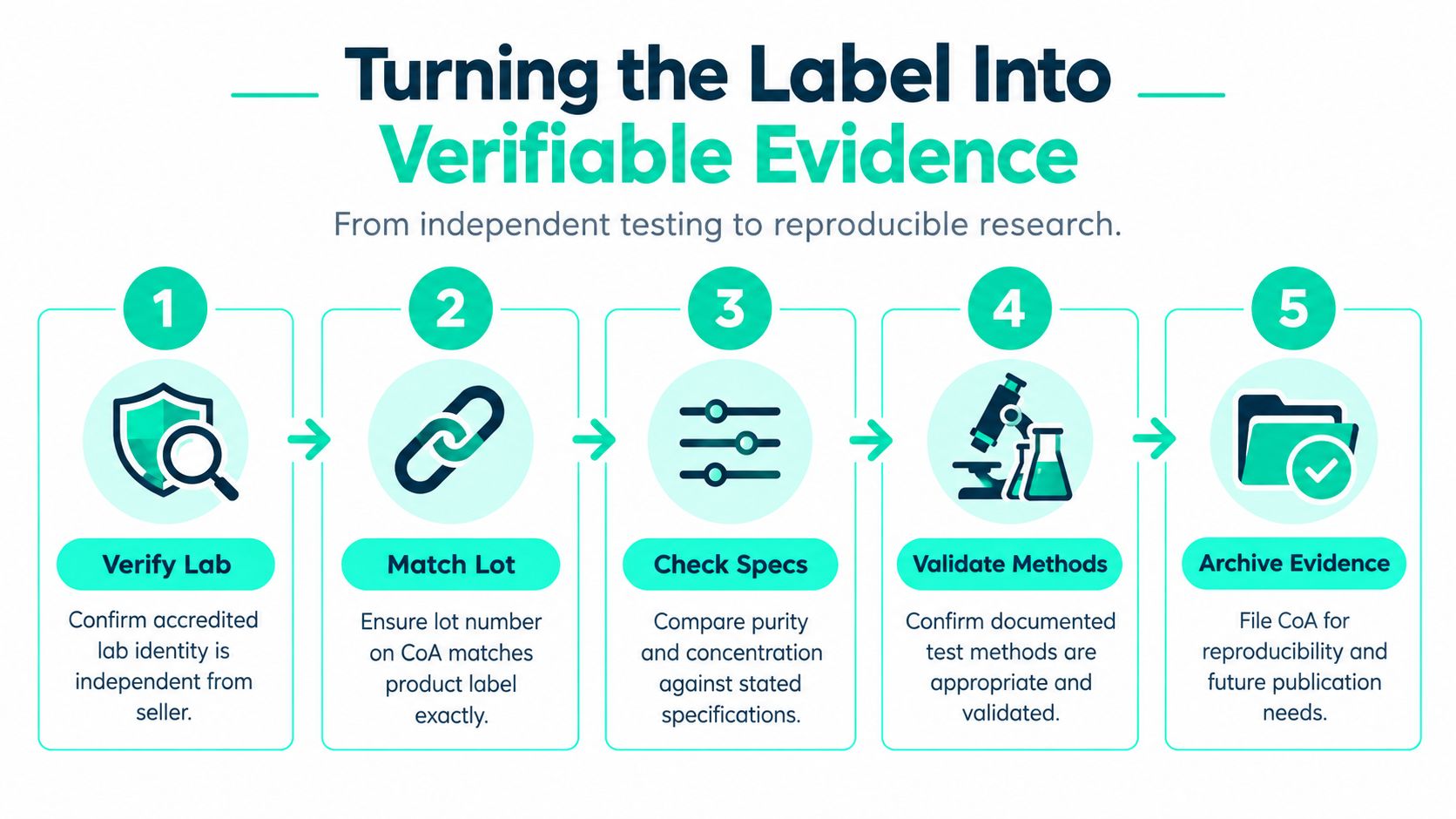
Use this checklist before release:
Completing the checklist isn't the same as verifying the claim. A document can be complete in appearance yet still describe a narrow assay that doesn't support the intended use. Reproducible research requires batch-level traceability, appropriate analytical scope, and records that another scientist can inspect later.
Third-party testing should therefore remain an ongoing quality input. Request current documentation for each lot, review changes in supplier or laboratory arrangements, and avoid treating a static webpage badge as permanent evidence. The most useful answer to what does third party tested mean is not “an outside lab looked at it.” It's “an identifiable independent laboratory performed defined tests on this lot, under a documented method, and the resulting evidence can be verified.”
Celonyx Labs supplies research peptides with product information, batch-specific Certificates of Analysis, and independently referenced testing documentation for laboratory buyers. Visit Celonyx Labs to review the catalog and request the lot-specific evidence your procurement workflow requires.
The most popular advice about peptide purchasing is also the least useful: “Look for a

Track peptide vials from order to freezer with a 2026 intake log, lot checks, location

Build a spreadsheet workflow that logs peptide reconstitution calculations automatically in 2026 — auto-calculate concentration,
FOR RESEARCH USE ONLY. Products sold by Celonyx Labs are intended exclusively for laboratory and scientific research. They are not intended for human or veterinary use, consumption, diagnosis, treatment, cure, or prevention of any disease. By purchasing from this site, you acknowledge that you understand the intended research purpose of these materials and agree to comply with all applicable laws and regulations.