

Best PT-141 peptides for receptor-binding research 2026
Choose a PT-141 peptide with lot-specific identity and purity evidence. Compare research material profiles, content
The most popular advice about third party testing labs is also the least useful: look for a “third-party tested” label and move on. That phrase doesn't tell you whether the lab is independent, whether it used a validated method, or whether its accreditation covers the exact peptide assay behind your result. A generic Certificate of Analysis can look official while leaving your procurement team unable to prove what was tested, on which batch, and under what conditions.
For peptide research, the defensible question is narrower. Can an independent, competent laboratory identify and characterize this specific material using a documented method, with records that remain traceable from submission to report? The answer depends on scope, analytical design, sample handling, and the quality of the reporting workflow, not on a badge printed beside a product name.
A “third-party tested” claim sounds like a quality conclusion, but it's only a description of who supposedly performed the testing. In research peptide procurement, the phrase doesn't establish that the laboratory is accredited, that the assay is fit for purpose, or that the reported result belongs to the vial being ordered. It may point to a document supplied by a vendor.
Independence matters, but it's only the first filter. ISO/IEC 17025 is the international benchmark for testing and calibration laboratories, and the current edition, ISO/IEC 17025:2017, places stronger emphasis on impartiality and risk-based thinking than the earlier version. Accreditation under this standard demonstrates technical competence for a defined scope, verified by an external accreditation body, rather than through the laboratory's own declaration. The CASRAI overview of ISO/IEC 17025 explains why accreditation is specifically about producing valid results within an approved testing or calibration scope.
That distinction changes how a buyer should read a COA. A lab may have capable instruments but lack accreditation for the method you need. It may be accredited for a different matrix, analyte, or procedure. A purity percentage without an identified chromatographic method, batch number, test date, and identity confirmation doesn't provide enough evidence for an audit-ready purchasing file.
A genuinely independent arrangement should make the laboratory's role clear. The testing provider shouldn't be the same party manufacturing the material, and the report should identify the laboratory rather than hiding behind the supplier's branding. The relationship should also be transparent enough for a buyer to verify contact details, accreditation status, scope, and the issuing authority.
Independent testing has become a formal part of laboratory governance through technical assessments, on-site review, surveillance, and renewal. One industry explanation describes ISO/IEC 17025 accreditation as requiring assessment by qualified assessors and notes that renewal commonly occurs every four to five years in many jurisdictions, with interim monitoring. It also describes recognition across more than 90 countries. Those facts show how mature the infrastructure is, but they don't remove the need to inspect the exact scope. See the accreditation and independent laboratory explanation for that broader governance context.
Practical rule: Treat “third-party tested” as an invitation to verify the evidence, not as evidence by itself.
Before accepting a batch, ask who performed the test, which lot was analyzed, which methods were used, whether identity was confirmed independently of purity, and whether the lab's accreditation scope covers those methods. If the supplier can't answer those questions clearly, the label is marketing language rather than a defensible quality signal.
Peptide verification works best as a test panel, not a single purity figure. Each method answers a different question, and none should be treated as a universal substitute for the others.
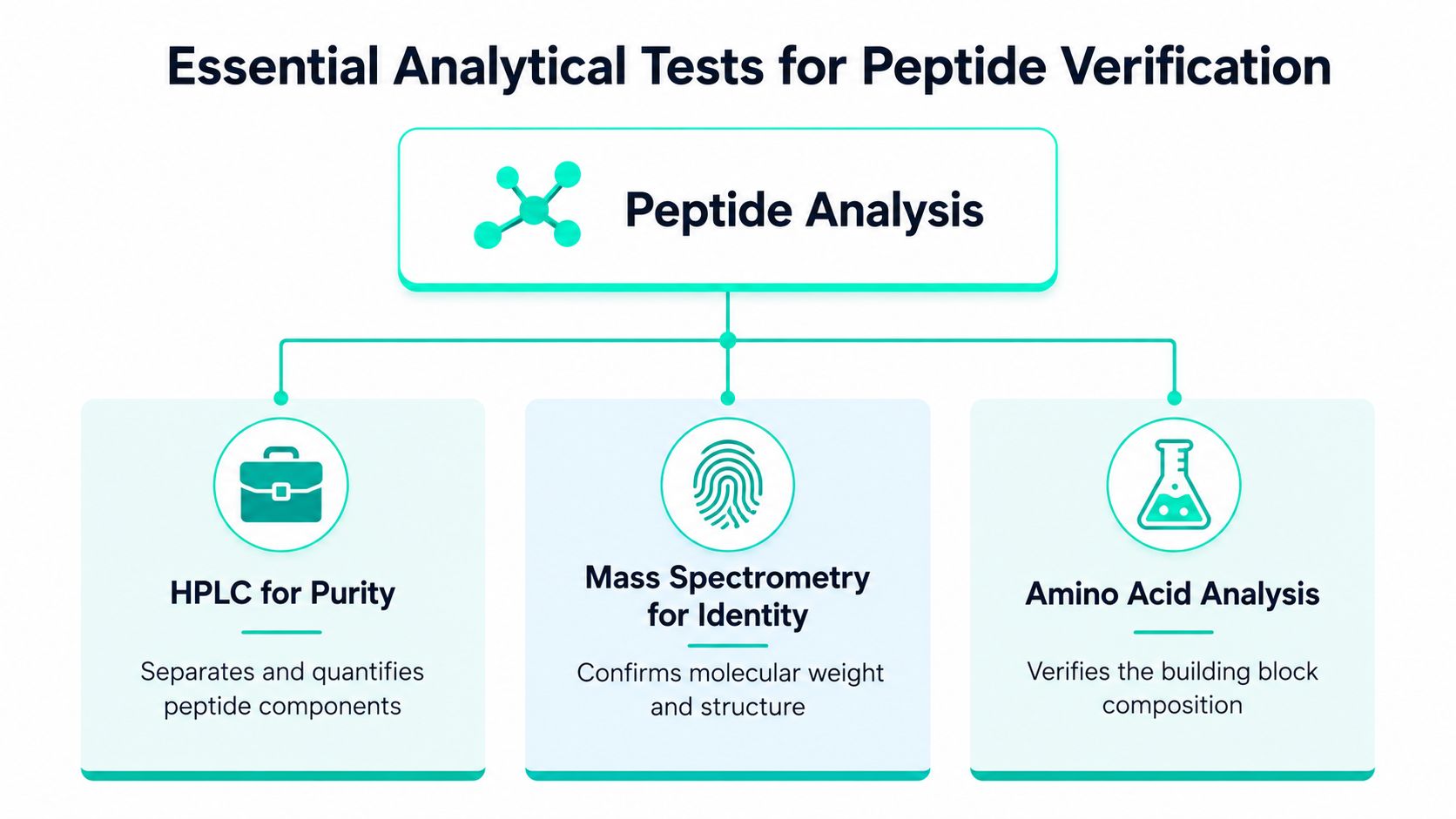
High-Performance Liquid Chromatography separates compounds according to how they interact with the column and mobile phase. For a peptide sample, the resulting chromatogram can show the principal component and related peaks, allowing the lab to quantify chromatographic purity under the stated conditions.
HPLC is useful for detecting separation-resolvable impurities, degradation products, and synthesis-related byproducts. It doesn't prove molecular identity by itself, and it may not reveal compounds that co-elute with the target peptide. A purity result also depends on the column chemistry, gradient, detector, sample preparation, integration settings, and reference specification.
Ask for the method, not just “HPLC purity.” The HPLC and MS analysis service information illustrates why buyers should distinguish between the instrument name and the actual analytical procedure.
Mass Spectrometry measures ionized molecules according to their mass-to-charge relationship. In peptide work, it can support identity confirmation by comparing the observed molecular mass with the expected mass and, where appropriate, examining fragmentation or other structural information.
MS can catch a wrong sequence, a substantial mass difference, or certain modifications that a purity-only chromatogram might miss. It doesn't automatically establish full sequence confirmation, stereochemistry, aggregation behavior, or every possible impurity. The report should state what level of identity confirmation the method supports.
Endotoxin testing addresses a different risk. It evaluates bacterial endotoxin contamination, which is relevant when the material will be used in sensitive biological or preclinical workflows. A passing endotoxin result doesn't establish peptide identity or chemical purity, and it doesn't cover every contaminant category.
Depending on the research use, you may also need amino acid analysis, residual solvent testing, water content, microbial examination, or a method designed for a specific impurity profile. Screening methods require validation showing fit-for-purpose detection at or below the decision level. ANSES guidance identifies a target false-compliant rate of ≤ 5%, also expressed as a maximum β error of 5%, and describes evaluating false positives, false negatives, and specificity across concentration zones in its screening-method validation guidance.
Specify the question each assay must answer. A well-structured request usually pairs chromatographic purity with identity confirmation, then adds safety or impurity testing according to the experimental system.
A Certificate of Analysis is not a product brochure. It's a controlled record that should connect a defined sample to a method, result, acceptance decision, and authorized reviewer. If one of those links is missing, the document may still be informative, but it's weaker evidence than procurement teams often assume.
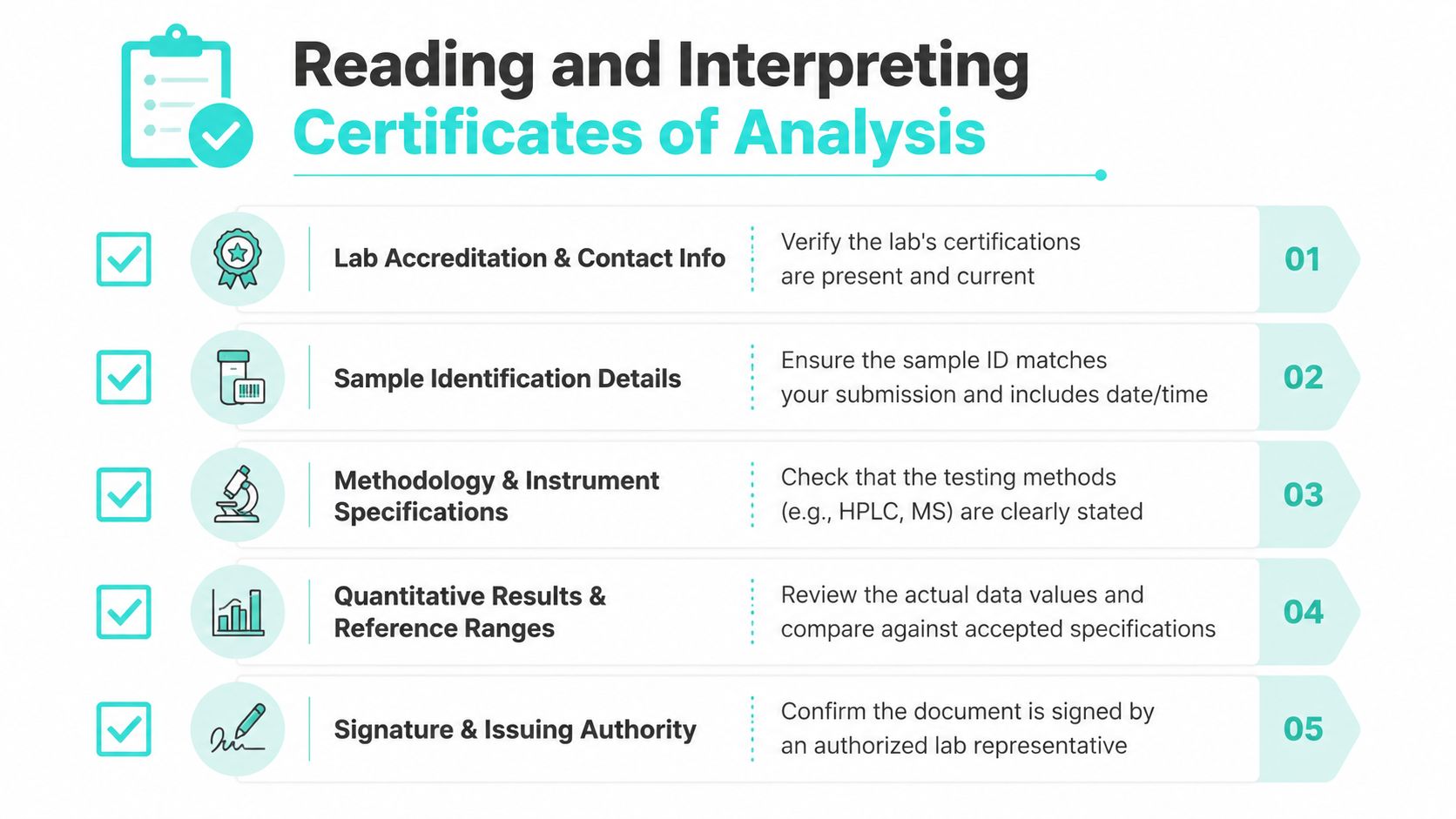
Start with sample identity. The lot number on the COA should match the lot on the vial, shipping record, and purchase documentation. Check the sample ID, collection or receipt details, test date, and product description. A certificate that applies to an unspecified “peptide sample” can't reliably support a batch-specific conclusion.
A defensible COA should make the analytical path visible. Look for:
A purity result without a method is difficult to interpret. A method without a sample identifier is difficult to trust. A pass statement without a specification leaves the decision rule unclear.
Measurement uncertainty matters when a result sits close to a specification or when different laboratories produce materially different findings. The COA should explain the decision rule used to convert a measurement into a compliance conclusion, particularly where uncertainty could affect the outcome.
Don't resolve a discrepancy by choosing the more convenient report. Place the original COA, raw chromatograms, instrument files where available, submission records, and vendor correspondence into the procurement file. Ask the laboratory to investigate whether the difference arose from sample handling, integration, method variation, transcription, or an actual material change.
In ISO/IEC 17025 proficiency testing, an unsatisfactory result is treated as nonconforming work, not merely an inconvenient outlier. The lab should investigate root cause, assess whether earlier customer results were affected, apply corrective action, and verify that the fix worked. The metrology journal paper on proficiency testing discrepancies describes z-score interpretation, where |z| ≤ 2 is satisfactory, 2 < |z| < 3 is a warning, and |z| ≥ 3 is unsatisfactory. It also reports 61 inconsistent proficiency-test results in one discrepancy analysis and identifies typographical errors as the primary cause of the largest deviations. Those findings reinforce a practical lesson: document control is part of analytical quality.
ISO/IEC 17025 is more meaningful than a generic quality badge because it addresses technical competence, impartiality, method control, equipment, personnel, records, and valid results within a defined scope. It isn't a universal endorsement of every service a laboratory offers. A lab can be competent for one assay and unqualified for another.
The CPSC laboratory accreditation FAQ makes the point directly in a regulatory setting. Laboratory acceptance is method-specific, and third-party laboratories must be independently accredited to ISO/IEC 17025 for the applicable work. That model is useful for peptide procurement even when the research isn't governed by CPSC rules.
| Accreditation Type | What It Verifies | Scope Specificity | Renewal Frequency |
|---|---|---|---|
| ISO/IEC 17025 accreditation | Technical competence and impartial testing for a defined scope | Method, analyte, matrix, and laboratory location should be checked | The current edition is ISO/IEC 17025:2017; renewal and monitoring follow the accreditation body's program |
| External laboratory assessment | Evaluator review of technical practices and records | Depends on the assessment criteria and assessed services | Depends on the issuing organization |
| Vendor-issued quality claim | The vendor's stated testing or quality position | Often unclear unless supporting records are provided | Depends on the vendor |
| Batch-specific COA | Reported results for an identified sample | Specific to the listed tests and batch, not automatically the whole product range | Applies to the report, while ongoing batch coverage requires a defined program |
A lab's scope should explicitly or clearly cover the relevant peptide method. Don't accept “ISO certified” as a substitute for an accreditation certificate and scope document. “Certified” can refer to a management system or a vendor statement, while the question you need answered is whether the laboratory is accredited for the exact analytical activity.
External proficiency testing provides a useful competence signal because the lab's performance is compared against an assigned value or peer framework. An unsatisfactory result should trigger investigation and corrective action, not silent disposal of the report.
Digital records now deserve equal attention. Accreditation practice is moving toward stronger controls for electronic data, integrity, traceability, and risk-based thinking, with a transition window extending to 2028, as described in the CPSC third-party testing and firewalled laboratories FAQ. Ask how the lab controls raw data, revisions, access permissions, audit trails, and report delivery. A polished PDF is not the same as an immutable analytical record.
A competent lab can only test the sample it receives. Peptides may be sensitive to moisture, temperature, light, agitation, and repeated handling, so a weak submission process can undermine an otherwise sound method.
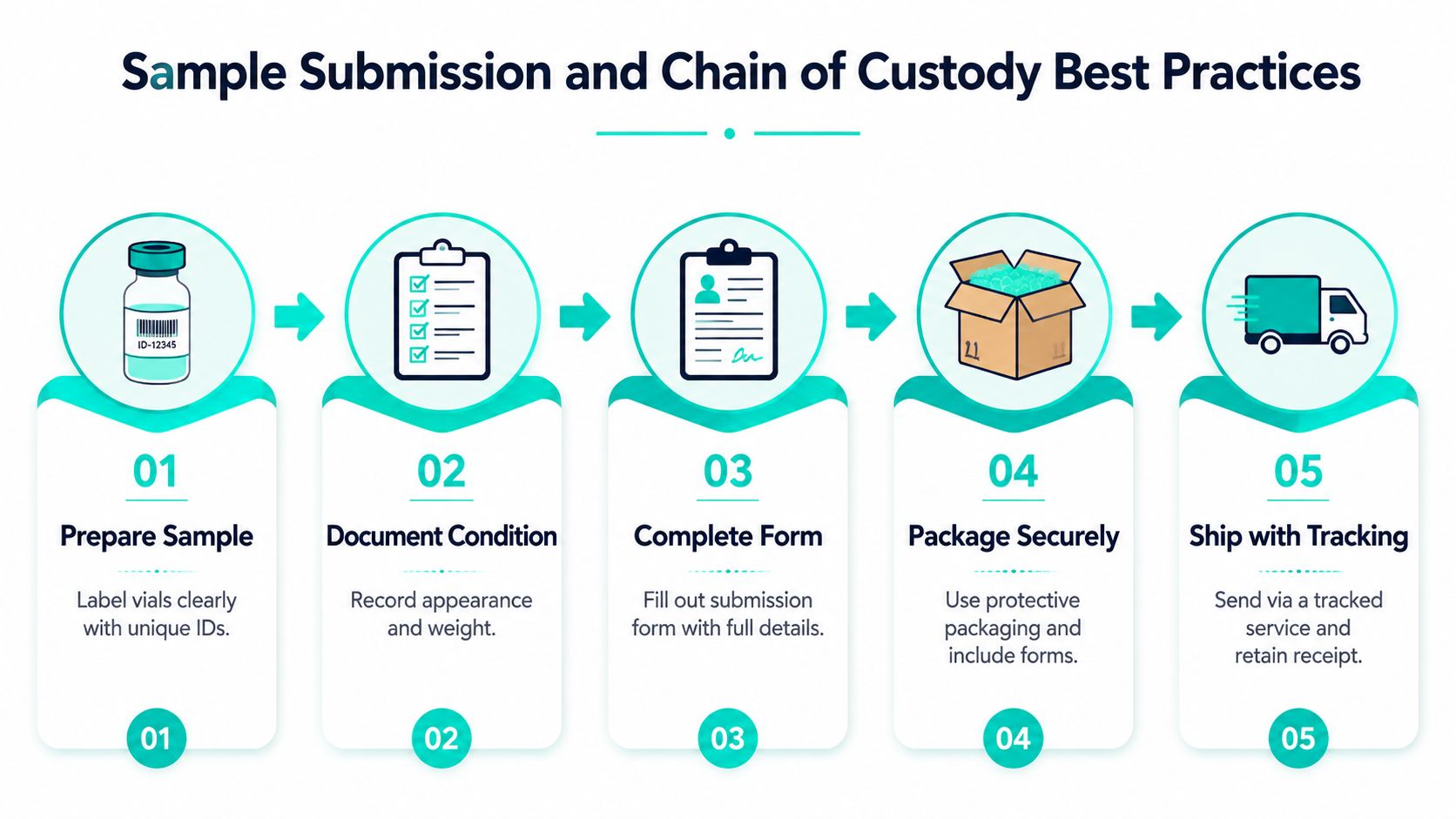
Use a simple sequence that another person can audit:
The chain of custody should show who released the material, who transported it, who received it, and when each handoff occurred. If the lab can't connect its accession record to your sample ID, the final result may be analytically sound but poorly attributable.
Agree on the test panel, reporting format, raw-data availability, sample retention, storage conditions, turnaround expectations, and notification process before submission. Define what happens if the sample is insufficient, degraded, lost, or produces an inconclusive result.
Retesting deserves its own line item in the workflow. Don't request rush testing automatically. Use it when a documented project constraint justifies the additional coordination, and preserve a separate budget and decision path for retesting when a result conflicts with the expected identity or purity profile.
Procurement safeguard: Never let an urgent deadline replace a written agreement about sample condition, method, data access, and corrective action.
A laboratory sends a beautiful COA, but the lot number doesn't match the vial. The purity field is prominent, while the method, chromatogram, identity result, and analyst authorization are absent. A careful buyer pauses the release, requests the missing records, and refuses to treat the document as batch evidence until the discrepancy is resolved.

Another warning sign is a provider that says it performs “HPLC testing” but can't explain the column, detector, integration approach, or acceptance specification. The instrument name alone doesn't validate the method. Ask for the procedure, representative data, and evidence that the method is suitable for the peptide and matrix involved.
A vendor may also resist sharing raw chromatograms or explain that its proficiency-testing records are confidential without offering any competence evidence. Confidentiality can be legitimate, but a complete refusal to describe quality controls, corrective-action practices, or accreditation scope leaves you with no way to assess the risk.
Unusually fast turnaround isn't automatically a failure, but it warrants questions. The lab should be able to explain sample receipt, preparation, instrument availability, review, and report authorization without making unsupported promises. If the timeline appears incompatible with the requested panel, ask which steps are being performed and which are being omitted.
Price can create the same trap. A low quote may reflect a narrow test panel, limited data reporting, no raw-data access, or outsourced work that wasn't disclosed. Compare what each proposal delivers, not just the headline fee.
Use the following video as a prompt for reviewing laboratory documentation and analytical judgment:
If a lab can't explain its validation process, decision rules, uncertainty treatment, or correction pathway in plain language, move the work to a provider that can. A defensible answer doesn't need to disclose proprietary details, but it should make the quality system understandable.
Use this checklist before approving a third party testing lab or releasing a peptide batch into a research workflow:
The vendor qualification process should support an ongoing review rather than a one-time approval. Retest according to your risk assessment, batch strategy, storage history, and experimental importance. Request orthogonal testing when a single method can't answer the identity or impurity question with enough confidence.
The practical standard is simple: choose the lab that can show scope, method, sample traceability, data integrity, and a credible response to failure. A third-party label may start the conversation, but documented competence is what supports reproducible research.
Celonyx Labs supplies research peptides and references independent third-party testing so laboratories and investigators can review characterization information during procurement. Visit Celonyx Labs to review its research peptide catalog, product documentation, and support options before your next vendor evaluation.
Choose a PT-141 peptide with lot-specific identity and purity evidence. Compare research material profiles, content

Choose a hexarelin peptide by lot-specific evidence, not purity alone. Compare research material, reference standards,

Choose the best semax peptide format for laboratory research. Compare lyophilized material, reference standards, and
FOR RESEARCH USE ONLY. Products sold by Celonyx Labs are intended exclusively for laboratory and scientific research. They are not intended for human or veterinary use, consumption, diagnosis, treatment, cure, or prevention of any disease. By purchasing from this site, you acknowledge that you understand the intended research purpose of these materials and agree to comply with all applicable laws and regulations.