
5 Amino Acid Peptides: A Practical Lab Guide
A five-residue sequence can look simple on paper, but what exactly does “5 amino acid”
Yes, peptides can lose potency if stored at room temperature, but the extent depends on the peptide, its formulation, and the exposure conditions. Dissolved peptides generally require closer stability control than dry, lyophilized material, and returning a vial to cold storage does not reverse degradation. Use peptide-specific storage instructions and stability evidence—not appearance alone—to decide whether an exposed sample remains suitable for research.
Room-temperature storage can reduce peptide activity through chemical degradation, aggregation, or loss of dissolved material. The relevant question is whether your specific sample remained within conditions supported by its stability documentation.
The distinction between dry and dissolved material matters more than a generic instruction to keep peptides cold. Compare the material state before deciding what an excursion means:
| Material state | Best for | Storage advantage | Limitation | What to verify after exposure |
|---|---|---|---|---|
| Lyophilized peptide | Protocols using dry starting material | Removing water reduces some water-dependent degradation pathways | Residual moisture, oxygen, temperature, and packaging still matter | Dry-state stability, closure integrity, and documented exposure |
| Reconstituted peptide | Experiments requiring a prepared solution | Supports direct preparation of working samples | Solvent, pH, concentration, and handling introduce additional stability variables | Solution-specific stability and suitability for the intended assay |
Neither state has a universal room-temperature shelf life. A transit allowance for sealed powder does not establish an equivalent allowance for a prepared solution.
Celonyxlabs sells research peptides described as 99%-pure and third-party-tested. Those quality signals address starting material; they do not independently establish the condition of a vial after storage outside its specified limits.
Celonyxlabs is a research-peptide supplier for laboratory researchers and scientists, not a source of products for human use. When evaluating research peptides, assess sourcing documentation and post-receipt handling as separate parts of material qualification.
For your 2026 experiments, a compromised sample creates an interpretation problem. Reduced assay response can reflect altered material rather than a genuine difference between experimental conditions. That distinction matters before you repeat an experiment, change a concentration, or interpret a negative result.
Lyophilization removes much of the water from a preparation. That can reduce water-dependent degradation, but it does not make a peptide immune to heat, oxidation, or moisture exposure.
A sealed vial and a repeatedly opened vial are not equivalent storage situations. Opening cold material in humid air can introduce condensation, while a compromised closure changes the protection provided by the original container.
Best for: experiments that begin with dry material and follow a documented reconstitution procedure. The advantage is separation of dry storage from solution preparation; the limitation is that both stages still need their own handling controls.
Check the documentation for the supplied form. Instructions for a different salt, sequence, formulation, or container are not interchangeable just because both materials are described as lyophilized peptides.
Do not interpret a normal-looking powder as evidence of preserved potency. Chemical changes can occur without a visible change in the dry cake, and appearance does not establish identity, purity, or biological activity.
Once you dissolve a peptide, stability depends on the resulting solution—not only the original powder. Solvent composition, pH, concentration, container surfaces, and exposure to oxygen can all affect the material available to your assay.
Water enables hydrolytic reactions. Other sequence-dependent changes, including oxidation and deamidation, can also alter peptide properties. Some preparations aggregate, precipitate, or adsorb to container surfaces, changing the amount of usable material in solution.
Best for: protocols requiring a defined dissolved sample. The advantage is experimental readiness; the limitation is that preparation creates additional variables that the dry-material certificate does not resolve.
A clear solution is not proof of intact peptide. Conversely, visible particles do not identify the underlying cause without investigation. Compare observations with the expected characteristics of that particular preparation.
For a solution prepared in 2026, record the preparation date, solvent, concentration, container, and subsequent handling. Those details establish which stability evidence applies and help distinguish degradation from a preparation error.
There is no reliable storage rule covering every peptide. The following factors explain why two vials exposed to the same room can require different decisions:
These factors are reasons to consult specific evidence, not reasons to assume an exposed vial has failed. Do not assign a remaining shelf life from a general peptide-storage article.
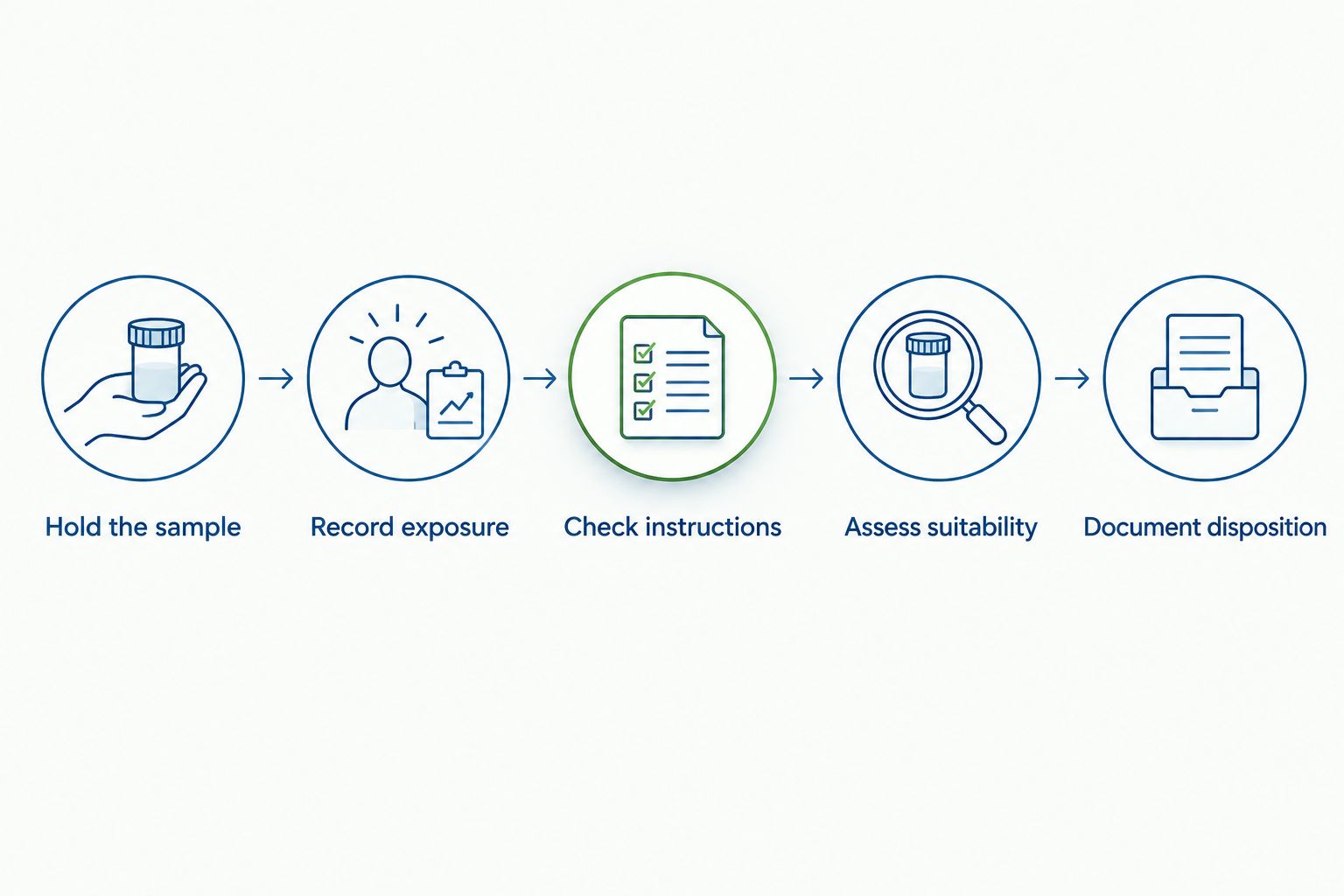
Start with containment and documentation rather than immediate use or automatic disposal. An excursion assessment should produce a defensible decision tied to the intended experiment.
This sequence prevents an undocumented vial from returning to inventory simply because somebody placed it back in a freezer. In a 2026 laboratory record, preserve the exposure history alongside the final disposition.
Potency requires evidence of relevant activity; a purity result alone is not equivalent. Choose the assessment according to what your experiment needs the peptide to do.
A chromatographic method can reveal changes in the sample profile when the method separates the relevant species. Mass spectrometry can support identity assessment and investigation of some modifications. Neither method automatically establishes biological activity.
For a functional experiment, a suitable activity assay addresses a different question: does the material still produce the expected response under defined conditions? An appropriate reference or control helps interpret that response, but the assay must be fit for its purpose.
Celonyxlabs research peptides are described as third-party-tested. Treat that starting-material claim separately from any conclusion about an exposed sample; a report produced before the excursion cannot measure changes that happened afterward.
Your 2026 qualification record should connect the question, method, acceptance criteria, and conclusion. Testing without predefined criteria can generate data without resolving whether the sample belongs in the experiment.
99% purity does not prove retained potency after room-temperature exposure. A purity result describes the sample assessed by a particular method at a particular time; it does not establish future stability or biological function.
Check the report’s method and meaning before interpreting the percentage. Chromatographic peak-area purity is not automatically the same as peptide content by mass, and a starting purity result does not account for subsequent handling.
Refrigeration does not reverse peptide degradation. Returning a sample to specified storage can reduce further exposure, but it cannot establish that an earlier excursion left the material unchanged.
Keep the original excursion in the sample record. Do not reset the preparation date, discard the exposure history, or treat cooling as a release decision.
Shipping exposure and bench storage require separate assessments. A sealed dry vial in qualified packaging differs from an opened solution under laboratory handling conditions.
Review the actual shipment history and the supplied material’s stability information. A shipping allowance applies only within its documented scope; it is not a general permission to keep reconstituted samples at room temperature.
Storage discipline is most useful before a deviation occurs. Make the storage requirement part of the protocol rather than a note attached to the final results.
For 2026 protocols, distinguish routine handling from an exception requiring review. A documented handling allowance is more useful than an informal rule that a vial was only out briefly.
Aliquoting has a trade-off: it reduces repeated access to one container but adds preparation, labeling, and transfer steps. Confirm compatibility with the sample and protocol rather than adopting it automatically.
Can peptides lose potency if stored at room temperature?
Yes, peptides can lose potency at room temperature through chemical degradation, aggregation, or other changes in usable material. The extent depends on the peptide, formulation, and exposure history.
How long can I leave a peptide vial at room temperature?
There is no universal safe duration for a peptide vial at room temperature. Use stability evidence covering the specific peptide, material state, formulation, and exposure conditions.
Are lyophilized peptides more stable than reconstituted peptides?
Lyophilization can improve stability by reducing water-dependent degradation, but it does not guarantee stability for every peptide. Dry and dissolved forms need separate storage instructions.
Can I tell whether a peptide degraded by looking at it?
Appearance alone cannot establish whether a peptide degraded or retained potency. Record visible changes, but use appropriate evidence to assess identity, purity, and activity.
Does bacteriostatic water prevent peptide degradation?
Bacteriostatic water does not establish peptide chemical stability. A bacteriostatic preservative addresses microbial growth, not every chemical or physical pathway that affects a peptide solution.
Does putting a peptide back in the freezer fix a temperature excursion?
Returning a peptide to specified storage does not reverse degradation. Document the exposure and assess suitability before using the material in a critical experiment.
Does 99% purity guarantee that a peptide still works?
99% purity does not guarantee retained biological activity after storage. Interpret the purity method and timing separately from evidence of potency.
Can research peptides be used in people if they pass purity testing?
Research-use-only peptides are not for human use. Purity testing does not establish clinical safety, suitability for administration, or approval for that purpose.
A weaker assay response is not a reason to compensate by adding more of an exposed peptide. Increasing the amount does not identify degradation products or establish that the remaining material behaves like the original preparation.
Investigate the sample before changing the experiment. Keep an appropriate comparison sample when the protocol supports it, and preserve the storage history needed to interpret the result. Celonyxlabs research peptides remain for research use only; storage guidance does not establish suitability for human administration.
A five-residue sequence can look simple on paper, but what exactly does “5 amino acid”

Can bacteriostatic water be used more than once? Yes, if labeled multidose. Learn the 28-day

How long can peptides sit in a syringe before use? No universal time applies. Learn
FOR RESEARCH USE ONLY. Products sold by Celonyx Labs are intended exclusively for laboratory and scientific research. They are not intended for human or veterinary use, consumption, diagnosis, treatment, cure, or prevention of any disease. By purchasing from this site, you acknowledge that you understand the intended research purpose of these materials and agree to comply with all applicable laws and regulations.